Machines That Fall Outside Arkansas’s ATV Definition
It can be incredibly frustrating to buy a new machine, full of excitement for hitting the trails or getting work done around your property, only to discover that it doesn't quite fit the state's definition of an "ATV" when you go to register it. This guide is here to walk you through exactly what Arkansas considers an ATV for registration purposes and, just as importantly, what machines often fall outside that definition, helping you avoid headaches and understand your options.
Understanding Arkansas's ATV Definition for Registration
Navigating the world of off-highway vehicle (OHV) registration can feel like trying to solve a puzzle, especially when different states have their own unique rules. In Arkansas, the definition of an All-Terrain Vehicle (ATV) for registration is pretty specific, and it's super important to understand it before you ever head to the revenue office. Many folks assume "if it's not a car, it's an ATV," but that's not always the case in the eyes of the law.
What the Law Actually Says (and Doesn't)
Arkansas's statute defines an ATV as a three-, four-, or six-wheeled vehicle that is 50 inches or less in width, has an unladen dry weight of 1,000 pounds or less, and is designed for off-highway use by a single operator or a single operator and a passenger. Crucially, it must also be equipped with nonhighway tires. Notice the key numbers there: 50 inches wide or less and 1,000 pounds or less. These are the critical measurements that often differentiate an ATV from other machines.
The law doesn't just say "any off-road vehicle." It's prescriptive, meaning it outlines specific physical characteristics. So, if your machine is wider than 50 inches, weighs more than 1,000 pounds, or has traditional highway-style tires, it immediately steps outside that core definition for registration purposes. This can be a real shock for someone who just bought what they thought was a standard ATV, only to find it's a bit too beefy for the official classification. For a deeper dive into the specifics, you can check out [Arkansas's 50-Inch, 1,000cc ATV Definition].
Why This Definition Matters for Your Wallet and Your Peace of Mind
Understanding this specific definition isn't just about legal jargon; it directly impacts whether you can legally register your machine as an ATV in Arkansas. If your machine fits the definition, you're in luck! You can proceed with the standard registration process, which is a one-time fee in Arkansas, meaning no annual renewals to worry about. This leads to getting your official decal, which is necessary for legal off-highway riding on designated trails and private land (with permission). The good news about this one-time fee is that once you've paid it, you generally won't have to worry about renewal notices cluttering your mailbox. More on that here: [Arkansas ATV Registration: One Time, Never Renewed].
However, if your machine doesn't fit the definition, you could run into a significant roadblock at the revenue office. You might not be able to get an ATV registration decal, which could limit where you can legally ride and potentially expose you to citations if you operate it on public land where registration is required. Beyond just the registration fee, there's also the sales tax aspect. While the registration itself is a one-time thing, the sales tax will still be collected at the time of purchase or registration. Understanding what constitutes an ATV for registration purposes directly impacts the paperwork you need to fill out and the fees you’ll be expected to pay. You'll also want to understand [Arkansas Sales Tax on an ATV Purchase] to fully grasp the financial implications.
Common Machines That Get Confused with ATVs
It's easy to lump all recreational off-road vehicles into one category, but Arkansas law makes clear distinctions. Many popular machines, while fantastic for outdoor adventures and work, simply don't fit the state's narrow definition of an ATV for registration purposes. This often leads to confusion and frustration for new owners.
Side-by-Sides and UTVs: Wider, Larger, Different Rules
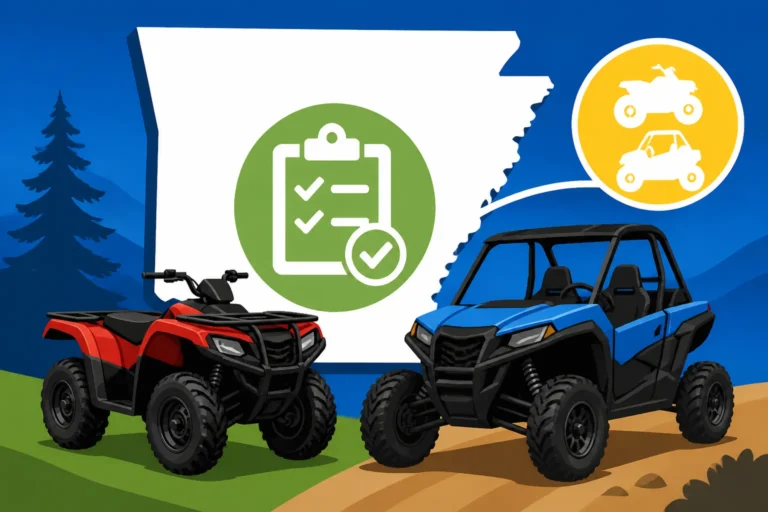
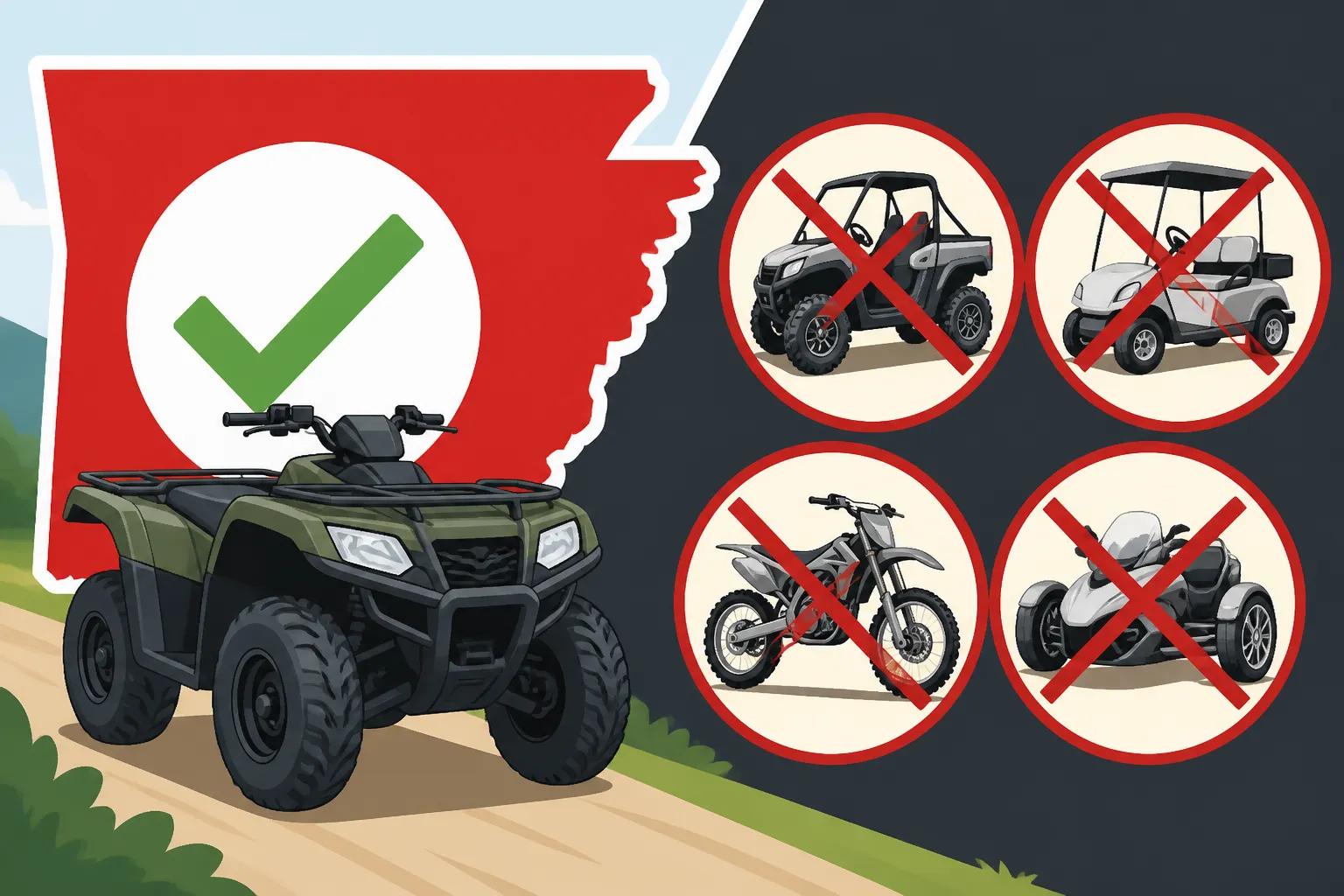
Perhaps the most common offenders against Arkansas's ATV definition are side-by-sides, also known as Utility Terrain Vehicles (UTVs). These machines have soared in popularity for their versatility, passenger capacity, and increased cargo space. However, their very design often pushes them outside the traditional ATV classification. Most modern UTVs are significantly wider than the 50-inch ATV limit, often measuring 60 inches or more across. They also typically exceed the 1,000-pound dry weight limit, sometimes by a considerable margin.
Because of these differences, UTVs don't register as ATVs in Arkansas. Instead, they fall under their own set of rules and often require a different registration process, if one is even available for pure off-highway use. The state has specific provisions, especially for those considering street-legal options in certain municipalities, which further highlights their distinct category. If you own a UTV, you'll want to specifically look into [Registering a Side-by-Side in Arkansas] or even broader [Arkansas UTV Registration Requirements] rather than the ATV guidelines. It's a different animal entirely in terms of paperwork and legal standing.
Golf Carts, Dirt Bikes, and Other Small Wonders
Beyond side-by-sides, several other popular vehicles also find themselves outside the ATV definition. Golf carts, for instance, are designed for specific purposes (golf courses, gated communities, slow-speed transport) and do not meet the criteria for an ATV in Arkansas. Even electric golf carts, despite their quiet operation and sometimes rugged appearance, are not considered ATVs. Their primary design and typical use-case immediately set them apart, and they have their own set of regulations, especially if you're trying to operate them on public roads in towns that permit them. For more on that, you might want to look at [Arkansas Registration for a Golf Cart].
Dirt bikes are another common point of confusion. While they are undoubtedly off-highway vehicles built for rough terrain, they are two-wheeled. The Arkansas ATV definition specifically calls for three, four, or six wheels. This simple characteristic immediately excludes dirt bikes from ATV registration. They fall under the umbrella of motorcycles or off-road motorcycles, which have distinct registration and titling requirements. If you're riding a dirt bike, your path to legal operation will look different than someone with a four-wheel quad. Similarly, machines like motorized bicycles, pocket bikes, or even some electric scooters, while small and potentially off-road capable, also don't fit the ATV mold. If you're riding a dirt bike, make sure you understand [Arkansas Registration for a Dirt Bike] rather than trying to fit it into the ATV category.
"Homemade" and Modified Machines: A Special Case
The spirit of ingenuity runs deep among off-road enthusiasts. Many riders love to tinker, build, and customize their machines, sometimes from the ground up. While incredibly rewarding, this passion can create unique challenges when it comes to getting your creation officially recognized and registered in Arkansas. When you start with a bare frame or combine parts from various machines, you're stepping into a gray area that requires careful attention to detail.
When Your Custom Build Doesn't Fit the Mold
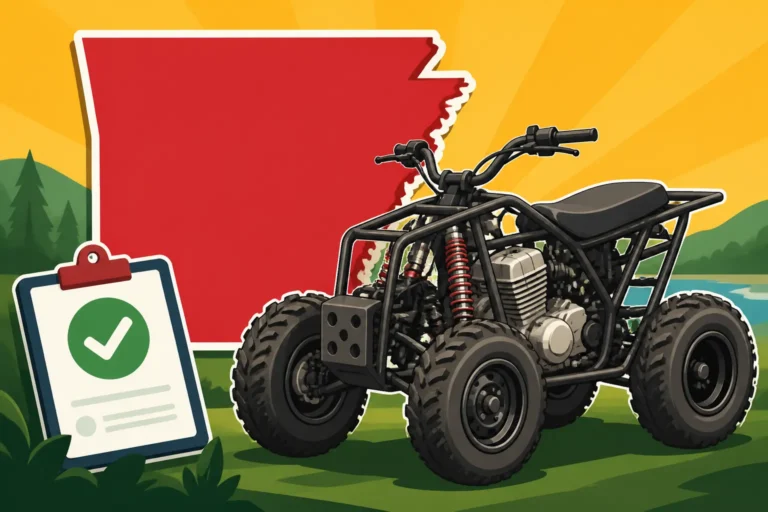
A "homemade" machine presents a few immediate hurdles for registration. The biggest one is often the lack of a manufacturer's VIN (Vehicle Identification Number) or a Manufacturer's Statement of Origin (MSO). These documents are standard for factory-produced ATVs and are crucial for proving ownership and initiating the registration process. Without them, you're essentially starting from scratch to prove your machine's identity and legality. You might need to go through a process of VIN assignment, which involves inspections and submitting detailed paperwork to the state to ensure your machine is safe and not stolen. This can be a time-consuming and often confusing ordeal.
Furthermore, if your custom build, even if starting from an ATV frame, ends up being wider than 50 inches, heavier than 1,000 pounds, or incorporates road-going tires, it will automatically be excluded from the Arkansas ATV definition. Imagine spending months building a dream off-road buggy, only to realize it's too wide by a few inches to qualify for ATV registration. This can be a heartbreaking discovery and definitely underscores the importance of knowing the regulations before you put all that time and effort into your project. For specific guidance on such unique situations, you might find information on [Arkansas Registration for a Homemade Machine] helpful.
Getting Your Unique Machine Registered (or Knowing When You Can't)
So, what do you do if your custom-built pride and joy doesn't easily fit the standard ATV definition? The first step is to be realistic about your machine's characteristics. If it clearly exceeds the width or weight limits, attempting to register it as an ATV will likely be a futile effort. For machines that are truly homemade and lack a VIN, you'll need to contact the Arkansas Department of Finance and Administration (DFA) to inquire about their process for assigning a VIN to a reconstructed or homemade vehicle. This will typically involve an inspection by a state police officer or designated agent to verify the components and ensure it's not made from stolen parts.
You'll also need robust proof of ownership for all major components used in the build. This means keeping receipts for everything from the engine to the frame to the axles. Without a clear paper trail, proving ownership can be incredibly difficult. Resources like LawDepot can be useful here, as they provide templates for bills of sale or affidavits that can help document the ownership transfer of individual parts, or even a full, custom-built machine, if you're buying or selling one. When you go to register, remember that [Arkansas Proof of Ownership for Registration] is always required, and it's even more critical for a homemade vehicle. In some cases, if your machine is truly unique and doesn't fit any established vehicle category, you might find that it simply cannot be registered for use on public lands or trails that require a state decal. In such scenarios, your machine might be restricted to private property use only.
Implications of Falling Outside the Definition
It can be disappointing, to say the least, to realize your machine doesn't fit the official ATV definition in Arkansas. This realization comes with a set of implications that directly affect where and how you can ride your vehicle. Understanding these consequences is key to avoiding legal trouble and making the most of your off-road machine.
What Happens If You Can't Register as an ATV?
The most immediate consequence of your machine falling outside Arkansas's ATV definition is that you simply won't be able to obtain an official Arkansas ATV decal. This decal is the state's stamp of approval that your vehicle meets the legal requirements for an ATV and has been properly registered. Without it, you are generally prohibited from riding on any public lands, designated ATV trails, or other areas that explicitly require a state-issued off-highway vehicle registration. This means popular spots like the Ouachita National Forest or many state-managed trails would be off-limits. You'd also find yourself unable to participate in many organized rides or events that mandate state registration.
Attempting to ride an unregistered machine (or one that doesn't fit the definition but you tried to register anyway) on restricted public lands could lead to fines, citations, and potentially even impoundment of your vehicle. The state takes these regulations seriously, and ignorance of the law is rarely an excuse. The absence of an ATV decal visually signals to law enforcement or park rangers that your machine may not be compliant. For more information on the decal and its placement, you can refer to [Arkansas ATV Decal Rules and Where It Goes].
Alternative Paths: Private Land Use, Local Ordinances, and Titling
If your machine doesn't fit the Arkansas ATV definition for registration, it doesn't necessarily mean it's useless or that you can never ride it. There are still viable avenues for enjoyment, primarily centered around private property. Many landowners and enthusiasts use larger UTVs, custom builds, or older, non-compliant quads exclusively on their own land, or on private land with express permission from the owner. In these scenarios, state registration for public trail access isn't required, offering a safe and legal way to enjoy your machine. You can explore this more with [Arkansas ATV Registration for Private Land Only Machines].
Another increasingly common path, especially for UTVs, involves local ordinances. Arkansas has provisions that allow individual cities and towns to pass their own ordinances permitting UTVs (and sometimes golf carts) on specific public streets within their municipal limits. These local rules often come with their own set of requirements, such as minimum age for drivers, insurance, turn signals, and sometimes even an annual local permit fee. It's crucial to check with the specific city clerk's office where you intend to ride, as these rules vary wildly from one town to the next.
It's also important to remember the distinction between registration and titling. While Arkansas ATVs receive a registration decal and are not issued a traditional title, other vehicles like UTVs might have different titling requirements, even if they don't get a "registration" in the same sense as an ATV. This can also affect how you prove ownership for insurance purposes or when you eventually sell the machine. You'll also notice that, unlike cars, [Arkansas Has No ATV License Plate] for these machines, further emphasizing the difference in their legal classification and use. Lastly, when dealing with private sales or purchases of machines that don't fit the standard definitions, having clear documentation like a bill of sale is paramount. LawDepot can be a helpful resource for generating legally sound bills of sale, ensuring both buyer and seller are protected, regardless of whether the machine is eligible for state registration.
Here's a quick overview of how common off-road machines typically line up with Arkansas's ATV definition:
| Machine Type | Typically 50" Wide or Less? | Typically 1,000 lbs Dry Weight or Less? | 3, 4, or 6 Wheels? | Designed for Off-Highway Use? | Fits Arkansas ATV Definition? |
|---|---|---|---|---|---|
| Typical Sport ATV | Yes | Yes | 4 | Yes | Yes |
| Typical Utility ATV | Yes | Yes | 4 (sometimes 6) | Yes | Yes |
| Modern Sport UTV (SxS) | No (>50") | No (>1,000 lbs) | 4 | Yes | No |
| Modern Utility UTV (SxS) | No (>50") | No (>1,000 lbs) | 4 (sometimes 6) | Yes | No |
| Golf Cart | Sometimes | Sometimes | 4 | Generally No (not "off-highway") | No |
| Dirt Bike | N/A | N/A | 2 | Yes | No |
| Homemade Machine | Varies (check dimensions) | Varies (check weight) | Varies | Varies | Depends on construction |
Disclaimer
This article is for general informational purposes only and does not constitute professional advice. Laws, prices and regulations vary by location and change over time. Consult a qualified professional for guidance on your specific situation.