When an Arkansas Golf Cart Ordinance Leaves Quads Out
Navigating the rules for riding ATVs, UTVs, and even golf carts on public roads in Arkansas can feel like trying to solve a Rubik's Cube blindfolded. Many riders assume that if their town allows golf carts on the street, their trusty quad or side-by-side must also be welcome. This is a common and understandable misconception that often leads to frustration, confusion, and sometimes, even a ticket. This comprehensive guide is here to untangle the specific reasons why an Arkansas golf cart ordinance frequently leaves quads (ATVs) out, and what you, as a rider, need to know to stay on the right side of the law.
The Blanket Ban: Arkansas's Default Stance on Off-Road Vehicles on Public Roads
Let's start with the foundational truth in Arkansas: off-road vehicles (ORVs) like ATVs and UTVs are generally not permitted on public roads. This isn't a suggestion; it's the law. The state legislature has, for a long time, held a clear position that these machines are designed for the dirt, the trails, and private lands, not for sharing the pavement with cars and trucks. This default prohibition is the starting point for all discussions about street legality in the Natural State, and it’s critical to understand before you even think about putting tires to asphalt.
Why "Off-Road" Means Off-Road in Arkansas
The core reason for this blanket ban lies in the legal definitions and intended design of these vehicles. Arkansas law categorizes ATVs and UTVs as "off-road vehicles." This designation immediately sets them apart from vehicles registered for highway use. They typically lack many of the safety features—like turn signals, proper mirrors, or specific lighting—that standard automobiles are required to have for safe road operation. More fundamentally, their suspension, tire design (often non-highway tires), and overall construction are optimized for uneven terrain, not the smooth, high-speed demands of public roads.
Think about it from a safety perspective: a traditional ATV, with its high center of gravity and knobby tires, behaves very differently on pavement than it does on a dirt trail. The responsiveness can be unpredictable, especially during sudden turns or braking at road speeds. This inherent design difference is a major factor in the state's decision to restrict their use to off-road environments. Understanding this default stance is the first step in clarifying where and when you can legally ride. [Can You Drive an ATV on the Road in Arkansas?] is a question many ask, and the default answer is "no," with specific exceptions we'll explore.
Six Specific Exceptions to the General Rule
While the default is a "no-go" for public roads, Arkansas law does carve out specific, narrow exceptions for ATVs and UTVs. These aren't blanket permissions; rather, they are highly contextual and tied to specific activities or circumstances. It's vital to recognize that these exceptions do not make your ATV "street legal" in the same way a car or motorcycle is. Instead, they allow temporary, restricted use under specific conditions.
These six statutory exceptions generally cover:
- Farming Operations: If you're using your ATV or UTV for bona fide farming purposes, such as moving equipment or checking fences, you may be allowed to operate it on public roads for short distances. This isn't for joyriding; it's for essential farm work.
- Hunting Operations: During open hunting seasons, ATVs can sometimes be used to access hunting land or retrieve game, often with restrictions on the type of road and distance. Again, it’s about practical access, not general transit.
- Serious Walking Disability: Individuals with a verifiable walking disability may be permitted to use an ORV on roads for necessary travel if it's their primary means of locomotion.
- Direct Crossing: You can generally cross a public road or highway at a roughly ninety-degree angle after coming to a complete stop, ensuring the way is clear, and proceeding directly across. You cannot ride down the road, only across it.
- Utility Company Employees: Workers for utility companies may use ORVs on roads when performing duties related to their employment.
- Law Enforcement and Emergency Medical Services (EMS): Obviously, these professionals can use ORVs as needed in the course of their official duties.
Each of these exceptions comes with its own set of implicit or explicit limitations regarding speed, distance, and the nature of the use. They are designed to address practical needs rather than to open up roads for general off-road vehicle traffic. [Arkansas's Six Statutory Road Exceptions] provides more detail on these specific scenarios.
How Local Ordinances Open Doors for UTVs, Not Always ATVs
While the state maintains a restrictive stance on most public roads, a significant legislative change in recent years empowered local municipalities to make their own decisions regarding side-by-side UTVs. This created a patchwork of rules across Arkansas, leading to much of the confusion riders face today. It's like a choose-your-own-adventure book, but each city writes its own ending.
Act 922 and the Rise of Local UTV Regulations
The game-changer for many communities was the passing of Act 922, which essentially gave Arkansas cities and towns the authority to decide if and how UTVs could be operated on their local streets. Before this, the state's default ban applied almost uniformly. This act recognized the growing popularity of UTVs and the desire of many communities to allow their residents to use these versatile machines for local errands, recreational travel, or simply to get to nearby trails.
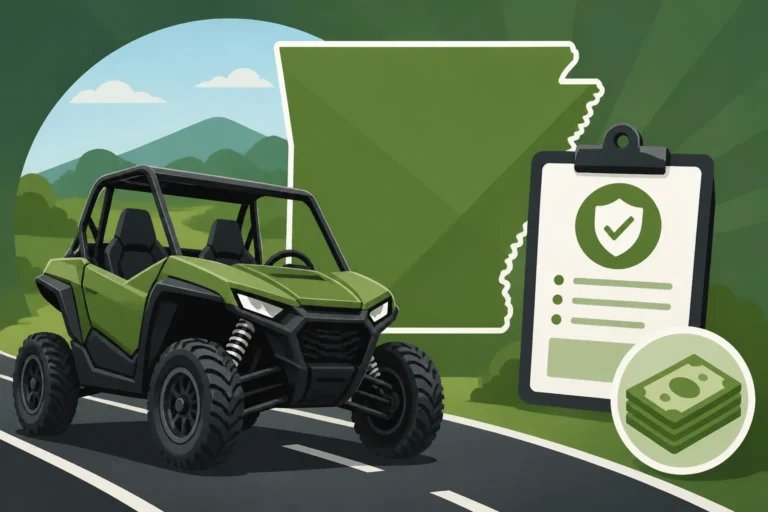
However, this power came with caveats. Cities aren't just throwing open the gates; they are typically implementing specific regulations to ensure safety and order. These often include requirements for vehicle equipment (like turn signals, mirrors, headlights, and brake lights), speed limits for UTVs (often restricted to streets with posted speed limits under 55 mph), insurance requirements, and sometimes even annual permits or fees. The intent was to allow UTVs under controlled conditions, acknowledging their somewhat closer resemblance to street-legal vehicles compared to ATVs, particularly the multi-passenger models. [How Arkansas Cities Got the Choice on UTVs] outlines the impact of this important legislation.
The Disparity: UTVs Get a Pass, ATVs Often Don't
Here’s where a major point of contention and confusion arises: while Act 922 opened the door for UTVs on city streets, it largely left ATVs in the cold. When cities craft their ordinances, they almost universally focus on side-by-sides, often explicitly excluding traditional four-wheelers (quads). This isn't an oversight; it's a deliberate decision based on several factors.
UTVs, or side-by-sides, are generally perceived as having better stability and more car-like controls (steering wheel, foot pedals, seat belts), making them seem safer for road use to city planners. Many UTVs also come from the factory with basic lighting and often have the ability to be easily outfitted with additional street-legal accessories like mirrors, horns, and [Arkansas Turn Signal Requirements for Street UTVs]. Brands like SuperATV offer a wide range of aftermarket accessories specifically designed to help UTV owners meet these municipal requirements, making their machines more adaptable for street use where allowed. ATVs, on the other hand, are often seen as less stable, more performance-oriented, and less suited for mixed traffic environments. This distinction is crucial and explains why you might see a UTV cruising down a city street while an ATV parked next to it is still restricted.
Diving Deep into Arkansas Golf Cart Ordinances
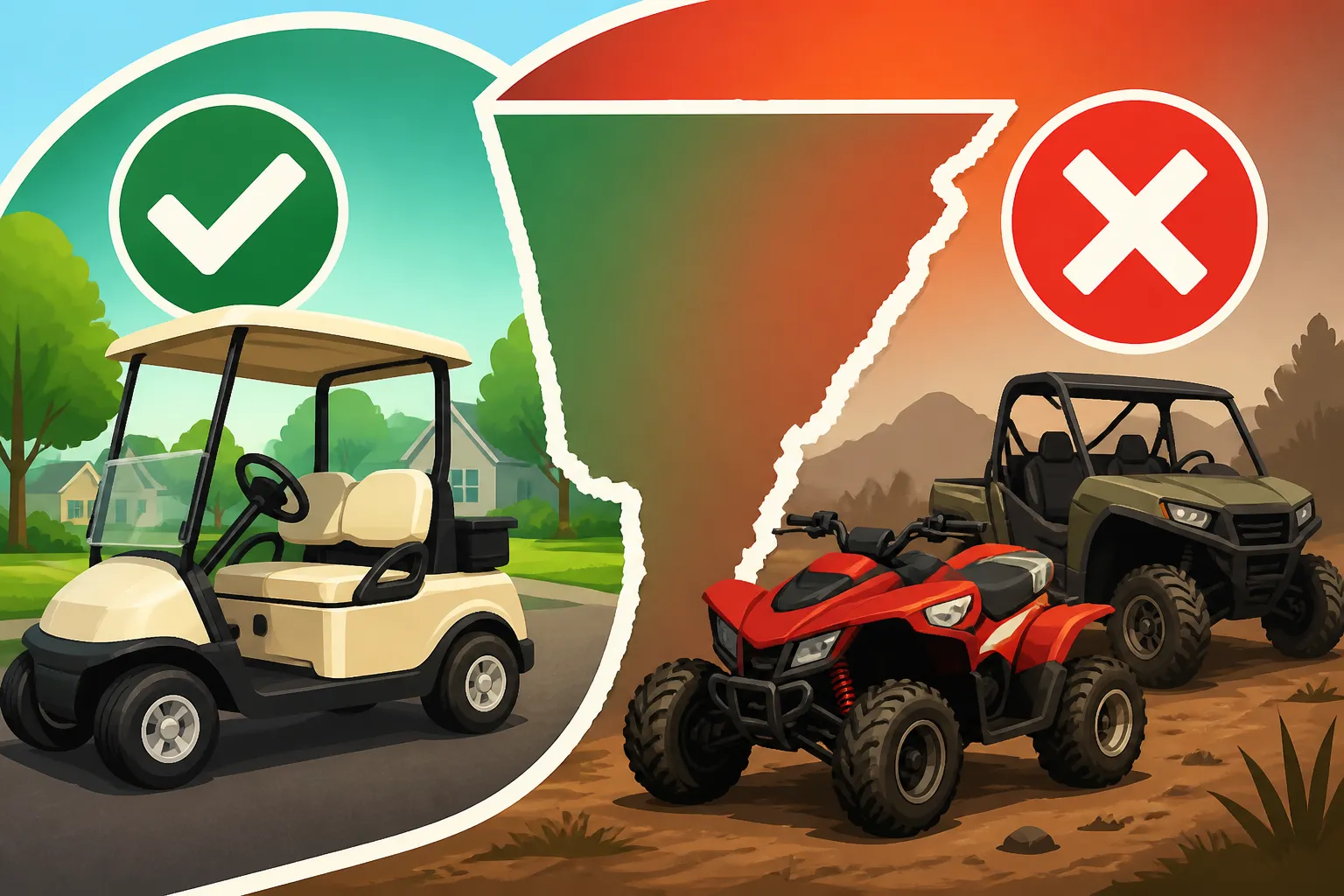
Beyond ATVs and UTVs, there’s another category of small recreational vehicles that often gets looped into this discussion: golf carts. Many Arkansas towns have long-standing ordinances permitting golf carts on certain public roads, especially in planned communities or quieter residential areas. However, these rules are distinct from those governing UTVs and almost always exclude ATVs.
The Legal Framework for Golf Carts on City Streets
Arkansas law provides municipalities with the authority to regulate the use of golf carts on their public streets, specifically under Ark. Code Ann. § 14-54-1410. This statute outlines the general framework, allowing cities to adopt ordinances that permit golf cart operation on designated streets, typically those with lower speed limits. The intent behind these laws is to accommodate residents in areas where golf carts are a common mode of short-distance transportation, such as within golf course communities, retirement villages, or small towns where distances are short and traffic is minimal.
Common elements of these golf cart ordinances include requirements for the operator to possess a valid driver's license (often with an age minimum like 16), proof of insurance, and specific equipment on the golf cart itself, such as headlights, taillights, brake lights, and a rearview mirror. Speed limits for golf carts are almost universally low, often capped at 20-25 mph, and they are usually restricted to streets with a posted speed limit of 35 mph or less. These regulations are designed to integrate golf carts into low-speed traffic flow safely, acknowledging their limited capabilities compared to other vehicles. Many [Arkansas Cities With Cart Ordinances] have adopted these local rules.
Where Golf Cart Rules Typically Apply
Golf cart ordinances are not universal across all public roads within a city. Instead, they are typically quite localized. You'll often find them applied to:
- Residential Neighborhoods: Especially those with low speed limits and minimal through traffic.
- Gated Communities: Where the roads are technically private but accessed by the public, or where the community works with the city for limited public road access.
- Small Towns or Resort Areas: Where the pace of life is slower, and golf carts are a common form of transport for short errands or sightseeing.
- Near Golf Courses: Facilitating easy travel between homes and the course itself.
These areas are chosen because they align with the inherent limitations and design of a golf cart. They are not intended for use on busy arterial roads, state highways, or any street with higher speed limits. The clear boundaries and specific conditions outlined in these ordinances underscore their niche application and prevent a free-for-all on all city streets.
Why the Distinction Matters: ATV vs. Golf Cart in Local Law
The heart of the confusion often lies in a superficial comparison between ATVs and golf carts. Both are smaller, off-highway-style vehicles. However, a deeper look reveals fundamental differences that compel municipalities to treat them very differently under the law, almost always leaving ATVs out of golf cart ordinances.
Fundamental Differences in Design and Purpose
At first glance, an ATV and a golf cart might seem similar as small recreational vehicles. But their engineering and intended use are worlds apart.
- Speed and Power: Most ATVs are designed for higher speeds and aggressive acceleration, capable of quickly reaching 40-60+ mph. Golf carts, on the other hand, are typically governed to max out around 15-25 mph. This speed difference is a critical factor for road safety.
- Stability and Suspension: ATVs are built for navigating rugged, uneven terrain, often with independent suspension and a higher center of gravity optimized for off-road articulation. This design, while excellent for trails, can make them less stable and more prone to rollovers on hard, flat surfaces, especially during sharp turns at speed. Golf carts have a much simpler, lower suspension system, designed for relatively smooth surfaces, making them more stable on pavement within their limited speed range.
- Tires: ATV tires typically feature aggressive knobby treads for maximum grip on dirt, mud, and rocks. These tires provide poor traction and wear quickly on pavement, affecting braking and handling. Golf cart tires are smoother, designed for minimal turf damage and efficient rolling on paved paths.
- Safety Features: While modern UTVs often come with seat belts and ROPS (Roll-Over Protective Structures), traditional ATVs are open-air vehicles with no cab or seatbelts, offering less passive safety in a collision or rollover. Golf carts, though not inherently crash-safe, are operated at such low speeds that collision forces are usually minimal.
These fundamental design disparities are not just technical specifications; they directly translate into how a vehicle performs and its inherent risks when introduced into a mixed-traffic environment.
Local Concerns Driving the Exclusion of ATVs
When a city council considers an ordinance to allow small vehicles on its streets, they are weighing public safety, noise, traffic flow, and liability. This is where ATVs often fall short in their considerations, particularly when compared to golf carts.
- Safety Perceptions: Due to their higher speeds, aggressive acceleration, and design for off-road use, ATVs are generally perceived as more dangerous on public roads than slow-moving golf carts. The potential for serious accidents involving ATVs and traditional vehicles is a major concern for local authorities.
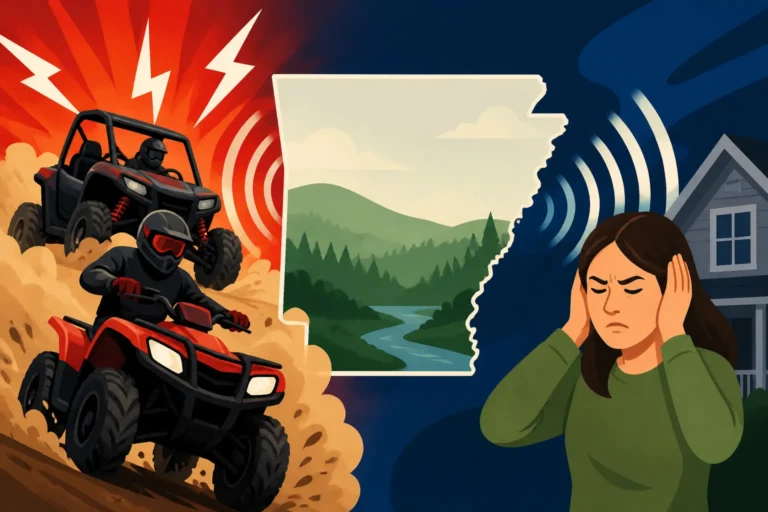
- Noise and Disturbances: Many ATVs, especially those with aftermarket exhausts (or even stock ones), can be quite loud. Noise complaints from residents about roaring engines are a common issue for cities. Golf carts, particularly electric models, are significantly quieter, making them more palatable for residential areas.
- Operator Behavior: There's a prevailing stereotype, sometimes unfortunately accurate, that ATV riders are more likely to operate their machines aggressively or recklessly, whether it's popping wheelies, speeding, or weaving through traffic. While this isn't true for all riders, it contributes to the hesitation of city councils to open their streets to ATVs. With UTVs, the multi-passenger configuration often lends itself to a more relaxed, family-oriented ride, which city officials often prefer.
- Liability: Cities are always concerned about liability. Allowing a class of vehicles with a higher perceived risk of accidents on their roads can expose them to legal challenges. The lower speed and perceived safer operation of golf carts generally reduce this concern.
Ultimately, when an [When an Arkansas Golf Cart Ordinance Leaves Quads Out], it's not arbitrary. It's usually the result of a careful consideration of vehicle characteristics, public safety concerns, and community impact. The legal framework provided by Arkansas law for golf carts is narrow and specific, and ATVs simply do not fit neatly into that mold.
Navigating Your Local Rules: What to Do and Where to Check
Given the complex and varied legal landscape in Arkansas, it's absolutely crucial that you, as a rider, do your homework before attempting to ride your ATV or UTV on any public road. Assuming you're covered by a general golf cart rule can lead to fines, confiscation, and other legal troubles. Ignorance of the law is not a defense, and the responsibility rests squarely on the rider.
Researching Your Specific City or Town Ordinance
The single most important step you can take is to directly investigate the ordinances in the specific city or town where you plan to ride. Do not rely on hearsay, what a friend of a friend said, or what you see others doing (they might be riding illegally or have a specific exemption).
Here’s how to effectively research:
- Contact the City Clerk’s Office: This is often the best first point of contact. The city clerk is the keeper of all municipal ordinances and can tell you if an ordinance exists for golf carts, UTVs, or ATVs, and what its specific provisions are. They can often provide you with a copy of the actual text.
- Check the City's Official Website: Many cities publish their full code of ordinances online. Look for sections related to "vehicles," "traffic," "off-road vehicles," or "golf carts." Use search functions to find relevant keywords.
- Consult with the Local Police Department: While their primary role is enforcement, police departments are usually well-versed in local traffic laws. They can confirm what is and isn't allowed. However, always try to get a copy of the actual ordinance for definitive proof.
- Read the Ordinance Carefully: Don't just skim the title. Pay close attention to definitions (what constitutes an "ATV," "UTV," or "golf cart" under their rules), specific street designations (which roads are allowed/forbidden), equipment requirements, operating hours, and any permit or licensing stipulations. [Reading Your Town's Ordinance Before You Ride] is non-negotiable.
Remember, rules can vary dramatically from one town to the next, even between adjacent communities. One town might allow UTVs with a permit, another might ban all ORVs outright, and a third might only have golf cart rules that don't apply to anything else.
Potential Avenues for ATV Riders Where Ordinances Don't Exist
If your town's ordinances don't explicitly allow ATVs on the street, or if you're in an unincorporated area, your options for street riding are extremely limited and typically revert to the state's default rules.
Your primary avenues are:
- Private Property: The safest and most legally sound option is to ride your ATV exclusively on private land with the owner's permission. This includes your own property, leased land, or designated off-road parks. This avoids all public road concerns. Even [Arkansas Registration Even for Backyard Riding] highlights that while registration is about ownership, it doesn't grant public road access.
- The Six State-Level Exceptions: As discussed earlier, if your specific use case falls perfectly within one of the six narrow state-level exceptions (farming, hunting access, direct crossing, etc.), you might be able to legally operate your ATV on a public road under those very strict conditions. Always have proof of your qualifying activity if challenged.
- Consider a UTV (If Allowed Locally): If street access is a major priority and your town allows UTVs, you might consider selling your ATV and investing in a UTV that can be legally outfitted for street use in your area. This is a practical, albeit significant, solution for some riders.
- Advocacy: If you feel strongly that ATVs should be allowed on your local streets, you could consider organizing with other riders and engaging with your local city council. This is a long-term strategy that requires presenting a well-researched case about safety, economic benefits, and responsible riding practices.
Do not assume that because a city allows UTVs, or even golf carts, that ATVs are also permitted. The distinctions are intentional, and a failure to respect them can lead to costly consequences.
Equipment and Safety: If You're Riding Legally
Even if you are lucky enough to live in a rare municipality that allows some form of ATV or UTV street access (most commonly UTVs), there will almost certainly be strict equipment requirements. These are not optional; they are there for your safety and the safety of others on the road.
What Street-Legal UTVs Need (and ATVs Often Lack)
For UTVs that are allowed on city streets through local ordinances, compliance with equipment standards is paramount. Most ordinances will mandate that your machine have:
- Headlights: Functional high and low beam headlights for visibility, especially during dawn, dusk, or nighttime operation.
- Taillights and Brake Lights: Clearly visible from the rear, with brake lights that illuminate when the brake pedal is pressed.
- Turn Signals: Front and rear turn signals are crucial for indicating your intentions to other drivers. These are often not standard on UTVs or ATVs and must be added. Brands like SuperATV specialize in these types of aftermarket street-legal kits, offering everything from turn signal kits to horn kits to ensure compliance.
- Rearview Mirrors: At least one, and often two, side mirrors are required to give you adequate visibility of traffic behind you.
- Horn: A functional horn is essential for warning pedestrians or other vehicles.
- Seat Belts: While UTVs typically come with seat belts, ensure they are in good working order and always worn by all occupants.
- Windshield: Some ordinances may require a windshield, especially if the UTV doesn't have a full cab.
- License Plate/Permit Display: Depending on the local rules, you may need to display a specific city permit sticker or, if applicable, a state-issued UTV tag (which is different from an ATV registration decal).
[Arkansas Turn Signals and Mirrors on a UTV] are common requirements. It's a significant investment to make a UTV street-legal, and these items are not just about legality; they are about genuinely enhancing safety when sharing the road with other vehicles. For ATVs, these modifications are often more challenging to integrate, and even with them, the fundamental stability issues on pavement usually remain a barrier to street legality.
Prioritizing Safety, Regardless of the Machine
Beyond the legal requirements, personal safety should always be your top priority. Whether you're riding an ATV on private land, a UTV on a permitted city street, or a golf cart in a designated community, taking precautions can save lives and prevent injuries.
- Helmets and Eye Protection: While [Arkansas Has No ATV Helmet Law] for riders 18 and older on private land, wearing a DOT-approved helmet and appropriate eye protection is always a smart choice, especially when near or on roads. Children under 18 are required to wear helmets. A helmet can be the difference between a minor bump and a life-altering injury.
- Appropriate Riding Gear: Long pants, long-sleeved shirts, over-the-ankle boots, and gloves provide crucial protection against scrapes, impacts, and environmental elements.
- Defensive Driving: Assume other drivers don't see you. Be extra vigilant at intersections, when turning, and when changing lanes. Drive predictably and avoid sudden movements.
- Know Your Machine's Limits: Understand how your ATV or UTV handles on different surfaces, especially pavement. Avoid exceeding speed limits, taking sharp turns rapidly, or making sudden stops.
- Never Ride Impaired: Operating any vehicle under the influence of alcohol or drugs is illegal and incredibly dangerous.
Riding is a fantastic pastime, but it comes with responsibilities. By understanding and adhering to Arkansas's complex rules for ATVs, UTVs, and golf carts on public roads, and by prioritizing safety above all else, you can ensure your adventures remain enjoyable and lawful.
Disclaimer
This article is for general informational purposes only and does not constitute professional advice. Laws, prices and regulations vary by location and change over time. Consult a qualified professional for guidance on your specific situation.