Best Arkansas ATV Trails for Beginners
A first Arkansas trail ride can feel intimidating when the route has loose rock, steep grades, creek crossings, or gates that are narrower than your machine. This guide compares beginner-friendly places to ride, explains what to check before you leave, and shows how to choose a route that lets you build confidence without getting in over your head.
Beginner-friendly Arkansas ATV trails to consider
“Beginner-friendly” does not mean every mile is easy. Trail surfaces and difficulty can change with rain, traffic, erosion, and maintenance, so choose a riding area with options and be ready to turn around if a route feels beyond your comfort level.
Hot Springs Off-Road Park for a gradual first ride
A private off-road park can be a reassuring starting point because its trail network may offer different levels of challenge in one place. At Hot Springs Off-Road Park, you can ask staff which routes are best for a first-time rider and whether conditions have made any sections more difficult. That local guidance can save you from following a trail simply because it looks short on a map.
Start with a short, easy loop rather than planning a full day on the toughest-looking routes. Pay attention to how your machine handles turns, braking, ruts, and uneven ground before adding steeper or rockier sections. If you are riding a side-by-side, confirm that the route suits its width and turning room.
Private parks set their own operating rules, check-in procedures, and trail access policies. Read those before you arrive, and ask about current conditions if rain is in the forecast. For a broader look at places where a beginner might ride, compare [Arkansas Private Off-Road Parks Compared] and [Best Arkansas ATV Trails for Beginners].
Mill Creek for riders who want to build skills
Mill Creek OHV Trail System near Ozark is a well-known riding destination, but a named trail system is not automatically a beginner loop. Terrain can vary, and even a route that seems manageable on a dry day can feel more demanding after rain. Before unloading, ask which sections are most suitable for a novice and whether any routes have difficult rocks, steep grades, or water crossings.
A useful first visit is one where you leave time to learn the layout instead of trying to cover the whole system. Ride at a pace that lets you stop before an obstacle, keep enough space between machines, and avoid following another group onto a route you have not evaluated. If a trail is too rough, turning around is a sound decision—not a failure.
Mill Creek has a trailhead in Ozark, but facilities and conditions can differ from what riders expect at a developed private park. Plan for essentials such as water, food, basic repair supplies, and a way to navigate if phone service is unreliable. Read [Mill Creek OHV Trail System in Arkansas] and [Mill Creek's Trailhead in Ozark] before planning your day.
Wolf Pen Gap for confident beginners with a plan
Wolf Pen Gap near Mena is a popular Ouachita National Forest riding area. Its reputation can make it tempting to treat it as a casual first ride, but the trails include terrain that may feel challenging to someone new to off-road riding. The better approach is to choose a modest route, check the latest trail information, and avoid pushing into unfamiliar sections just to keep up with a group.
Rocky ground, changes in elevation, and narrow or uneven sections can make a beginner work harder than expected. A smaller, slower first loop is usually more useful than a long ride that leaves you tired and less attentive. If you are unsure whether your machine will fit through a gate or handle a particular route, check the posted information and ask a ranger or knowledgeable local before proceeding.
Public-land riding also involves access rules and permit requirements that may differ between areas. Check what applies to Wolf Pen Gap specifically, and do not assume that one forest pass covers every Arkansas trail system. [Wolf Pen Gap: Arkansas's Best Known OHV Complex] and [Arkansas Riders Need Two Different Forest Passes] are useful starting points for trip planning.
| Riding area | Why a beginner might consider it | What to check before riding |
|---|---|---|
| Hot Springs Off-Road Park | A private park may offer a range of routes and on-site guidance | Current trail difficulty, park rules, machine fit, and access arrangements |
| Mill Creek OHV Trail System | A place to build experience gradually if you choose an appropriate route | Trail conditions, route difficulty, facilities, and applicable permit rules |
| Wolf Pen Gap | A well-known destination for riders ready to plan carefully and progress at their own pace | Rocky sections, gates, trail status, machine width, and forest permit requirements |
| Byrd's Adventure Center | A private recreation setting with multiple outdoor activities and riding options | Which routes suit your experience, operating rules, and current conditions |
Byrd's Adventure Center for a mixed outdoor weekend
Byrd's Adventure Center on the Mulberry River can appeal to groups who want to combine riding with camping or other outdoor activities. For a new rider, the key is to confirm which riding options are appropriate rather than assuming that every route or area is beginner terrain. Call ahead or check the park's own information for current access details and rules.
A mixed-ability group should agree on the ride before setting out. New riders may want a shorter route with places to stop, while experienced riders may be eager to explore farther. Splitting into groups can be safer and more enjoyable than asking beginners to keep pace on terrain they are not ready for. Set a meeting point and a return time before anyone leaves the staging area.
For a more complete trip plan, compare [Byrd's Adventure Center on the Mulberry River] with [Arkansas ATV Camping With Trail Access]. Lodging and trail access can make a weekend easier, but they do not replace checking the riding rules and route difficulty for the day.
How to choose a trail that matches your experience
A good first ride is less about finding the most famous trail and more about matching the terrain, machine, weather, and group to your comfort level. A route that is easy for an experienced rider may feel stressful if you are learning braking and steering at the same time.
Match the route to your machine and your group
Before you choose a trail, identify what you are riding: a quad, side-by-side, youth machine, or rental. Width matters on some routes, especially where gates or narrow trail sections are involved. A wide side-by-side may not fit where a smaller ATV can pass. Check machine restrictions and measure your vehicle if the riding area publishes a maximum width.
Think about passengers as well as the driver. A first-time driver carrying a passenger has more to manage, and a passenger can shift the machine’s balance if they lean the wrong way. Follow the manufacturer’s passenger guidance and the riding area’s rules. If children are coming along, confirm age, supervision, and protective equipment requirements before the trip.
Choose a route that gives the least experienced person a comfortable margin. If one rider is nervous about steep descents or loose rock, don’t plan a route where those features are unavoidable. Resources such as [Arkansas ATV Trails That Allow Side-by-Sides] and [Arkansas ATV Trails With Width Limits] can help you narrow down options before you commit.
Check trail conditions instead of relying on an old report
Trail difficulty is not fixed. Rain can turn a familiar stretch muddy, wash out a crossing, or make loose rock harder to manage. Recent storms can also lead to closures or reroutes. Check the riding area’s official updates before driving out, and confirm the status again if weather changes during your trip.
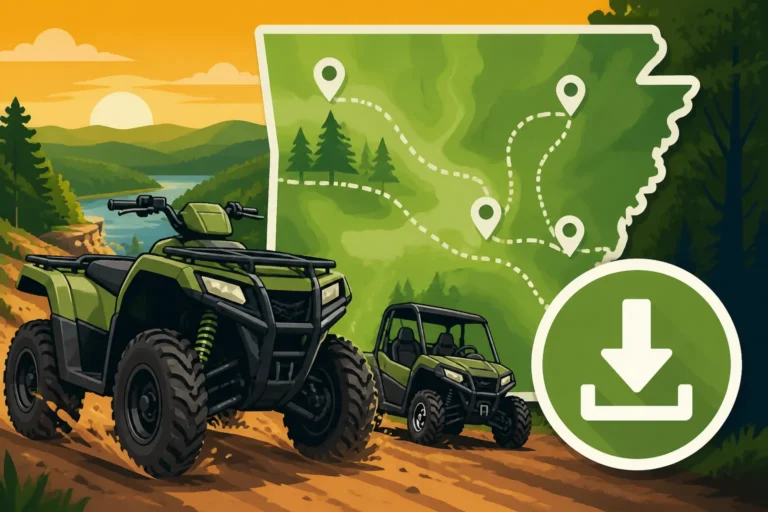
A mapping app can help you understand where you are, but it should not be treated as permission to ride every line shown on a screen. With onX Offroad, riders can use mapping tools to prepare a route and orient themselves; still, verify access, closures, and local requirements with the land manager or park. Download or save the information you need before entering areas where service may be limited.
Build a backup plan. If your preferred trail is closed, too wet, or beyond your ability, know whether there is another route or riding area that works for your group. [Arkansas Trail Conditions Before You Tow] and [How to Check Wolf Pen Gap Trail Status] can help make that check part of your pre-trip routine.
Start with a short loop and increase difficulty gradually
For your first outing, pick a route that allows you to learn without feeling rushed. Practice starting, stopping, turning, and controlling speed on forgiving ground before tackling obstacles. Keep both hands positioned to maintain control, look ahead rather than directly at the front tires, and leave enough distance to stop if the rider ahead slows unexpectedly.
Use breaks to check in with yourself and the group. Fatigue can make a familiar hill or rut feel much harder late in the day. If a rider is tense, cold, overheated, or struggling to keep control, take a break or head back. Trying to finish a planned route at all costs is a poor trade for a first-time rider.
As your confidence grows, change one thing at a time. Try a slightly longer route or a modestly rougher surface rather than combining a long ride, steep terrain, and unfamiliar machine handling all at once. You will learn more from a controlled progression than from a day spent white-knuckling the handlebars.
What to prepare before your first Arkansas trail ride
A little preparation prevents common frustrations: arriving to find a route closed, realizing your machine does not fit a gate, or discovering that your phone has no signal when you need directions. Make the decisions that are easy to handle at home before you reach the trailhead.
Confirm access, permits, and local rules
Arkansas riding areas may be on private property, national forest land, or other public land, and each can have different rules. Check whether a permit is needed, where it applies, and whether it must be displayed or carried. Do not assume that registration or permission to ride on one type of land automatically covers another area.
Read posted signs and respect gates, closures, and restrictions. Stay on routes that are open to your machine, and do not use an unmarked shortcut to get around a closure. If you are unsure whether a trail is open or whether your vehicle qualifies, ask the managing agency or park staff before riding it.
The rules for public roads are separate from trail access rules. A trail permit does not make an ATV or UTV legal to ride on every road. Review [Arkansas ATV Trails: Where to Ride] and [Arkansas OHV Permits: Two Forests, Two Prices] when planning a trip that involves public land.
Pack for changing weather and limited service
Bring water, snacks, basic first-aid supplies, and clothing suited to the forecast. Arkansas weather can make a ride feel very different from the conditions you saw when leaving home. A light rain jacket, gloves, and an extra layer can be welcome after a shower or when temperatures drop in the evening.
Wear a helmet and eye protection, even where a particular rule may not require them. Closed-toe shoes, gloves, and clothing that protects against branches, dust, and scrapes help make an ordinary ride more comfortable. Carry a small repair kit appropriate for your machine, and know how to use the tools you bring.
If you use onX Offroad or another navigation tool, save the map information you need before you leave reliable service. Carry a paper map or written directions as a backup, especially in remote areas. Let someone know where you plan to ride and when you expect to return. For a detailed packing refresher, see [Arkansas Trail Etiquette Locals Expect].
Make a simple ride plan everyone understands
Before unloading, agree on the route, pace, hand signals, and what to do if the group gets separated. Keep the least experienced rider near the front with a capable guide, or close enough to the lead that route changes are clear. An experienced rider should sweep the group from behind so nobody is left alone on the trail.
Set a turnaround point before you start. That makes it easier to shorten the outing if conditions worsen, someone feels uncomfortable, or the group is taking longer than expected. At intersections, regroup and confirm the next direction rather than assuming everyone saw the same turn.
Finally, make sure every rider knows how to stop safely and what to do after a breakdown or minor injury. A calm plan is more valuable than a complicated one. When everyone knows the basics, beginners can focus on learning the trail instead of worrying about what happens if something goes wrong.
Disclaimer
This article is for general informational purposes only and does not constitute professional advice. Laws, prices and regulations vary by location and change over time. Consult a qualified professional for guidance on your specific situation.