Arkansas ATV Trails for Kids
Taking kids on an Arkansas ATV ride can be a wonderful family day—until a trail turns rocky, a creek rises, or a young rider gets tired miles from the parking area. This guide helps you choose a suitable riding area, match the route and machine to your child, and plan for Arkansas’s trail rules, permits, weather, and safety needs.
Choosing an Arkansas riding area for kids
A trail system that works well for experienced adults may not be a good fit for a child’s first ride. Before choosing a destination, think about the youngest or least experienced rider in your group, not just the machine’s capabilities.
Look for manageable routes, not just popular names
Arkansas has a mix of public-land trail systems and private off-road parks. They differ in terrain, access rules, trail difficulty, services, and whether side-by-sides are allowed. Start with the basics: Is the area open to the type and width of your machine? Are there easier routes? Is there a practical place to stop if a child needs a break?
Wolf Pen Gap near Mena is a well-known riding area, but a famous destination is not automatically a beginner-friendly one. Check the route’s difficulty, current access information, and any width restrictions before setting out. For a broader starting point, see [Arkansas ATV Trails: Where to Ride] and [Best Arkansas ATV Trails for Beginners].
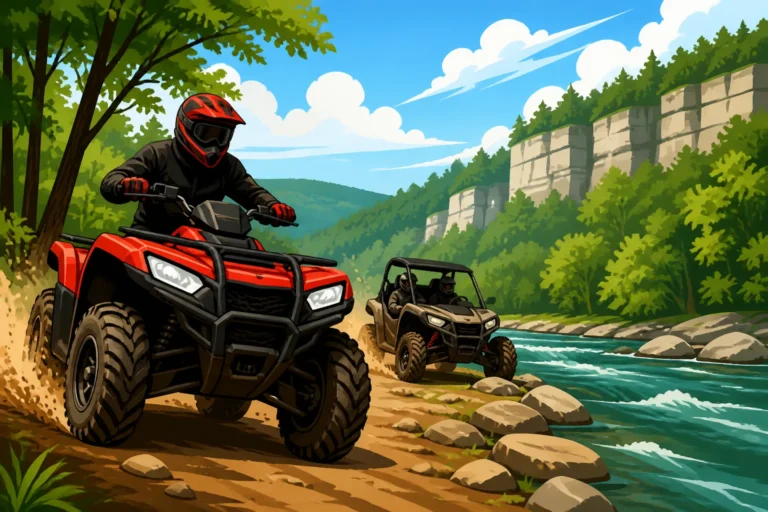
Mill Creek near Ozark and Huckleberry Mountain in the Ouachita region are other areas families may consider, but the right choice depends on the route, the rider, and current trail conditions. A child who is comfortable on a smooth, short loop may find loose rock, steep grades, mud, or repeated water crossings overwhelming. Consider choosing a destination with a way to shorten the ride or return to the trailhead without committing to a long outing.
Private parks may offer a different first-ride experience from forest trails. Some have marked routes, staff, rentals, or guided options, while others still involve challenging terrain. Call ahead and ask specifically about routes for children and new riders, machine requirements, age rules, and whether a parent or guardian must accompany a young rider. Don’t assume a trail described as “family friendly” will suit every child.
Compare trail features before you commit
Trail difficulty is only one part of the decision. Check the distance between practical stopping points, whether the route includes exposed hillsides or water crossings, and how easy it is to turn around. A short trail can still be demanding if it is rocky and uneven; a longer route may be manageable if it is smooth, predictable, and easy to exit.
Maps can help you understand how trails connect and where they lead, but don’t treat a map as a promise that every route is open or suitable. onX Offroad can help you review mapped routes and terrain before leaving home. Use it alongside official trail information and posted signs, and check conditions close to your trip. A line on a screen cannot tell you whether a recent storm has left a washout or whether a gate is closed.
| What to check | Why it matters for a family ride |
|---|---|
| Trail rating and terrain | A route with steep, rocky, or muddy sections may exceed a young rider’s ability |
| Distance and exit options | Children may tire sooner than adults, and an easy way back can prevent a stressful ride |
| Machine width rules | Some routes or gates may not accommodate wider side-by-sides |
| Current closures and conditions | Rain, erosion, maintenance, or seasonal restrictions can change access |
| Services at the trailhead | Parking, restrooms, water, and cell coverage affect comfort and emergency planning |
| Permit requirements | Public-land riding may require a pass separate from an Arkansas registration decal |
For help understanding route labels, read [Arkansas Trail Ratings and What They Mean]. If your family is bringing a side-by-side, check [Arkansas ATV Trails That Allow Side-by-Sides] rather than assuming every ATV route is open to it.
Matching the route and machine to your child
Children vary widely in size, coordination, confidence, and ability to follow instructions. Choosing a route and machine based on age alone can create problems. Think about whether your child can control the machine, understand trail signals, and respond calmly when the terrain changes.
Keep the first ride short and predictable
A first ride should be short enough that you can finish while the child is still having fun. A familiar, manageable loop is usually a better introduction than a long adventure with a dramatic overlook or a remote destination as the main goal. Let the child get used to the machine and protective gear before adding rough terrain, steep grades, or a busy group ride.
Before leaving the staging area, practice stopping, turning, and maintaining a safe following distance in an appropriate place. Agree on a simple signal for “stop” and a plan for what the child should do if separated from the group. Set the pace around the child, leave plenty of space between machines, and stop before fatigue turns into frustration.
A child riding their own ATV needs a machine they can control without stretching to reach the controls or struggling to handle its weight. A side-by-side passenger needs a properly fitted seat and must be able to stay seated with the restraint system used as intended. Don’t carry a child as a passenger unless the machine is designed for passengers and the manufacturer’s instructions and park rules allow it.
Families sometimes assume that buying a small ATV makes any trail appropriate. It doesn’t. A youth-sized machine can still be difficult to control on steep, rutted, slippery, or rocky ground. If the child is anxious, has trouble stopping smoothly, or cannot keep a steady pace without close prompting, choose an easier setting or postpone the ride.
Give width, terrain, and turning room real attention
A route that looks wide on a map may narrow at a gate, between trees, or along a rocky section. This matters especially when the family brings a side-by-side, which may not fit routes designed for narrower machines. Check posted restrictions and verify the machine’s width before traveling. [Arkansas ATV Trails With Width Limits] explains why width is worth checking before you tow.
Turning around also takes space. On a narrow hillside or a muddy trail, a quick U-turn may be unsafe or impossible. When riding with children, avoid routes where you would have no sensible way to retreat if the youngest rider becomes tired or a section feels too difficult. Keep the group together, but don’t crowd a young rider with multiple machines close behind.
A useful pre-ride conversation includes what the child should do if they encounter a puddle, a steep section, or a stopped rider. The answer should not be “just follow the person ahead.” Tell them to stop at a safe distance, wait for an adult’s direction, and never attempt an obstacle beyond their comfort level. Adults should be ready to walk a section, turn around, or change plans without making the child feel they have failed.
Arkansas rules and safety considerations for young riders
Trail access involves more than choosing a route. Registration, land-manager permits, posted restrictions, park policies, and rules for young riders may all apply. Check the requirements for the specific place you plan to visit, because a state registration decal and a trail-use permit are not necessarily the same thing.
Check supervision rules and local requirements
Arkansas has rules that affect riders under twelve, and trail parks or land managers may have additional requirements. Before your trip, review [Arkansas Rules for Riders Under Twelve] and confirm what applies to the exact location. A private park may set its own minimum ages, supervision expectations, machine rules, and waiver requirements. Ask directly rather than relying on what another family experienced at a different park.
Adults should stay close enough to supervise effectively. On a trail, that means being able to see or quickly reach the child, not simply riding somewhere in the same group. Keep younger riders between responsible adults when practical, and agree in advance on where the group will stop if someone falls behind.
Registration and riding permits are also separate issues to check. Arkansas registration requirements depend on the machine and its use, while public riding areas can have their own permit rules. Review [Arkansas OHV Permits: Two Forests, Two Prices] and [Do Out-of-State Riders Need an Arkansas Registration Decal?] if your family is visiting from outside Arkansas. For general registration questions, [How to Register an ATV in Arkansas] is a useful companion.
Treat helmets and protective gear as essential
Even where a particular helmet rule does not apply to an ATV rider, a properly fitted helmet is a sensible family safety choice. Check [Arkansas ATV Helmet Requirements] for the legal context, then follow the machine manufacturer’s guidance and the riding area’s rules. A helmet should fit securely and be appropriate for the activity; a loose helmet that shifts over the eyes is not protective equipment a child can rely on.
Protective clothing helps with more than comfort. Closed-toe footwear, gloves, long sleeves, and eye protection can help reduce scrapes, sun exposure, dust irritation, and contact with branches. For a child, check fit before the trip: gloves should allow control of the grips and brakes, and goggles should not slide or interfere with the helmet.
Take water, snacks, a basic first-aid kit, and a charged phone. Cell service can be unreliable in parts of the Ozarks and Ouachita Mountains, so tell someone where you are going and when you expect to return. Carry a paper map or save offline navigation information when available; a phone battery can drain quickly in poor coverage or cold weather.
Planning a family ride that can change with the day
Arkansas weather and trail conditions can turn a comfortable route into a tiring one. A little planning helps, but the most important part is staying willing to shorten the ride or head back when conditions don’t suit the least experienced rider.
Check conditions, access, and facilities before leaving
Rain can make clay, rock, and creek crossings more challenging, while dry conditions can create dust that affects visibility. Check the riding area’s latest notices and ask about closures, trail maintenance, and recent weather. [Arkansas Trail Conditions Before You Tow] can help you build a useful pre-trip checklist.
onX Offroad can be useful for looking over mapped routes and planning where a group might turn around, but confirm access with the land manager or park. Posted signs and local notices take priority over a route shown on a map. If your map suggests a connection that is not clearly marked on the ground, stop and verify rather than guessing.
Look at practical facilities, too. Families with younger children may value a nearby restroom, a shaded place to eat, or a campground close to the riding area. Some trailheads have limited services or no water, so bring enough for the full outing. If staying overnight, compare access and amenities in advance using [Arkansas ATV Trails With Camping].
Build a flexible day around the youngest rider
Start early enough to avoid rushing through check-in, unloading, and safety instructions. Give everyone time to adjust helmets and gear before the ride, and avoid scheduling a long route immediately after a car journey. Children may arrive excited but still be tired from the drive, and that can affect attention and patience.
Plan breaks before anyone is exhausted. At each stop, check whether the child is warm or overheated, thirsty, hungry, or uncomfortable. Ask whether they want to continue, and take the answer seriously. If the trail becomes more difficult than expected, turning back is a sound decision—not a disappointing end to the day.
A simple family plan might look like this:
- Confirm the riding area is open and suitable for your machine.
- Check permit, registration, age, and supervision requirements.
- Review the route and identify an early turnaround point.
- Pack protective gear, water, food, a first-aid kit, and navigation backups.
- Set group signals and explain what the child should do if separated.
- Start with an easy section and reassess before continuing.
- Head back while the youngest rider still has energy.
onX Offroad may help with route planning, but the best family ride is not the one that covers the most miles. It is the one where children can ride within their abilities, adults can supervise closely, and the group can make a safe decision when the trail or the day changes.
Disclaimer
This article is for general informational purposes only and does not constitute professional advice. Laws, prices and regulations vary by location and change over time. Consult a qualified professional for guidance on your specific situation.