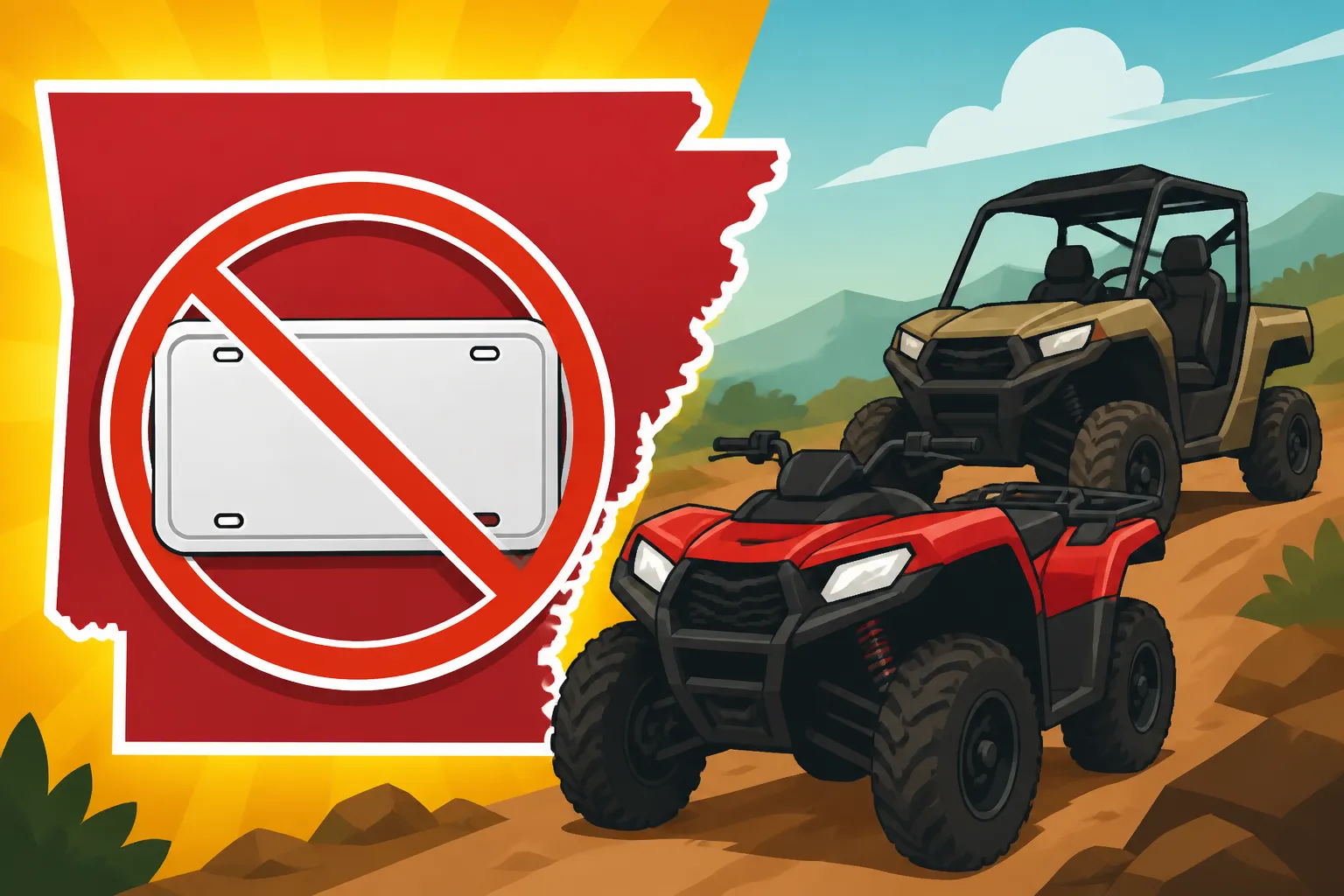
Arkansas Has No ATV License Plate
It can be incredibly confusing, can't it? You buy an ATV, you're excited to hit the trails, and then you start hearing whispers about "registration" and "identification." But unlike your car or truck, you won't be slapping a metal license plate on your quad in Arkansas. This guide is here to cut through the confusion and explain exactly why Arkansas has no ATV license plate, what the state does require, and how you can stay on the right side of the law.
Unpacking the "No ATV License Plate" Reality in Arkansas
When you're dealing with vehicles, especially off-highway ones, it feels like every state has its own unique rulebook. And Arkansas is definitely marching to the beat of a different drum when it comes to ATV identification. You might be used to seeing license plates on almost any motorized vehicle that's registered, so it's natural to wonder why your shiny new quad doesn't get one.
The Statutory Framework: Why Plates Aren't Part of the Picture
The core reason Arkansas doesn't issue ATV license plates lies deep within its state statutes. Unlike passenger cars, trucks, or motorcycles, which are fundamentally designed and intended for public road use, All-Terrain Vehicles (ATVs) are classified differently. The state legislature has drawn a clear line, defining ATVs as Off-Highway Vehicles (OHVs) primarily meant for off-road operation. This distinction is crucial because the regulations for OHVs focus on different aspects of identification and control compared to those for on-road vehicles.
When the laws were written, the emphasis for ATVs wasn't on facilitating their easy identification on public highways, but rather on acknowledging their presence, ensuring sales tax collection, and providing a unique identifier for off-road use. A traditional license plate, with its numbers and expiration dates often linked to annual renewals and road-use fees, simply didn't fit the envisioned model for ATVs in Arkansas. The state decided on a less cumbersome, more specific method that suits the off-road nature of these machines.
Decals as the Primary Identification: A Different Approach
Instead of a bulky, reflective license plate, Arkansas mandates a registration decal for ATVs. Think of it as your ATV's unique ID badge. This decal is more than just a sticker; it's the official proof that your ATV has been registered with the state, that you've paid your due sales tax, and that your machine is recognized within Arkansas's system. What makes this system particularly distinct is that it's typically a [Arkansas ATV Registration: One Time, Never Renewed]. You get the decal once, and it's good for the life of your ownership in Arkansas. There's no annual trip to the Department of Finance and Administration (DFA) or a revenue office to renew it year after year, which can be a huge relief compared to other vehicle registrations.
This decal-based system simplifies things for both the owner and the state. It's a visible, easy-to-apply identifier that signals compliance without the overhead of manufacturing, distributing, and tracking thousands of annually renewing plates for vehicles that rarely, if ever, touch a public road. It clearly marks your ATV as a legally recognized machine within the state's framework, even if it's not meant for the highway.
The Logic Behind Arkansas's System: Beyond the Pavement
The decision to forego license plates for ATVs in Arkansas truly boils down to their primary use: off-pavement adventure and utility. ATVs are designed for trails, mud, gravel roads on private property, and agricultural work, not cruising down Highway 67. The state's regulations reflect this reality. For vehicles that are overwhelmingly used on private land, designated trails, or for specific farm or hunting operations, the need for a universally recognized, highly visible, and annually renewed street plate is largely absent.
Consider the practicalities: a license plate might get snagged on brush, caked with mud, or simply not be necessary for a machine that never exceeds 30 mph on a public thoroughfare (and then only in very specific, limited circumstances). The decal, being smaller and more securely placed, serves its purpose without adding unnecessary bulk or complexity. This system underscores Arkansas's focus on regulating the ownership and sales tax aspects of ATVs, rather than their extensive road use, which is generally prohibited anyway. It's a pragmatic approach that recognizes the specific niche ATVs fill in the lives of many Arkansans.
What Arkansas Does Require: The Essential Registration Decal
So, while you won't be getting a license plate, that doesn't mean your ATV is completely off the state's radar. Arkansas has a clear and straightforward system for identifying and tracking these machines, centered around that mandatory registration decal. Understanding this process is key to enjoying your ATV without any unexpected legal hiccups.
Understanding the Arkansas ATV Registration Process
The process for registering an ATV in Arkansas is distinct from registering a car or truck, mainly because it's a one-and-done deal. There's no annual renewal to worry about. Once you've gone through the initial registration, you're set, as long as you own that specific machine. This means no more forgotten renewal notices or scrambling to get to the [Arkansas Revenue Offices That Handle ATVs] before a deadline rolls around each year. It's a refreshing change for many riders!
The Department of Finance and Administration (DFA) oversees this process, and your local revenue office is where you'll handle the paperwork. The primary goal of this registration is two-fold: to ensure all applicable sales tax is paid and to issue that unique, permanent decal. It also creates a record of ownership, which can be invaluable in cases of theft or when you decide to sell the machine down the road. Even if you plan on using your ATV exclusively on private land, like your own backyard or a deer lease, [Arkansas Registration Even for Backyard Riding] is typically required if it meets the state's definition of an ATV. It's not about where you ride, but about the machine itself and your ownership of it within the state.
Securing Your Decal: Steps and Necessary Documentation
Getting your ATV registered and securing that all-important decal requires a visit to a state revenue office. You'll need to gather a few key documents to make the process smooth. First and foremost, you'll need [Arkansas Proof of Ownership for Registration]. This usually means the manufacturer's statement of origin (MSO) if it's a new machine, or a bill of sale if you bought it used. If you're using a bill of sale, especially for a private party purchase, ensure it meets [Arkansas ATV Bill of Sale Requirements] – clear details like buyer/seller names, signatures, date, machine description (VIN, make, model), and purchase price are vital. Sometimes, it's wise to use a standardized template, and resources like LawDepot can provide helpful forms to ensure all necessary fields are covered.
You'll also need to complete Arkansas DFA Form 10-381, a crucial piece of paperwork for registering your off-highway vehicle. Understanding how to fill out [Filling Out Arkansas Form 10-381 Line by Line] can save you a lot of time and potential headaches at the revenue office. Expect to pay [What Arkansas Charges to Register an ATV], which primarily covers sales tax. This isn't a "plate fee" or an annual registration fee; it's the sales tax due on the purchase, plus a small processing fee. Remember, [Arkansas Sales Tax on an ATV Purchase] applies, and this can be a significant part of the cost, as ATVs are not subject to the same sales tax cap as highway vehicles.
Where Your Decal Belongs: Placement and Visibility
Once you've completed the registration process and paid your dues, you'll walk out with your new, permanent decal. But where does it go? This isn't just a suggestion; there's a specific rule for [Arkansas ATV Decal Placement on a Side-by-Side] and standard ATVs to ensure visibility and compliance. The decal must be affixed to the left front of your ATV. This could be on the left front fender, the left front cowl, or any other prominent part of the machine's front, so long as it's on the left side and clearly visible.
The reason for this specific placement is consistency and ease of identification for law enforcement or park rangers. They know exactly where to look to verify your ATV's registration status. Think of it like a vehicle's inspection sticker – it has a designated spot for a reason. Make sure the area is clean and dry before applying the decal for maximum adhesion. Peeling or lost decals can be replaced, but it's an extra step you'd rather avoid. Ensure your decal is always legible and securely attached, as it is the official proof of your ATV's registration in Arkansas.
Decals vs. License Plates: A Clear Distinction
It’s easy to get caught up in the idea that every vehicle needs a license plate, especially when crossing state lines or seeing different rules for different machines. But in Arkansas, the distinction between an ATV decal and a traditional license plate is fundamental. Understanding this difference is not just academic; it has practical implications for how you operate your machine and what the law expects of you.
Functional Differences: What Each Signifies
Let's lay it out clearly: a license plate and an ATV decal serve fundamentally different purposes, reflecting the distinct legal classifications of the vehicles they identify. A license plate, like those found on your car or motorcycle, is primarily a permit for public road use. It's often renewed annually or biennially, contributing to highway maintenance funds, and its design ensures it's easily readable at speed and distance. It ties into a vast database that law enforcement can access instantly to verify everything from insurance to ownership and outstanding violations. This is the essence of [Why a Decal Is Not a Plate].
The Arkansas ATV registration decal, on the other hand, is a proof of registration specific to off-highway use. It signifies that your sales tax has been paid, and your machine is recorded with the state for ownership purposes. It’s not about granting permission for road travel (which is generally restricted for ATVs in Arkansas), but about documenting the vehicle for tax collection and general identification within an off-road context. The decal doesn't typically expire or require annual renewal, reinforcing its role as a permanent marker rather than a recurring permit for road access.
Legal Ramifications of Misunderstanding the System
Mistaking your ATV decal for a license plate, or assuming you don't need any identification simply because there's no plate, can lead to unwelcome consequences. Riding an unregistered ATV in Arkansas can result in [Arkansas Penalties for Riding Unregistered]. This isn't just a minor inconvenience; it could involve fines or other legal actions, especially if you're involved in an incident or stopped by law enforcement. The decal is your proof of compliance, and its absence is a red flag.
Conversely, if you mistakenly believe your decal grants you the same road privileges as a license plate, you could find yourself in trouble for operating an ATV on a public highway where it's not permitted. Arkansas law is quite clear: ATVs are generally not street legal, with only a handful of very specific exceptions, such as direct ninety-degree crossings or certain farming/hunting operations. Relying on your decal as an authorization for extensive road use is a dangerous misunderstanding that could lead to citations for illegal road riding.
Out-of-State Considerations for Arkansas Riders
Traveling with your ATV can add another layer of complexity. What happens if you take your Arkansas-registered ATV with its decal to, say, Missouri or Oklahoma, where different ATV registration and plate rules might apply? And what if a rider from another state, where they do issue ATV plates, comes to Arkansas?
Generally, when you travel to another state, you are expected to comply with the local laws of that state regarding ATV operation, which might include specific registration, permitting, or even plate requirements, even if your home state has a different system. While some states offer reciprocity for registration, it's never a guarantee. It's always best to check the regulations of the state you plan to visit. Conversely, if you're an out-of-state rider bringing your ATV into Arkansas, you generally won't need to get an [Arkansas Registration for a Machine Bought Out of State] or a decal if your machine is properly registered in your home state, especially for recreational use on designated trails. However, if you become an Arkansas resident, the rules change, and you'll then need to register your ATV in Arkansas. The key takeaway here is always to do your homework before you travel.
Common Questions and Practical Advice for ATV Owners
Navigating the world of ATV regulations can bring up a lot of specific questions. Because ATVs occupy a unique space between utility and recreation, and because Arkansas has its own distinct approach, it's normal to have lingering doubts. Let's tackle some of the most frequent queries and offer some practical advice to ensure you're always prepared.
What About Side-by-Sides and Other OHVs?
This is a really common point of confusion. Many people hear "ATV" and think only of a traditional quad, but the world of off-highway vehicles is much broader, including side-by-sides (UTVs), dirt bikes, and even some six-wheeled machines. So, does the "no license plate" rule apply across the board to all these machines? For the most part, yes, for their initial state-level registration for off-highway use.
Side-by-sides, or UTVs, are also considered Off-Highway Vehicles in Arkansas and typically follow the same registration decal requirements as ATVs. So, if you're looking to [Registering a Side-by-Side in Arkansas], you'll go through the same one-time registration process at a revenue office and receive a decal, not a license plate. The same generally holds true for dirt bikes and other machines that fall under the state's OHV definition. The critical thing to remember is that this state-level decal makes them legal for off-highway use and ensures sales tax has been collected. It does not automatically make them street legal. However, some Arkansas cities have passed local ordinances that do allow UTVs (and sometimes golf carts, but rarely ATVs) to be operated on specific city streets, usually with an additional city-issued permit or sticker and adherence to certain equipment requirements. These are local exceptions, not statewide changes to the ATV plate rule.
Proof of Ownership and Transfers Without a Plate
Since there's no official title issued for ATVs in Arkansas (unlike cars), and certainly no license plate, how do you prove ownership? This question becomes especially critical when you're buying or selling a used machine. The answer largely hinges on thorough documentation. The manufacturer's statement of origin (MSO) for a new machine, or a comprehensive bill of sale for a used one, becomes your primary proof.
When you're buying a used ATV from a private seller, always insist on a well-documented bill of sale. This is your legal record of the transaction and critical for proving ownership when you go to register it yourself. Make sure the bill of sale includes:
- Full names and addresses of both buyer and seller.
- The date of the sale.
- The exact purchase price.
- A detailed description of the ATV, including make, model, year, and most importantly, the Vehicle Identification Number (VIN).
- Signatures of both parties.
Using a reliable template, perhaps one from LawDepot, can help ensure you don't miss any vital information. This document, along with your previous owner's registration paperwork (if they had it), will be what the revenue office looks for. When [Selling a Registered Machine in Arkansas], be sure to provide the buyer with all your original registration paperwork and a clear bill of sale, as this is how they'll be able to prove their new ownership.
Keeping Your Registration Valid and Visible
While the Arkansas ATV decal doesn't expire, it's not a "set it and forget it" item entirely. You still need to ensure your decal remains visible and legible. Over time, exposure to sun, mud, and trail debris can cause the decal to fade, peel, or become damaged. If you find your [Arkansas Decal Replacement If It Peels Off], you'll need to contact the DFA or visit a revenue office to inquire about obtaining a duplicate. It’s much better to proactively replace a damaged decal than to risk a fine because it’s unreadable.
Beyond the decal itself, it's always smart to carry proof of your ATV's registration with you while riding. While a physical license plate isn't required, having a copy of your completed registration form (the one stamped by the revenue office) in a waterproof bag on your machine or in your riding gear can be incredibly helpful if you're ever stopped or involved in an accident. This documentation, alongside your bill of sale, is your official paper trail proving you're the rightful and registered owner of the ATV in Arkansas.
Beyond the Decal: What Does Matter for Arkansas ATV Riders?
Understanding the decal system is a big step, but successful ATV ownership and riding in Arkansas involves more than just a sticker. It's about knowing the broader context of the law, where you can ride, and ensuring your machine itself fits the state's definitions.
Understanding Where You Can Ride Legally
The absence of an ATV license plate in Arkansas should be a strong indicator of where these machines are not primarily intended to be ridden: public roads. [Can You Drive an ATV on the Road in Arkansas?] The general answer is no, with very few exceptions. Arkansas law explicitly prohibits the operation of ATVs on public streets, roads, and highways.
The exceptions are typically limited to:
- Direct Crossings: Crossing a highway at approximately a ninety-degree angle after coming to a complete stop.
- Specific Operations: For farming, hunting, disability, utility, law enforcement, or state parks personnel, under very specific conditions and usually when directly related to their work.
- Local Ordinances: As mentioned, some cities have passed ordinances allowing UTVs (but generally not ATVs) on certain low-speed city streets, requiring an additional city permit.
For legitimate off-road riding, Arkansas boasts a fantastic network of trails and riding areas. Places like [Wolf Pen Gap: Arkansas's Best Known OHV Complex] and [Mill Creek OHV Trail System in Arkansas] offer miles of designated trails where your registered ATV can be legally and safely enjoyed. These are the places where your decal truly comes into play, signifying your compliance for off-highway recreation.
Sales Tax and Registration: The Financial Side
While you avoid annual plate renewal fees, the initial financial aspect of ATV registration in Arkansas is primarily tied to sales tax. [What Arkansas Charges to Register an ATV] isn't a separate, annual levy for the privilege of riding; it's the state sales tax (and potentially local sales tax) on the purchase price of your ATV, collected when you first register it. This can be a significant amount, as ATVs are typically not exempt from sales tax, nor are they subject to the same sales tax cap that applies to highway vehicles in some cases.
When you buy a new ATV from a dealer, they will typically collect the sales tax at the point of sale. If you buy a used ATV from a private party, you will be responsible for paying the sales tax directly to the revenue office when you go to register the machine and obtain your decal. It's crucial to budget for this, as it's a mandatory part of getting your ATV properly registered in Arkansas.
Ensuring Your Machine Meets Arkansas's ATV Definition
Finally, it's important to know what Arkansas considers an "ATV" in the first place, as this determines whether your machine falls under these specific registration and identification rules. [Arkansas's 50-Inch, 1,000cc ATV Definition] states that an ATV is a motor vehicle:
- Designed for off-road use.
- Having a seat or saddles for the use of the rider.
- Designed to travel on three, four, or six wheels.
- Having an engine size not exceeding 1,000 cubic centimeters (cc).
- Having a width not exceeding 50 inches.
If your machine exceeds these specifications – for example, if it's wider than 50 inches (like many modern side-by-sides) or has an engine larger than 1,000cc – it might be classified differently under Arkansas law. While side-by-sides generally follow the same decal rule, understanding the exact definition helps clarify which rules apply to your specific machine. Always double-check your machine's specifications against the current Arkansas statute to ensure proper registration and compliance.
| Feature | Arkansas ATV (OHV) | Typical Road Vehicle (Car/Truck) |
|---|---|---|
| Primary ID | Registration Decal | License Plate |
| Renewal | One-time registration, never renews | Annual or biennial renewal |
| Placement | Left front fender/body (specific rules) | Rear (and sometimes front) bumper |
| Purpose | Proof of registration for off-highway use | Proof of registration for public road use |
| Title Issued? | No (for ATVs, in most cases) | Yes |
| Street Legal? | Generally not, with limited exceptions | Yes |
Disclaimer
This article is for general informational purposes only and does not constitute professional advice. Laws, prices and regulations vary by location and change over time. Consult a qualified professional for guidance on your specific situation.