Arkansas Registration Even for Backyard Riding
It's a common thought for many ATV and UTV owners across Arkansas: if I'm just riding around my own property, or on a friend's private land, or strictly sticking to a hunting lease, why would I need to bother with registration? It feels like a lot of extra paperwork and a fee for something that will never touch a public road or a designated trail system. But the truth in Arkansas is that, in most cases, your machine needs to be registered with the state, even if its tires never leave private dirt. This guide is here to unravel that seemingly confusing requirement and explain why it's the law, what you need to do, and what happens if you don't.
The Core Rule: Why Private Land Riding Still Needs Registration
The idea that you need to register an ATV or UTV that only sees private land often comes as a surprise, sometimes even a frustrating one, to many folks. After all, if your vehicle isn't on public roads, trails, or parks, what business is it of the state's, right? Well, Arkansas law takes a broader view of what constitutes an "Off-Highway Vehicle" and what it means to "operate" one within its borders.
Understanding Arkansas's Broad Definition of "OHV"
Let's start by clarifying what Arkansas considers an Off-Highway Vehicle (OHV). The statute doesn't discriminate much based on where you plan to ride. It focuses on the machine itself. Generally, an ATV (all-terrain vehicle) or UTV (utility-terrain vehicle or side-by-side) is defined by its characteristics: engine size, width, and wheel count. For instance, the law typically covers three, four, or six-wheeled vehicles primarily designed for off-road use, not intended for highway travel. The common misconception is that if it's not a car, or if it's under a certain engine size, or if you call it a "golf cart" (when it's clearly not), it might be exempt. But most machines that look, feel, and act like an ATV or UTV will fall under this definition. This broad scope means your weekend warrior machine, even a smaller one, is likely included. If you're curious about the specifics, checking out [Arkansas's 50-Inch, 1,000cc ATV Definition] can give you a clearer picture of what the state defines.
The "Operation" Clause: It's About Use, Not Just Location
Here's where the rubber meets the road, so to speak, regarding private land. Arkansas law states that an OHV must be registered if it is "operated" within the state. It doesn't say "operated on public land" or "operated on designated trails." It simply says "operated." This is a crucial distinction. If you start the engine and drive your ATV or UTV across your own field, down a path to your deer stand, or even just putter around your backyard to trim the hedges, you are, by definition, "operating" the vehicle in Arkansas.
Think of it this way: the state wants to keep track of these vehicles for various reasons, including ownership verification, theft prevention, and sometimes even for environmental or safety initiatives. The moment an OHV is being used, regardless of who owns the land, it falls under this operational clause. So, whether you're breaking new ground in your back forty or simply cruising a well-worn path to your fishing hole, Arkansas Registration Even for Backyard Riding is typically a requirement, much to the surprise of many first-time owners. It's less about where you're going and more about what you're driving and that you're driving it.
Common Misconceptions About Private Land Exemption
It's completely understandable why many ATV and UTV owners believe they're exempt from registration if they're not hitting public trails or roads. The system for motor vehicles on the street often has different rules for private property. However, off-highway vehicles in Arkansas are treated somewhat uniquely.
"But I Only Ride on My Own Land!"
This is perhaps the most frequent argument against registration for private land use, and it's a perfectly logical one if you're thinking about typical road-going vehicles. You don't need a driver's license to drive your car around your own driveway, and you might not need it registered if it never leaves your property (though that's rare for cars). But with ATVs and UTVs in Arkansas, the rules are different. The state's OHV registration statute doesn't include an exemption for vehicles operated solely on the owner's private property.
The lawmakers created a distinct category for these off-highway machines, and the intent was broad coverage for "operation." This means that the act of riding, driving, or otherwise using your ATV or UTV, even if confined entirely to the boundaries of your own land, triggers the registration requirement. It's a key point that catches many off guard, leading to confusion and sometimes, penalties. The law aims to cover the existence and use of these machines within the state, irrespective of the specific parcel of land.
The Myth of the "Farm Exemption" for Recreation
Another common point of confusion arises around "farm exemptions." Many states offer some form of exemption for vehicles used exclusively for agricultural purposes on private land. Arkansas does have very specific, narrow exemptions for certain farm equipment. However, it's critical to understand that these exemptions are typically for implements of husbandry or vehicles strictly used in direct support of a farming operation, like a tractor or a farm truck with specific licensing. Most ATVs and UTVs, even if owned by a farmer and used on a farm, often don't qualify for these exemptions if they're also used for recreational riding.
If your UTV is primarily used to haul feed, check fences, or assist with livestock, it might fall into a grey area depending on the exact nature of its use and how strictly the exemption is interpreted. But if that same machine is also used for weekend rides with the family, cruising to a fishing spot, or running trails on the back forty, it's highly unlikely to qualify. The moment recreational use enters the picture, even on a working farm, the standard OHV registration rules tend to apply. It's always best to verify with the Department of Finance and Administration (DFA) if you believe your specific farming use might qualify, but generally, don't assume a broad "farm exemption" covers your ATV. For those seeking clarity on what might be exempt, reading up on [Arkansas Farm Exemptions Worth Asking About] is a wise move, but remember, recreational riding usually negates such exemptions.
Hunting Leases and Other Private Property Scenarios
The concept of a hunting lease is quintessential Arkansas. Many residents own ATVs or UTVs specifically for navigating their deer leases, bird hunting spots, or just general recreation on leased timberland. These properties are private, and riders often feel a sense of security that their machine, because it's on private land they have permission to use, doesn't need to be registered. Unfortunately, this is another scenario where the state's definition of "operation" overrides the private land aspect.
Whether you own the land, lease it, or have explicit permission from the landowner, the requirement for your ATV or UTV to be registered remains. The legal framework doesn't differentiate between your deeded property and land you have legal access to. If you're operating the machine within the state of Arkansas, it generally needs that state-issued registration decal. So, for all those dedicated hunters and outdoor enthusiasts, make sure your machine is squared away before you head out to the lease. It's a crucial point that's often overlooked, but ensuring you're compliant will save you headaches down the line. You can find more specific guidance on [Registering an Arkansas ATV Used Only on a Deer Lease].
What Happens If You Don't Register Your Backyard Machine?
So, you've heard the arguments, but you're still thinking, "Who's going to know if I only ride in my backyard?" It's a fair question, but overlooking the registration requirement, even for private land use, can lead to some unwelcome consequences. It's not just about avoiding a fine; it's also about potential issues with insurance and liability down the road.
The Risk of Citations and Penalties
While it might seem unlikely for law enforcement to show up at your private property to check your ATV's registration, it's not impossible, and it's certainly not worth the risk. There are several ways an unregistered machine could lead to a citation. Perhaps a neighbor complains about noise or dust, leading an officer to investigate. Or, if an accident occurs on your property involving the unregistered ATV, law enforcement might become involved. You could also be pulled over while transporting your unregistered ATV on a trailer to or from your property, and an officer might inquire about its registration status for operation within the state.
If you are caught operating an unregistered ATV or UTV in Arkansas, you could face fines and penalties. While I can't give specific dollar amounts (as these can change), the financial impact can be significant, often far exceeding the cost of simply registering the machine in the first place. Beyond the immediate fine, there could be court costs or other administrative fees. It's a preventable expense and hassle that no one wants to deal with, especially when you consider that [Arkansas ATV Registration Has No Annual Renewal], making it a one-time fee for most machines. It's a small investment for peace of mind and legal compliance. Taking a moment to understand [Arkansas Penalties for Riding Unregistered] can help underscore the importance of this step.
Insurance and Liability Concerns
Beyond the immediate legal penalties, operating an unregistered ATV or UTV, even on private land, can create significant complications if an accident occurs. While state registration doesn't automatically mean your machine is insured (that's a separate step), the lack of registration could affect how an insurance company views a claim. Many personal liability or homeowner's policies have clauses regarding unregistered vehicles or recreational vehicles. If an accident happens and your ATV is unregistered, an insurance provider might deny or limit coverage, arguing that you weren't operating the vehicle legally.
Imagine a scenario: a friend is riding your unregistered UTV on your property, has an accident, and sustains an injury. Or, your machine damages property, either your own or a neighbor's. In such cases, if your machine isn't properly registered, you could face substantial out-of-pocket expenses for medical bills, repairs, or legal defense. Having a registered machine helps establish legal ownership and compliance, which can be beneficial in navigating insurance claims and liability issues. It's another layer of protection that, while not directly tied to collision insurance itself, can certainly influence outcomes. Don't assume your homeowner's policy will cover everything if you haven't taken the basic step of registering the machine. This is a good opportunity to learn more about [Is Insurance Part of Arkansas ATV Registration?] and how these two aspects intertwine.
The Simple Steps to Get Your ATV/UTV Registered
Okay, so we've established why it's important, even for backyard riding. Now, let's talk about how to actually get it done. The process in Arkansas is straightforward, especially since it's a one-time registration and not an annual renewal. Gathering your documents ahead of time will make the visit to the revenue office much smoother.
Gathering Your Paperwork
The key to a hassle-free registration experience is having all your ducks in a row before you head out. You'll need a few essential documents to prove ownership and identity.
- Proof of Ownership: This is paramount. For a new machine, you'll need the Manufacturer's Statement of Origin (MSO). If you bought a used machine, you'll need a valid bill of sale. A strong, detailed bill of sale is crucial, especially for private sales. It should include the buyer's and seller's names and addresses, the sale date, the purchase price, and a clear description of the ATV/UTV, including its Vehicle Identification Number (VIN). For private sales, you can find customizable templates online from services like LawDepot, which can help ensure all the necessary details are captured legally. Knowing [Arkansas ATV Bill of Sale Requirements] in advance can save you a trip.
- Arkansas Department of Finance and Administration (DFA) Form 10-381: This is the application for an Off-Highway Vehicle Decal. You can usually download and print this form from the DFA website or pick one up at the revenue office. Filling it out accurately will speed up the process. A detailed look at [Arkansas DFA Form 10-381 Explained] can guide you line by line.
- Proof of Identity: A valid government-issued photo ID (like a driver's license or state ID card) is always required.
- Proof of Address: Sometimes they'll ask for additional proof of residency, like a utility bill, if your ID doesn't clearly reflect your current Arkansas address.
- Payment for Fees: Be prepared to pay the registration fee and any applicable sales tax. While I can't provide current figures, be ready for these costs.
Double-checking this checklist before you leave will prevent frustrating delays.
Where to Go and What to Expect
Once you have your paperwork ready, your next stop will be an Arkansas State Revenue Office. These are the same offices where you would typically handle car tag renewals or driver's license services.
When you arrive, you'll present your documents, including your proof of ownership, your completed Form 10-381, and your identification to a clerk. They will review everything, process your application, and collect the necessary fees. This includes the initial registration fee and any sales tax that may be due on the purchase, depending on how and when you bought the machine. It's worth noting that Arkansas's sales tax on vehicles applies even to ATVs and UTVs, and there's generally no vehicle tax cap like there might be for cars. So, be prepared for that portion of the cost, especially if you haven't already paid it to a dealer. For a smooth transaction, it's always a good idea to know [What Arkansas Charges to Register an ATV]. The clerks are usually quite helpful, and their goal is to get you squared away, so don't hesitate to ask questions if something is unclear. More details about the process can be found in [Registering an ATV at an Arkansas Revenue Office].
The Arkansas OHV Decal: Your Proof of Registration
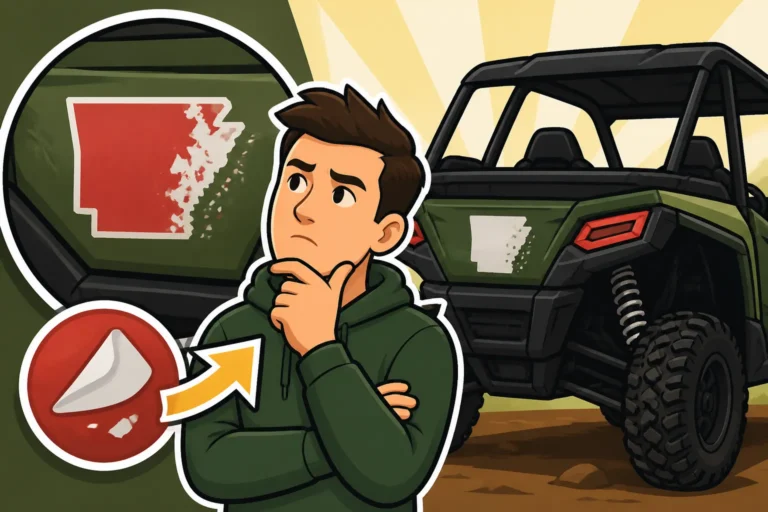
After your paperwork is processed and fees are paid, you'll receive your official Arkansas Off-Highway Vehicle Decal. This small sticker is your proof of registration and is designed to be placed prominently on your ATV or UTV. The state specifies that the decal should be affixed to the left front fender or other visible location on the left front of the machine. It's important to put it where it's easily seen, as this is what an officer or ranger will look for if they need to verify your registration.
One of the best aspects of Arkansas ATV/UTV registration is that it's a one-time deal. Unlike car tags that need annual renewal, your OHV decal doesn't expire. Once you've paid the fee and received your decal, you're good to go for the life of the machine in Arkansas. This means no more annual fees, no more renewal notices to keep track of, and no more recurring trips to the revenue office for that particular machine. This "never renewed" aspect is a huge relief for many owners and makes the initial effort even more worthwhile. You can learn more about this in [Arkansas ATV Decal Rules and Where It Goes] and why [Arkansas ATV Registration Has No Annual Renewal] is such a benefit.
Beyond Registration: Other Important Considerations for Private Land Riders
While getting your ATV or UTV registered is a critical step, especially for those backyard riders, there are other important considerations for responsible ownership and operation, even when you're sticking to private land. Registration covers the legal status of your machine, but safe and respectful riding involves more.
Landowner Permission and Trespass Laws
Let's be absolutely clear: even if your ATV or UTV is perfectly registered, that decal doesn't give you free rein to ride anywhere you please. The registration applies to your machine's legal status within the state, not your right to access private property. You must always have explicit permission from the landowner to ride on any land you don't own. This includes hunting leases, timber company land, a friend's farm, or any other private parcel.
Trespassing laws in Arkansas are serious, and landowners have the right to protect their property. Many properties are marked with "No Trespassing" signs or, increasingly, with purple paint on trees or fence posts, which legally signifies private property where entry is prohibited. Before you ever unload your machine onto someone else's property, make sure you have clear, preferably written, permission. Understanding [Arkansas Rules on Land You Lease] and the importance of [Written Permission From an Arkansas Landowner] can prevent awkward, or even legally troubling, encounters. Respecting property rights is fundamental to enjoying off-road riding in Arkansas.
Safety Gear and Practices on Private Property
Just because you're riding on private land doesn't mean safety goes out the window. In fact, many accidents happen on familiar territory. While Arkansas does not have a mandatory helmet law for ATV riders (it's covered in [Arkansas Has No ATV Helmet Law]), wearing one is always, always a smart decision. Helmets can prevent serious head injuries, and whether you're cruising through your pasture or tackling a backyard obstacle course, falls and rollovers can happen unexpectedly.
Beyond helmets, consider other protective gear like goggles, gloves, long pants, and sturdy boots. Ride within your skill level and the machine's capabilities. Don't overload the ATV/UTV, and be particularly mindful of passengers, especially children. Ensure that anyone operating the machine, including younger riders, understands basic safety principles. Even on private land, you are responsible for the safe operation of your vehicle and the well-being of anyone riding it. Basic safety practices are universal, regardless of the terrain or ownership.
Noise, Dust, and Neighborly Relations
Finally, let's talk about being a good neighbor. While your private land is yours to enjoy, excessive noise or dust from ATV/UTV riding can quickly sour relations with those living nearby. Even if you're perfectly within your legal rights to operate your registered machine on your property, a constant roar or clouds of dust drifting over property lines can lead to complaints and animosity.
Consider when and how you ride. Are there times of day when noise would be less disruptive? Can you alter your riding patterns to minimize dust near property lines? Even small gestures, like occasionally hosing down dusty areas or choosing quieter times for rides, can go a long way in maintaining good relationships. Sometimes, a friendly conversation with a neighbor can prevent minor issues from escalating. After all, enjoying your machine responsibly also means being considerate of your community. For further reading, look into [Arkansas Noise Complaints About Quads] to understand how these issues can sometimes become formal complaints.
Disclaimer
This article is for general informational purposes only and does not constitute professional advice. Laws, prices and regulations vary by location and change over time. Consult a qualified professional for guidance on your specific situation.