Do You Need to Register an ATV in Arkansas?
There's often a lot of head-scratching and misinformation floating around about whether you actually need to register your ATV or UTV in Arkansas. Many folks assume that if they're only riding on their own private land, or if it's just a weekend toy, the state doesn't care. That assumption can lead to a lot of headaches, from legal issues to difficulties proving ownership. This guide is here to cut through the confusion and explain clearly when, why, and how you need to register your off-highway vehicle (OHV) in the Natural State, giving you the peace of mind to hit the trails or tackle chores.
The Core Question: Does Arkansas Require ATV Registration?
Let's get straight to the point because this is where many people get tripped up. The simple answer is yes, almost every ATV and UTV in Arkansas must be registered with the state, regardless of whether you plan to ride it on public land, a private deer lease, or just around your own property. It’s a common misconception that registration is only for street-legal vehicles or those used on designated public trails, but Arkansas law casts a much wider net.
The "Yes, But" of Public Land Use
If you're eyeing those fantastic trails in the Ouachita or Ozark-St. Francis National Forests, or planning to cross a public road to get to another section of your property, then the need for registration becomes immediately apparent. When you register your ATV, the state issues you a distinct decal that serves as your proof of registration. This isn't just a suggestion; it's a requirement that deputies and forest rangers will check. Without that decal properly displayed, you could face fines or other penalties, turning a fun day out into a costly hassle.
One of the most unique aspects of Arkansas's system is that this registration isn't an annual affair. Unlike your car tags that you renew every year, once you register an ATV in Arkansas, that registration is generally good for the life of the machine in the state. This means less recurring paperwork and fees, which is a nice change of pace. Just get it done once, display your decal, and you're set. This single-time registration often surprises folks from other states. For more on this, check out [Arkansas ATV Registration Has No Annual Renewal].
What About Private Land Riding?
Here's where the biggest misunderstanding usually lies. Many ATV owners believe that if their machine never leaves private property – say, a farm, a hunting club lease, or even just their expansive backyard – then registration isn't necessary. This is incorrect for Arkansas. The state's statute requires registration for all ATVs as defined by law, regardless of their intended use or location of operation. The spirit of the law isn't just about controlling public access; it's also about establishing a clear ownership record for every off-highway vehicle in the state.
Imagine this scenario: you've got a fantastic quad that you only use to check fences on your sprawling farm property. You never take it on the road, never hit the public trails. But if that machine were ever stolen, having it registered with the state provides an official record of your ownership, making it significantly easier for law enforcement to track it down and return it to you. Without registration, proving ownership can be a much more complicated and drawn-out process, often relying solely on a bill of sale that could be lost or questioned. This might sound like an unnecessary hoop to jump through, but it provides a critical layer of protection for your valuable equipment. Even if your ATV will never see a public trail, you still need to get it registered. For a deeper dive into this specific aspect, take a look at [Arkansas Registration Even for Backyard Riding] and [Arkansas ATV Registration for Private Land Only Machines].
The Specifics: What Arkansas Defines as an ATV
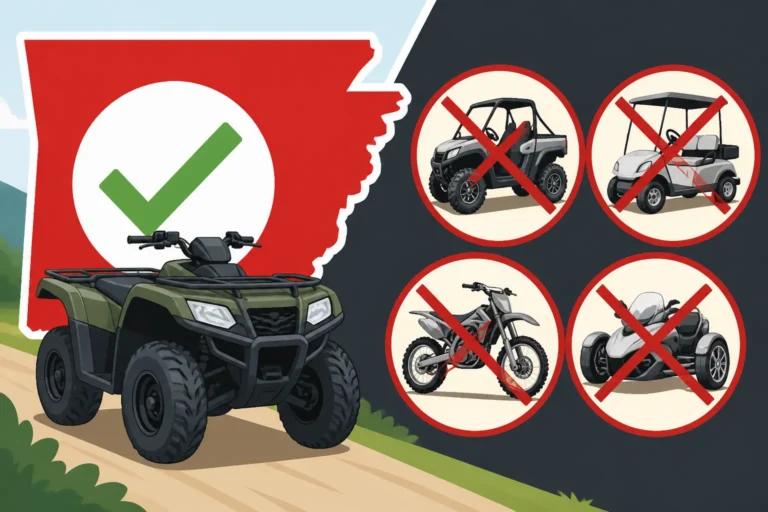
The registration requirement applies to what Arkansas legally defines as an "all-terrain vehicle." It's important to understand this definition, as machines that fall outside of it might have different rules. Generally, an ATV in Arkansas is a motorized vehicle designed for off-highway use, 50 inches or less in width, with a dry weight of 1,000 pounds or less, traveling on three or more non-highway tires, and having a seat designed to be straddled by the operator. Some UTVs (side-by-sides) can also fall under this registration umbrella if they meet the criteria, though wider or heavier machines might be classified differently or have additional rules.
This specific definition helps the Department of Finance and Administration (DFA) differentiate between vehicles that need the standard ATV registration and those that might require something else, like a golf cart permit in a municipality, or vehicles that are simply too large or specialized to be considered ATVs under the statute. Understanding these parameters is key to ensuring you're registering your machine correctly. If your machine is wider than 50 inches or over 1,000cc, the rules can still apply to you, but it’s important to understand the specific definitions. You can find more details on this by reading [Arkansas's 50-Inch, 1,000cc ATV Definition] and [What Arkansas's ATV Statute Covers].
Why Registration Matters (Beyond Just the Law)
Beyond simply complying with state law, registering your ATV in Arkansas offers several practical benefits. It's not just about avoiding a ticket; it's about protecting your investment, simplifying future transactions, and giving you peace of mind.
Proof of Ownership and Theft Deterrence
Let's face it, ATVs and UTVs are significant investments, and unfortunately, they can be attractive targets for theft. Registering your machine with the state provides an official, government-backed record of your ownership. This is incredibly valuable. If your ATV is ever stolen, law enforcement can quickly cross-reference the vehicle identification number (VIN) with state records, greatly assisting in recovery efforts. Without this official record, proving ownership can become a bureaucratic nightmare, especially if you've lost your original bill of sale or if the machine has changed hands multiple times.
When you go to sell your ATV down the line, having it properly registered with the state makes the process much smoother for both you and the buyer. It creates a clear paper trail, assuring the buyer that the machine isn't stolen and that you are its rightful owner. This can significantly increase buyer confidence and streamline the transfer of ownership. A well-documented history, starting with registration, is always a plus. Even when drafting a bill of sale for a private transaction, tools from services like LawDepot can help you create legally sound documents that further solidify the ownership chain, complementing your state registration. This helps clarify any [Arkansas ATV Title Questions Answered] that might arise.
Peace of Mind on Public Trails and Road Crossings
While Arkansas is predominantly an "off-highway" state for ATVs, there are specific, limited circumstances where you might find yourself on or crossing a public road. This could be to access a different part of a trail system, move between hunting parcels, or even to get gas in a small town that has enacted a local ordinance for UTVs. In all these situations, having a properly registered ATV is non-negotiable. If you're stopped by a sheriff's deputy or a game warden and your ATV isn't registered, you're looking at a citation.
The penalties for riding an unregistered ATV on public land or making an illegal road crossing can be steep, often including fines, court costs, and potentially having your machine impounded. It's simply not worth the risk. Knowing that your ATV is legally registered allows you to focus on the enjoyment of your ride or the task at hand, without the nagging worry of a run-in with law enforcement. Understanding the exact rules for riding on public land and especially crossing roads is crucial, as the state has very specific guidelines. Make sure you're aware of [Arkansas Penalties for Riding Unregistered] and review [Arkansas ATV Road Rules: What 27-21-106 Says] to stay informed.
The Unique "One-Time" Aspect of Arkansas Registration
One of the most appealing features of ATV registration in Arkansas is its permanence. Unlike most other types of vehicle registrations which require annual renewals, ATV registration here is a one-time event. You pay the fee, you get your decal, and that's generally it for as long as you own that specific machine within the state. This means no forgotten renewal notices, no rushing to the revenue office every year, and no recurring registration fees draining your wallet.
This "set it and forget it" approach simplifies ATV ownership significantly. However, it's vital to understand that "one-time" refers to the registration process itself, not necessarily the decal. If your decal is lost, damaged, or peels off over time, you will need to request a replacement. But the underlying registration of your VIN to your name remains active. When you sell the machine, the registration effectively transfers with it, and the new owner simply needs to update the ownership records in their name, often a quick process with a valid bill of sale. For detailed information on this unique feature, refer to [Arkansas ATV Registration: One Time, Never Renewed].
What You'll Need to Get Your ATV Registered
Okay, so you understand why you need to register your ATV. Now, let's talk about the practical steps and what documents you'll need to gather to make the process as smooth as possible.
Key Documents and Information
When you head to an Arkansas Revenue Office, you'll need to bring a few crucial pieces of paperwork. The most important is proof of ownership. For a brand-new ATV, this will typically be the Manufacturer's Statement of Origin (MSO) or Certificate of Origin, often provided by the dealership. If you bought a used ATV, especially from a private seller, you'll need a properly executed bill of sale. This document should include the VIN, make, model, year, purchase price, and the names and signatures of both the buyer and seller. Without clear proof of ownership, the Revenue Office simply cannot process your registration.
In addition to proof of ownership, you'll need a valid photo ID (like your driver's license) and proof of your Arkansas address. If there's a lien on the ATV (meaning you financed it), you'll also need the lienholder's information. It's always a good idea to bring a copy of the bill of sale even if you have an MSO, as it shows the purchase price which is necessary for calculating sales tax. For private sales, a robust bill of sale is your best friend. Services like LawDepot offer customizable bill of sale templates that can help ensure all the necessary legal information is included, making your registration process much smoother. More specifics on what's accepted can be found in [Arkansas Proof of Ownership for Registration] and [Arkansas ATV Bill of Sale Requirements].
The Revenue Office Visit (or Mail-In Option)
Once you have all your documents in order, your next step is usually a visit to your local Arkansas Revenue Office. These offices handle all sorts of vehicle registrations, including ATVs. You'll fill out Arkansas DFA Form 10-381, which is the official application for ATV registration. The form is fairly straightforward, asking for information about you and your ATV, including the VIN, make, model, and the purchase details. A clerk will review your documents, calculate any applicable sales tax, and collect the registration fee.
While visiting in person is the most common method, Arkansas does offer a mail-in option for ATV registration, which can be convenient if you live far from a Revenue Office or prefer to handle things remotely. If you choose this route, you'll need to carefully send all original documents (or certified copies, as specified by the DFA) along with your completed Form 10-381 and payment. Always call ahead or check the DFA website for the exact mail-in requirements to avoid delays. Understanding the nuances of Form 10-381 can save you time, so considering resources like LawDepot for general legal document comprehension might even help you feel more confident about the process, especially if you're unfamiliar with official forms. For a detailed guide on the mail-in process, see [Arkansas Mail-In ATV Registration], and for a line-by-line explanation of the form, check out [Arkansas DFA Form 10-381 Explained].
Costs Involved and Sales Tax Considerations
When you register your ATV, you'll be responsible for a one-time registration fee. While specific amounts can change, it's generally a nominal fee, much less than the sales tax you'll likely pay. The bigger financial consideration is often the Arkansas sales tax. Arkansas collects sales tax on the purchase of ATVs, even if you buy from a private party or bring it in from out of state. This tax is typically calculated on the purchase price you declared on your bill of sale or MSO.
It's important to be aware that Arkansas sales tax includes both a state portion and often a local portion, which varies by city and county. This means the total sales tax rate can differ depending on where you live or where you bought the machine. If you purchased your ATV from a licensed dealer in Arkansas, they usually collect the sales tax at the time of sale. However, if you bought it from a private seller or out-of-state, you'll pay the sales tax directly to the Revenue Office when you register the machine. Don't forget to budget for this, as it can be a substantial amount. For a clear breakdown of the financial side, look at [Arkansas Sales Tax on an ATV Purchase] and [What Arkansas Charges to Register an ATV].
Here's a quick overview of what you'll need for ATV registration in Arkansas:
| Requirement | Description | Why It's Needed |
|---|---|---|
| Proof of Ownership | Manufacturer's Statement of Origin (MSO) for new ATVs, or a detailed Bill of Sale for used ATVs. | Establishes legal ownership and allows for VIN tracking. |
| Photo Identification | Valid driver's license, state ID, or other government-issued photo ID. | Confirms your identity as the owner. |
| Proof of Address | Utility bill, lease agreement, or other document showing your current Arkansas residency. | Verifies you are an Arkansas resident for registration purposes. |
| DFA Form 10-381 | Official Arkansas All-Terrain Vehicle Registration Application. | The formal application document for your ATV's registration. |
| Registration Fee | A one-time state fee for processing your ATV registration. (Check DFA for current amount.) | Covers administrative costs of the registration process. |
| Sales Tax | Calculated based on the purchase price of your ATV, including state and local rates, due at registration if not collected by a dealer. (Check DFA for current rates.) | State and local tax required on the purchase of all vehicles in Arkansas. |
| Lienholder Info | If financed, full name and address of the bank or credit union holding the lien. | Records any outstanding loans against the ATV. |
Ultimately, while the question "Do you need to register an ATV in Arkansas?" might seem nuanced, the answer is a resounding yes for nearly all off-highway vehicles in the state. Whether you're a serious trail rider, a weekend recreationalist, or a landowner using your machine strictly for chores, taking the time to properly register your ATV ensures you're compliant with state law, protects your investment, and provides invaluable peace of mind. Get your paperwork in order, visit your local Revenue Office, and get that decal displayed so you can enjoy the great outdoors the Natural State has to offer, legally and confidently.
Disclaimer
This article is for general informational purposes only and does not constitute professional advice. Laws, prices and regulations vary by location and change over time. Consult a qualified professional for guidance on your specific situation.