Arkansas WMA Access for a Quad
Arkansas WMA access for a quad is not a blanket permission to ride anywhere on public hunting land. Rules depend on the specific wildlife management area, the road or route, and sometimes the season or reason for travel. Before unloading, check that riding is allowed where you plan to go and that your machine and paperwork meet the applicable requirements.
Start With the Specific WMA’s Rules
Wildlife management areas are managed for purposes that include wildlife habitat and hunting, so access rules can differ from one area to another. A road that is open to vehicle travel on one WMA may be closed to quads, seasonally restricted, or subject to special conditions on another.
Start with the current Arkansas Game and Fish Commission regulations for the WMA you intend to visit. Read the area-specific rules alongside any map or posted notices. A general statewide rule or an old map may not tell you whether a particular route is open now.
“Open road” does not mean every road
When a WMA rule allows vehicle use on open roads, treat “open” as a defined status, not as a casual description. A visible road, worn track, or route that another rider has used may still be closed. Look for the current map, signs, gates, and other official markings that identify where vehicle travel is allowed.
The distinction matters because a quad can leave a road quickly. Cutting across a field, entering a wildlife opening, or riding around a barrier can violate area rules even if the route looks passable. Open Access Roads and What They Mean explains why road access is not the same as unrestricted riding.
Some WMAs may have additional conditions tied to hunting, camping, or other authorized activities. Do not assume that a hunting license, a campsite reservation, or permission to enter the area also grants permission to ride every road. If an exception applies, confirm its exact scope, including where, when, and for what purpose it allows travel.
For a closer look at how these limits fit together, see Arkansas WMA Vehicle Rules in Plain English. If you are considering an area with a specific exception, Arkansas WMAs Named in the Exception List can help you identify the issue to verify in the current regulations.
Rules can change by place and season
A WMA may have restrictions that vary by season, road condition, wildlife-management activity, or other temporary circumstances. A route open during one visit may not be open later. Closures can also be posted at a trail entrance, gate, or road junction, so check notices at the site as well as information you reviewed before leaving home.
If the posted sign conflicts with an older map, do not ride past the sign on the assumption that the map is more current. Stop and verify the restriction with the managing agency. When you cannot confirm that a route is open to your quad, the safer choice is to leave the machine parked and use an allowed route on foot.
Where a Quad Can and Cannot Go
On a WMA, access for a quad is about both the place and the route. Even when vehicle travel is permitted in an area, that does not necessarily mean you can ride off-road, make a new trail, or use every feature of the property. Stay on routes specifically open to the type of vehicle you are using.
| Area or route | What to check before riding |
|---|---|
| Road shown as open to vehicles | Confirm the current WMA rules allow your quad on it and check for signs or temporary closures |
| Gated or cabled road | Treat the barrier as a closure unless the current rules clearly authorize access |
| Food plot or wildlife opening | Do not assume it is a riding route; check for a specific, current authorization |
| Levee or dam | Verify the restriction directly; these areas may be closed to vehicle use |
| Road with a hunting-related exception | Confirm the eligible activity, season, route, and purpose before relying on the exception |
| Private or leased land within or near a WMA | Determine who manages it and what separate access permission applies |
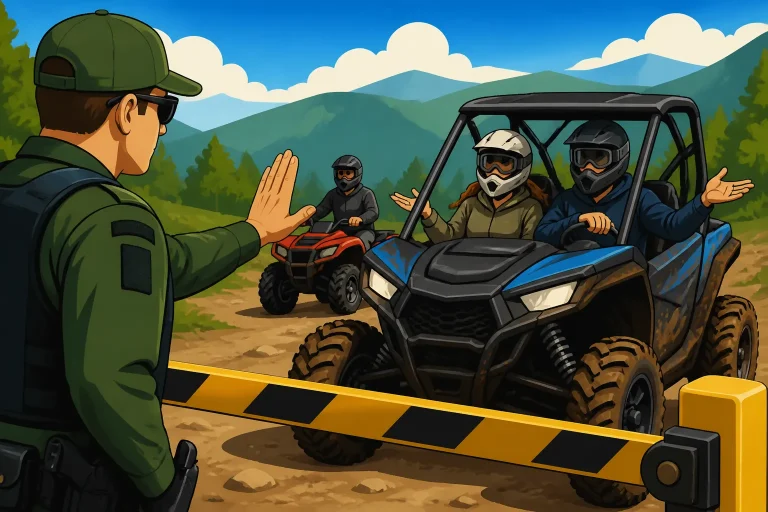
A gate or cable is a strong signal to stop. Do not drive around, under, or through a barrier to reach a road that appears open farther ahead. Arkansas WMA Gated and Cabled Barriers covers why a visible track beyond a barrier is not a reliable indication that the route is available.
The same caution applies to levees, dams, food plots, fire lanes, and wildlife openings. These features may look like convenient shortcuts or wide, level routes, but their appearance does not make them public riding areas. Confirm the rules for each feature rather than treating all maintained ground as a road. See Arkansas WMA Levees and Dams Are Closed and Arkansas WMA Food Plots and Fire Lanes for more on these common problem areas.
Avoid making your own detour around mud, erosion, a fallen tree, or a blocked section. Going around an obstacle can take you onto ground that is closed or sensitive. If a route is impassable, turn back or contact the managing office for advice instead of widening the trail.
Hunting exceptions are narrow
Some WMA rules may allow particular vehicle use for a limited hunting-related purpose. An exception should not be read as general recreational permission. Check whether it applies to your activity, the dates involved, the route, and the specific machine. If the rule allows travel to or from a camp, for example, do not assume it also allows trail riding or unrestricted scouting.
Keep any required proof of authorization with you, and be ready to explain why you are using the route. If the applicable exception is unclear, ask the agency responsible for that WMA before riding. Arkansas Hunting Season and Trail Access provides useful context for planning around seasonal access.
Registration, Permits, and Other Paperwork
A state ATV registration, a forest OHV permit, a hunting license, and permission to ride on a WMA are different things. Having one does not automatically provide the others. Check each requirement separately.
Arkansas ATV registration is a state requirement for covered machines, but registration does not open a closed WMA road or grant permission to ride off-road. If you need to confirm whether your quad must be registered, start with Who Must Register an ATV in Arkansas. For the basics of the registration system, see Arkansas ATV Registration: One Time, Never Renewed.
Likewise, do not confuse a WMA with a national forest riding area. Forest OHV permits apply to designated forest riding locations under their own rules; they do not replace WMA access rules. Arkansas OHV Permits: Two Forests, Two Prices explains the separate forest-permit system. If your plans include both a WMA and a forest trail system, check the requirements for each location and carry the documents each one requires.
Your checklist may include:
- The current WMA regulations and map for the exact area
- Confirmation that the route is open to your type of machine
- Required state registration or other machine documentation
- Any hunting, camping, or access authorization that applies to your trip
- Any separate permit required for a different riding area on the itinerary
- A phone or printed copy of the rules, in case cellular service is limited
Keep paperwork accessible rather than packed where it cannot be reached on the trail. A photo of a document may be useful for your records, but do not assume that a digital copy is accepted in place of a document or permit that must be displayed or carried. Follow the instructions from the agency issuing it.
A Practical Check Before You Unload
A short check before riding can prevent a long detour or an avoidable violation. Use the exact WMA name when looking up rules; nearby public lands may have different managers and restrictions.
- Identify the land manager. Confirm that the place is the WMA you think it is, rather than a nearby national forest, state forest, leased property, or private tract.
- Read the current area rules. Look for vehicle and ATV language, seasonal dates, hunting-related exceptions, and any special restrictions.
- Confirm the route. Check the current map and road status. Do not rely only on tire tracks, online directions, or what another rider says.
- Check barriers and signs at the site. A gate, cable, closure notice, or posted restriction can change what you may do, even if a route appeared open on an older map.
- Match your paperwork to the location. Carry the registration and any other documents or permissions that apply, but remember that paperwork does not override a closure.
- Ask before relying on an exception. If a rule is ambiguous, contact the managing agency and describe the intended route, activity, and dates.
- Have a backup plan. Choose another legal route or riding area in case the WMA road is closed or conditions have changed.
If the WMA has a special permit or access program, check who it covers and where it is valid. In particular, leased-land arrangements may not apply to every WMA or to every route. Arkansas Leased Lands Permit WMAs is a useful starting point for understanding why the land status and permit scope matter.
The key is to treat WMA riding as route-specific access, not general permission to explore. Confirm the area’s current rules, stay on routes open to your quad, and respect closures even when an alternate path looks easy. When you cannot verify that a road is open, do not ride it.
Disclaimer
This article is for general informational purposes only and does not constitute professional advice. Laws, prices and regulations vary by location and change over time. Consult a qualified professional for guidance on your specific situation.