Arkansas WMA Riding on Open Roads
Riding an ATV or UTV on an Arkansas Wildlife Management Area can be confusing: a road may look usable without being open to your machine. The key is to confirm both the road’s access status and the rules that apply to your vehicle, purpose, and WMA before unloading. Here’s how to check those details and avoid treating a gate, map, or registration decal as permission to ride.
What “Open Road” Means on an Arkansas WMA
On a Wildlife Management Area, an open road is a route the public may use for vehicle travel under the area’s rules. It does not automatically mean every type of vehicle is allowed, or that the route is open to ATVs and UTVs for every purpose. The WMA’s current regulations, signs, barriers, and any seasonal restrictions still matter.
This distinction is easy to miss because an open gravel road can look much like a closed forest road. A track that appears well used, or one shown on an older map, is not reliable proof of current access. Likewise, a road that is open to a pickup or car may have separate restrictions for off-highway vehicles.
Think of “open” as one part of the check, not the whole answer. You need to establish:
- Whether the route is open to public motor-vehicle traffic.
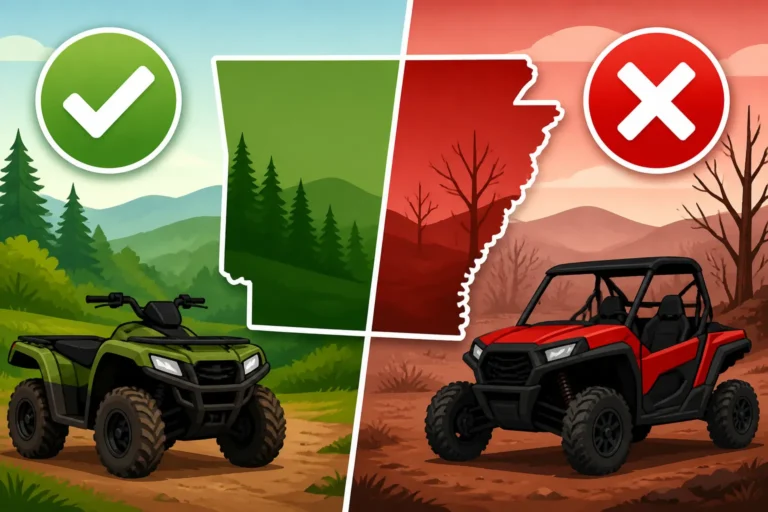
- Whether an ATV or UTV is allowed on that route.
- Whether your reason for riding is permitted there.
- Whether seasonal, hunting-related, or area-specific restrictions apply.
- Whether you need a permit for that particular WMA or type of access.
The area-specific details are important. Rules can differ between WMAs, and restrictions may change with conditions or management needs. For the broader framework, see Arkansas WMA Vehicle Rules in Plain English and Open Access Roads and What They Mean.
Open roads are not the same as trails
A road open to vehicles is not automatically an ATV trail. Riding beyond the road onto a game trail, fire lane, field, food plot, levee, or other route can be prohibited even if it seems like a natural extension of the trip. Stay on the route the rules identify as open.
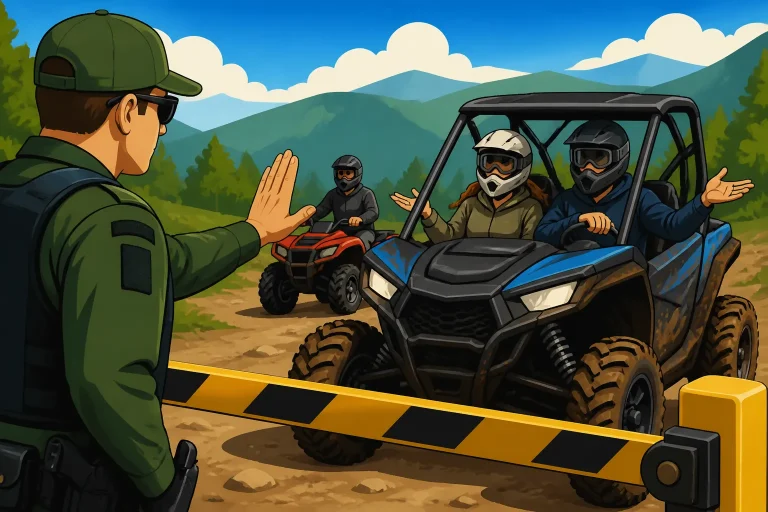
The same applies to a road that ends at a barrier. A gap around a gate, a washed-out section, or tire tracks beyond a cable do not make the closed portion legal to ride. The barrier is a clear signal to stop and check the official information rather than finding another way around.
Road access does not override road-use law
WMA access rules and Arkansas road laws are separate questions. A WMA may identify a road as open to public vehicle traffic, but that designation should not be read as a blanket exemption from state rules governing ATV and UTV use on roads. The machine’s registration, required equipment, the road’s legal status, and the purpose of the trip can all affect whether travel is allowed.
If a route connects to a public road, do not assume you may ride there simply because it leads to an open WMA road. Check the applicable road rules and local restrictions before using that connection. Arkansas ATV Road Rules: What 27-21-106 Says explains the state-level road-use issue, while Arkansas WMA Roads Open to Vehicles focuses on WMA access.
How to Confirm a Road Is Open to Your ATV or UTV
Use current official information for the specific WMA, then compare it with what you see at the entrance and along the route. No single clue should carry the whole decision. A map can be outdated, and a sign may describe only one part of the restriction.
A practical check looks like this:
- Identify the exact WMA. Make sure you have the right area name and entrance. A road can cross property boundaries or lead from one management area into another, where different rules apply.
- Check current AGFC WMA information. Look for area-specific vehicle rules, maps, seasonal notices, and any special hunting-access provisions. Confirm details close to your ride, especially during hunting seasons or after storms.
- Look for the road’s status on the current map. Distinguish roads open to vehicle traffic from closed roads, trails, and routes restricted to particular uses. If the map legend is unclear, don’t guess.
- Read signs at the entrance. Observe posted restrictions, dates, vehicle limitations, and instructions about gates or barriers. A sign at the road can narrow or clarify what the map shows.
- Check the vehicle and purpose rules. Confirm whether your ATV or UTV is allowed and whether the rules differ for hunting access, general recreation, or travel to and from a camp.
- Stop when information conflicts. If a map suggests the road is open but a sign says closed, follow the restriction and contact the responsible office for clarification before riding.
The word “road” on a map can mean different things. Some maps show routes for orientation without indicating that all routes are open to every motor vehicle. Look for the legend and the specific symbols or notes that explain which roads are accessible.
| What you see | What it tells you | What to do |
|---|---|---|
| A route marked open for public vehicle use | The route may be available for vehicle travel, subject to other rules | Confirm ATV or UTV access, purpose restrictions, and current signs |
| A gate, cable, or posted closure | The route is restricted beyond that point unless official instructions say otherwise | Do not go around it; check the area rules |
| An old map or an unmarked track | Access status is uncertain | Find current official information before riding |
| A road open to cars or trucks | The road is open to some public traffic | Do not assume this alone allows an ATV or UTV |
| A road leading toward a food plot, levee, or fire lane | The route may pass near a separately restricted feature | Stay on the authorized road and check specific restrictions |
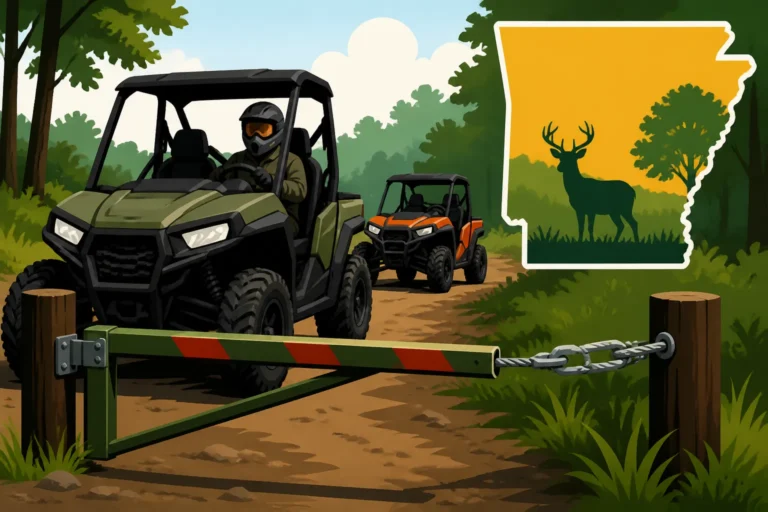
Gates and cables are particularly important. They can mark a closed road even when the ground beyond them is dry, smooth, and clearly traveled. For more on interpreting these barriers, see Arkansas WMA Gated and Cabled Barriers. Separate restrictions may also apply to food plots and fire lanes, covered in Arkansas WMA Food Plots and Fire Lanes.
Permits, Registration, and Hunting Access
An ATV registration decal, a forest OHV permit, and permission to ride on a WMA are not interchangeable. Each answers a different question. Registration concerns the machine under Arkansas’s registration rules; a forest permit applies to the relevant forest riding area; and WMA access depends on the rules for that management area.
That means a machine can be properly registered and still be prohibited on a particular WMA road. A permit for riding in one forest does not, by itself, grant access to a Wildlife Management Area. Before the trip, verify the requirements that apply to the location you plan to use rather than relying on a decal or pass you already have.
Some WMAs have special access provisions connected to hunting, leased lands, or travel to and from a hunting camp. Those provisions should not be treated as general recreational permission. They may depend on the specific area, the season, the rider’s activity, and the route. Check the current WMA rules for any named exception and follow its limits closely. For context, see Arkansas WMAs Where Hunters May Ride and Arkansas Leased Lands Permit WMAs.
A hunting trip does not make every route accessible. If the rules allow vehicle travel for a defined hunting purpose, that does not necessarily authorize a recreational loop, a shortcut across a closed road, or off-road travel to reach a stand. The allowed purpose and route matter.
Before you go, confirm these points:
- Whether the WMA requires a specific permit or authorization for the access you plan to use.
- Whether a permit applies to the WMA, the machine, the rider, or a particular kind of activity.
- Whether hunting access is limited to certain dates, routes, or travel to and from camp.
- Whether passengers, vehicle size, or other machine features affect access.
- Whether the WMA’s rules add restrictions beyond general registration requirements.
If you are unsure whether a permit applies, ask the agency or office responsible for that WMA and describe your planned route and purpose. A general question such as “Are ATVs allowed?” may not get a useful answer if access is limited to certain roads or activities. Ask about the specific road, date, machine, and reason for travel.
A Safer Plan for Riding WMA Roads
A little preparation can prevent a long drive to an entrance where the route is closed or your machine is not allowed. Save the current WMA map or rules for offline use if cell service may be unreliable. Then plan a route that stays on clearly authorized roads, with a backup plan that does not depend on crossing a gate or taking an unmarked track.
At the entrance, take time to read the posted information before unloading. Check for temporary closures and instructions that may not appear on a map. If the route is blocked, do not lift a cable, move a barrier, or use a path around it. Turn around and use an authorized route instead.
During the ride, stay on the road and avoid widening it by driving around mud, puddles, or fallen limbs. Riding around an obstacle can create a new track and may take you into an area closed to vehicles. If a road becomes impassable, turn back rather than continuing cross-country.
A practical pre-ride checklist:
- Confirm the WMA name and entrance.
- Review the current road map and its legend.
- Check area-specific restrictions and seasonal notices.
- Verify that your vehicle and riding purpose are allowed.
- Confirm permit or authorization requirements.
- Carry any required documentation and keep the machine’s registration information accessible.
- Follow signs and barriers, even if they differ from older maps.
- Have an alternate legal route or a different riding location in mind.
If you cannot confirm that a road is open to your vehicle, do not use it until you have checked with the responsible office. That is especially important when the route is unmarked, a barrier has been moved, or hunting access appears to be the only applicable exception. Arkansas WMA Access for a Quad can help with the vehicle-specific side of the question, but the current rules for the individual WMA remain the final check.
The useful rule of thumb is simple: an open road designation is not a free pass for every vehicle, purpose, or season. Confirm the route, machine, activity, and any permit requirements together. Then stay on the authorized road and treat closures as firm boundaries.
Disclaimer
This article is for general informational purposes only and does not constitute professional advice. Laws, prices and regulations vary by location and change over time. Consult a qualified professional for guidance on your specific situation.