Arkansas WMAs That Allow ATVs and Those That Do Not
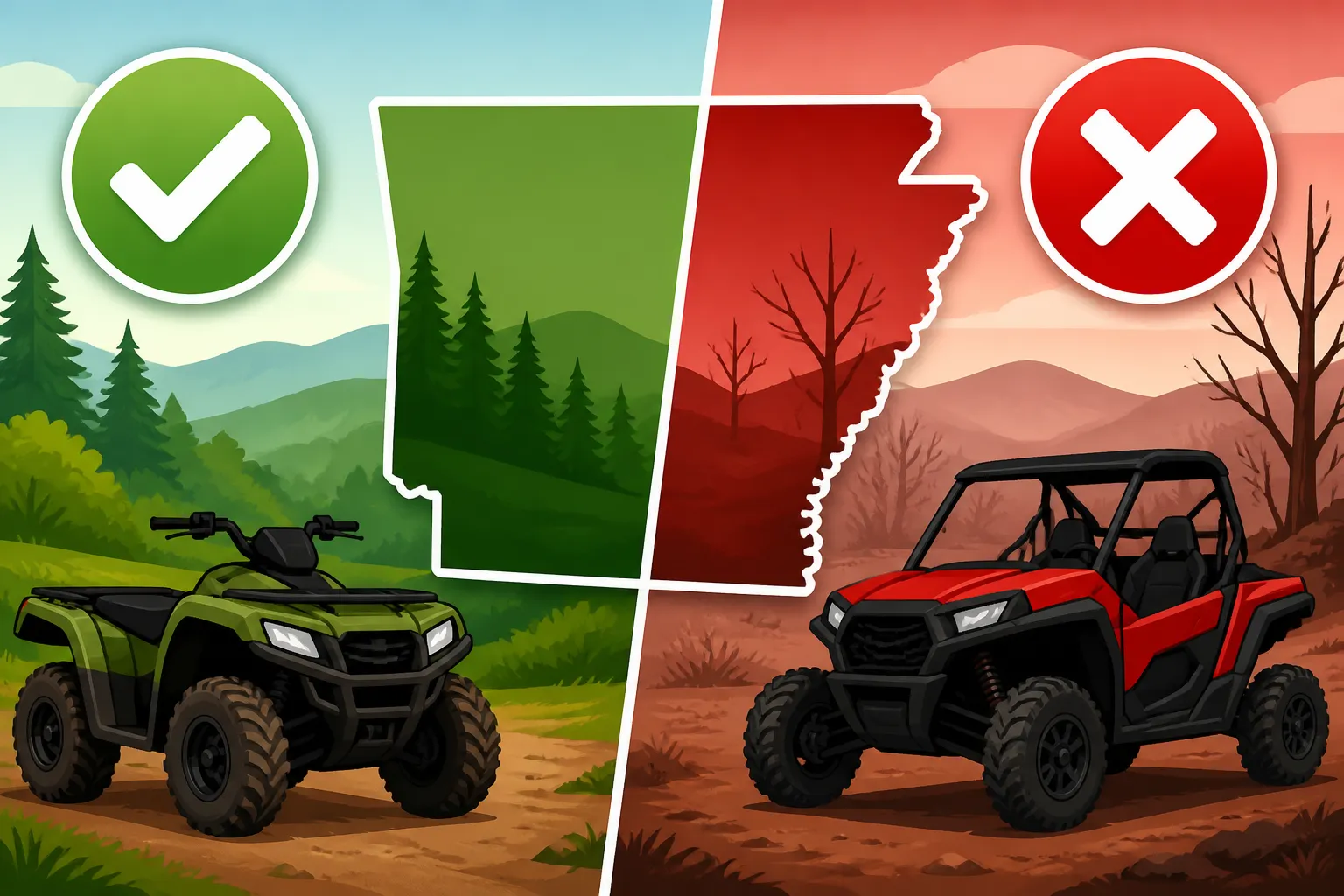
Arkansas WMA access is not a statewide yes-or-no rule. Some wildlife management areas identify roads or situations where ATVs may be used; others prohibit them or close routes to motor vehicles. Before you unload, check the rules for the exact WMA, the route and the season. This guide explains how to tell what is allowed and which permits do, and do not, give you access.
The Short Answer: Permission Is Specific to the WMA and Route
An ATV registration decal, a forest OHV permit or permission to hunt does not automatically authorize riding on every Arkansas WMA. The controlling question is whether the current rules expressly allow your machine to travel on that WMA’s particular route at that time.
Some WMAs have limited vehicle access on designated roads or under specific hunting-related conditions. Other roads may be closed by gates, cables, signs or seasonal restrictions. A road that appears on a map—or that you have driven before—may not be open to your ATV now.
Use this as a starting point, not as permission to ride:
| WMA or access situation | What to assume before checking the current rules |
|---|---|
| A WMA listed in an ATV or vehicle-use exception | Riding may be allowed only on specified roads, during stated dates or for a stated purpose. Confirm the details. |
| A WMA with a leased-lands permit requirement | The permit may provide access under that program’s rules; it does not necessarily open every road or authorize off-road riding. |
| Hot Springs State Forest WMA | Treat ATV access as prohibited unless current official rules clearly state otherwise. |
| A gated, cable-barred or signed-closed route | Do not ride through or around the closure, even if the route appears on a map. |
| A WMA with no express ATV authorization | Do not assume ATVs are allowed. Find a current written rule that applies to that area and route before riding. |
The named exceptions matter. If a WMA is on an official exception list, that does not turn the whole area into an off-road park. The authorization may apply only to certain roads, dates, vehicles or activities. Likewise, a route open to ordinary road traffic is not automatically open to ATVs.
For a practical overview of how these restrictions fit together, see Arkansas AGFC WMA Rules for Riders and Arkansas WMA Vehicle Rules in Plain English. The key habit is to verify the exact area and route instead of relying on a rule that applied somewhere else.
How to Check Whether a WMA Allows ATVs
Arkansas WMA rules can vary by property and by season. A reliable check takes a few minutes, but it should answer more than “Is this WMA open?” You need to establish whether your machine may use the specific road you plan to ride, during the dates you will be there, for the purpose you have in mind.
Start with the exact property name
First, confirm the official name of the WMA. Similar names, adjoining properties and nearby state or national forest land can make it easy to read the wrong set of rules. Use the property name shown on the official map or regulations, not only the name people use locally.
If the WMA includes multiple access points, note the trailhead or road entrance you plan to use. A road may enter an area from one side and encounter a gate, closure or boundary on the other. A route that looks continuous on a phone map can cross into a different management area.
Look for an express vehicle rule
Search the current official WMA regulations for terms such as ATV, all-terrain vehicle, off-highway vehicle, motor vehicle, designated road, closed road and travel to or from camp. Read the full rule, including any conditions and exceptions. A short line on a map or an old forum post may omit the limitation that matters.
Pay attention to whether the rule describes:
- A whole WMA or only a named route
- A particular season or date range
- A particular reason for travel, such as access to a hunting camp
- A specific vehicle type or width
- A permit, license or other requirement
- A prohibition on leaving the road
If the language is unclear, do not fill in the gap with an assumption. Ask the managing agency or the WMA office which rule applies to your planned route. Keep a record of the answer and check again before your trip, since temporary closures and updated regulations can change access.
Confirm the route on the ground
The written regulation tells you what may be allowed; signs and barriers help show where access ends. Check the latest official map and look for closures at the entrance. A gate or cable is not a suggestion to find another way around. It can mark a boundary, a closed road, a sensitive habitat or a route that is closed for management work.
For more detail on what to do when a road is blocked, see Arkansas WMA Gated and Cabled Barriers. Also review Arkansas WMA Roads Open to Vehicles. “Open road” is not a synonym for “open to ATVs everywhere,” and permission to use a designated road does not usually mean permission to ride across fields, food plots or timber.
Separate permanent rules from temporary closures
A WMA may have a general vehicle rule and still close a road temporarily. Weather damage, habitat work, fire danger, road maintenance or hunting management can affect access. Check for current notices shortly before leaving, not only when you plan the trip.
This matters especially when a route is muddy or flooded. A road that is technically open may still be unsafe or easily damaged. If conditions make it necessary to ride around a wet spot, you could leave the permitted route and cause damage—or violate the access rule.
WMAs That Allow ATV Use: Read the Exception, Not Just the Name
Some Arkansas WMAs allow limited ATV use under specific exceptions. The important word is limited. A WMA’s inclusion in an exception does not, by itself, establish that every machine, road, date or type of riding is allowed.
The safest way to identify the areas that allow riding is to check the current official exception list and then read the individual conditions attached to the WMA. For a focused explanation of how that list works, see Arkansas WMAs Named in the Exception List. Do not rely on a list copied into a social media post or an old map unless you can confirm it is still current.
Designated roads are not open riding areas
When a regulation permits ATVs on designated roads, stay on those roads. That permission does not normally authorize riding through woods, across a field, over a levee or around a barrier. A road can also have a narrower vehicle rule than the WMA as a whole.
Before you go, identify the route you intend to use and the point where the permitted travel ends. If the written rule refers to a designated road but the map does not clearly show it, ask the managing agency to identify the route. A GPS line, a worn track or tire marks from another rider do not establish legal access.
Hunting access has its own limits
A rider may be allowed to use an ATV for a defined hunting-related purpose in a particular place, but that does not mean the machine is permitted for recreational trail riding. Conditions can include when the trip occurs, where the vehicle can travel, how it must be operated and whether the machine may be used only to reach a camp or other authorized location.
Do not treat “I’m hunting” as a general pass to ride. Verify that the specific WMA rule covers the trip you intend to make. A hunting license or a lease agreement does not automatically override vehicle restrictions. For related details, read [Arkansas Hunting License and Quad Access] and Travel To and From a Hunting Camp.
Leased land is a separate access question
Some Arkansas areas operate under leased-lands or other permit arrangements. A permit may provide access to designated land or roads under that program’s rules, but it is not the same thing as blanket authorization to ride anywhere on a WMA. The permit may also apply only to certain activities, dates or routes.
Check whether the parcel is actually covered by the permit you hold, and whether ATV travel is included. If a property is part of a leased-land program, use the program’s current maps and rules rather than assuming that the word “permit” means unrestricted motorized access. Arkansas Leased Lands Permit WMAs explains why that distinction matters.
Verify the exception for your particular machine
Even when an area allows some ATV use, a machine may not qualify for every route. Width limits, vehicle definitions, road conditions and local restrictions can all matter. A large side-by-side may not fit through a narrow gate or may be excluded from a route that is open to smaller ATVs.
Check the exact vehicle category used in the rule. If it says ATV, do not assume that a UTV or side-by-side is included. If the machine is close to a width limit, measure it as directed by the relevant rule rather than estimating from the brochure. A machine’s registration category does not settle the question of which WMA roads it may use.
WMAs and Routes Where You Should Not Ride
The practical rule is simple: if the applicable regulation does not authorize ATV use, do not ride there. You should not have to guess whether an open-looking track is legal. If you cannot find a current rule that allows your planned access, choose a confirmed legal riding area instead.
Hot Springs State Forest WMA
Hot Springs State Forest WMA is identified in the reference materials as an area where ATVs are banned. Treat that as a no-ATV area unless current official rules clearly establish a change or a specific exception. Do not assume a nearby trail, forest road or private park’s rules extend into the WMA.
This is a useful reminder that state forest land, a WMA and a designated OHV trail system can be close together while operating under different access rules. Confirm the land boundary and the managing agency before riding.
Closed roads, barriers and signed areas
A road closed by a gate, cable or posted sign is not a route to use just because it is visible on a map. Do not bypass a barrier by riding through vegetation, around its end or across adjacent land. The closure can apply even if the road is open to another type of use or was accessible during a previous visit.
Also avoid routes closed to motor vehicles, wildlife openings, food plots, fire lanes, levees and dams unless the current rule expressly says otherwise. See Arkansas WMA Food Plots and Fire Lanes and Arkansas WMA Levees and Dams Are Closed. A track on the ground does not prove that riding on it is permitted.
Do not confuse a public road with an open trail
A county road or other public route may cross or border a WMA. That does not make the surrounding land open to riding. Stay on the road you are authorized to use and observe the rules that apply to it. Do not pull off into the WMA for a shortcut, photo stop or campsite unless that use is allowed.
The reverse can also happen: a road may look like a public route but be a management road that is closed to the public or restricted to certain users. Check the sign at the entrance and the official map. If the road status is uncertain, stop and verify rather than riding farther in.
Private permission does not replace WMA rules
A landowner or hunting-club member may give you permission to use private property. That permission only applies to the land they control. It does not extend across a WMA or public road, and it does not cancel the WMA’s restrictions. Before following a route across several parcels, confirm who manages each segment and what rules apply.
A lease can also have terms beyond the state’s general rules. The person who invited you may know the property, but ask specifically whether ATV access is permitted and where. If the route crosses public land, confirm that portion separately.
Permits, Registration and Reciprocity: What Each One Does
A common source of trouble is having one valid document and assuming it covers every part of the trip. Arkansas ATV access can involve separate rules for machine registration, public-land permits, WMA entry and trail-system use. One does not automatically replace the others.
State ATV registration is not WMA permission
An Arkansas registration decal may satisfy a registration requirement, but it does not open a closed WMA road or authorize off-road use. Registration is about the machine’s administrative status. The WMA rule controls where and when you may ride on that property.
Likewise, an out-of-state registration or decal does not grant access to an Arkansas WMA. It may help establish that your machine is registered where you live, but local property rules still apply. See Arkansas Rules for an Out-of-State UTV and Arkansas Rules for a Visiting Missouri Rider for the broader distinction between a visitor’s machine and Arkansas access rules.
Forest OHV permits are not WMA permits
Arkansas riders may encounter separate OHV permit requirements for national forest riding areas. Those permits apply to the specified forest system and routes under that program. They do not create an ATV exception on a WMA or authorize you to cross onto land managed under another rule set.
This is especially important when a ride combines public roads, forest trails and WMA land. You may need different permissions for different portions—or need to avoid a section entirely. Review Arkansas Riders Need Two Different Forest Passes if your plans include forest trail systems, and then check WMA rules separately.
Out-of-state riders should not assume reciprocity
A home-state registration, permit or trail pass does not automatically transfer to an Arkansas WMA. Reciprocity, where it applies, is specific to the document and jurisdiction involved. It does not turn a closed route into an open one.
If you are visiting, check three things before loading the machine:
- Whether your machine’s registration or documentation is acceptable for your circumstances in Arkansas.
- Whether any separate permit is required for the land or trail system you plan to use.
- Whether the WMA specifically allows your vehicle on the selected route and on your travel dates.
If the trip includes more than one managed area, check each one. A permit issued for one forest or trail system should not be assumed to cover another.
Hunting licenses and WMA access are not interchangeable
A hunting license may authorize hunting activity under the applicable rules. It does not necessarily grant permission to drive an ATV on a WMA. Similarly, access to a hunting area does not necessarily include access by motor vehicle.
Read the vehicle rule alongside the hunting rule. Confirm any limits on travel to a camp, dates, road choice or purpose. If your plans combine hunting and riding, treat each activity as a separate permission question.
Plan a WMA ATV Trip Without Guesswork
A little preparation can prevent a wasted drive, an awkward stop at a gate or an avoidable citation. Use this process for each WMA you plan to visit, even if you have ridden in the area before.
- Write down the official WMA name and entrance. Make sure your map and directions refer to the same property.
- Find the current official WMA rules. Look specifically for ATV, UTV, motor vehicle, designated-road and seasonal language.
- Check the exception and its conditions. Confirm that the rule applies to your machine, reason for travel and dates.
- Trace the route. Identify where the permitted road starts and ends, and note any connecting roads or boundaries.
- Check closures shortly before departure. Look for current notices and be prepared to change plans if a road is closed.
- Confirm the permit requirements for each property. Keep WMA access, forest OHV permits and machine registration separate in your notes.
- Carry the documents you may need. Keep relevant permits and registration information accessible, along with a map or screenshot of the approved route.
- Follow signs and barriers on arrival. If a closure conflicts with your plan, turn around. Do not improvise a bypass.
- Stay on the authorized route. Avoid shortcuts, side tracks and off-road detours unless the rules explicitly allow them.
- Recheck before a later visit. Do not assume the rule or the road condition will be unchanged next weekend or next season.
A useful pre-trip note can be short: WMA name, permitted route, allowed dates, permit needed, closure contact and backup riding area. Keep a paper copy or save the official information offline if cell service may be poor.
Pack for a legal, low-impact ride
The right gear does not make an unauthorized route legal, but good preparation helps you stay on the approved route and handle minor problems without damaging the property. A map or offline navigation device is useful; a phone-only plan can fail when service drops. A waterproof map sleeve, tire gauge and basic repair supplies are practical items that riders can find through retailers such as Amazon, but choose equipment that fits your machine and riding conditions.
If you use your phone for navigation, download the relevant map before leaving service. Mark the entrance and turnaround point so you are not tempted to follow an uncertain track. Amazon may be one place to find a durable phone mount or weather-resistant case, but test the setup before the trip and make sure it does not block your controls or view.
Bring water, a first-aid kit and the tools needed for a small repair. In remote areas, a delayed return can become more than an inconvenience. A paper map is a sensible backup even when you carry GPS. Amazon listings can also be a source for compact map cases, but verify the dimensions and whether the case can be secured safely on your machine.
Be ready to change plans
A gate closure or a new notice can make a planned route unavailable. Have a legal alternative ready, such as a confirmed trail system or private riding area. Do not respond to a closed route by wandering onto adjacent land or continuing along a track that is not clearly open.
Weather matters too. A road that is open in dry conditions may become unsafe or vulnerable to damage after heavy rain. If your machine begins to rut the surface, stop rather than making the problem worse. A route may be legally open and still be a poor choice in current conditions.
Common Mistakes That Lead to WMA Access Problems
The rules are easier to follow when you know where riders tend to make assumptions. These errors can happen even to experienced owners, especially when a group ride crosses several kinds of public land.
Treating “open to the public” as “open to ATVs”
A WMA may be open for hunting, wildlife viewing or other public uses while restricting motor vehicles. Public access does not mean every activity or vehicle is allowed. Check the motor-vehicle rule separately.
Relying on an old map or a friend’s memory
A friend may have ridden a route in a different season, under an exception that no longer applies, or on land managed by a different agency. Maps can also show roads without showing whether ATVs are permitted. Confirm current rules from the responsible agency.
Assuming a permit means unrestricted access
A permit may be required for a particular program or area, but that does not mean it allows riding on every road. Read the scope of the permit and the property rules. If it does not clearly cover the route, ask before you ride.
Following tracks around a barrier
Tire marks are not authorization. Riders may have crossed illegally, or the route may have been open before it was closed. A barrier is a clear reason to stop and check.
Using the wrong vehicle category
ATV, UTV, side-by-side and other off-highway vehicle terms are not interchangeable in every rule. If a provision names one category, do not presume it includes another. Ask the agency if the wording does not clearly cover your machine.
Assuming a hunting purpose is enough
The fact that you are headed to a deer stand or camp does not automatically establish that ATV travel is allowed. Look for a specific rule for that WMA and activity. Observe any limits on roads, dates and destinations.
Confusing WMA rules with state-road rules
A road-use exception under Arkansas traffic law is not an all-purpose permission to ride on WMA property. Likewise, WMA access does not automatically make an ATV legal on every public road. Property access and road legality are separate questions.
Riding off route to avoid mud or a narrow section
A detour around a puddle, gate or difficult stretch can put you on closed land. If the authorized route is impassable, turn back or use a permitted alternative. Protecting the road and habitat is part of responsible access.
A Simple Rule for Deciding Where to Ride
For Arkansas WMAs, look for affirmative permission tied to the exact area and route. A general assumption that “ATVs are allowed on WMAs” is not enough, and a permit or registration document does not fill the gap.
The areas to treat as potentially open are those named in current official exceptions, subject to their individual limits. The areas to treat as closed are those with an express ban, a closed route, a barrier or no clear authorization. Hot Springs State Forest WMA is identified as a no-ATV area; check current official materials before making any plan there.
Before you unload, be able to answer four questions: Is this the correct WMA? Does a current rule allow my type of machine? Is this specific route open on these dates? Do I have every separate permit the area requires? If you cannot answer one of them, pause and verify. That small check is better than relying on a guess once you are already on the property.
Disclaimer
This article is for general informational purposes only and does not constitute professional advice. Laws, prices and regulations vary by location and change over time. Consult a qualified professional for guidance on your specific situation.