Arkansas Registration for a Golf Cart
It’s easy to get confused when you start looking into the rules for riding off-road vehicles in Arkansas. With specific state-level registration requirements for ATVs and UTVs, many golf cart owners wonder if their trusty cart needs the same treatment. The good news is, golf carts operate under a distinctly different set of rules than their off-road cousins. This guide is here to untangle that confusion and walk you through exactly what "registration" means for your golf cart in the Natural State, focusing on local ordinances rather than state-mandated processes.
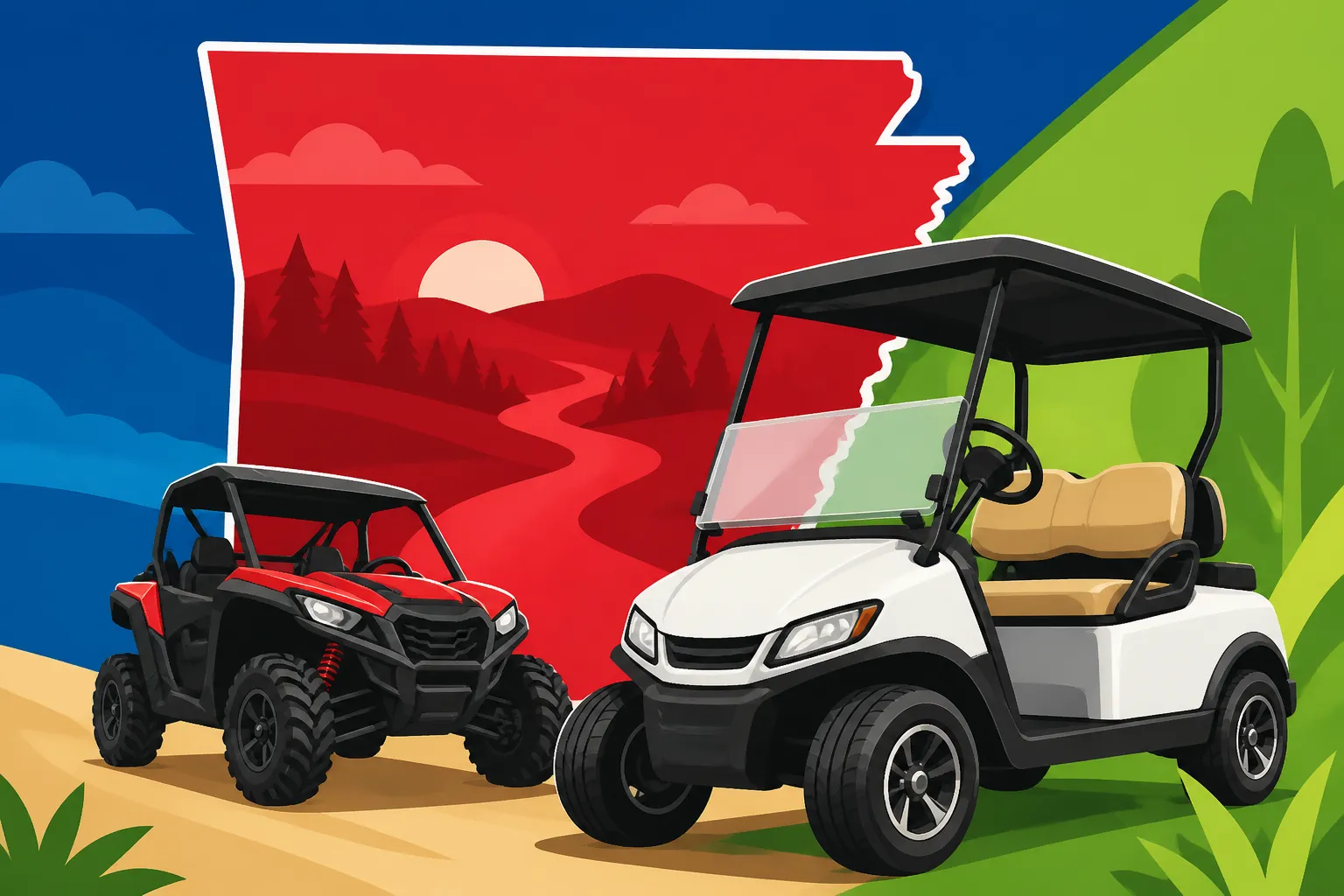
The Core Difference: Golf Carts Are Not ATVs or UTVs in Arkansas
One of the biggest sources of confusion for folks in Arkansas is assuming that all types of small, motorized recreational vehicles fall under the same umbrella of state registration requirements. This simply isn't the case. While you absolutely have to register an ATV or a UTV with the Department of Finance and Administration (DFA) for legal off-road use, golf carts exist in their own separate category, largely governed by local rules. It's a critical distinction to understand from the outset.
Why the Distinction Matters for Registration
When you're dealing with an ATV or a side-by-side, the state of Arkansas has a very clear process. You'll head to a Revenue Office, fill out [Arkansas DFA Form 10-381 Explained], pay a fee, and receive a permanent decal. This decal signifies that your machine is registered for off-highway use across the state, and you only do it once because [Arkansas ATV Registration Has No Annual Renewal]. For golf carts, this state-level registration process doesn't exist. You won't be visiting the Revenue Office with your golf cart title or bill of sale hoping to get a decal.
The reason for this lies in their fundamental design and intended use. ATVs and UTVs are built for rugged terrain, higher speeds, and more demanding off-road conditions. Golf carts, on the other hand, are typically designed for lower speeds, paved or groomed surfaces, and specific environments like golf courses, gated communities, or large private properties. This difference in design and purpose dictates how each type of vehicle is regulated, leading to a completely different approach to "registration."
Where Golf Cart Rules Originate
Instead of a statewide mandate from the Arkansas DFA, the regulatory power for golf carts primarily rests with local city and county governments. This means that if you live in Fayetteville, the rules for your golf cart might be entirely different than if you live in Hot Springs or a small, unincorporated community. This local control stems from state statute [Arkansas Golf Cart Ordinances Under 14-54-1410], which specifically empowers cities and towns to enact ordinances concerning golf cart operation on public streets.
Because of this, there's no single "Arkansas golf cart registration law" that applies uniformly across the entire state. Each municipality can decide if and how golf carts can be operated on its public roads. This hyper-local approach means that the most important first step for any golf cart owner is to investigate the specific rules of their city or town, rather than searching for a statewide agency to register with. This can be a bit frustrating if you're used to a more streamlined process for other vehicles, but it's crucial for staying on the right side of the law with your golf cart.
Navigating Local Golf Cart Ordinances
Since state registration doesn't apply to golf carts in the same way it does for ATVs and UTVs, your primary focus as a golf cart owner in Arkansas needs to be on understanding and complying with local ordinances. This is where the rubber meets the road, so to speak, for getting your golf cart legally onto any public streets in your community.
How Cities Create Golf Cart Rules
Arkansas cities and towns have the authority to create their own rules for golf carts, and they do this by passing local ordinances. These ordinances are like mini-laws specific to that municipality, and they can cover a wide range of requirements and restrictions. It's not uncommon for these rules to vary dramatically from one town to the next, reflecting the unique character and needs of each community. For example, a small, rural town might have very relaxed rules, while a denser urban area might have stricter requirements or even outright bans on golf carts on public roads.
These local ordinances often specify things like:
- Allowed Streets: Which streets, if any, are permissible for golf cart use (often limited to those with speed limits under a certain threshold, like 25 mph or 35 mph).
- Equipment Requirements: What safety equipment your golf cart must have, such as headlights, taillights, brake lights, turn signals, seat belts, mirrors, and even windshields.
- Driver Qualifications: The minimum age of the operator (typically 16 with a valid driver's license), similar to rules for a [Arkansas Street UTV Driver's License at 16].
- Operating Hours: Whether golf carts can be operated after dark.
- Insurance: Proof of liability insurance for the golf cart.
- Permit Fees: An annual or one-time fee to obtain a local street permit.
- Display: How and where the local permit sticker must be displayed on the cart.
Because of this patchwork of regulations, the single most important piece of advice is: do not assume that what's legal in one Arkansas city is legal in another. Always verify the rules for your specific location.
Common Requirements for Street-Legal Golf Carts (If Permitted)
If your city does allow golf carts on certain public streets, you can generally expect a list of safety equipment mandates designed to bring these low-speed vehicles closer to street-legal standards. While an ATV might only need a state decal for off-road use, a golf cart venturing onto city streets will need more.
Typical requirements for a street-legal golf cart in an Arkansas town might include:
- Lights: Headlights, taillights, and brake lights are almost always required, especially for any operation after dusk.
- Signals: Turn signals, just like a car, are common.
- Mirrors: A rearview mirror, and sometimes side mirrors, to improve visibility.
- Safety Belts: Seat belts for all occupants, even if the cart wasn't originally equipped with them.
- Horn: A working horn for signaling.
- Windshield: A windshield, often made of safety glass.
- Speed Limitations: Some ordinances might require the cart to be capable of a minimum speed for traffic flow but not exceed a maximum speed, usually around 20-25 mph.
Beyond the equipment, you'll also likely need to obtain a local permit. This usually involves an application process, an inspection of your golf cart to ensure it meets all equipment requirements, and payment of an annual fee. This permit, not a state registration, is what legally allows you to operate on specified city streets. It's a system that closely mirrors how [Arkansas Local Permits for Street UTVs] work in some towns.
Here’s a quick comparison to highlight the difference:
| Feature | Arkansas ATV/UTV (Off-Highway Use) | Arkansas Golf Cart (Street Use, if allowed) |
|---|---|---|
| Governing Body | State (DFA, Revenue Offices) | Local (City/County Ordinances) |
| "Registration" | State-issued permanent decal | Local street permit (annual or one-time) |
| Fee Structure | One-time state fee | Annual local permit fee |
| Equipment | Spark arrestor, sound limits | Headlights, taillights, turn signals, mirrors, horn, seatbelts |
| Renewal | None (permanent decal) | Annual renewal for local permit often required |
| Driver Age | Varies by trail/landowner, some state guidelines for youth | Typically 16 with a valid driver's license |
What This Means for "Registration"
When we talk about "Arkansas registration for a golf cart," it's crucial to clarify what kind of "registration" we're actually referring to. Unlike your car, truck, or even your ATV, golf carts don't undergo a formal state-level vehicle registration process that issues a title or traditional license plate for street use.
No State-Level ATV/UTV Registration for Golf Carts
Let's put this clearly: you will not be heading to an [Arkansas Revenue Offices That Handle ATVs] to register your golf cart. There's no equivalent state form like the [Arkansas DFA Form 10-381 Explained] for golf carts. The Department of Finance and Administration (DFA) simply doesn't handle golf cart registration in the same way they do for ATVs and UTVs. This means you won't get a permanent [Arkansas ATV Decal Rules and Where It Goes] or anything like a [Arkansas Has No ATV License Plate] for your golf cart from the state.
Instead, the term "registration" for golf carts almost exclusively refers to obtaining a local permit from your specific city or town. This permit is what allows you to operate your golf cart on public streets within that municipality, provided you meet all their other requirements, such as specific equipment and driver age rules. If you only plan to use your golf cart on private land, such as your own property, a golf course, or within a private, gated community, then generally no state or local "registration" or permit is required. This is similar to how [Arkansas ATV Registration for Private Land Only Machines] has a different set of considerations for ATVs.
When and Where You Can Ride Your Golf Cart
Understanding where you can legally ride your golf cart is key, as it directly relates to whether any form of "registration" (i.e., a local permit) is even necessary.
-
Private Property & Golf Courses: This is the natural habitat for golf carts. On your own land, a friend's property with permission, or within the confines of a golf course, you generally have full freedom to operate your golf cart without any state or local permits. The rules for private land are quite simple: if it's not a public road, you're usually good to go. This makes riding for chores or fun in your backyard straightforward, unlike ATVs which still face some questions about [Arkansas Registration Even for Backyard Riding].
-
Specific City Streets: This is where local ordinances come into play. If your city has passed an ordinance allowing golf carts on certain public streets, you may be able to ride there. However, you absolutely must comply with all the city's rules, which almost always include getting a local permit, ensuring your cart has the required safety equipment, and making sure the driver meets the [Arkansas Golf Cart Age Minimum]. Typically, these allowed streets will have low-speed limits (e.g., 35 mph or less) and are not state highways. You'll need to know which streets are permitted and which are explicitly off-limits.
-
State Highways & County Roads: As a general rule, golf carts are not permitted on state highways or most county roads in Arkansas, unless there's a very specific and narrow exception for crossing at a 90-degree angle, and even then, local ordinances might further restrict this. The state's default position is that vehicles like golf carts are not meant for general road use. This differs significantly from the six statutory exceptions that allow ATVs to cross or briefly use public roads under specific circumstances, as outlined in [Arkansas ATV Road Rules: What 27-21-106 Says]. Do not assume a county road has the same rules as a city street that has specifically opened its roads to golf carts.
Practical Steps for Golf Cart Owners
Given that golf cart rules are primarily local, your journey to legally operating your golf cart on public streets in Arkansas starts and ends with your specific city or town. There's no blanket state process to follow, which can feel a bit like navigating a maze, but breaking it down into practical steps makes it much clearer.
Verifying Your Local Rules
The very first and most critical step is to find out exactly what your local government allows. You can't just guess or assume based on what you see in a neighboring town. Every city, every incorporated area, can have its own distinct rules.
Here’s how to go about it:
- Contact Your City Clerk's Office: This is often the best starting point. Call or visit your city clerk's office and ask if there's an ordinance regarding golf cart use on public streets. They are the official record keepers for all local laws and can direct you to the exact ordinance or tell you if one even exists. Be prepared to state your specific address so they can confirm you're within their jurisdiction.
- Check the City's Official Website: Many cities, especially those listed in [Arkansas Cities With Cart Ordinances], post their ordinances online. Look for sections on "municipal code," "ordinances," "transportation," or "recreational vehicles." Use their search function for terms like "golf cart," "low-speed vehicle," or "off-highway vehicle." Just make sure you're looking at the most current version, as ordinances can change.
- Attend City Council Meetings (If Needed): If you're having trouble finding clear information, or if you're in a community without an existing ordinance and want to advocate for one, attending a city council meeting can be informative. This is where these decisions are made, and you might hear discussions about potential changes or clarifications.
- Read the Specific Ordinance: Once you find the ordinance, read it thoroughly. Don't just skim it. Pay close attention to:
- Definitions: How the city defines a "golf cart" or "low-speed vehicle."
- Permitted Streets: The explicit list or description of streets where operation is allowed.
- Required Equipment: Every single piece of equipment (lights, mirrors, etc.) that must be installed.
- Driver Requirements: Age, license status, etc.
- Fees and Application Process: How much it costs and what paperwork is needed.
- Penalties: What happens if you violate the ordinance.
Obtaining a Local Permit (If Applicable)
If your city does permit golf carts on its streets, and you've verified all the requirements, the next step is typically to obtain a local permit. This permit is what allows you to operate your cart legally within that specific municipality.
The process usually involves:
- Application Form: You'll likely need to fill out an application form provided by the city. This form will ask for details about you (name, address, driver's license information) and your golf cart (make, model, serial number).
- Vehicle Inspection: Many cities require an inspection to ensure your golf cart meets all the specified safety equipment requirements (headlights, taillights, turn signals, mirrors, horn, seatbelts, etc.). This might be done by a city official, or you might need to provide proof of inspection from an authorized mechanic.
- Proof of Ownership and Insurance: You'll generally need to show proof that you own the golf cart, such as a bill of sale. If you're selling or buying a golf cart, even without state registration, a proper bill of sale can be important. Resources like LawDepot can help you generate a [Arkansas ATV Bill of Sale Requirements] document that works for various private vehicle sales. You will also likely need to provide proof of liability insurance, ensuring you're covered in case of an accident.
- Fee Payment: There will almost certainly be an annual permit fee. The amount can vary widely from city to city, so be prepared for this cost.
- Permit Display: Once approved and the fee is paid, you'll receive a permit, often in the form of a sticker or decal. The ordinance will specify exactly where this permit must be displayed on your golf cart, usually somewhere visible like the windshield or front fender. This acts as your visual proof of local authorization, similar to how an [Arkansas ATV Decal on the Left Front] shows state registration for an ATV.
Remember, this local permit is specific to that city. If you live in one town that allows golf carts but want to drive it in another town for a special event, you would need to check the rules for that second town as well. It's truly a hyper-local approach to golf cart operation in Arkansas.
Disclaimer
This article is for general informational purposes only and does not constitute professional advice. Laws, prices and regulations vary by location and change over time. Consult a qualified professional for guidance on your specific situation.