The 50-Inch Width Line in the Statute
It can be incredibly frustrating to think you've bought a fantastic all-terrain vehicle, only to discover it doesn't quite fit the legal definition in Arkansas, especially when it comes to riding where you want to go or getting it properly registered. A huge point of confusion for many riders revolves around the physical dimensions of their machine, particularly its width. This guide will walk you through Arkansas's specific 50-inch width line in the statute, explaining why this measurement is so crucial, how it impacts everything from registration to trail access, and what it means for your riding adventures across the Natural State.
Understanding Arkansas's ATV Definition and the 50-Inch Rule
Arkansas, like many states, has specific legal definitions for what constitutes an "All-Terrain Vehicle" (ATV). These definitions are not just bureaucratic jargon; they directly impact how you can register your machine, where you can ride it, and what rules apply to you as an owner. The 50-inch width rule is one of the most significant aspects of this definition and often catches new, or even experienced, riders by surprise.
What Arkansas Considers an "All-Terrain Vehicle"
In Arkansas, the legal definition of an all-terrain vehicle is quite specific. The statute typically defines an ATV as a motorized vehicle designed for off-highway use, having three or more wheels, a seat designed to be straddled by the operator, and handlebars for steering. Crucially, it must also be equipped with nonhighway tires. However, the often-overlooked but incredibly important detail is that for a machine to be legally classified as an ATV in Arkansas, it cannot exceed 50 inches in width. This [Arkansas's 50-Inch, 1,000cc ATV Definition] is a foundational aspect of ATV ownership in the state.
This isn't just about what looks like an ATV; it's about what the law says it is. If your machine, regardless of its appearance, crosses that 50-inch threshold, it immediately falls out of the "ATV" category and into something else entirely. This distinction impacts how you interact with the Department of Finance and Administration (DFA) and what paperwork you'll need. Understanding [What Arkansas's ATV Statute Covers] truly helps clear up a lot of the initial confusion many riders face when they buy a new machine. It's not uncommon for people to assume all quads or side-by-sides are the same, but the law draws very clear lines based on these specifications, including the type of [What Counts as a Nonhighway Tire].
The Legal Significance of the 50-Inch Mark
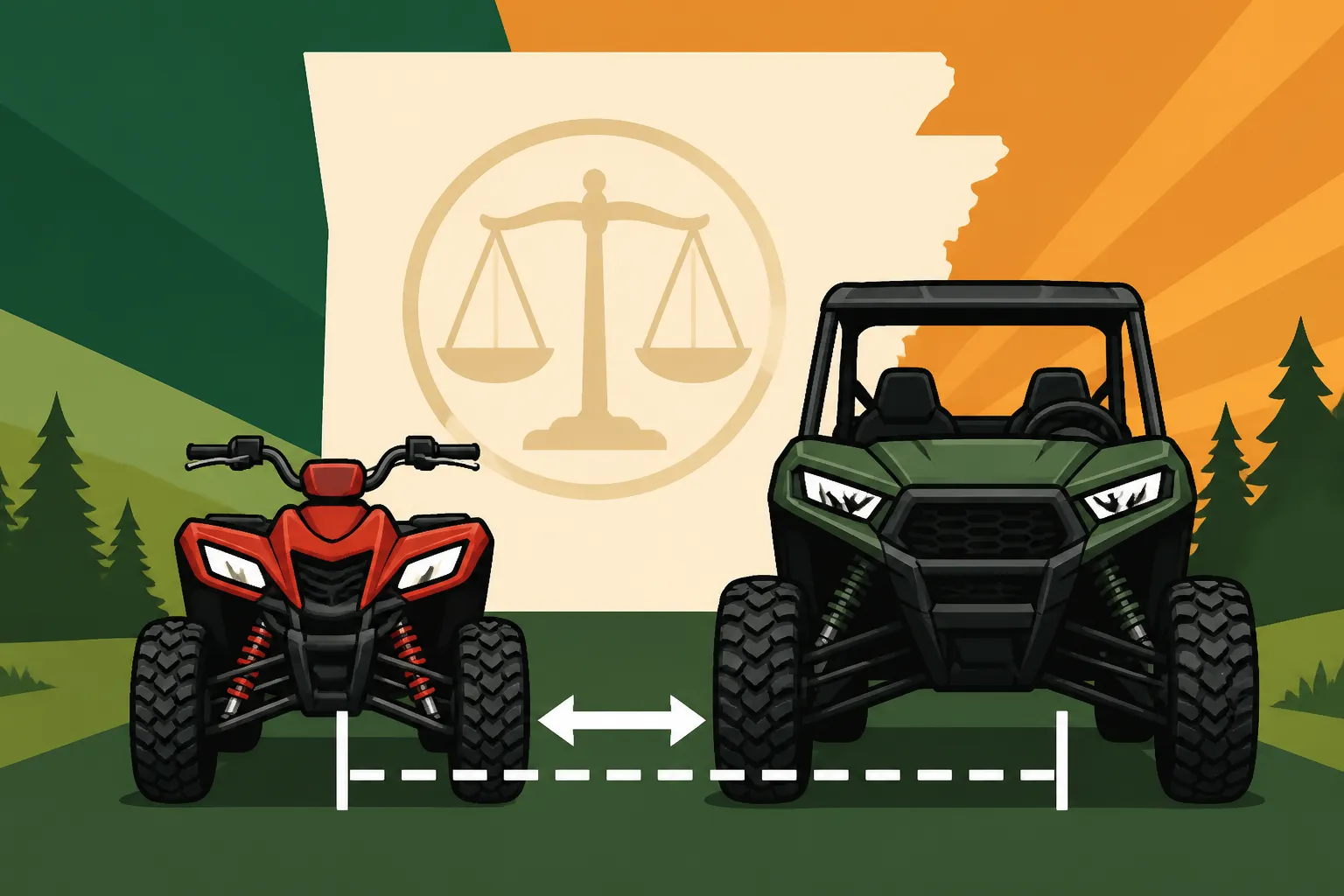
The 50-inch measurement isn't an arbitrary suggestion; it's a hard legal boundary. When a machine exceeds 50 inches in width, it is no longer considered an ATV under Arkansas law. This doesn't mean it's illegal, but it does mean it becomes a "side-by-side" (UTV) or some other type of off-highway vehicle, each with its own set of rules and regulations. The minute your machine hits, say, 52 inches, it steps into a different legal world, which can be a real headache if you weren't expecting it.
This precise measurement dictates how your vehicle is treated for a variety of purposes. For instance, trail access rules often hinge on this width, and the ability to register your vehicle might be entirely different. Imagine buying a new UTV, thinking it's just a bigger ATV, only to find out you can't ride it on your favorite trail because it's too wide for the posted restrictions. That frustration is exactly what the 50-inch rule can lead to if you're not aware. It's a critical point of differentiation, separating traditional ATVs from [Machines That Fall Outside Arkansas's ATV Definition] and shaping your entire experience as a rider.
Why the 50-Inch Rule Matters for Your Riding
The 50-inch width line has far-reaching consequences that touch upon nearly every aspect of owning and riding an off-road vehicle in Arkansas. From the moment you decide to purchase a machine to where and how you can legally operate it, this single measurement can make all the difference. Misunderstanding its importance can lead to costly mistakes, missed riding opportunities, or even legal trouble.
Registration and Titling Implications
For machines that fit Arkansas's definition of an ATV (under 50 inches wide, among other criteria), the state has a unique and somewhat simplified registration process. These ATVs typically qualify for [Arkansas ATV Registration: One Time, Never Renewed], meaning once you register it, you generally don't have to worry about annual renewals. This is a significant benefit for ATV owners. However, if your machine is wider than 50 inches, this "one-time" rule often doesn't apply.
Wider machines, like most side-by-sides, may not fall under the standard ATV registration process at all, or they might have different requirements. You might find yourself needing to look into [Registering a Side-by-Side in Arkansas] or navigating more complex [Arkansas UTV Registration Requirements] which can be very different from what you expected for an ATV. This distinction can be incredibly confusing for consumers who see a dealer selling both "ATVs" and "UTVs" without fully understanding the regulatory differences. Getting this wrong can mean your machine is unregistered and you could face penalties if caught riding on public lands or roads where registration is required.
Trail Access and Riding Restrictions
Perhaps one of the most immediate and impactful consequences of the 50-inch rule is how it affects where you can ride. Many popular ATV trail systems across Arkansas, particularly those within national forests like the Ouachita or Ozark-St. Francis, have strict width limitations. These limits are often designed to protect sensitive ecosystems, prevent trail erosion, and ensure rider safety on narrower paths. For traditional ATVs under 50 inches, access is usually straightforward.
However, if your machine exceeds this width, even by just a few inches, you might find yourself explicitly prohibited from certain trails. Imagine arriving at a popular trailhead, excited for a day of riding, only to see a sign or a physical gate set at 50 inches wide, making it impossible for your UTV to pass. This scenario is a common frustration for owners of wider machines. It's vital to check [Arkansas ATV Trails With Width Limits] before you load up and head out, especially if you have a side-by-side, to avoid disappointment. Even if your machine physically fits, riding a wider vehicle on trails explicitly designated for narrower ATVs could still lead to fines or being asked to leave. Also, remember that [Arkansas Rules for Riding a County Road] might have different nuances based on your vehicle's classification.
Road Use and Street Legality
Arkansas law generally prohibits the operation of ATVs on public roads. This is a fundamental rule designed for safety and to keep these off-road machines in their intended environment. However, there are some very specific exceptions, such as crossing a highway at a 90-degree angle or for certain farming or hunting operations. These exceptions typically apply to machines that meet the legal definition of an ATV.
When your machine is wider than 50 inches and thus falls into the UTV category, the rules for road use can become even more complex. While some cities and towns in Arkansas have passed ordinances allowing street-legal UTVs on certain municipal roads, this is a distinct regulatory path separate from the general ATV road rules. You can't just assume that because a smaller ATV has an exception, your wider UTV does too. Each town can set its own [Arkansas UTV Street Legal Rules by Town], and these rules often require additional equipment (like turn signals, mirrors, or insurance) and specific permits. Understanding [Arkansas ATV Road Rules: What 27-21-106 Says] is crucial, but remember that a UTV might not fall under the same exact statute, adding another layer of complexity to legal road riding.
Machines That Fall Outside the 50-Inch Width
The market for off-road vehicles has exploded with options, and while many machines share similarities, their legal classifications can be vastly different, primarily due to that 50-inch width line. It's easy to lump all multi-wheeled off-road vehicles together, but Arkansas law makes critical distinctions that every owner needs to understand.
Side-by-Sides and UTVs: The Common Wider Machines
When people talk about machines wider than 50 inches, they are most often referring to side-by-sides, also known as Utility Terrain Vehicles (UTVs). These vehicles are characterized by their car-like seating, often with two or more bucket seats side-by-side, a steering wheel instead of handlebars, and a generally wider, more stable stance. Their design naturally pushes them beyond the 50-inch limit, often ranging from 60 to 72 inches or even wider. The sheer popularity of these machines has grown exponentially, leading to increased confusion among riders who might mistakenly assume they fall under the same rules as traditional ATVs.
While UTVs offer many advantages, like increased cargo capacity, passenger comfort, and a sense of security due to their wider base, their width immediately changes their legal status in Arkansas. This means that while they are perfectly legitimate and enjoyable off-road vehicles, they require a different approach to registration, trail access, and potential road use compared to a narrower ATV. Understanding this distinction is key to a smooth ownership experience. You can find more specific details on [Arkansas Machines Wider Than 50 Inches] and [Arkansas UTV Registration Requirements] if you own one of these popular vehicles.
Other Vehicles Not Covered by the ATV Statute
It's also important to remember that not all off-highway vehicles are ATVs or UTVs. There's a diverse range of machines, each with its own set of rules and classifications. For example, dirt bikes are classified as motorcycles, with entirely different registration and riding regulations. Golf carts, while sometimes used off-road, typically fall under specific municipal ordinances, especially if they're allowed on city streets in places like Hot Springs Village or other planned communities.
Even some [Arkansas Six-Wheeled ATVs and the Statute] might have unique classifications depending on their specific design and features. The key takeaway here is that Arkansas's 50-inch ATV definition is very specific. If your machine doesn't fit that mold—whether it's a dirt bike, a golf cart, or a larger specialized off-road vehicle—it will likely have its own set of statutes governing its use. This fragmented regulatory landscape is precisely why doing your homework on your specific machine is paramount to avoiding unexpected issues.
Navigating Registration and Rules for Wider Machines
So, you've realized your machine is wider than 50 inches. Don't panic! It doesn't mean you can't enjoy it in Arkansas, but it does mean you need to be aware of a different set of rules and a distinct process for registration and legal operation. The goal is to ensure you're compliant with the law, can access the trails you want, and avoid any unnecessary fines or complications.
The Different Path for UTV Registration
Since machines wider than 50 inches typically fall outside the official "ATV" definition in Arkansas, their registration process can be different. Unlike the [Arkansas ATV Registration: One Time, Never Renewed] system, UTVs might not be eligible for the same straightforward, permanent decal. Some UTVs may be registered as "special vehicles" or "utility vehicles" with the Department of Finance and Administration (DFA), which could entail different fees, forms, or even an annual renewal requirement depending on current statutes. It's not a uniform system across the board, which can make it confusing for owners.
This is where having all your ducks in a row with documentation becomes incredibly important. When you purchase a UTV, ensuring you have a proper bill of sale or other proof of ownership is crucial for any registration attempt. Tools and templates from services like LawDepot can be invaluable for creating a legally sound bill of sale, whether you're buying from a private seller or want to ensure your own sale is well-documented. This kind of paperwork, even for a machine that doesn't fit the standard ATV definition, provides the necessary foundation when you approach the revenue office for [Arkansas UTV Registration Requirements]. They'll want to see clear proof of ownership and the vehicle's specific details to classify it correctly and guide you through the appropriate process.
Practical Tips for Identifying Your Machine's Classification
The easiest and most reliable way to determine if your machine falls under or over the 50-inch width limit is to simply measure it. Take a tape measure to the widest point of your vehicle, which is typically across the outside of the tires or the widest part of the wheel wells, depending on the machine. Don't just eyeball it; a couple of inches can make all the difference legally.
Beyond physical measurement, consult your owner's manual or the manufacturer's specifications. These documents will clearly list the overall width of your machine. Keep these records handy, especially when visiting an Arkansas revenue office or if questioned on a trail. When you're dealing with a private sale, and perhaps the original documentation is missing, getting a solid bill of sale, perhaps using a template from LawDepot, can still help you get the essential details of the machine to then research its exact specifications. Knowing these details before you try to register or head to a restricted trail will save you a lot of time and potential hassle.
When in Doubt: Consult the Experts
The nuances of off-road vehicle laws in Arkansas can be complex, and local ordinances for UTVs are always evolving. If you are ever unsure about your machine's classification, registration requirements, or where you can legally ride, your best bet is to consult the experts. The Arkansas Department of Finance and Administration (DFA) website is a great resource, and a visit or call to your local Arkansas revenue office can provide definitive answers specific to your situation. These offices are there to help you navigate the process and ensure you are compliant.
Additionally, don't hesitate to reach out to reputable ATV/UTV dealers in Arkansas or local off-road riding clubs. These communities often have up-to-date, practical knowledge of local rules and trail access. They can offer insights that you might not find in official government documents. Getting expert advice ensures you're riding legally and safely, maximizing your enjoyment of Arkansas's incredible off-road opportunities. Remember, having meticulous records, whether through manufacturer documents or reliable legal forms like those found on LawDepot, is always a smart move when dealing with vehicle ownership and compliance.
| Feature | ATV (Under 50" Width) | UTV (Over 50" Width) |
|---|---|---|
| Typical Width | Up to 50 inches | 50+ inches (often 60-72+ inches) |
| Seating Arrangement | Straddle seat, operator sits astride | Side-by-side bucket seats, operator sits in the vehicle |
| Steering Mechanism | Handlebars | Steering wheel |
| Engine Capacity | Typically up to 1,000cc (but width is key) | Varies widely, often larger than ATVs |
| Arkansas Registration | Often one-time, never renewed decal. | May require different registration (e.g., "special vehicle"), potentially annual. |
| Trail Access | Generally permitted on most designated ATV trails. | Often restricted or prohibited on narrower ATV trails due to width limits. |
| Road Use (General) | Prohibited on public roads, limited exceptions. | Prohibited on public roads, specific local ordinances may allow street use in some towns with permits. |
Disclaimer
This article is for general informational purposes only and does not constitute professional advice. Laws, prices and regulations vary by location and change over time. Consult a qualified professional for guidance on your specific situation.