Arkansas Stop Before You Cross
It can be incredibly frustrating to be out enjoying a ride on your ATV or UTV in Arkansas, only to hit a paved road and feel unsure about the rules for crossing it. You're just trying to get from one section of trail or private land to another, and suddenly you're wondering if you're breaking the law simply by traversing a bit of asphalt. This guide is here to clear up that confusion, specifically focusing on the critical "stop before you cross" rule and other vital considerations for safely and legally navigating those road intersections in the Natural State.
The Core Rule: Why Stopping Matters
Arkansas law has a very clear stance on what you need to do before your off-highway vehicle (OHV) touches a public road: you must stop. It’s not just a suggestion; it’s a legal requirement designed to keep everyone safe. Many riders assume a quick glance is enough, but the statute demands more, recognizing the inherent dangers when a fast-moving vehicle meets a slower, less visible one at an unexpected point. This isn't about hindering your fun; it's about preventing serious accidents.
What the Law Actually Says
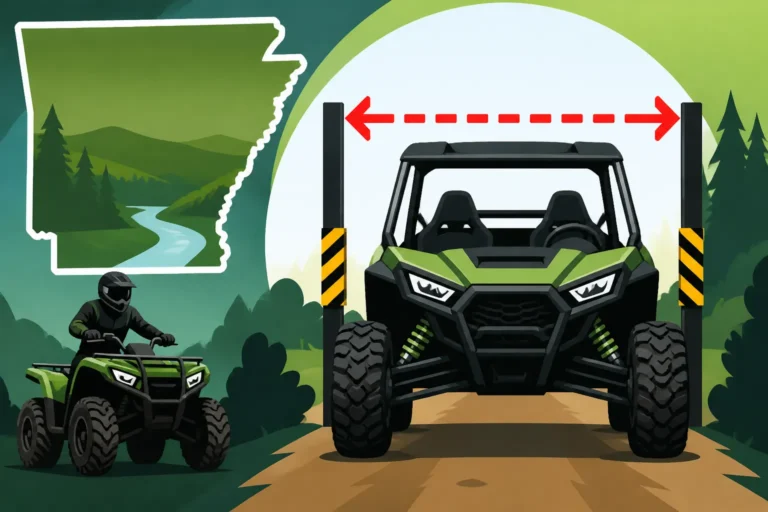
The legal text in Arkansas is pretty direct: you can only cross a public road if you come to a complete stop immediately before entering the road and then proceed to cross at an angle of "roughly ninety degrees." This phrasing is crucial. "Complete stop" means just that – your tires must cease all forward motion. No rolling stops, no slowing down to a crawl. It’s about creating a moment of stillness where you can fully assess the situation without the added variable of your machine’s momentum. [What Arkansas Law Forbids on a Public Road] explains the broader context here.
The "roughly ninety degrees" part means you're aiming for a straight-shot crossing, minimizing your time on the paved surface. You're not meant to drive down the shoulder for any distance or make a wide, sweeping turn. This specific angle helps ensure you're visible to oncoming traffic for the shortest possible duration, reducing the chance of a side-impact collision. It acknowledges that ATVs and UTVs aren't designed for road travel and should spend as little time as possible mixing with cars and trucks.
Beyond the Statute: Common Sense Safety
While the law dictates your actions, common sense safety is the ultimate reason behind these rules. Think about it from a driver's perspective: a car traveling at 55 mph approaches a spot where the driver doesn't expect an OHV. If you roll onto the road without a full stop, or if you're attempting a diagonal crossing, you drastically reduce their reaction time. Your machine, while capable off-road, is often smaller and less visible than a typical vehicle, especially with brush or topography obscuring views.
A complete stop gives you the best chance to see and be seen. It provides those precious extra seconds to confirm the road is clear, accounting for things like blind spots, approaching vehicles, or even other OHVs on the other side of the road. It also prevents you from inadvertently "jerking" onto the road if you misjudge a gap in traffic. Many experienced riders in Arkansas have learned the hard way that a moment of patience at the shoulder can prevent hours of paperwork or, worse, a trip to the emergency room.
Understanding Arkansas's Six Statutory Road Exceptions
While the general rule is "no public road travel," Arkansas law carves out specific exceptions where OHVs are permitted on roads under certain conditions. These aren't blanket permissions to cruise down Main Street; they are carefully defined scenarios where the use of an ATV or UTV on a public road is deemed necessary for a specific purpose. It's critical to understand these distinctions to avoid citations. The state recognizes certain essential functions that often require the use of these machines.
Farming and Hunting Operations
One of the most common exceptions applies to OHVs used in farming or hunting operations. If you're using your ATV or UTV to directly support agricultural work, such as checking fences, moving feed, or accessing fields, you generally have an exemption for brief road use. The same goes for hunting – if you’re using your machine to access a deer stand on a large lease, retrieve game, or maintain food plots, the law offers some leeway. However, this isn't an excuse to ride to the local convenience store for snacks after your hunt or to use it for casual rides between farming tasks. The machine's use must be directly related to the operation. [Arkansas Farming Operation Road Use] and [Arkansas Hunting Operation Road Use] delve deeper into what qualifies.
It's important to remember that even with these exceptions, the "stop before you cross" rule still applies when you're entering or crossing any paved public road. These exceptions mostly pertain to brief travel along roads or crossing where otherwise forbidden. You must still operate the machine safely and be aware of other traffic. Deputies can, and do, differentiate between legitimate operational use and recreational riding that's simply trying to masquerade as an exception.
Law Enforcement, EMS, Utility, and State Parks
Beyond farming and hunting, specific professional entities also have statutory exceptions for using OHVs on public roads. This includes law enforcement officers and emergency medical services personnel when they are performing their official duties. Picture a sheriff's deputy using an ATV to patrol a remote area or an EMS crew using a UTV to reach an accident scene off the main road. Their ability to access difficult terrain quickly is paramount to public safety.
Similarly, employees of public utilities (like electric companies or gas pipelines) and those working for the Arkansas Department of Parks, Heritage, and Tourism are also granted exemptions when using OHVs in the course of their duties. This allows utility crews to access remote infrastructure for repairs or maintenance, and park rangers to patrol trails or conduct conservation work. These are not recreational uses; they are essential job functions where the unique capabilities of an ATV or UTV are necessary. Understanding these [Six Exceptions to Arkansas's Ban on Road Riding] helps clarify when you might see these machines on public roads.
| Exception Category | Description of Permitted Use | Key Condition |
|---|---|---|
| Farming Operations | Transporting equipment, checking fences, accessing fields for agricultural purposes. | Use must be directly related to agricultural work. |
| Hunting Operations | Accessing hunting blinds, retrieving game, maintaining food plots during hunting season. | Use must be directly related to hunting activities. |
| Law Enforcement | Patrol, pursuit, or other official duties. | Performed by authorized personnel in official capacity. |
| Emergency Medical | Responding to emergencies, accessing accident scenes. | Performed by authorized personnel in official capacity. |
| Utility Companies | Repair, maintenance, or inspection of utility infrastructure. | Performed by authorized personnel in official capacity. |
| State Parks, Heritage, & Tourism | Park maintenance, patrol, conservation efforts within their jurisdiction. | Performed by authorized personnel in official capacity. |
The "Complete Stop" in Practice
Okay, so the law says "complete stop." But what does that really look like when you're out on the trails? It’s more than just tapping the brakes; it’s a full mental and physical pause that lets you make a truly informed decision about when it’s safe to proceed. It's the moment where you transition from off-road adventuring to briefly interacting with public thoroughfares, and that shift in mindset is crucial for safety.
Where to Stop and What to Look For
When you approach a road, you need to find a safe, stable place to stop. Ideally, this means stopping on the shoulder of the road, before your tires touch the pavement. If there's no shoulder, stop at the edge of the dirt trail, just shy of the paved surface. The key is to have a clear line of sight in both directions without encroaching on the roadway itself. You'll want to stop where you have the best view possible, looking for any vegetation or dips in the terrain that might block your vision.
Once stopped, you need to actively scan the road. Don't just glance. Look left, then right, then left again. Are there blind curves in either direction? Is there a crest in the road that could hide an approaching vehicle? Listen for engine noise. On a quiet country road, you might hear a car long before you see it. Take your time. Don't feel pressured to rush. This is your life, and the lives of your passengers, you're looking out for. It's a fundamental part of [Crossing at a Complete Stop].
Why Rushing a Crossing is Never Worth It
We've all been there: you see a seemingly open gap in traffic, and the temptation is to just gun it and get across. But rushing a crossing is incredibly dangerous and can lead to severe consequences, both legal and physical. The penalties for riding illegally on public roads, which often includes improper crossings, can include hefty fines and court costs, as covered in [Arkansas Penalties for Illegal Road Riding]. More importantly, a collision with a car or truck can result in serious injury or fatality, as your OHV offers far less protection than a passenger vehicle.
The "illusion of speed" is a real phenomenon here. A vehicle that looks far away might be traveling at 60 mph and closing the distance much faster than you anticipate. When you're only going 10-15 mph crossing the road, a vehicle moving at highway speeds can cover a lot of ground in the few seconds it takes you to traverse the pavement. Always err on the side of caution. If there's any doubt, wait. Another minute of waiting is infinitely better than an accident.
The "Roughly Ninety Degrees" Mandate
Beyond stopping, the law is equally clear on how you must cross: at "roughly ninety degrees." This isn't just bureaucratic language; it's a specific instruction designed to minimize your exposure to potential hazards on the roadway. It impacts everything from how you approach the road to how quickly you can complete your crossing.
Straight Across, Not Parallel
The core idea behind crossing at roughly ninety degrees is to get you off the pavement as quickly and directly as possible. This means your path should be perpendicular to the road, forming a right angle. You are explicitly not allowed to travel down the shoulder, even for a short distance, to find a "better" crossing point or to angle yourself more favorably. That would be considered traveling on the road, which is generally prohibited outside of the specific exceptions we discussed. [Crossing at Roughly Ninety Degrees] emphasizes this.
Imagine you're standing on one side of a river and need to get to the other. You wouldn't walk upstream along the bank just to make a diagonal swim. You'd cross directly. The same principle applies here. Your goal is to traverse the "river" (the road) in the most direct line, minimizing the time you spend in the flow of traffic. Any deviation from this straight path increases the time you're on the pavement and, consequently, your risk of a collision. This is why you need to evaluate the crossing point before you even approach the road.
Practical Challenges and Solutions
Sometimes, the terrain leading up to a road might make a perfect 90-degree crossing feel impossible. Perhaps there's a steep ditch, a culvert, or dense undergrowth that forces you to approach at an awkward angle. In these situations, you have to prioritize safety and legality. If a perfect 90-degree crossing isn't feasible, you must find the closest safe and direct path that approximates that angle. This might mean walking your machine across a particularly tricky spot or looking for an alternative crossing point altogether, even if it adds a few minutes to your ride.
It's also where having a well-equipped machine comes in handy. A UTV with good ground clearance or an ATV with robust tires can more easily handle those slightly uneven transitions from dirt to pavement and back. For those looking to upgrade, accessories from companies like SuperATV can provide lift kits or heavier-duty suspension components that make navigating such transitions smoother and safer. However, even with the best equipment, the legal requirement for a direct, perpendicular crossing remains.
Crossing Different Types of Roads
Not all roads are created equal, and your approach to crossing them should reflect that. A quiet, gravel county road presents a very different set of challenges and risks compared to a multi-lane state highway. Understanding these differences and adjusting your caution level accordingly is vital for safe riding in Arkansas.
State Highways vs. County Roads
When you're looking to cross a state highway in Arkansas, your level of caution needs to be at its absolute maximum. These roads typically have higher speed limits, more traffic volume, and often less forgiving shoulders. Vehicles travel much faster, and the distances they cover are significant. Here, the "complete stop" and "roughly ninety degrees" rules are not just legal requirements but life-saving mandates. You need to be extra vigilant, look multiple times, and wait for a truly clear and safe gap in traffic before you even think about engaging the throttle. [Arkansas Rules for Crossing a State Highway] details these specific dangers.
On the other hand, crossing a county road, especially an unpaved one, might feel less daunting. These often have lower speed limits, fewer vehicles, and drivers who might be more accustomed to seeing farm equipment or other slow-moving vehicles. However, this doesn't mean you can relax your guard. The "complete stop" rule still applies, as does the "roughly ninety degrees" crossing. Even on a quiet county road, a collision can be serious. Drivers might be distracted, or a vehicle could appear unexpectedly. Always assume a vehicle is coming. For more on navigating these local routes, check out [Arkansas Rules for Riding a County Road].
Understanding Local Ordinances for Street-Legal UTVs
It's important to distinguish between simply crossing a road and traveling on a road. While the state-level crossing rules apply universally, some Arkansas cities and towns have passed ordinances allowing street-legal UTVs to operate on certain public roads within their municipal limits. This is a local option, not a state-wide mandate. If your UTV is street-legal (equipped with lights, mirrors, turn signals, etc.) and you're in a town that permits street use, you might be able to drive down that road, not just cross it.
However, even in these specific towns, there are usually restrictions: speed limits for UTVs, specific roads that are off-limits (like four-lane highways), and permit requirements. These local ordinances do not override the basic state law about crossing for ATVs or UTVs that are not permitted for street use. Always check the specific ordinance for the town you're in. Don't assume that because your buddy heard Bono allows UTVs, it applies everywhere. [Arkansas UTV Street Legal Rules by Town] and [Arkansas Towns Can Open Their Streets to UTVs] are excellent resources to help you figure out what's allowed where.
Equipment and Mindset for Safe Road Crossings
Safety isn't just about following the law; it's about proactively equipping your machine and preparing your mindset for potential hazards. When you're interacting with public roads, even briefly, you need every advantage you can get to ensure visibility and prevent accidents. Think of it as gearing up for a different kind of challenge, one that requires a different approach than just navigating a muddy trail.
Visibility Enhancements
One of the biggest dangers when crossing a road is simply not being seen by oncoming traffic. OHVs are often low to the ground and can blend into backgrounds, especially at dawn, dusk, or in areas with heavy tree cover. This is where visibility enhancements become crucial. Consider adding a bright orange safety flag to the rear of your machine, positioned high enough to be seen over brush or other vehicles. Many riders also add extra LED lights, not just for night riding, but for daytime visibility. A bright, amber flashing light on the rear can make a huge difference.
Reflective tape is another simple, inexpensive, and highly effective addition. Apply it to the front, rear, and sides of your machine. You can also wear reflective vests or clothing. Think about a motorist's perspective: anything that makes you stand out from the background and catch their eye is a win. Quality aftermarket lighting, like those offered by SuperATV, can significantly increase your machine's presence on or near roads. Even if you're only crossing for a few seconds, making sure you're seen can be the difference between a close call and a serious incident. More tips can be found in [Reflective Tape Worth Adding].
Riding with Awareness
Beyond equipment, a "riding with awareness" mindset is your most powerful tool for safe road crossings. This means being a defensive rider, always anticipating what other drivers might do, and understanding that they are likely not looking for an ATV or UTV. Don't assume they see you, even if you feel you're highly visible. Make eye contact if possible, but prepare for them not to react.
Ride sober, always. Alcohol or drug impairment severely compromises your judgment and reaction time, making road crossings exponentially more dangerous. If you're riding with a group, establish clear communication signals before you reach a road. The lead rider should signal "stop" well in advance, and everyone should take their turn crossing safely. Never follow another rider across blindly. Each person must make their own assessment of traffic. If, despite all precautions, an accident does occur, remember that reporting requirements exist, as discussed in [Arkansas Accident Reporting for an ATV Crash].
Disclaimer
This article is for general informational purposes only and does not constitute professional advice. Laws, prices and regulations vary by location and change over time. Consult a qualified professional for guidance on your specific situation.