Does an Arkansas Street Permit Require a Horn?
Figuring out the exact requirements for making your UTV or ATV street legal in Arkansas can feel like navigating a maze. It’s not always a straightforward process, and many riders find themselves scratching their heads over seemingly minor details, like whether a simple horn is required. This guide is here to untangle those specific questions, giving you a clear understanding of Arkansas's local option laws for street-permitted UTVs and what you need to know about equipping your machine with a horn to comply.
Understanding Arkansas's Local-Option UTV Street Legal Framework
Arkansas has a unique approach to making UTVs street legal, which often causes confusion for riders. Unlike some states that have a blanket statewide law, Arkansas shifted the decision-making power to local municipalities. This means whether you can legally ride your UTV on public roads often depends entirely on where you live or where you plan to ride. It's not just a matter of showing up at a state office; you've got to dig into your city or county's specific rules.
This local-option approach, largely brought about by [How a Bill Became Arkansas Act 922] which became effective on August 5, 2025, acknowledges that what works for a small rural town might not be suitable for a bustling city. While it offers flexibility, it also places the burden on individual riders to be diligent and informed about their local ordinances. You can't just assume that because a neighboring town allows street riding, your town does too, or that the equipment requirements will be identical. Many riders learn this the hard way, thinking they're compliant only to find a different set of rules just a few miles down the road.
The Power of Local Ordinances
Before Act 922, the default state law essentially made it unlawful to ride ATVs and UTVs on most public roads, with only a few specific exceptions. The major change was that cities and towns were given the authority to pass their own ordinances to allow and regulate UTVs on their streets. This was a game-changer for many communities where UTVs are a common mode of transportation for chores, recreation, or simply getting around.
However, this decentralization means that there's no single, universal checklist for "Arkansas street legal" equipment. What [Bono's Street Rules for UTVs in Arkansas] might require, another town, like Cotter, might explicitly ban, as outlined in [Cotter's Ordinance Banning ATVs in Arkansas]. It means your first and most crucial step is always to check with your specific city or county government. Their clerk's office or website is the definitive source for their unique UTV ordinance, including any mandates for equipment like a horn. This is why you'll find varying requirements across the state, making due diligence absolutely essential for riders.
Common Equipment Requirements for Street-Permitted UTVs
While specific requirements can vary, most Arkansas cities that permit UTVs on their streets tend to follow a general pattern for necessary equipment, often mirroring what's expected of other motor vehicles to ensure safety and visibility. These are typically baseline items designed to make your UTV visible and controllable in a mixed traffic environment. Think about what a car needs to drive safely, and many of these apply to street-legal UTVs.
These common requirements often include features like headlights, taillights, brake lights, and turn signals. Most ordinances also specify the need for mirrors, often both a rearview mirror and side mirrors, to give the driver a full view of traffic. Some will also specify a windshield, or at least eye protection for riders, and seatbelts for all occupants. The goal is to integrate these machines safely into existing road infrastructure, and that means equipping them with the basics for communication and awareness. You can find more general information on this topic in [Arkansas Equipment for a Street-Permitted Machine] and [Arkansas Turn Signal Requirements for Street UTVs].
The Specifics: Does a Street Permit Demand a Horn?
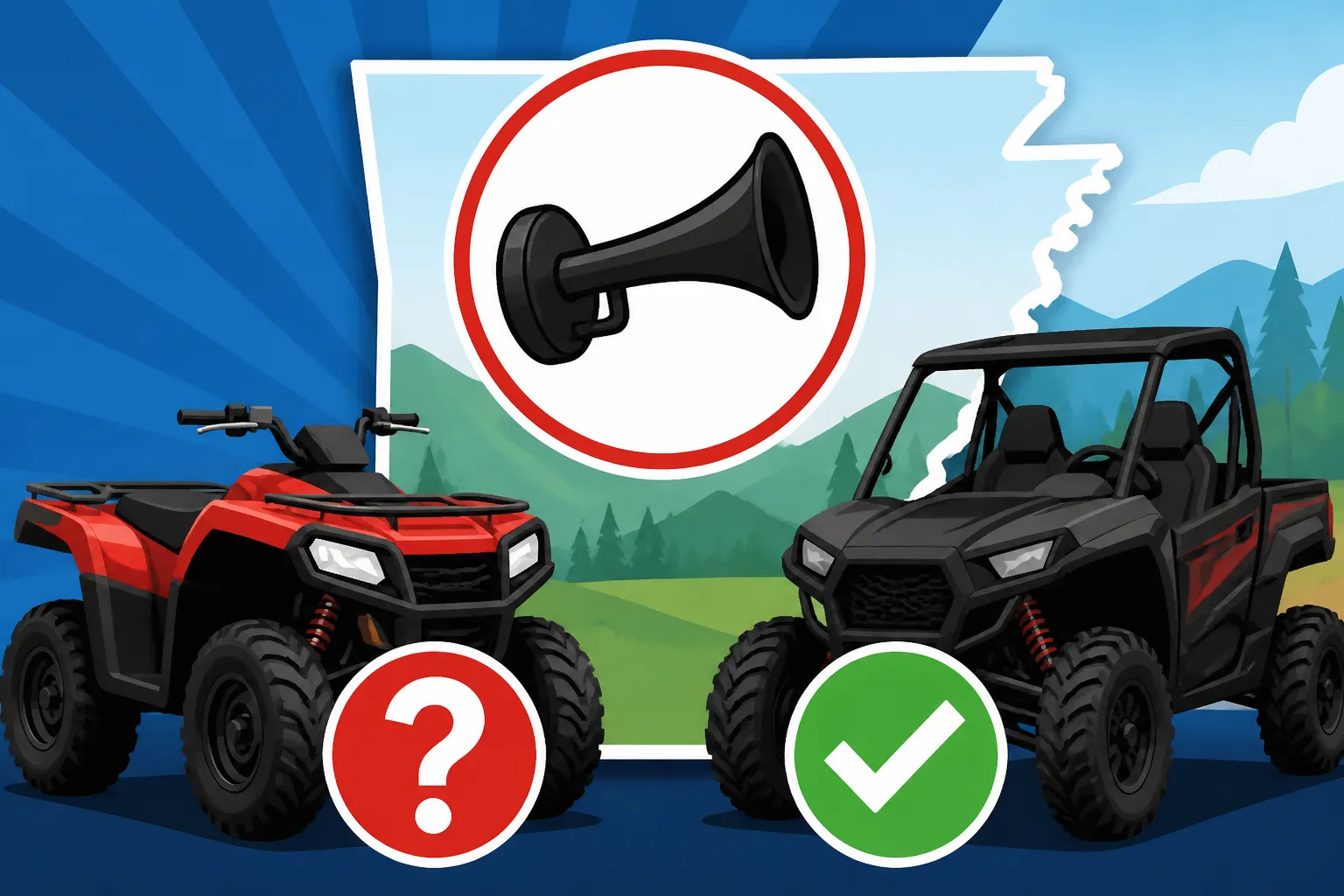
Now, let's get down to the brass tacks: the horn. Does an Arkansas street permit automatically require your UTV to have one? The simple answer is: it depends entirely on the specific local ordinance of the city or town where you wish to ride. There isn't a statewide blanket rule from Arkansas's general ATV/UTV statutes that explicitly mandates a horn for every machine on every street. However, most local ordinances that do allow UTVs on roads include a horn as a standard requirement.
Think about it from a safety perspective. On a public street, you need to be able to alert other drivers, pedestrians, or even wildlife to your presence or an impending hazard. A horn is a universal communication tool in traffic. While the state doesn't universally declare it for all ATV/UTV use, the local governments that have taken the step to open their roads to these machines almost always include a horn in their list of necessary safety equipment. It’s part of ensuring that these machines can integrate safely and predictably with other vehicles.
Checking Your Local Ordinance for Horn Requirements
Because of Arkansas’s local-option law, the only way to know for certain if a horn is required for your street-permitted UTV is to consult the specific ordinance of the city or town where you plan to ride. This cannot be stressed enough. What applies in Mena might not apply in Ozark, and vice-versa. You might even find slight variations in equipment lists between adjacent towns in the same county.
Your best bet is to contact the city clerk's office directly. Most cities that have passed these ordinances will have them readily available, often on their municipal website. Don't rely on word-of-mouth or what your friend in another town said. Get the actual text of the ordinance. When you're [Reading Your Town's Ordinance Before You Ride], look for a section detailing "equipment requirements" or "safety features." This is where you'll find the definitive answer regarding a horn, along with other items like mirrors, lights, and turn signals. It might seem like a hassle, but it’s crucial to avoid potential citations or accidents.
What Arkansas Statutes Say (or Don't Say) About Horns
Arkansas state law, specifically Arkansas Code Title 27, Chapter 21, Subchapter 1, which governs "Off-Road Vehicles," sets some broad definitions and prohibitions but generally leaves the specifics of street-legal equipment to the local level once a city passes an ordinance. The state statute itself doesn't contain a universal, explicit requirement for a horn on all ATVs or UTVs that might be used under a local street-legal permit.
However, many cities, when crafting their ordinances to permit UTVs on streets, will often reference or adapt language from existing motor vehicle laws or best safety practices. It's common for them to include requirements such as functional headlights, taillights, brake lights, mirrors, and, yes, a horn. While the state may not mandate a horn for all off-road vehicles, the local jurisdictions, in their effort to safely integrate UTVs into traffic, will almost certainly require one as part of their [Arkansas UTV Street Permits and Annual Fees] conditions. This demonstrates a practical approach to safety even where state law might be silent on the minutiae for these specific vehicles.
Why a Horn is Essential for Street Safety
Even if, by some rare chance, your particular local ordinance doesn't explicitly list a horn as a requirement for a street permit, equipping your UTV with one is an absolute must for safety. Think about the scenarios you encounter daily in a car: someone is backing out of a parking spot, a pedestrian isn't looking, or another driver is drifting into your lane. In all these situations, a quick blast of the horn can prevent a collision or alert someone to your presence. On a UTV, which can sometimes be less visible or quieter than a full-sized car, this audible warning becomes even more critical.
Riding a UTV on public roads means sharing the space with larger, faster, and often less attentive vehicles. Your ability to communicate quickly and effectively can be the difference between a close call and a serious accident. Beyond legal compliance, it's about responsible riding and ensuring your own safety and the safety of those around you.
Alerting Other Drivers and Pedestrians
Picture this: you're driving your UTV down a two-lane street in a small Arkansas town. A car suddenly starts to pull out from a driveway without seeing you. A quick honk of your horn can immediately grab the driver's attention, preventing them from pulling into your path. Similarly, pedestrians, especially in busy areas or near schools, might be distracted by phones or conversations. A polite, brief horn tap can alert them to your presence as you approach a crosswalk or navigate through a residential area.
On a UTV, you're often lower to the ground and sometimes less visually prominent than a car or truck, especially if you're navigating around parked vehicles. The sound of an engine might not always cut through the ambient noise of a town. A horn provides an unmistakable, universally understood signal that you are there and potentially in a situation that requires attention. It's an active safety measure that puts control into your hands, allowing you to react defensively to unpredictable situations.
Signaling Intent and Presence
Beyond emergency alerts, a horn is also crucial for general communication on the road. It's how drivers signal a quick "hello," a friendly reminder, or a warning of intent. For instance, if you're approaching a blind corner on a winding road, a short honk can warn oncoming traffic that you're there, especially if they might not see your headlights immediately. This is particularly relevant in areas like the Ouachita Mountains or Ozarks, where roads can be tight and visibility limited.
It’s about more than just avoiding accidents; it’s about participating in the unspoken language of the road. A UTV, even one with bright lights, can sometimes be overlooked. A horn helps establish your presence and intent, making you a more predictable and therefore safer participant in traffic. Many experienced riders will tell you that a reliable horn is just as important as good brakes or working headlights when you're out on the pavement.
Equipping Your UTV with a Compliant Horn
So, you've checked your local ordinance, and yes, a horn is required (or you've decided it's essential for safety, which it is!). Now, how do you go about equipping your UTV with one that meets potential legal standards and performs reliably? The good news is there are plenty of options out there, ranging from simple electric units to more robust air horns, all designed for the rigors of off-road vehicles.
When choosing a horn, you'll want to consider not just its sound output but also its durability and how easily it can be integrated into your UTV's electrical system. You don't want a horn that's too quiet to be effective, nor one that's overly complex to install. Finding a balance between functionality, compliance, and ease of installation is key.
Types of Horns for UTVs
When it comes to horns for UTVs, you generally have a couple of main categories to consider:
-
Electric Horns: These are the most common type and are similar to what you'd find in a standard car. They typically consist of a diaphragm that vibrates when an electrical current passes through it, producing a distinct "beep" or "honk."
- Pros: Relatively inexpensive, easy to install with basic wiring knowledge, compact size. They draw minimal power and are often available in various sound levels. Many UTV street-legal kits will include a simple electric horn.
- Cons: Can sometimes be less loud or attention-grabbing than an air horn, especially in noisy environments or against larger vehicles.
-
Air Horns: These horns use compressed air to produce a very loud, penetrating sound. They often require an air compressor and a small air tank, or at least a powerful 12V compressor built into the unit itself.
- Pros: Extremely loud and effective at grabbing attention, even from a distance or in heavy traffic. Great for high-speed road use or in situations where you need to be heard unequivocally.
- Cons: More complex and expensive to install, requiring more components (compressor, wiring, air lines, sometimes a tank). They draw more power and take up more space.
For most city ordinances, a standard electric horn that produces a clear, audible sound is perfectly sufficient. The goal is to have a functional warning device, not necessarily something that sounds like a train. However, if you frequently ride in high-traffic areas or simply prefer the added assurance of a very loud warning, an air horn can be a solid choice.
Installation Considerations and Aftermarket Solutions
Installing a horn on your UTV typically involves finding a suitable mounting location, running electrical wiring, and connecting it to a switch (often a push-button mounted on the dash or steering wheel). You'll want to mount the horn in a location that's protected from excessive mud and water, but still allows the sound to project effectively. Many riders choose to mount it under the hood, behind the grille, or on a sturdy frame member.
If you're considering a street-legal conversion for your UTV, many aftermarket manufacturers offer kits that include all the necessary components, often with wiring harnesses and detailed instructions. Brands like SuperATV, for instance, are well-known for producing high-quality UTV accessories, including comprehensive street-legal kits that typically contain a horn, turn signals, mirrors, and other required items. These kits can simplify the process significantly, as they're designed to integrate seamlessly with popular UTV models.
| Requirement | Standard Car Expectation | Typical Arkansas Local UTV Ordinance | Horn Requirement |
|---|---|---|---|
| Headlights | Yes | Yes | N/A |
| Taillights | Yes | Yes | N/A |
| Brake Lights | Yes | Yes | N/A |
| Turn Signals | Yes | Very Likely Yes | N/A |
| Rearview Mirror | Yes | Often Yes | N/A |
| Side Mirrors | Yes | Often Yes (at least one) | N/A |
| Windshield/Eye Protection | Yes | Often Yes | N/A |
| Horn | Yes | Almost Always Yes | Local Ordinance Dictates |
| Seatbelts/Restraints | Yes | Yes | N/A |
When running wires, always use appropriate gauges and ensure connections are secure and weatherproof. Consider using a relay if your horn draws significant current to protect your UTV's electrical system. If you're not comfortable with electrical work, it's always a good idea to have a professional install the horn. This ensures it's done correctly, safely, and compliantly, allowing you to hit the streets with confidence and a clear conscience, knowing you can sound off if needed.
[Arkansas Towns Can Open Their Streets to UTVs]
[Arkansas UTV Street Legal Rules by Town]
[Arkansas Equipment for a Street-Permitted Machine]
[Arkansas Turn Signal Requirements for Street UTVs]
[Arkansas Insurance for a Street-Permitted UTV]
[Arkansas Driver's License at 16 for Street UTVs]
[Arkansas UTV Permit Cost in a City]
[Reading Your Town's Ordinance Before You Ride]
[Arkansas Act 922 and What Changed]
[How Arkansas Cities Got the Choice on UTVs]
[Arkansas Street UTV Annual Renewal]
[Arkansas Rules That Changed in 2025]
Disclaimer
This article is for general informational purposes only and does not constitute professional advice. Laws, prices and regulations vary by location and change over time. Consult a qualified professional for guidance on your specific situation.