Crossing at a Complete Stop
It's incredibly frustrating when you're out enjoying the beautiful Arkansas trails, only to find a public road blocking your path to the next section or your private property. Many riders are left scratching their heads, wondering if they can even touch asphalt, let alone cross it safely and legally. This guide is here to untangle the confusion surrounding Arkansas's specific rules for ATV and UTV riders when it comes to crossing public roads, with a deep dive into the absolute necessity of coming to a complete stop.
Understanding Arkansas's Default Road Ban for ATVs and UTVs
Let's get this out of the way upfront: Arkansas law generally says "no" to riding your ATV or UTV on public roads. This isn't just some arbitrary rule; it's rooted in the idea that these machines are designed for off-highway use, not for sharing lanes with cars, trucks, and 18-wheelers. The whole premise of an all-terrain vehicle is right there in the name – built for dirt, mud, rocks, and trails, not asphalt.
The Core Principle: Off-Road Means Off-Road
The default position in Arkansas is that ATVs and UTVs are non-highway vehicles. This means, by law, they are generally prohibited from operating on public streets, roads, and highways. This primary statute is designed to keep everyone safe, recognizing the inherent differences between an off-road machine and a street-legal vehicle. Things like top speed, braking capabilities, turn signals, mirrors, and even tire type – often non-highway specific – differentiate these machines from what's expected on a paved road. It's a fundamental concept that can be hard to swallow when you just want to get from Point A to Point B, but it's the baseline we all have to work from.
This blanket prohibition often catches new riders, or those visiting from other states with different laws, completely off guard. You might be on a fantastic hunting trip in the Ozarks or exploring a new area with your side-by-side, and suddenly, a paved county road appears. Your instinct might be to just zip across, especially if you can see your destination on the other side. But that's where the law steps in, reminding us that even a brief moment on the pavement can bring legal repercussions if you're not following the very specific exceptions Arkansas has carved out. Understanding this core principle is the first step in riding responsibly and avoiding trouble.
Why This Rule Causes Frustration
Believe me, I hear you. This strict road ban can be incredibly frustrating for riders. Imagine you're on a fantastic section of trail, perhaps near [Wolf Pen Gap: Arkansas's Best Known OHV Complex], and the only way to get to the next designated riding area is a short hop across a paved road. Or maybe your deer lease is split by a county road, and you need to move your machine from one section of your property to another. For farmers, trying to get from one field to another with their utility quad, or for hunters needing to access a [Arkansas WMA Riding on Open Roads] via a public road, the rules can feel like an unnecessary barrier.
This frustration is compounded by the fact that many riders use their machines for practical purposes beyond just recreation. They're tools for work around the property, for hauling feed, or for getting to that perfect fishing spot. When a public road cuts through a logical path, it feels like the law is preventing you from using your machine efficiently and practically. It also forces riders to either find complicated detours, trailer their machines for very short distances, or, unfortunately, take illegal shortcuts, which only invites trouble. This is why knowing the specific exceptions, like the "crossing" rule, is so vital for Arkansas riders.
The "Direct Crossing at Ninety Degrees" Exception
While the general rule is "no public roads," Arkansas law does provide a crucial exception that allows ATVs and UTVs to cross a public road. This isn't a free pass to drive down the road for any distance, but rather a narrow allowance for connecting trails or property separated by a roadway. However, this exception comes with very specific requirements, and chief among them is the mandate to make a complete stop.
What "Direct Crossing" Truly Means
When the law talks about "direct crossing," it's not being vague. It means you must cross the road at approximately a ninety-degree angle to the flow of traffic. Think of it like walking across a crosswalk, straight from one side to the other, not meandering or riding parallel to the road for any distance. The intent is to minimize the time your machine spends on the public road surface and to make your movement predictable to other drivers. This means no joyriding down the shoulder to find a better crossing spot, no turning onto the road and then immediately turning off. It's a straight shot, as perpendicular as possible.
This "ninety degrees" stipulation is key. It's about reducing the unpredictability of an off-road vehicle suddenly entering a road. If you're cutting across at a sharp angle, or worse, riding alongside traffic, you're not only increasing your risk of an accident but also clearly violating the spirit and letter of the law. Imagine a car coming around a bend – they expect vehicles to be traveling in a predictable manner. A machine suddenly veering across at an acute angle is much harder to anticipate and react to than one making a clear, quick, perpendicular crossing after a full stop. It's a safety measure disguised as a legal formality.
The Importance of a Full, Complete Stop
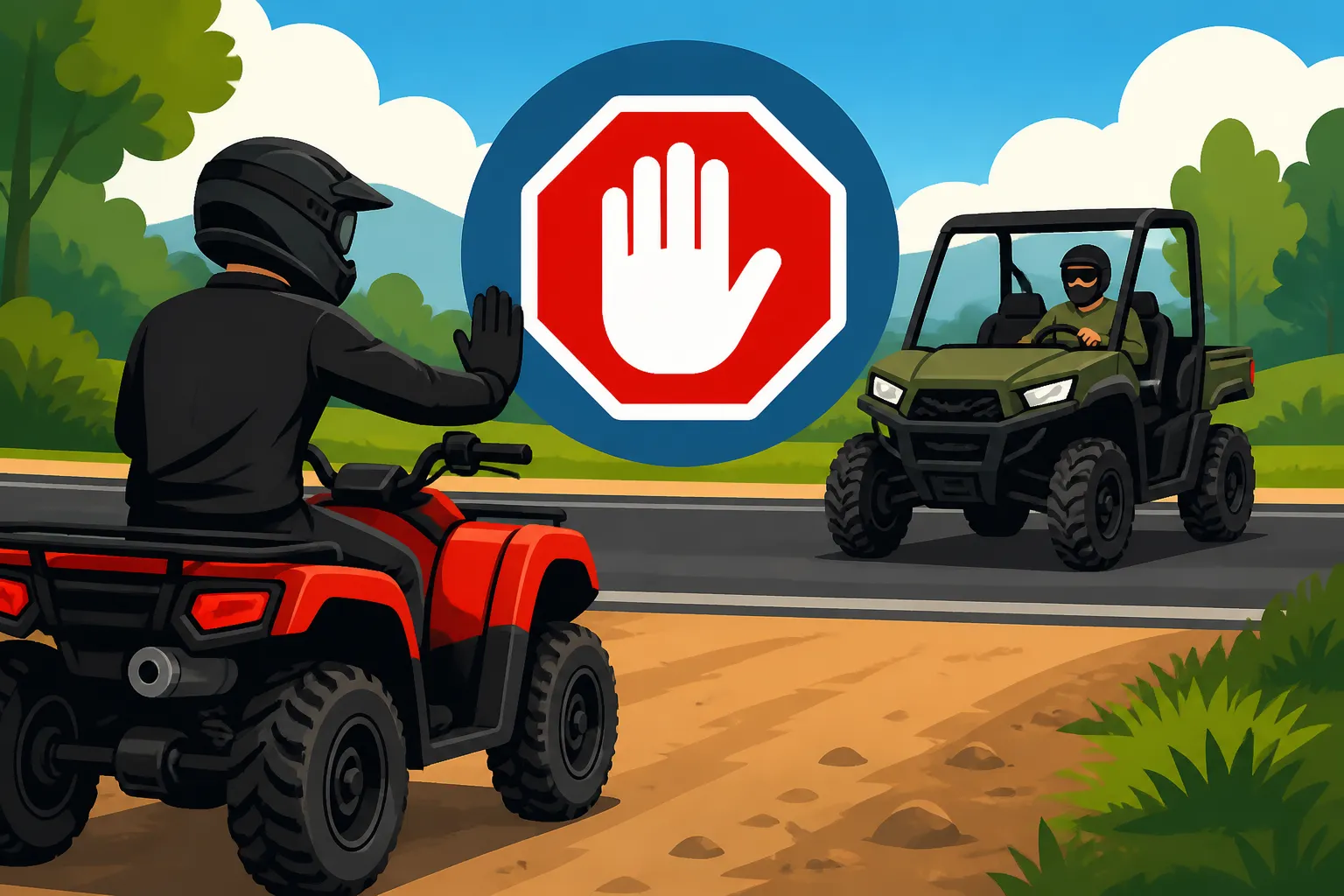
This is perhaps the most critical component of the direct crossing rule: you must come to a full, complete stop before entering any paved public road. This isn't a "rolling stop" or a "slow down and look" – it's a dead halt, just like you would at a stop sign or a railroad crossing. Your wheels need to cease rotation, and you need to take a moment to assess the situation fully. This isn't just good advice; it's a legal requirement that can lead to a citation if ignored.
Why is this complete stop so important? First and foremost, it's about safety. It gives you the necessary time to scan for oncoming traffic from both directions, assess the speed of approaching vehicles, and ensure there's a safe gap for you to cross. Unlike a car, your ATV or UTV might not accelerate as quickly, and other drivers might not expect you to be on the road at all. A complete stop forces you to make a conscious decision that the path is clear. Secondly, it demonstrates to any law enforcement officer who might be observing that you understand and are complying with the specific conditions of the exception. A rolling stop, even if no traffic is present, is still a violation of the "complete stop" rule. This is a non-negotiable step to stay legal and safe. You might think, "What's the big deal if there's no one around?" But the law is clear, and deputies are trained to look for this specific action.
Practical Steps for a Safe and Legal Road Crossing
Crossing a public road on your ATV or UTV isn't something to take lightly. Even if it's a quiet county road in a rural area, you're interacting with different rules of the road and potentially fast-moving traffic. Approaching this maneuver with a clear, step-by-step process can help ensure both your safety and your compliance with Arkansas law.
Situational Awareness Before You Approach
Before you even get close to the pavement, start thinking about your crossing. Scan the area ahead for visibility issues like blind curves, hills, or thick foliage that might obscure oncoming traffic. Listen for the sounds of approaching vehicles, even if you can't see them yet. If you're riding with a group, communicate your intention to cross. Pick a spot where you have the best sightlines in both directions. Sometimes, moving just a few yards up or down the trail can make a huge difference in your visibility.
Consider the surface conditions as well. Is the shoulder muddy or loose? Will you have good traction when you come to a stop and accelerate across? Planning your approach means being aware of everything around you – not just the road itself, but the immediate environment. You should already be slowing down and preparing for a complete stop well before your tires touch asphalt. This proactive mindset is crucial, especially if you're riding in unfamiliar territory, perhaps exploring new trails in the Ouachita Mountains or the Ozarks where road conditions can vary widely.
Executing the Stop and Crossing Safely
Once you've chosen your crossing spot and ensured a clear approach, bring your machine to a full and complete stop before entering the paved portion of the road. Your wheels should be stationary. At this point, it's time for a thorough visual check: look left, then right, then left again. Take your time. Don't rush this process. Are there any vehicles approaching? How fast are they going? Is there enough time and distance for you to cross safely without causing them to brake or swerve? If there's any doubt, wait. Patience here is absolutely paramount.
Once you've confirmed the road is clear, accelerate smoothly and directly across the road at as close to a ninety-degree angle as possible. Do not drive down the road, even for a few feet, to align yourself with a trail on the other side. Get across and off the paved surface as quickly and safely as you can. Your goal is to be on the pavement for the absolute minimum amount of time. Once you're safely on the other side, away from the flow of traffic, you can resume your off-road journey. Think of it as a momentary interruption in your off-road adventure, executed with precision and caution.
Gear and Machine Readiness for Crossing
While Arkansas law doesn't typically require a full street-legal setup for simply crossing a road, ensuring your machine is ready for a brief interaction with traffic is just plain smart. Good working headlights and taillights are essential, even in broad daylight, as they significantly increase your visibility to other drivers. If your machine is equipped with turn signals, use them if it helps communicate your intentions, though the direct crossing doesn't usually involve turns on the road itself. A functional horn can also be a life-saver in an emergency.
Consider adding reflective tape or brighter flags to your machine, especially if you frequently ride near roads or in areas with limited visibility. Brands like SuperATV offer a wide range of accessories, from bright LED light bars that can make you more noticeable to durable flags and mounts that enhance visibility. While these might not be explicitly required for a crossing, any modification that increases your presence to other motorists is a wise investment. Make sure your brakes are in excellent working order, too – a sudden stop for unexpected traffic is always a possibility.
Here's a quick comparison of proper versus improper crossing actions:
| Action | Proper Crossing | Improper Crossing |
|---|---|---|
| Stopping | Full and complete stop before pavement | Rolling stop, slow down, or no stop |
| Angle | Directly across (approx. 90 degrees) | Diagonal, acute angle, or riding parallel on shoulder |
| Observation | Look left, right, then left again; assess speed | Quick glance, assumption of clear road |
| Speed on Road | Smooth, quick acceleration across | Hesitant, slow, or prolonged travel on pavement |
| Visibility | Headlights on, wear bright colors | No lights, dark clothing |
| Intent | Connect trail/property | Travel down road, seek better spot |
| Legal Status | Compliant with exception | Violation of road ban |
Common Mistakes and Misconceptions About Road Crossings
Even with clear rules, it's easy to fall into traps of misunderstanding or develop bad habits when it comes to crossing roads. These common mistakes can not only put you at risk but also land you in hot water with Arkansas law enforcement. Being aware of these pitfalls is just as important as knowing the rules themselves.
The "Quick Dash" vs. The "Complete Stop"
One of the most frequent mistakes I see is riders attempting a "quick dash" across a road, especially if they perceive it to be clear. This often involves a rolling stop, or even no stop at all, followed by a burst of speed to get to the other side. The thought process is usually something like, "If I'm on the road for less time, it's safer." However, this couldn't be further from the truth. The "quick dash" mentality leads to a lack of proper observation, a hurried decision-making process, and a much higher chance of misjudging traffic.
A true complete stop, as discussed, forces you to pause, breathe, and consciously evaluate the situation. It's about deliberation, not speed. Law enforcement officers, particularly in rural areas where these crossings are more common, are keenly aware of the "complete stop" requirement. They understand that a moment of hesitation can save a life. Therefore, even if the road looks deserted, skipping that full stop isn't just dangerous; it’s a clear violation that could easily result in a citation. Think of it as a mandatory pause button for safety.
Assuming All Roads Are Fair Game
Another common misconception is that the "direct crossing" rule applies to all public roads equally. While the general principle is uniform, the practical reality of crossing a small, low-traffic county road is vastly different from attempting to cross a busy state highway or even a multi-lane federal route. While the law permits the crossing, common sense and self-preservation should guide your decisions. Attempting to cross a highway with heavy, fast-moving traffic, even with a complete stop, is inherently more risky.
Arkansas state law, specifically [Arkansas ATV Road Rules: What 27-21-106 Says], broadly covers these machines. While it allows for crossing, it doesn't diminish the danger. Furthermore, remember that the "direct crossing" exception does not mean you can access a state highway or interstate and ride along it. This exception is strictly for moving from one side of a road to the other. Always assess the type of road and traffic volume. Sometimes, the safest and smartest option is to find an alternate route, even if it's longer, or to trailer your machine rather than attempting a high-risk crossing.
The "Local Ordinance" Confusion
Arkansas has seen a rise in cities and towns passing ordinances to allow UTVs (and sometimes ATVs) on certain public streets. Towns like Bono have adopted rules for [Bono's Street Rules for UTVs in Arkansas], and many others are considering similar measures under [How Arkansas Cities Got the Choice on UTVs]. This is fantastic news for UTV owners in those specific localities! However, this progress often leads to confusion regarding the general road crossing rules. Many riders mistakenly believe that if a nearby town allows UTVs on its streets, then the "complete stop" rule for simply crossing any public road is somehow relaxed or no longer applies outside of those city limits.
This is a dangerous misconception. Local street-legal ordinances for UTVs are distinct from the statewide rules for crossing roads. A city ordinance only applies within that city's boundaries and for machines that meet specific criteria (often requiring turn signals, mirrors, insurance, and annual permits). It does not override the statewide requirement for a complete stop when you're simply crossing a public road in areas without a specific street-legal ordinance. These are two separate categories of rules, and it’s critical to understand the difference to avoid legal trouble. Always verify the specific rules for the county or city you are in.
Penalties for Improper Crossings and Staying Compliant
Nobody wants to get a ticket, especially when you're just trying to enjoy a ride or get some work done. But ignoring the "complete stop" rule, or any other part of Arkansas's ATV and UTV road laws, can lead to real consequences. Understanding these potential penalties and the importance of compliance is key to responsible riding.
What Happens When You're Caught
If a law enforcement officer observes you failing to come to a complete stop before crossing a public road, or if you're riding down a road when not specifically permitted, you can expect to be pulled over. The primary consequence will likely be a citation. This isn't just a slap on the wrist; it can carry a significant fine, plus court costs. These costs can quickly add up, making a momentary shortcut much more expensive than you ever anticipated. This is money that could have gone into maintaining your machine, buying new gear from SuperATV, or funding your next adventure.
Beyond the financial hit, a citation can also mean valuable time lost dealing with court appearances or administrative processes. It can be a major inconvenience and a damper on your riding experience. In some cases, repeated offenses or reckless behavior could lead to more serious legal action, though a simple crossing violation is usually a misdemeanor. The takeaway here is simple: that quick, non-stop dash across the road isn't worth the potential hassle and expense of a ticket. Deputies are often out on patrol, especially in areas popular with riders, and they know what to look for.
The Importance of Knowing the Law
This entire discussion underscores one crucial point: as an ATV or UTV owner and rider in Arkansas, it is your responsibility to know and understand the laws that govern your machine. Ignorance of the law is never an excuse. Whether you're riding on public land, private property with permission, or just trying to navigate around a public road, being well-informed protects both you and others. Relying on hearsay, what a friend told you, or assuming "it's probably fine" is a recipe for trouble.
Take the time to familiarize yourself with Arkansas's relevant statutes, like [What Arkansas's ATV Statute Covers]. If you're unsure about a specific situation, reach out to local law enforcement or the Arkansas Department of Finance and Administration for clarification. There are resources available to help you understand the rules. Being knowledgeable means you can ride with confidence, knowing you're operating within the bounds of the law, and that you're contributing to a positive image of off-road enthusiasts in Arkansas. This commitment to compliance helps keep trails open and reduces the likelihood of further restrictions being imposed on our sport.
Other Road Exceptions to Keep in Mind
While the "complete stop" for direct crossing is a major one, it's not the only scenario where your ATV or UTV might legally interact with a public road in Arkansas. It's important to be aware of these other specific exceptions, as they are often misunderstood or misapplied, leading to unintended violations.
Farming and Hunting Operations
Arkansas law does provide specific exceptions for ATVs and UTVs when used for bona fide farming or hunting operations. For example, [Arkansas Farming Operation Road Use] and [Arkansas Hunting Operation Road Use] describe scenarios where you might be able to operate your machine on a public road for short distances. This typically involves traveling between fields, accessing parts of a farm, or getting to a hunting stand. However, these are highly specific exceptions with their own set of limitations. They are generally not a blank check to ride your machine on roads for casual recreation.
These exceptions are designed to accommodate the practical needs of those engaged in agriculture or hunting, recognizing that these machines are often essential tools. But it's crucial to understand that they don't negate the need for caution and responsible operation. You still need to be aware of other traffic, operate safely, and ensure your activities genuinely fall under the definition of a "farming operation" or "hunting operation" as defined by state law. Simply going for a ride on the county road with your hunting buddies does not qualify.
Designated Street Legal UTVs in Cities
As mentioned earlier, some progressive cities and towns in Arkansas have passed local ordinances to allow UTVs to be street-legal on designated city streets. This is a separate and distinct category from the statewide direct crossing rule. For instance, you might find specific zones where [Arkansas UTV Street Legal Rules by Town] apply, often requiring special permits, safety equipment like turn signals, mirrors, and even insurance. [Arkansas UTV Street Permits and Annual Fees] are common in these areas.
If you live in or are visiting a city with such an ordinance, you must ensure your UTV fully complies with all the local requirements before you attempt to ride on city streets. This means checking your machine's equipment, ensuring you have the necessary permits, and understanding any speed limits or road restrictions the ordinance specifies (e.g., [Arkansas Streets Under 55 mph for UTVs]). These local rules generally do not extend to ATVs, and they certainly don't apply outside the specified city limits. They are a welcome development for UTV enthusiasts, but they require careful adherence to a separate set of regulations.
Disclaimer
This article is for general informational purposes only and does not constitute professional advice. Laws, prices and regulations vary by location and change over time. Consult a qualified professional for guidance on your specific situation.