Arkansas Rules for Riding a Logging Road
Navigating the beautiful, sprawling landscapes of Arkansas often means encountering logging roads, and for many ATV and UTV enthusiasts, the immediate question is, "Can I ride my machine here?" The desire to explore these rugged, often scenic routes is strong, but the rules aren't always clear, leading to frustrating uncertainty and the fear of breaking the law. This guide is designed to cut through that confusion, offering a clear understanding of Arkansas's regulations concerning ATV and UTV use on logging roads, whether they're public or private, so you can ride with confidence and peace of mind.
Understanding Logging Roads in the Eyes of Arkansas Law
Before you even think about putting your tires on a logging road, it's absolutely crucial to understand how Arkansas law generally views these pathways. Many logging roads, especially those that have been established for a long time and maintained by public entities, often fall under the broad definition of a "public road" or "county road." This might seem counterintuitive if you're picturing a remote, unpaved track, but the legal distinction isn't always about the surface type or how well-traveled it is.
The General Rule: Public Roads Are Off-Limits by Default
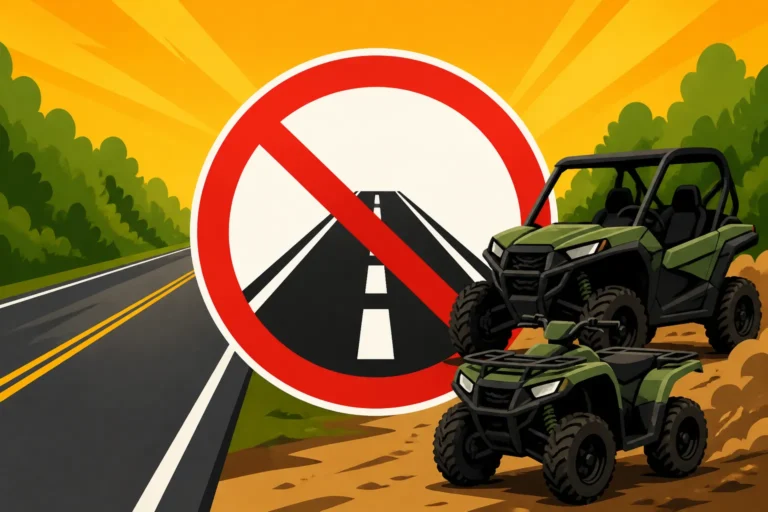
In Arkansas, the baseline rule for ATVs and UTVs is that they are generally prohibited from operating on public roads and highways. This is a tough pill to swallow for many riders who just want to get from point A to point B or access a remote trail. Because many logging roads are classified as public roads, even if they're gravel or dirt, they inherently fall under this restriction. This default ban is in place to maintain traffic safety and prevent conflicts between slower-moving, less protected off-highway vehicles and standard road traffic. It's a common source of frustration, especially when these roads seem perfectly suited for off-road machines. If you've ever tried to map out a route through the woods only to find your path blocked by this rule, you know exactly what I mean. Remember, Arkansas has a clear stance that [Arkansas Makes Road Riding Unlawful by Default].
What Defines a "Public Road" or "County Road"?
The definition of a public road in Arkansas can be a bit nebulous for the average person, but generally, it refers to any road or highway that is maintained by a governmental entity – be it the state, a county, or a city – and is open to the public for vehicular travel. Even if a logging road sees very little traffic or isn't paved, if the county road department performs maintenance on it, such as grading, graveling, or culvert repair, it's likely considered a public road. This is a critical distinction because it means even roads deep in the forest, which feel like private trails, can still be subject to public road laws. The surface doesn't always tell the whole story.
The Implications for ATV/UTV Riders on Public Logging Roads
So, what does this mean for you when you're itching to ride a logging road? It means that if that logging road is indeed a public road, you generally cannot ride your ATV or UTV on it. This can seriously limit direct access to certain areas, like hunting leases or remote campgrounds, and often forces riders to trailer their machines much closer to their destination or to designated off-road parks. It's not the answer most riders want to hear, especially when the path seems perfect for their machine, but it's the law. Violating this can lead to citations, fines, and even your machine being impounded, so it's not something to take lightly.
Navigating the Exceptions: When Can You Ride a Logging Road?
While the default rule for public roads is restrictive, Arkansas law does provide [Arkansas's Six Statutory Road Exceptions] where ATVs and UTVs are allowed to operate on public roads, including those logging roads classified as such. Understanding these exceptions is key to legally enjoying these scenic routes. However, these aren't free passes to joyride; they are specific and must be adhered to strictly.
1. Farming Operations and How They Apply
One significant exception allows ATVs and UTVs to operate on public roads, including logging roads, when directly related to a farming operation. This means if you're using your machine for agricultural purposes, such as hauling supplies, checking livestock, or accessing fields on land that is genuinely part of a farming operation, you may be permitted to ride on these roads. The key here is "directly related." You can't just take a scenic ride and claim you're scouting for a future garden plot. The use must be legitimate and part of ongoing agricultural work. Think about a farmer checking fence lines or moving equipment between pastures. This exception is designed to facilitate necessary agricultural activities, not recreational riding. For more details on this, look into [Arkansas Farming Operation Road Use].
2. Hunting Operations and Their Scope
Similar to farming, Arkansas law provides an exception for ATVs and UTVs used in conjunction with a legitimate hunting operation. This is a huge one for many riders who use their machines to access remote hunting camps, retrieve game, or scout for deer stands. The catch? Again, it must be "directly related" to a hunting operation. This usually means during open hunting seasons and while actively engaged in activities like transporting gear, hunters, or harvested animals to and from a hunting lease or private property. Cruising around for fun on a logging road that's also a public road, even during hunting season, might not qualify if you're not demonstrably involved in a hunting operation. It's about purpose, not just presence. [Arkansas Hunting Operation Road Use] provides more context here.
3. Direct Crossing of a Public Road
There are times when a logging road might intersect with another public road, or you might need to cross a paved road to get from one section of trail to another. Arkansas law allows ATVs and UTVs to cross a public road or highway, including logging roads that are classified as such, but with very strict conditions. You must bring your machine to a complete stop, cross at approximately a ninety-degree angle, and yield to all oncoming traffic. This isn't permission to ride down the road, but merely to traverse it as directly as possible to continue on an off-road path. It's a quick, perpendicular movement, not a leisurely drive. It's a common maneuver when you have a vast network of trails or private land split by a small county road. Understanding [Arkansas Crossing a Highway on an ATV in Arkansas] is crucial for this.
4. Disability, Emergency, and Utility Use
Beyond farming, hunting, and direct crossings, there are a few other specific exceptions that are less common for the average recreational rider but are important to know. Individuals with a serious walking disability can obtain a permit to operate an ATV or UTV on public roads for transportation related to their disability. Additionally, law enforcement, emergency medical services, and utility company personnel are often exempt when performing official duties. State parks employees also have an exemption for their work. These exceptions are for specific, authorized uses and don't apply to general public recreational riding.
The World of Private Logging Roads: Permission is Key
While many logging roads are public, a significant number of them are entirely on private property, owned by timber companies, private landowners, or hunting clubs. These roads are not public thoroughfares, and the rules for riding them are completely different.
Identifying Private Versus Public Logging Roads
How do you know if a logging road is private or public? This can be the trickiest part. Signs are the easiest indicator: "Private Property," "No Trespassing," "Authorized Vehicles Only," or gates clearly mark private land. However, not all private roads are well-marked. Sometimes, checking county plat maps or land ownership records can help, but that's a lot of work for a spontaneous ride. Often, it comes down to local knowledge or asking around. If a road leads directly into what appears to be actively managed timberland and isn't maintained by the county, it's a good bet it's private. If it's used by a hunting club, it's definitely private. Always err on the side of caution.
Seeking Permission from Landowners
If a logging road is on private property, the golden rule is simple: you absolutely must have permission from the landowner to ride there. Riding on private land without explicit permission is trespassing, a legal offense that can lead to fines, your machine being impounded, and a lot of headaches. This holds true whether the landowner is a large timber company like Weyerhaeuser or a private individual. Many timber companies have specific policies regarding public access, some allowing it under certain conditions, others prohibiting it entirely. It's not uncommon for these companies to lease hunting rights to clubs, and those clubs then control access. If you're a member of a hunting club, your lease agreement might outline your riding privileges. Always carry proof of permission if you have it. You can learn more about this in [Arkansas Rules With a Landowner's Permission] and [Arkansas Rules on Land You Lease].
The Importance of Posted Land and Purple Paint
Arkansas has a "purple paint law" which allows landowners to mark their property boundaries with purple paint instead of traditional "No Trespassing" signs. A stripe of purple paint on trees or posts at specific intervals serves as legal notice that the land is private and entry is prohibited without permission. Whether it's purple paint or explicit "No Trespassing" signs, these are legally binding and must be respected. Ignoring them can lead to charges under [Arkansas Trespass Law for Riders]. Even if you don't see specific signs but suspect the land is private, it's best to turn around rather than risk trespassing. When in doubt, don't go.
Here's a quick summary of the differences between public and private logging roads:
| Feature | Public Logging Road (County Road) | Private Logging Road (Timber Co./Individual) |
|---|---|---|
| Legal Status | Generally public thoroughfare | Private property |
| Maintenance | Often by county road department | By landowner, timber company, or not at all |
| ATV/UTV Riding | Generally prohibited, except for specific exceptions | Requires explicit landowner permission |
| Access Indicators | Unmarked, sometimes named on maps | "Private Property," "No Trespassing" signs, gates, purple paint |
| Enforcement | State & local law enforcement (fines, impound) | Landowner can enforce trespass laws (fines, charges) |
| Primary Use | General public access, resource extraction | Resource extraction, hunting, private recreation |
Safety and Etiquette on Logging Roads
Whether you're on a public logging road under an exception or a private one with permission, safety and respectful riding are paramount. These roads often present unique hazards and require a different approach than groomed trails.
Sharing the Road with Logging Trucks and Other Vehicles
Logging roads are, by their very nature, active industrial sites. This means you are highly likely to encounter heavy machinery, especially logging trucks. These trucks are massive, fast, and often loaded, and they have the right-of-way. They cannot stop quickly and their drivers often have limited visibility. If you see a logging truck approaching, pull over immediately and give them ample room. This isn't the place to play chicken or try to squeeze by. Similarly, you might encounter other vehicles, like timber company supervisors in pickups, hunters in their own trucks, or even other recreational users. Always assume there could be oncoming traffic, especially around blind turns or over hills. The product durability from companies like SuperATV can certainly help your machine stand up to rough roads, but no amount of aftermarket strength can save you from a collision with a fully loaded logging truck.
Table: Logging Road Safety Checklist
| Item | Importance | Details |
|---|---|---|
| Yield to Large Vehicles | Crucial for survival | Logging trucks, heavy machinery have right-of-way; pull over. |
| Visibility | Prevent collisions on blind turns | Assume oncoming traffic; consider flagging if dusty. |
| Helmets | Arkansas has no helmet law, but always recommended | Protects against head injury on unexpected bumps or falls. |
| Spark Arrestor | Legal requirement for forest riding | Prevents wildfires; check if your machine has one. |
| First Aid Kit | Remote areas mean delayed help | Essential for minor injuries or emergencies. |
| Communication Device | Cell service can be spotty | Satellite messenger or two-way radio for emergencies. |
| Water & Snacks | Stay hydrated, fueled for unexpected delays | Remote areas mean no quick stores. |
| Map & Compass/GPS | Easily get lost on complex networks | Paper map backup is always a good idea. |
| Appropriate Tires | Enhance grip on varied terrain | Good for mud, gravel, and rocky sections. SuperATV offers great options. |
| Spare Tire/Repair Kit | Flats are common on logging roads | Patch kit or spare tire for UTVs can be a lifesaver. |
Environmental Considerations and Tread Lightly Principles
When riding logging roads, especially those that traverse sensitive forest ecosystems, it's vital to practice responsible riding and "Tread Lightly." This means staying on existing roads and trails, not creating new ones, and avoiding riding in extremely wet or muddy conditions that can cause excessive rutting and erosion. Respect all natural resources, wildlife, and other users. Pack out everything you pack in, and leave no trace. Many logging roads are critical for forest management, and abuse can lead to closures or stricter regulations for everyone. Maintaining a well-equipped machine with quality components, such as those from SuperATV, ensures reliability and reduces the chances of breaking down and leaving debris.
Essential Gear for Logging Road Adventures
Because logging roads can be remote and unpredictable, being well-prepared is key. Beyond your basic riding gear, consider bringing:
- A reliable map and GPS: Cell service can be spotty in many parts of rural Arkansas.
- First aid kit: For minor scrapes or more serious incidents far from help.
- Tools and spare parts: A tire repair kit, basic tools, and perhaps a spare belt can get you out of a bind.
- Plenty of water and snacks: You never know how long you might be out.
- Fire extinguisher: Especially in dry conditions, a small fire can quickly get out of control.
- Winches and recovery gear: For those inevitable moments when you (or a buddy) get stuck.
Riding logging roads in Arkansas offers incredible access to nature and exciting adventures. By understanding the distinction between public and private roads, strictly adhering to the legal exceptions, and practicing responsible riding, you can ensure your trips are both enjoyable and lawful. Always prioritize safety, respect the land, and stay informed about local regulations.
Disclaimer
This article is for general informational purposes only and does not constitute professional advice. Laws, prices and regulations vary by location and change over time. Consult a qualified professional for guidance on your specific situation.