Arkansas Rules for Riding a Gravel Road
Riding an ATV or UTV in Arkansas can be an absolute blast, a fantastic way to experience the state's natural beauty or simply get work done on the farm. But when it comes to riding those machines on public roads, especially those seemingly innocuous gravel roads that crisscross the countryside, many riders find themselves in a real pickle. The assumption often goes, "It's just gravel, not a highway, so it must be okay, right?" Unfortunately, that assumption can lead to unexpected fines and a ruined day. This guide is here to untangle the often-confusing rules surrounding ATVs and UTVs on Arkansas's gravel, county, and unpaved roads, helping you understand where you can legally ride and what precautions you need to take.
The Blanket Ban and Key Exceptions for Off-Highway Vehicles on Arkansas Roads
Let's start with the fundamental truth that often surprises people: Arkansas has a general prohibition against riding ATVs and UTVs on public roads. This isn't just for major interstates or busy paved highways; it applies to all public roads by default, including those charming, dusty gravel routes. Ignorance of this rule is no defense, and a deputy patrolling a county road can and will issue a citation if you're caught riding illegally.
The General Rule: No ATVs/UTVs on Public Roads
The core of the issue stems from Arkansas Code Annotated § 27-21-106, which broadly defines what constitutes an "off-highway vehicle" and prohibits its operation on public streets or highways. The key here is "public." If a road is maintained by the state, county, or a municipality, it falls under this blanket prohibition. This means that scenic gravel county roads, the dirt road leading to your favorite fishing spot, or even a quiet residential street in a small town are, by default, off-limits for your ATV or UTV.
This can be incredibly frustrating for riders who just want to get from one section of their property to another, or access a trail system that happens to have a county road in between. It forces a lot of folks to trailer their machines even for short distances, which feels cumbersome and unnecessary for a quick hop down the road. Understanding [Can You Drive an ATV on the Road in Arkansas?] is crucial before you even think about putting tires to asphalt or gravel. The law prioritizes public safety and the safe flow of traffic, which is why these powerful, often non-street-legal machines are generally kept off public thoroughfares.
Understanding Arkansas's Six Statutory Road Exceptions
While the general rule is a firm "no," Arkansas law does provide [Arkansas's Six Statutory Road Exceptions] where an off-highway vehicle can legally be operated on a public road. These exceptions are specific and should not be interpreted broadly. They are not an open invitation to joyride on county roads but rather narrowly defined allowances for specific circumstances.
- Farming Operations: This is a big one for many rural residents. You can operate an ATV or UTV on a public road when it's being used directly in a farming operation. This means moving between fields, accessing equipment, or tending to livestock. It doesn't mean taking a scenic ride on a Sunday afternoon just because you own a few chickens. This is strictly about the legitimate business of farming, as detailed in [Arkansas Farming Operation Road Use].
- Hunting Operations: Similar to farming, ATVs and UTVs can be used on public roads as part of a hunting operation. This typically involves traveling to and from a hunting camp or a specific stand location during an open hunting season. Again, this is not an excuse for recreational riding, but for a direct purpose related to hunting, as covered by [Arkansas Hunting Operation Road Use].
- Serious Walking Disability: Individuals with a serious walking disability can operate an ATV or UTV on a public road if it's necessary for their mobility. Proper documentation is usually required to prove the disability.
- Law Enforcement and EMS: Obviously, law enforcement, fire, and emergency medical services personnel can use ATVs and UTVs on public roads while performing their official duties.
- Utility Company Crews: Utility workers, such as those for electric, gas, or telecommunications companies, can use these machines on public roads to access and maintain utility infrastructure.
- Direct Crossing: This is perhaps the most commonly misunderstood exception. You can make a direct crossing of a public street or highway at approximately a ninety-degree angle, but only after coming to a complete stop and yielding to all traffic. This allows you to cross a gravel county road to get from one section of your property to another, or to reach a trail on the opposite side of the road. It does not, however, allow you to ride down the road, even for a short distance. This critical rule is further explained in [Arkansas Direct Crossing at Ninety Degrees].
These exceptions are your only legal pathways for operating an OHV on a public road in Arkansas, gravel or otherwise, without a specific local ordinance. Always ensure your use strictly falls within one of these definitions to avoid a citation.
Riding on Unpaved, Gravel, and County Roads: A Closer Look
When people talk about riding ATVs and UTVs on "the roads," they often differentiate between paved highways and unpaved gravel or dirt roads. In Arkansas, this distinction can be a bit of a trap if you assume "unpaved" means "unregulated." The truth is more nuanced, especially concerning how the law views these rural byways.
Distinguishing Paved vs. Unpaved from a Legal Standpoint
From a legal perspective in Arkansas, the surface material of a public road (paved, gravel, dirt) doesn't change its classification as a "public street or highway." If the county or state maintains it, or it's dedicated for public use, it's a public road, and the default prohibition against ATVs and UTVs applies. This means a dusty, single-lane gravel path leading to a remote cabin is treated legally the same as a bustling paved highway when it comes to off-highway vehicle use, unless one of the six statutory exceptions (or a local ordinance for UTVs) is in play.
This is a key point of confusion. Many riders, especially those from states with more lenient rules for rural unpaved roads, might mistakenly believe that Arkansas's laws are similar. They are not. A county road, regardless of its surface, is still a county road. So, when you're thinking about [Arkansas Rules for Riding a County Road], remember that the core prohibition still applies unless you meet a specific exemption. This often means that even if you're just taking your UTV a quarter-mile down a gravel road to check the mail, you're technically violating the law if you don't fit one of those six exceptions.
Practical Scenarios for Riding on Gravel Roads Under Exceptions
Let's consider some real-world examples where the exceptions might apply to a gravel road.
Imagine you're a farmer in Pope County with fields on both sides of a gravel county road. You need to move your utility vehicle, loaded with tools, from one field to the other. Under the farming operations exception, this would likely be permitted. You're using the machine for an agricultural purpose, and the gravel road is part of that necessary movement. However, if you finished your chores and decided to take a scenic loop on the gravel road just for fun, that would fall outside the exception and could result in a ticket.
Another common scenario involves hunting. You've leased some land in the Ouachitas, and the only way to get to your hunting stand is to drive your ATV a short distance on a gravel logging road that also happens to be a county-maintained route. During deer season, this would typically fall under the hunting operations exception. You're using the ATV as part of your legitimate hunting activity. Again, this doesn't authorize general recreational riding on that same road outside of the direct scope of hunting. Many landowners who have large tracts crossed by county roads rely on these exceptions.
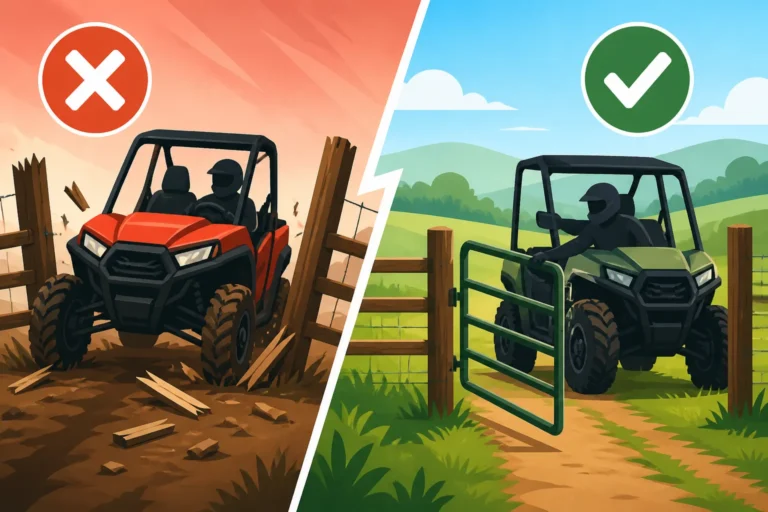
Even if you're not farming or hunting, the "direct crossing" exception is vital for many. Let's say your property is bisected by a gravel road. To get your ATV from the barn on one side to your back acreage on the other, you must cross the road. You absolutely can. But you must come to a complete stop, look both ways (even if it's a rarely traveled road), yield to any traffic, and then proceed directly across at a ninety-degree angle. You cannot turn onto the road, ride down it for any distance, and then turn off. It's a "cross and go," not a "ride and turn." This applies whether you're dealing with asphalt or a dirt path.
The "Direct Crossing" Rule on Gravel Roads
The direct crossing rule is a lifeline for many rural landowners and riders, but it's crucial to understand its strict limitations. As mentioned, it allows you to cross a public road, including a gravel one, at approximately a ninety-degree angle. The operative words here are "cross" and "approximately a ninety-degree angle."
What does this look like in practice? Imagine a straight section of a gravel county road. You're on your side-by-side on your private property, directly adjacent to the road. You wish to access your property on the other side. You must [Crossing at a Complete Stop] before entering the roadway. This means coming to a full halt, assessing traffic, and ensuring the way is clear. Then, and only then, can you proceed across the gravel road. You should aim to make your path across as perpendicular to the flow of traffic as possible – hence the "ninety-degree angle" phrasing. You are not allowed to drive parallel to the road for any distance, even if it's just a few feet to align yourself better for a turn into a driveway on the other side.
This rule is often interpreted very literally by law enforcement, and for good reason: it's designed to minimize the time an OHV is operating on a public thoroughfare, reducing potential hazards. A direct crossing is a specific maneuver, not an excuse to briefly travel on the road. If you find yourself needing to go any distance along a gravel road, you either need to fit one of the other five statutory exceptions, or if you have a UTV, you need to be in an area with a valid local ordinance that permits street-legal UTVs. This distinction is vital for staying on the right side of the law.
UTVs and the Rise of Local Ordinances on Public Ways
While ATVs and UTVs are both off-highway vehicles, UTVs (or side-by-sides) have a distinct advantage when it comes to road use in Arkansas: the possibility of local ordinances. A significant change in Arkansas law now allows cities and counties to create their own rules for UTVs on certain public streets, including some gravel roads within their jurisdiction.
How Arkansas Cities Can Open Streets to UTVs
For years, the statewide ban on ATVs and UTVs on public roads was rigid. However, [Arkansas Towns Can Open Their Streets to UTVs] due to Act 922, which became effective in August 2025. This act gives city councils and county quorum courts the authority to pass ordinances allowing the operation of "utility terrain vehicles" (UTVs) on public streets within their jurisdiction. This is a game-changer for UTV owners, but it's critical to understand that this authority is local-option, not statewide.
This means that whether you can ride your UTV on a gravel road in, say, Eureka Springs versus Springdale, depends entirely on whether those specific cities (or the county they are in, if applicable) have passed an ordinance. And even then, the ordinance will specify which roads are open and under what conditions. It's not a green light for all UTVs on all city or county roads. These ordinances typically stipulate speed limits (often under 55 mph), require specific equipment, and mandate permits or insurance. If you're hoping to ride your UTV on public roads, your first step is to check with the city or county clerk's office in the area you plan to ride to see if such an ordinance exists. Without a specific local ordinance, the default state-level ban on public road use still applies, even for UTVs. This nuance is why a resource like [Arkansas UTV Street Legal Rules by Town] is so important.
What a Local Ordinance Might Mean for Gravel Roads
If a city or county does pass a UTV ordinance under Act 922, it will outline the specific types of roads that are open to UTV traffic. This could absolutely include gravel or unpaved roads within that jurisdiction. For example, a small rural town might open all its non-state highway gravel roads to permitted UTVs, recognizing that these machines are a practical mode of transportation for its residents.
However, the ordinance will also come with requirements. It's not just a free-for-all. You'll likely need to ensure your UTV meets certain street-legal equipment standards. Companies like SuperATV offer a wide range of accessories, from mirrors and turn signal kits to horns and windshields, that can help bring your UTV into compliance with these local street-legal requirements. These accessories are essential if you plan to take advantage of any local ordinances.
It's also crucial to distinguish between cities and counties. A city ordinance only applies within the city limits. If you ride your UTV on a gravel county road outside those city limits, you're back under the statewide prohibition unless the county quorum court has also passed its own ordinance. This patchwork of rules means you need to be diligent about knowing the local laws for your specific riding area. Never assume that because one town allows UTVs on its gravel roads, the next town over or the unincorporated county land will too.
Key Requirements for Street-Legal UTVs Under Local Ordinances
When a city or county passes an ordinance allowing UTVs on its streets, it's not simply a matter of getting permission. These ordinances typically come with a list of mandatory equipment and operational requirements designed to make UTVs safer for road use and compatible with other traffic. These requirements often mirror those for other low-speed vehicles or golf carts.
Common requirements often include:
- Lights: Headlights, taillights, brake lights, and often turn signals. Many UTVs come with basic lighting, but [Arkansas Turn Signals and Mirrors on a UTV] are often an aftermarket addition needed for street legality.
- Mirrors: Side mirrors and a rearview mirror are usually mandatory to ensure proper visibility.
- Horn: A working horn is a standard safety requirement.
- Windshield: Some ordinances may require a windshield.
- Seatbelts: While UTVs typically have seatbelts from the factory, ensuring they are functional and worn is usually part of the rules.
- Insurance: Proof of liability insurance is almost always required for any vehicle operating on public roads. This is a critical point covered in [Arkansas Insurance for a Street-Permitted UTV].
- Driver's License: The operator must possess a valid driver's license. There's typically a minimum age, often 16, for driving street-permitted UTVs.
- Permit/Decal: The city or county will often require you to obtain an annual permit and display a decal on your UTV, proving it's been inspected and registered for street use within that jurisdiction.
Remember, these are not universal laws but specific requirements set by the local ordinance. Always review the exact text of the ordinance for the area where you intend to ride. Installing the right accessories from a reputable vendor like SuperATV can help ensure your UTV meets these crucial safety and legal standards, saving you from potential fines or accidents.
Safety and Smart Riding Practices on Arkansas Gravel Roads
Even when you're legally riding an ATV or UTV on a gravel road, whether through an exception or a local ordinance, it presents unique challenges compared to a paved surface or an off-road trail. Prioritizing safety and adopting smart riding practices is paramount.
The Unique Challenges of Gravel Road Riding
Riding an ATV or UTV on gravel roads comes with its own set of dangers that riders need to be acutely aware of. Unlike a paved road that offers consistent traction or a dedicated dirt trail with predictable obstacles, gravel can be highly variable and unpredictable.
- Reduced Traction: Loose gravel significantly reduces tire traction, making it easier to slide, especially when accelerating, braking, or turning. This can lead to a loss of control much more quickly than on pavement. Aggressive or knobby tires, which excel off-road, can sometimes feel squirrelly on loose gravel. When considering tires, think about the kind of riding you'll primarily be doing; some all-terrain options might offer a better compromise for occasional gravel road use. SuperATV, for instance, offers a variety of tires that can handle mixed terrain effectively, but always match the tire to your specific conditions.
- Dust: On dry days, gravel roads kick up an enormous amount of dust, drastically reducing visibility for you and making it difficult for other drivers to see you. This is especially dangerous when following other vehicles or encountering oncoming traffic.
- Loose Aggregate and Washboards: Gravel roads can develop "washboarding"—a series of ripples that create a bumpy, vibrating ride and can lead to loss of control. Large, loose rocks can also be thrown by tires, potentially damaging your machine or posing a hazard to others. Your machine's suspension system will get a workout, and if it's not up to par, you'll feel every bump. Upgrading suspension components from a company like SuperATV can significantly improve comfort and control on these types of roads.
- Blind Corners and Hills: Rural gravel roads often have blind corners and steep hills with limited sightlines. The risk of encountering another vehicle (a truck, car, or another OHV) unexpectedly is high.
These challenges highlight why cautious and defensive riding is so important on gravel roads, even when operating legally.
Essential Gear and Preparedness
No matter how short the ride or how familiar the road, wearing appropriate safety gear is non-negotiable when operating an ATV or UTV on gravel roads.
- Helmets: While Arkansas does not have a mandatory [Arkansas ATV Helmet Requirements] for adult riders, wearing a helmet is simply smart. A fall or collision on a gravel road can result in serious head injuries, regardless of speed. Ensure it's DOT-approved and fits properly. For youth riders, helmets are absolutely essential and often legally required.
- Eye Protection: Dust, rocks, and debris are constant threats on gravel roads. Goggles or a full-face helmet with a visor are crucial for [Eye Protection Worth Wearing]. Without them, your vision can be compromised, leading to dangerous situations.
- Gloves: Gloves improve grip, reduce hand fatigue from vibrations, and offer protection in case of a fall.
- Long Sleeves and Pants: These protect your skin from abrasions, branches, and sun exposure.
- Sturdy Footwear: Closed-toe boots offer protection and better grip on footpegs or floorboards.
Beyond personal gear, consider equipping your machine for safety. A basic toolkit, a tire repair kit, and a first-aid kit are always good to have. If you're on a less-traveled road, consider a communication device like a satellite messenger where cell service is unreliable. Being prepared for common mishaps means a safer and more enjoyable experience for everyone.
Respecting Property and Local Residents
Riding on gravel roads, even legally, comes with a responsibility to be a good neighbor and respect the environment. Many gravel roads pass directly by homes, farms, and private property, and excessive noise or dust can be a major nuisance to residents.
- Manage Your Speed: Slow down when passing residences or livestock. This reduces dust, noise, and the chance of spraying gravel onto private property. It also allows you more time to react to unexpected situations like children or animals near the road.
- Control Dust: If the road is very dry, slowing down is the best way to minimize dust. This improves visibility for everyone and shows consideration for those living along the road.
- Noise Levels: While ATVs and UTVs are inherently noisy, avoid modifications that make them excessively loud. If your machine is equipped with a particularly loud exhaust, it's worth considering alternatives, potentially quieter options from a supplier like SuperATV, especially if you plan to frequently ride on roads near residential areas.
- Stay on the Road: Never venture off the gravel road onto private property without explicit permission from the landowner. [Arkansas Trespass Law for Riders] is strictly enforced, and it's essential to know where private property begins and ends. Look for fences, "No Trespassing" signs, or purple paint marks, which are also indicators of private land in Arkansas.
- Be Mindful of Other Users: Gravel roads are often shared by various users—cars, trucks, bicycles, pedestrians, and even horse-drawn buggies in some areas. Always yield to other traffic, slow down, and pass safely. Remember, they might not expect to see an ATV or UTV on the road.
By practicing responsible riding, you not only ensure your own safety but also help maintain a positive image for the entire ATV and UTV community, which can be crucial for encouraging continued access and reasonable regulations.
| Road Type | Default ATV/UTV Status in Arkansas | Exceptions & Considerations |
|---|---|---|
| Paved State Highway | Prohibited | Only by specific statutory exception (e.g., direct crossing, farming) |
| Paved City Street | Prohibited | UTVs may be allowed by local ordinance (Act 922), ATVs generally not. |
| Gravel County Road | Prohibited | UTVs may be allowed by local ordinance, or by statutory exception (e.g., farming, hunting, direct crossing). ATVs only by statutory exception. |
| Dirt Private Road | Permitted (with owner permission) | Not a "public" road; owner's rules apply. |
| Designated OHV Trail | Permitted | Requires appropriate permits (e.g., Forest Service), safety gear. |
Disclaimer
This article is for general informational purposes only and does not constitute professional advice. Laws, prices and regulations vary by location and change over time. Consult a qualified professional for guidance on your specific situation.