Motor-Driven Cycles and Motorized Bicycles
It's incredibly frustrating when you're trying to figure out what the rules are for your ATV or UTV in Arkansas, only to run into legal jargon that seems to apply to some machines, but maybe not yours. Many riders get caught up trying to understand if their quad or side-by-side falls under categories like "motor-driven cycles" or "motorized bicycles," especially when it comes to helmet laws and street legality. This guide is here to untangle that confusion, explaining what these terms actually mean in Arkansas law and, more importantly, why your ATV or UTV is usually defined quite differently, with significant implications for how and where you can ride.
Understanding Arkansas's Legal Definitions
Before we can understand why ATVs and UTVs are not motor-driven cycles or motorized bicycles, we first need to get a handle on what Arkansas law does classify those terms as. It's all about very specific legal definitions that often hinge on things like engine size, the ability to pedal, and top speed. Getting these straight is the first step in making sense of the state's rules.
What is a Motor-Driven Cycle in Arkansas?
In Arkansas, a "motor-driven cycle" generally refers to a two-wheeled vehicle that has an engine no larger than 250 cubic centimeters (cc). Think of smaller motorcycles, scooters, or mopeds that don't require you to pedal. These machines are designed primarily for motorized propulsion, and while they might not have the power of a full-sized motorcycle, they are still considered motor vehicles for many legal purposes, including registration and operator licensing.
The law sets these specific engine displacement limits because it aims to categorize vehicles based on their potential speed and impact on public roads. If you're riding something like a 150cc scooter around town, it likely falls squarely into this category. The legal distinction means that certain rules, like those for headlights, taillights, and often helmet requirements, apply to these vehicles, setting them apart from both larger motorcycles and the off-road machines we love.
What is a Motorized Bicycle in Arkansas?
A "motorized bicycle" in Arkansas is a different beast altogether. This term specifically refers to a bicycle that has an attached motor, usually a small one, that assists with propulsion. The key here is that it retains the ability to be pedaled by the operator. Arkansas law typically limits the engine size for a motorized bicycle to less than 50 cc and often caps its top speed to around 20 or 25 miles per hour on level ground when the motor is engaged.
These are the kinds of vehicles you might see where someone has added a small gasoline engine kit to a regular bicycle, or purpose-built electric bicycles that offer pedal assist. Because they can be operated like a bicycle, they often have a unique set of rules that sit somewhere between a regular bicycle and a full-fledged motor vehicle. The legal framework acknowledges their dual nature, but it also creates clear boundaries so they aren't confused with more powerful machines that demand different safety and registration protocols.
Why ATVs and UTVs Are Different
This is where the rubber meets the trail, so to speak. Your ATV or UTV, while it certainly has a motor and can move, typically doesn't fit into either the "motor-driven cycle" or "motorized bicycle" definitions under Arkansas law. The distinctions are crucial because they dictate everything from whether you need a helmet to whether you can legally ride on public roads.
The Key Distinctions in Vehicle Classifications
The main reason ATVs and UTVs are treated differently comes down to their design, size, and intended use. Arkansas law defines an ATV generally as a machine that's 50 inches or less in width, has a dry weight of 1,000 pounds or less, and is designed for off-highway use. Side-by-sides (UTVs) often exceed these width and weight limits, falling into a broader "off-road vehicle" category, but are similarly not designed for public road use by default. These classifications are miles apart from the narrow, two-wheeled, smaller-engined definitions of motor-driven cycles or motorized bicycles.
For instance, an ATV typically has four wheels and handlebars, while a UTV has multiple wheels (often four or six), a steering wheel, and bucket seats. Neither of these configurations aligns with the two-wheeled, pedal-capable, or sub-250cc engine characteristics of the other categories. This fundamental difference in design and performance is why they are regulated under completely separate statutes. Understanding [Arkansas's 50-Inch, 1,000cc ATV Definition] helps clarify these distinctions. When your machine is wider than 50 inches or weighs more than 1,000 pounds, it immediately falls outside the common ATV definition and certainly outside the scooter or motorized bicycle category.
Implications for Road Legality and Exceptions
Because ATVs and UTVs don't fit the definitions of street-legal motor-driven cycles or motorized bicycles, they are generally not allowed on public roads in Arkansas. This is a critical point of frustration for many riders who wish they could simply take their side-by-side down the road to a gas station or trailhead. Instead, their road use is restricted to a very specific set of exceptions carved out in state law, or through local ordinances passed by individual cities.
These exceptions, such as those for farming or hunting operations, or direct ninety-degree crossings, are quite narrow. They do not grant ATVs or UTVs the same general road access that a properly registered motor-driven cycle might have. Similarly, for UTVs, many towns across Arkansas have passed ordinances allowing them on certain city streets, but even these local rules often come with specific requirements for permits, insurance, and equipment that further highlight their distinct legal status. You can learn more about these exceptions in [Arkansas's Six Statutory Road Exceptions] and how [Arkansas Towns Can Open Their Streets to UTVs]. Without these specific exceptions or ordinances, taking your quad or side-by-side onto a public road could lead to a citation for illegal road riding, a problem that riders of motor-driven cycles rarely face unless they are violating traffic laws specific to those vehicles.
Helmet Laws: Where the Confusion Often Lies
One of the biggest areas of confusion stems from helmet laws. Many people assume that if a vehicle has a motor and is ridden, a helmet is required by law. However, Arkansas law is very specific about which types of vehicles require helmets, and this is where the distinction between ATVs/UTVs and motor-driven cycles/motorized bicycles becomes particularly important.
Arkansas's Motorcycle Helmet Rule Is Not an ATV Rule
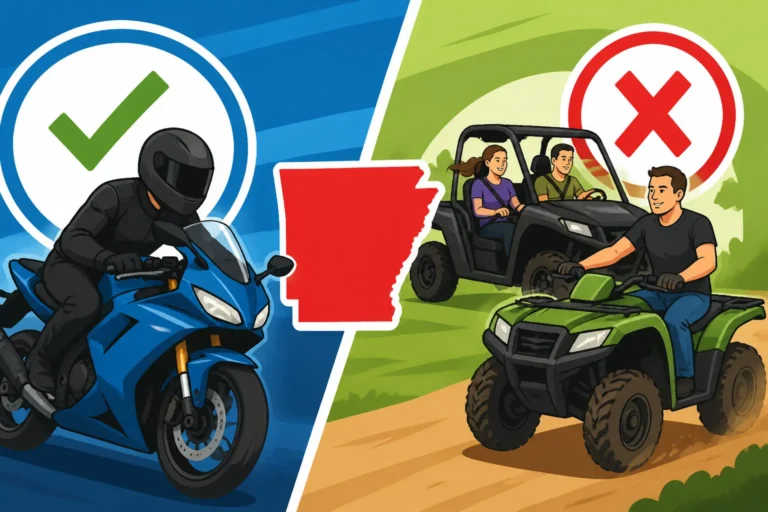
It's a common misconception, but the Arkansas law requiring helmets for certain riders does not apply to ATVs or UTVs. The statute, often referred to as the "motorcycle helmet rule," specifically targets operators and passengers of motorcycles, motor-driven cycles, and motorized bicycles who are under a certain age (typically 21, though details can vary and change). This means that while a 19-year-old on a moped might legally need to wear a helmet, that same 19-year-old on a quad often doesn't face the same state-mandated requirement.
The law is meticulously worded to define "motor-driven cycle" and "motorized bicycle" and then apply helmet mandates to those specific classifications. ATVs and UTVs simply don't fall into those categories. Therefore, [Arkansas Has No ATV Helmet Law] that specifically mirrors the motorcycle helmet requirements. This doesn't mean it's a good idea to ride without one, but legally, the state does not mandate it for ATVs and UTVs in the same way it does for other two-wheeled, motor-driven vehicles.
Why This Distinction Matters for Riders
For ATV and UTV riders, this legal distinction is critically important because it clarifies their responsibilities. You won't be pulled over or ticketed by a state trooper for not wearing a helmet on your ATV in a national forest, for example, based on the state's motorcycle helmet law. However, it's vital to remember that "not legally mandated" does not mean "not recommended." The absence of a state helmet law for ATVs in Arkansas is a key point that differentiates them from motor-driven cycles and motorized bicycles, which do have such mandates for younger riders.
This legal void puts the onus on the rider to make wise safety choices. While you might not face a fine from the state for riding helmet-less on your quad, the risks of head injury in an accident are just as real, if not more so, than on a two-wheeled vehicle. It’s a point of rider freedom, certainly, but one that comes with a significant personal safety consideration. This distinction helps you understand what a deputy can legally ask to see versus what is simply a smart practice for self-preservation.
Navigating Local Ordinances and Safety Recommendations
While state law might not classify your ATV or UTV as a motor-driven cycle, and therefore not impose the same helmet mandates, the conversation doesn't end there. When you venture into areas where local rules come into play, or simply consider your own well-being, additional factors come into focus.
Local Ordinances and Equipment Requirements
Here's where things can get a little nuanced. While state law doesn't typically require helmets for ATVs and UTVs, if you plan to ride your UTV on city streets where an ordinance allows it, that local municipality can and often does impose its own equipment requirements. Many towns that have passed ordinances to allow UTVs on their streets will stipulate that operators and passengers must wear helmets, even if state law doesn't. They might also require things like turn signals, mirrors, or specific lighting – items that might not be standard on your off-road machine but are common on motor-driven cycles.
This is why it's absolutely crucial to check the specific ordinance of any town where you intend to ride your UTV on the streets. What's legal and required in Bono, for example, might be different from what's allowed in another Arkansas city. These local rules often exist to ensure public safety when off-road vehicles share the road with traditional traffic. For more on what cities might require, look into [Arkansas UTV Street Permits and Annual Fees] and [Arkansas Equipment for a Street-Permitted Machine]. Companies like SuperATV offer a wide range of aftermarket accessories like turn signal kits and mirrors that can help UTV owners meet these local requirements, transforming an off-road machine into one capable of navigating city streets.
Prioritizing Safety Regardless of Legal Mandate
Even in the absence of a statewide legal mandate, prioritizing safety should always be at the forefront of every rider's mind. The terrain in Arkansas can be unpredictable, whether you're navigating rocky trails in the Ouachitas or muddy tracks in the Delta. Accidents happen, and a helmet is your best line of defense against serious head injuries. This isn't just about avoiding a ticket; it's about coming home safe.
Beyond helmets, consider other vital safety gear. Eye protection, sturdy boots, gloves, and long pants can prevent a lot of scrapes, breaks, and even permanent damage from flying debris or rollovers. Taking a voluntary safety course, even if it's not required, can also equip you with crucial skills for navigating challenging terrain and avoiding common riding hazards. Think of it this way: while the law differentiates your machine from a motor-driven cycle, your brain and body are just as vulnerable to impact, so protecting them is always the smartest move.
Here's a quick comparison of these vehicle types in Arkansas:
| Feature | Motor-Driven Cycle | Motorized Bicycle | ATV / UTV |
|---|---|---|---|
| Typical Design | Two-wheeled, engine-driven | Two-wheeled, pedal-capable | Multi-wheeled (3, 4, or 6), designed for off-road |
| Engine Size | Up to 250cc | Under 50cc | Often over 250cc, no strict upper limit |
| Pedal-Capable | No | Yes | No |
| Primary Use | Road travel, commuting | Pedal-assist, light travel | Off-road recreation, utility, hunting, farming |
| State Helmet Law (for riders <21) |
Yes | Yes | No |
| Default Road Legal | Yes, with registration | Often, with restrictions | No, only via specific exceptions/local ordinances |
| Registration | Required | Often exempt/different | Required (for most uses) |
Disclaimer
This article is for general informational purposes only and does not constitute professional advice. Laws, prices and regulations vary by location and change over time. Consult a qualified professional for guidance on your specific situation.