Parks Employees and Their Exemption
It's a common frustration for ATV and UTV owners across Arkansas: you've got this amazing machine designed for tackling tough terrain, but the moment you need to cross a public road, you're faced with a looming threat of a citation. The law is pretty clear that, for most of us, these vehicles belong off the pavement. However, there are very specific, statutorily defined exceptions to this rule, and one of the most important, yet often misunderstood, involves the dedicated folks who work in our state and national parks. This guide will walk you through exactly who qualifies, what they can do, and the nuances of the parks employee exemption.
Understanding Arkansas's General ATV/UTV Road Ban
Let's face it, the default rule in Arkansas about ATVs and UTVs on public roads can feel pretty restrictive. You've invested in a powerful, versatile machine, and it feels counterintuitive that you can't even run it down the road for a quarter-mile to get to the next section of your property or a different trail. This initial frustration is completely valid, as many other states have different rules. But in Arkansas, the general principle is that these vehicles are built for off-highway use, and our public roads are off-limits for the vast majority of riders.
The Default Rule: Off-Road Only
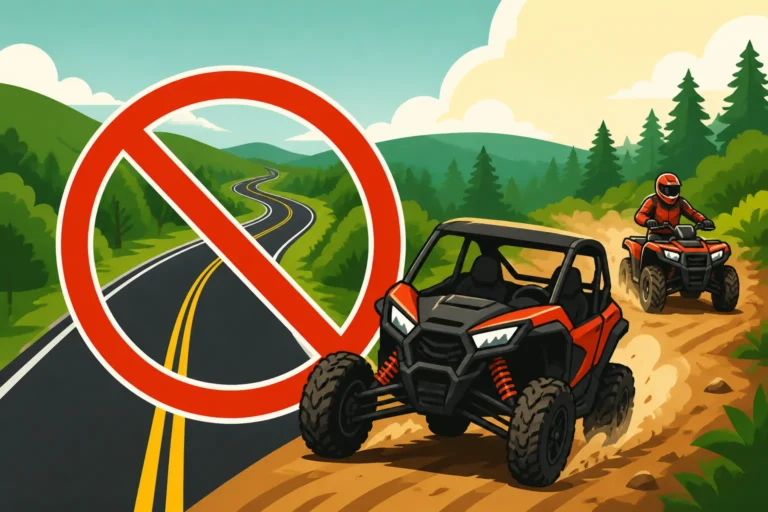
For personal use, if you're not on private property with permission, or within specific, locally approved UTV street legal zones, your ATV or UTV is expected to stay off public roads. This isn't just about highways; it extends to county roads, city streets, and even many gravel roads. The statute, specifically Arkansas Code Ann. § 27-21-106, lays this out in no uncertain terms. It's a blanket prohibition with only a handful of very specific carve-outs. We've gone into detail about this in [Can You Drive an ATV on the Road in Arkansas?].
Imagine you're at a popular trailhead, and you just want to drive your side-by-side to a nearby gas station for fuel. In many places, that's a quick, easy trip. In Arkansas, without a specific local ordinance permitting UTVs on that particular street (and those are rare for ATVs), you'd be breaking the law. It creates a logistical headache for many riders who just need to cover a short distance on a paved or graveled surface.
Why the Ban Exists: Safety and Vehicle Design
The rationale behind Arkansas's strict road ban often boils down to safety and the inherent design of ATVs and UTVs. These machines are engineered for agility, traction, and durability on uneven terrain, not for highway speeds or stable cornering on asphalt. Their suspension systems, tire types (often aggressive knobbies or low-pressure designs not meant for pavement), and steering geometry are optimized for off-road performance.
Think about the tires on your machine – those deep lugs are fantastic for mud and rocks, but on pavement, they can wear quickly, create excessive vibration, and reduce grip. Unlike a traditional car or truck, ATVs and UTVs often lack standard safety features like robust crumple zones, advanced braking systems designed for high-speed stops, or even basic turn signals and rearview mirrors as factory standards. [Arkansas Equipment for a Street-Permitted Machine] delves into what's typically required for street use where permitted.
From the legislative perspective, mixing these off-road vehicles with conventional traffic at higher speeds on public roads poses significant risks, not just to the ATV/UTV operator, but to other motorists as well. While some may argue that modern UTVs are becoming more car-like, the core statute was established with traditional ATVs in mind, and the updates have largely focused on creating very narrow exceptions rather than a broad reclassification.
The Specific Exemption for Parks Employees
Now, let's get to the heart of the matter: the special consideration given to those who work tirelessly to maintain and manage our beautiful state and national parks. While the general public faces strict limitations, park employees are explicitly permitted to use ATVs and UTVs on public roads under specific circumstances. This isn't a loophole; it's a carefully crafted exemption designed to facilitate their vital work. This is one of the [Arkansas's Six Statutory Road Exceptions] that allows specific groups to operate off-highway vehicles where others cannot.
Who Qualifies Under This Exemption
The exemption specifically applies to employees of "state parks, national parks, and state and federal forestry services." This isn't just any government employee; it's very focused on those whose job duties directly relate to the operation, maintenance, and protection of these recreational and natural areas.
- State Parks Employees: This includes park rangers, maintenance staff, interpretive naturalists, and other personnel who are employed by the Arkansas Department of Parks, Heritage, and Tourism (or similar state-level agencies). Their work often involves traversing large areas, transporting equipment, or responding to incidents within park boundaries.
- National Parks Employees: For areas like the Hot Springs National Park, employees of the National Park Service would fall under this exemption. Their roles mirror those in state parks but operate under federal jurisdiction.
- State and Federal Forestry Services: This refers to employees of organizations like the Arkansas Department of Agriculture's Forestry Division and the U.S. Forest Service (which manages areas like the Ouachita and Ozark-St. Francis National Forests). These individuals use ATVs/UTVs for tasks such as timber management, wildfire prevention and response, trail maintenance, and biological surveys.
It's crucial to understand that "employee" is the key here. This exemption does not extend to volunteers, contractors (unless explicitly covered by a separate, specific agreement that might allow for such use, but not under this specific statute), or family members of employees. It's tied directly to the performance of official duties.
What Activities Are Covered
The exemption isn't a blank check to joyride on public roads. It's strictly defined by the purpose of the travel. Essentially, parks and forestry employees can operate their ATVs or UTVs on public roads "in the course of their employment." This means the use must be directly related to their official job responsibilities.
Common activities covered might include:
- Patrolling Park or Forest Lands: Rangers and forest service personnel often use ATVs/UTVs to cover vast areas for monitoring visitor activity, enforcing regulations, and ensuring public safety. They might need to cross or briefly travel on a public road to get from one section of a park or forest to another.
- Maintenance and Repair: Moving tools, equipment, or materials from one work site to another within a park's jurisdiction. This could involve transporting a chainsaw, fencing supplies, or even small debris.
- Emergency Response: In situations requiring immediate attention, such as search and rescue operations, medical emergencies, or wildfire containment, these vehicles are invaluable for reaching remote areas quickly.
- Wildlife Management and Research: Scientists and wildlife biologists might use ATVs/UTVs to access specific research plots, conduct surveys, or manage wildlife populations, often needing to cross or use public roads to do so.
- Trail Construction and Upkeep: Transporting staff and light equipment to various points along trails, which sometimes necessitates short stints on roads.
For instance, a state park ranger at a facility like Mount Magazine State Park might use a UTV to transport a downed limb from a hiking trail across a paved park road to a chipping area. This is a clear "in the course of their employment" use. Or a U.S. Forest Service employee might drive a SuperATV equipped UTV with a sprayer attachment along a forest service road (which may be a public road) to address invasive species. These are not recreational trips but essential work functions.
Conditions and Limitations of the Exemption
While granted this crucial flexibility, parks employees are not entirely without rules when operating on public roads. There are implicit and sometimes explicit conditions that govern this privilege.
First and foremost, the vehicle must be operated safely and responsibly. This means adhering to speed limits, obeying traffic laws, and operating the vehicle in a manner that doesn't endanger others. Just because they can use the road doesn't mean they can drive recklessly.
Secondly, the exemption is tied to the official nature of their duties. If a park employee is off-duty or using the ATV/UTV for personal reasons, the exemption does not apply. They revert to the same rules as any other private citizen. So, a ranger driving their personal ATV to the grocery store on a public road would still be in violation.
Thirdly, while the statute doesn't explicitly list equipment requirements for these exempted vehicles when used on public roads, common sense and general safety principles dictate that certain features are highly advisable. For example, if they are crossing a highway, having clear visibility (headlights, taillights) is paramount. Many park service vehicles are already equipped with safety enhancements like flashing amber lights, reflective tape, and often upgraded SuperATV accessories such as sturdy bumpers or windshields that improve safety and utility.
It's also important to note that this exemption does not override local ordinances where those might exist and conflict, particularly if a city has specific rules about UTVs on its streets. However, for most roads within or connecting state and national park or forest lands, the state exemption takes precedence for their employees. [Arkansas Rules for Riding a County Road] might offer more context on where general rules apply versus specific exemptions.
Practical Implications for Park Operations
The existence of this specific exemption is more than just a legal technicality; it's a cornerstone for how state and national parks, as well as forestry services, can effectively carry out their missions. Without it, their operational efficiency would be severely hampered, making land management, emergency response, and visitor services far more challenging and costly.
Equipment Considerations for On-Road Use
Even with the exemption, parks and forestry services are proactive about outfitting their ATVs and UTVs for safety and functionality, especially when they might encounter public roads. While the general public needs to look into extensive modifications to make a UTV street legal in specific towns, parks employees focus on practical enhancements for their unique work.
Consider what a park ranger's UTV might look like:
- Visibility: Many government-owned ATVs and UTVs are equipped with flashing amber lights, brightly colored paint or decals, and often an orange safety flag, making them highly visible to other motorists, especially during patrols or maintenance tasks that require road crossings. Upgraded LED lighting, available from brands like SuperATV, also ensures better visibility during low-light conditions.
- Storage and Utility: These machines are often rigged with racks, cargo boxes, and specialized tool mounts to carry everything from chainsaws and weed eaters to first-aid kits and emergency response gear. This often involves heavy-duty accessory mounts.
- Communication Equipment: Two-way radios are standard, allowing employees to communicate with dispatch or other units, which is crucial when operating on or near public roads where coordination with local law enforcement or EMS might be necessary.
- Tires: While off-road tires are necessary for their primary function, services might opt for a more all-terrain style that offers a better compromise between off-road grip and minimal impact/wear on paved surfaces for brief road use.
These enhancements are not just about compliance, but about maximizing the safety and effectiveness of their personnel and ensuring their equipment can handle the diverse tasks required in park and forest environments.
Navigating Different Types of Park Roads
Park and forest lands aren't just one monolithic type of terrain. They encompass everything from dirt trails to gravel roads, and sometimes even paved park roads or segments of state highways that run directly through or adjacent to their property. The exemption for employees allows for the fluid movement necessary across this varied infrastructure.
- Paved Park Roads: Within many state parks, there are paved roads connecting campgrounds, visitor centers, and other amenities. An employee might need to drive a UTV along these roads to respond to a maintenance call or assist a visitor.
- Gravel and Dirt Roads: A vast network of gravel and dirt roads crisscrosses national forests and larger state parks. While less trafficked than paved highways, these are still considered public roads, and the exemption allows employees to use their ATVs/UTVs on them for patrols, fire breaks, or accessing remote sites. You can learn more about general rules in [Arkansas Rules for Riding a Gravel Road].
- Crossing State Highways: Perhaps the most critical aspect of the exemption is the ability to cross or briefly traverse state highways. This is done with extreme caution, often requiring direct crossing at roughly ninety degrees, as detailed in [Crossing a Highway on an ATV in Arkansas]. For a park employee, this could mean moving from one side of a divided park or forest to another.
The ability to use these different road types ensures that a park ranger can efficiently manage an incident on one side of a park that is bisected by a public road, rather than having to load and unload their ATV/UTV onto a trailer for a short hop. This saves valuable time and resources.
Compliance and Best Practices
For employees operating under this exemption, maintaining strict compliance and adhering to best practices is paramount. This not only ensures their safety but also upholds the integrity of the exemption itself.
- Clear Identification: Vehicles should be clearly marked as belonging to the state park, national park, or forestry service. This helps public perception and avoids confusion with private citizens illegally riding.
- Training and Certification: Employees operating ATVs/UTVs as part of their job often undergo specialized training for safe operation, including defensive driving techniques on varied terrain and road conditions. While there isn't a mandatory state-wide ATV safety course for the public, agencies often require their employees to complete such training. [Arkansas Safety Course Options] discusses voluntary courses.
- Documentation: Employees should always carry official identification and any necessary documentation proving their employment and the official nature of their travel. While a deputy might be familiar with park vehicles, having documentation on hand can expedite any queries. [What a Forest Ranger Checks on an Arkansas Trail] highlights similar checks in a different context.
- Regular Maintenance: Given the demanding nature of their work, these vehicles undergo rigorous maintenance schedules to ensure they are always in safe operating condition. This includes checks on brakes, tires, lights, and steering components.
The exemption for parks employees is a testament to the practical needs of those who safeguard Arkansas's natural beauty and recreational opportunities. It's a recognition that their unique roles require flexibility that the general public does not have, all while emphasizing responsible and safe operation. It's a crucial tool that keeps our parks running smoothly and our natural resources protected.
Disclaimer
This article is for general informational purposes only and does not constitute professional advice. Laws, prices and regulations vary by location and change over time. Consult a qualified professional for guidance on your specific situation.