Golf Carts Allowed Where Quads Are Not
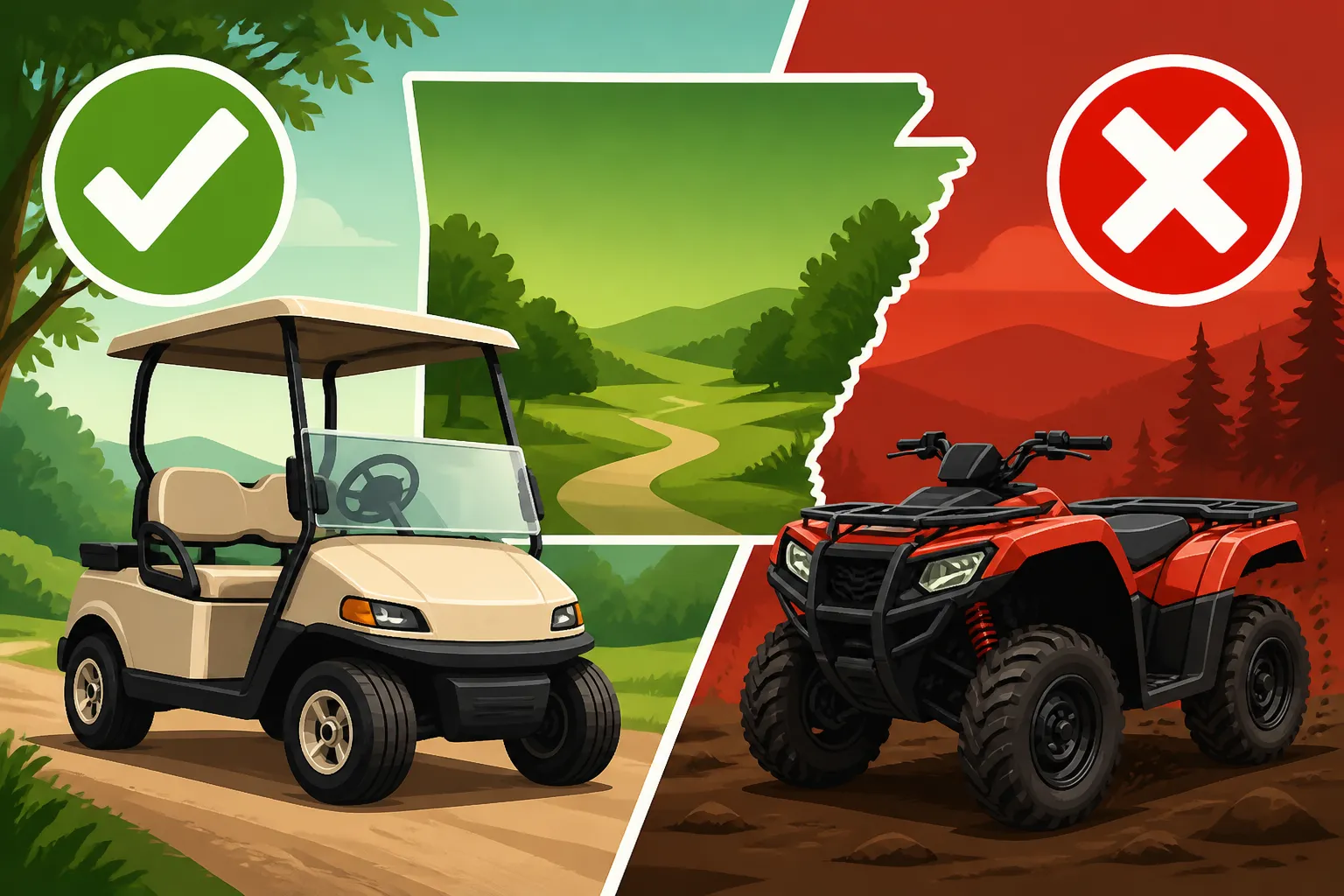
It can be incredibly frustrating to see a golf cart merrily zipping down a neighborhood street or even heading to the local store, while your powerful ATV or versatile UTV sits in the garage, seemingly forbidden from touching public asphalt. If you've ever wondered why Arkansas towns seem to have different rules for golf carts compared to off-highway vehicles like ATVs, you're not alone. This guide will walk you through the distinct legal frameworks that govern these different types of machines in Arkansas, explaining why one might be street-legal in your town while the other remains strictly off-road.
The Core Difference in Arkansas Law: Definitions Matter
The fundamental reason for the disparity lies in how Arkansas state law defines and categorizes these vehicles. It's not just about what a machine looks like, but what the statutes say it is. This legal distinction dictates which rules apply and, critically, how much leeway local municipalities have in creating their own ordinances.
What Arkansas Law Says About ATVs and UTVs
For the most part, Arkansas state law views ATVs (All-Terrain Vehicles) and UTVs (Utility Terrain Vehicles or Side-by-Sides) as off-highway vehicles (OHVs). The state's primary stance, codified in various statutes, is that these machines are not designed or intended for public road use. This means there's a default, overarching ban on operating them on state highways, county roads, and most city streets. It's a "guilty until proven innocent" situation, legally speaking.
This general prohibition means that unless there's a very specific, explicit exception in state law, or a narrowly defined local ordinance, your quad or side-by-side isn't welcome on the pavement. The state has a specific definition for what constitutes an ATV, often referencing width, engine size, and the number of wheels. For instance, [Arkansas's 50-Inch, 1,000cc ATV Definition] helps clarify what machines fall under this category. There are a few statewide exceptions for things like farming operations, hunting activities, or direct perpendicular crossings of a highway, but these are very limited and don't grant general street access. If you're using your machine for recreational purposes, these exceptions typically won't apply.
Where Golf Carts Fit (or Don't) into State Law
Golf carts often occupy a different legal space entirely. Unlike ATVs and UTVs, they typically don't fall under the same "off-highway vehicle" definitions in state statute. Instead, many golf carts are often considered "low-speed vehicles" or similar classifications, or they simply exist in a regulatory gray area that allows local jurisdictions more freedom. Arkansas law, specifically through statutes like [Arkansas Golf Cart Ordinances Under 14-54-1410], provides a clear pathway for municipalities to regulate golf carts on their local streets.
This critical difference in categorization means that while the state largely restricts ATVs and UTVs from roads by default, it hands the reins over to cities and towns when it comes to golf carts. A city council can, and often does, pass an ordinance allowing golf carts on certain roads within its jurisdiction, setting specific rules and requirements for their operation. This power isn't generally extended to ATVs in the same way, leading directly to the situation you observe in many communities.
Local Control: How Cities Decide Who Can Ride Where
The power of local municipalities to regulate vehicles on their own streets is a key factor, but this power isn't uniform across all vehicle types. Arkansas law grants cities different levels of authority depending on whether they're dealing with golf carts, UTVs, or ATVs.
The Specific Statute for Golf Cart Ordinances
Arkansas law provides a pretty clear path for cities to make their own rules for golf carts. This is why you'll see [Arkansas Cities With Cart Ordinances] all over the state, each with slightly different parameters. These ordinances typically address things like the types of streets where golf carts are allowed (often limiting them to streets with lower speed limits), specific hours of operation (sometimes only during daylight), required safety equipment (like headlights, taillights, seatbelts, or turn signals), and often a permit or registration process unique to that town.
For example, a city might decide that golf carts can be driven on any street with a posted speed limit of 25 mph or less, but they must have working headlights and taillights if operated after dusk, and the driver must possess a valid driver's license. The city council can tailor these rules to fit the specific needs and concerns of their community, which is a big reason why golf carts have found a niche in many neighborhoods and smaller towns, providing a convenient way to get around without invoking the stricter state regulations on other types of vehicles.
Act 922 and the Limited UTV Option for Towns
While cities have long had the ability to regulate golf carts, the option for UTVs on public streets is a much more recent development and comes with significant limitations. Before a certain date, UTVs (and ATVs) were almost entirely banned from public roads across Arkansas, with only those very specific state-level exceptions. However, Act 922 changed things, giving cities a limited ability to create ordinances for UTVs. It's important to stress that this act does not apply to ATVs. It's specifically for UTVs, often referred to as side-by-sides. You can read more about [How an Arkansas City Council Opens Streets to UTVs].
Even with Act 922, the power given to cities for UTVs is much more constrained than for golf carts. For instance, a city's UTV ordinance might have strict width caps (often 80 inches), require specific safety equipment (like turn signals, mirrors, and seatbelts), mandate insurance, and limit UTVs to streets with speed limits under 55 mph, often excluding four-lane streets or state highways passing through town. Not every town has adopted such an ordinance, and those that have often have very particular rules, sometimes requiring an annual permit or sticker to be displayed. This means that even if you have a UTV, you can't just assume it's street legal; you have to check if your specific town has an ordinance and if your machine meets all its stringent requirements, which might include modifications with components from brands like SuperATV.
Practical Implications for Riders
Understanding the legal landscape is one thing; navigating it as a rider is another. The distinctions between golf carts, UTVs, and ATVs in Arkansas law have very real consequences for where and how you can ride.
What This Means for Your ATV or UTV
If you own an ATV, the message is pretty clear: unless you're operating under one of the very specific state-mandated exceptions (like crossing a highway directly, engaging in farming activities, or performing utility work), you generally cannot ride it on public streets in Arkansas. Attempting to do so can lead to citations, fines, and even impoundment of your machine. There's simply no statewide or local ordinance framework that broadly allows ATVs on city streets for general transportation or recreational use. It's a tough pill to swallow for many enthusiasts, but the law is quite strict on this.
For UTV owners, the situation is slightly more nuanced, but still restrictive. While Act 922 opened a narrow window for some cities to permit UTVs, it's not a blanket approval. You absolutely must verify if the specific town or city you're in has passed a UTV ordinance, and then meticulously review its requirements. These ordinances often demand that your UTV meet certain equipment standards (like turn signals, mirrors, and headlights/taillights), which might require aftermarket additions. They also often come with restrictions on speed limits of the roads, and usually forbid riding on state highways or multi-lane roads. Always ask: [Can You Drive an ATV on the Road in Arkansas?] and remember the answer for ATVs is usually no, and for UTVs, it's "maybe, but check every single local rule." Many riders, for instance, have a machine that's too wide for the 80-inch cap some ordinances impose, making it instantly non-compliant.
Navigating Golf Cart Rules in Your Community
If you're a golf cart owner, or considering becoming one with the idea of street use, your first step is always to contact your local city clerk's office or visit your city's official website. That's where you'll find the specific ordinance, if one exists, that dictates golf cart operation within city limits. You can also consult resources that list [Arkansas Cities With Cart Ordinances]. Don't just rely on what your neighbor does, because rules can change, or your neighbor might simply be unaware of a specific nuance.
Typically, these ordinances will outline:
- Allowed Streets: Which roads are permissible, often based on speed limits (e.g., 30 mph or less).
- Equipment Requirements: What lights, mirrors, seatbelts, or other safety features your golf cart must have. Sometimes, even a slow-moving vehicle sign is required.
- Driver Requirements: Often, a valid driver's license is a must, even if you're only driving a few blocks.
- Permit/Registration: Whether you need to obtain a special city permit or sticker, often with an annual fee, and where to display it.
- Hours of Operation: Restrictions on night driving, particularly if your cart isn't fully equipped with proper lighting.
It's crucial to follow these rules diligently. While golf carts are generally perceived as less threatening than ATVs, improper operation can still lead to fines or accidents. Being proactive and informed will ensure your golf cart adventures are hassle-free and legal.
Why the Distinction? Policy and Perception
The different legal treatments of golf carts versus ATVs and UTVs aren't arbitrary. They stem from a combination of perceived safety, historical precedent, and how these vehicles are typically used.
Perceived Safety and Design Differences
One of the biggest factors in the regulatory distinction is the inherent design and perceived safety of these vehicles. Golf carts are generally designed for slower speeds, lighter loads, and use in contained environments like golf courses or planned communities. They typically have smaller engines, less aggressive tires, and a top speed that rarely exceeds 20-25 mph. This makes them appear less of a threat to other traffic and pedestrians on residential streets.
In contrast, ATVs and UTVs are built for off-road performance. They often have powerful engines, knobby tires, high ground clearance, and suspension designed to handle rugged terrain. Even many factory-spec UTVs from brands like SuperATV can reach highway speeds, and while this is great for trails, it presents a different set of safety concerns when mixed with cars, trucks, and larger vehicles on public roads. The public, and by extension, lawmakers, tend to view a fast-moving, aggressive-looking off-road machine as inherently more dangerous on a paved street than a slower, smaller golf cart. The potential for higher speeds, larger mass, and less predictable handling characteristics contribute to this perception, influencing state statutes to be more restrictive.
Historical Context and Local Flexibility
The regulatory journey for golf carts also has a longer history of local flexibility. For decades, many communities, particularly retirement communities or towns centered around golf courses, have had golf carts integrated into their local transportation fabric. The ability for local governments to regulate them through ordinances became a natural extension of their existing powers to manage local traffic and vehicle use. This historical precedent established a clear pathway for cities to create their own rules without necessarily needing extensive state-level legislation for every nuance.
For ATVs and UTVs, however, the push for road legality is a more recent phenomenon, largely driven by the increasing popularity and utility of these machines. When lawmakers began to consider allowing them on public roads, the discussion often centered on balancing the desires of riders with broader public safety concerns. This led to state-level intervention, such as Act 922, which grants limited and conditional authority to cities for UTVs, rather than a broad, flexible mandate like that for golf carts. The state wants to maintain a higher level of control over what it considers inherently off-road vehicles, ensuring that any road use is carefully managed to mitigate risks. This piecemeal approach means the state's default "no" for ATVs remains firm, while UTVs get a conditional "maybe" from certain cities, and golf carts enjoy a more robust "yes, if" from local ordinances.
Here's a quick breakdown of the general situation for each vehicle type in Arkansas:
| Feature/Requirement | ATV (All-Terrain Vehicle) | UTV (Utility Terrain Vehicle) | Golf Cart (Low-Speed Vehicle) |
|---|---|---|---|
| Default State Legality | Generally illegal on public roads. | Generally illegal on public roads. | State law allows local ordinances. |
| Local Ordinance Option | No general local ordinance option for street use. | Yes, limited by Act 922 for UTVs only (not ATVs). | Yes, broad authority for cities to create ordinances. |
| State Exceptions | Limited (farming, hunting, direct crossing). | Limited (farming, hunting, direct crossing). | No direct state exceptions for street use, relies on local rules. |
| Width Restrictions | Often 50 inches or less for state definition. | Local ordinances may impose width caps (e.g., 80 inches). | Typically narrower, less of a concern. |
| Speed | Designed for off-road speed. | Can be high speed; local ordinances often cap speed on roads (e.g., 35 mph). | Low speed (typically 20-25 mph top). |
| Typical Use | Recreation, utility, off-road trails. | Recreation, utility, off-road trails, some on-road in specific towns. | Short-distance transport, golf courses, planned communities. |
| Required Equipment | Minimal for off-road use. | Local ordinances may require signals, mirrors, horn, windshield, etc. | Local ordinances may require lights, mirrors, seatbelts, etc. |
| Driver's License | Not required for off-road, but needed for road exceptions. | Required if operating on permitted public roads. | Often required by local ordinance for street use. |
This article is for general informational purposes only and does not constitute professional advice. Laws, prices and regulations vary by location and change over time. Consult a qualified professional for guidance on your specific situation.