How Arkansas’s Local-Option Rule Works
There's a common dream among ATV and UTV owners in Arkansas: the desire to legally take their machine from their driveway straight to the local ice cream shop or a friend's house down the street. For years, this was largely a pipe dream, leaving many frustrated by the rigid state laws. However, a significant change has opened the door for local communities to decide for themselves, and this guide will walk you through exactly how Arkansas's local-option rule works, clarifying what you need to know to ride legally in towns that embrace it.
Understanding Arkansas's General Stance on Road Riding
Before we dive into the exciting possibilities of local ordinances, it's crucial to understand the baseline: what does Arkansas law generally say about ATVs and UTVs on public roads? The state's default position has long been pretty restrictive, making most road riding unlawful. This is where a lot of the initial frustration comes from, as many folks believe their UTV, with its headlights and seatbelts, should be just as street-worthy as a golf cart in some areas.
Arkansas law [§ 27-21-106] defines off-highway vehicles, which include ATVs and UTVs, and generally prohibits their operation on public streets and highways. The state sees these machines primarily as recreational or utility vehicles meant for off-road use, not as standard transportation like cars or trucks. This distinction is really important, because it means your machine isn't automatically granted the same privileges just because it has four wheels and an engine. It’s built for the trails, the fields, and the woods, and that’s how the state statute views it, too. [Arkansas Makes Road Riding Unlawful by Default]
Now, there are some very specific, narrow exceptions carved out in state law for certain situations, even before the local-option rule came into play. For instance, farmers might be allowed to cross a highway to access another part of their property, or a hunter might ride a short distance on a county road to get to a deer stand. Utility workers or emergency personnel also have specific allowances. These exceptions, often involving direct crossings or very limited use, are quite different from casually cruising through town. They're about necessity, not general access. These pre-existing state exceptions provide a very limited scope, which is why the local-option rule was such a game-changer for many riders hoping for more freedom. [Arkansas's Six Statutory Road Exceptions]
The State's Default Ban and Its Rationale
The state's general ban stems from concerns about safety, vehicle standards, and the intended design of ATVs and UTVs. These machines typically lack many of the safety features found on conventional street-legal vehicles, such as extensive crash protection, robust lighting systems for all conditions, and specific braking requirements. Even when aftermarket parts are added, they might not meet the rigorous standards set for on-road vehicles. Lawmakers wanted to keep traffic flow predictable and ensure that all vehicles sharing public roads met a certain threshold of design for safety and visibility.
Think about it: an ATV is designed for agility over rough terrain, not for high-speed merging onto a busy highway. While many modern UTVs are much more capable, they still fall under the general "off-highway vehicle" umbrella in the state's eyes. This foundational understanding is key, because it highlights why simply having a UTV doesn't automatically mean you can drive it anywhere a car can go. It requires specific legal frameworks to grant that permission, which is precisely what the local-option rule aims to provide at the community level.
How the Local-Option Rule Empowers Arkansas Cities
The frustration of being unable to legally ride a UTV on local streets led to a significant legislative change in Arkansas. Recognizing that local communities might have different needs and desires regarding UTV use, the state implemented a "local-option rule," primarily through Act 922. This act fundamentally shifts some of the control from the state to individual cities and towns, allowing them to decide for themselves whether to permit UTVs on certain municipal roads. This was a huge step forward for riders, as it acknowledged that what works for a bustling metropolitan area might not make sense for a small, rural town.
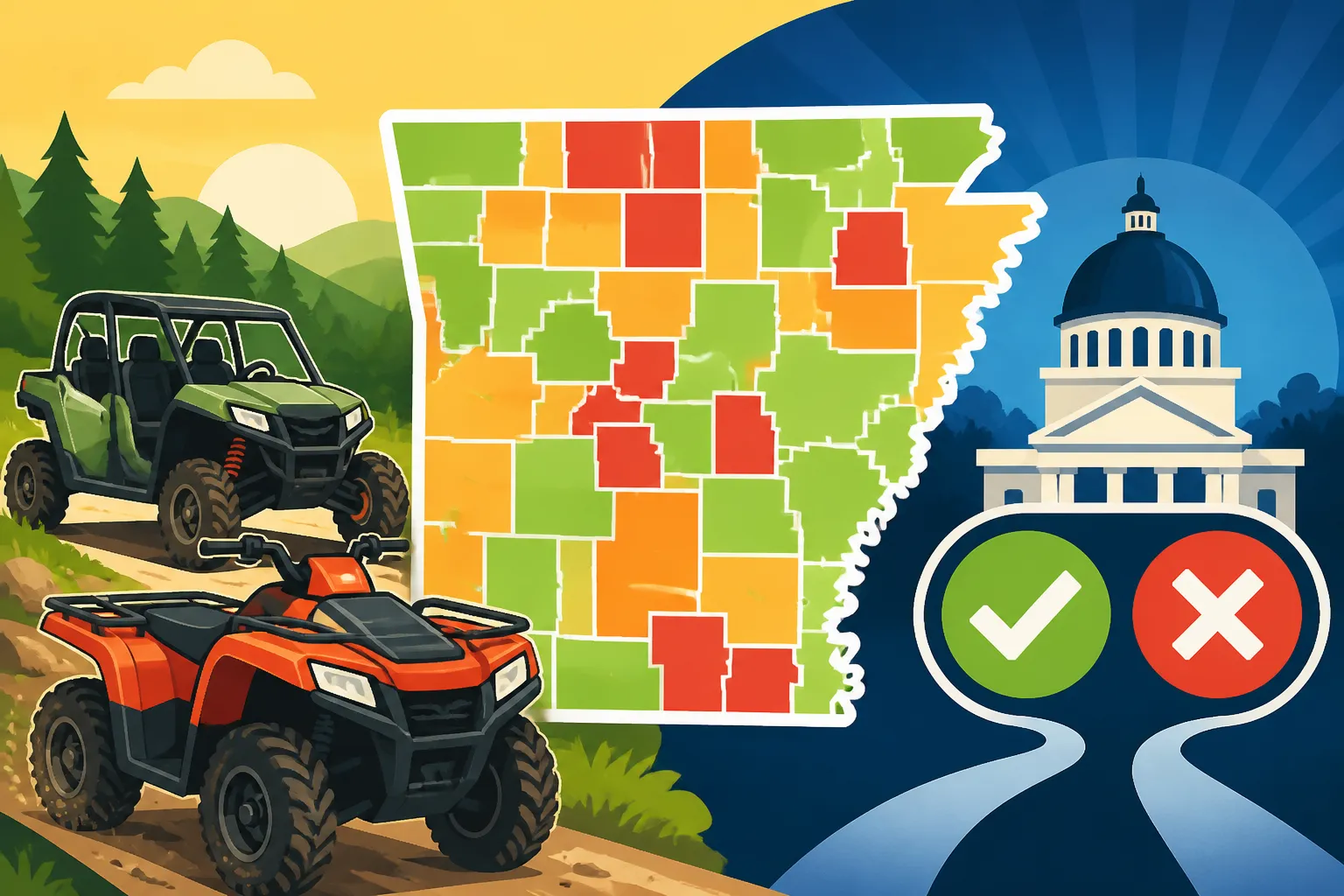
The core of this rule is that an Arkansas city council, or other governing body, can pass an ordinance that specifically allows UTVs on designated public streets within its corporate limits. It's not a blanket permission across the state; it's a power granted to each local government. This means that just because UTVs are allowed on city streets in, say, Bono, doesn't automatically mean they're permitted in Cotter. Riders must verify the rules for each specific municipality they intend to ride in. [How Arkansas Cities Got the Choice on UTVs]
Passing a Local Ordinance: What Cities Can Do
For a city to open its streets to UTVs, its local governing body, usually the city council, must draft and pass an ordinance. This isn't a simple handshake agreement; it's a formal legal process. The ordinance will typically outline the specific conditions and restrictions under which UTVs can be operated on city streets. This might include designating certain streets as permissible, setting speed limits for UTVs, or specifying required safety equipment beyond what a UTV comes with from the factory. [How an Arkansas City Council Opens Streets to UTVs]
Once an ordinance is passed, it generally empowers the city to implement things like permit systems. This means riders might need to apply for and display an annual permit to operate their UTV on city streets, often for a fee. The fees help cover administrative costs and potentially contribute to road maintenance. These local ordinances are a testament to the idea that smaller communities can best understand and address the unique needs and preferences of their residents, balancing the desire for recreational access with public safety concerns. It’s about tailoring the rules to the local flavor.
Streets Under 55 mph and Other Restrictions
It's important to understand that the local-option rule doesn't give cities carte blanche to open all their roads. There are typically limitations built into the state law that guide what local ordinances can permit. A common restriction is that UTVs are generally only allowed on streets with a posted speed limit of 55 mph or less. This helps keep UTVs off high-speed thoroughfares where they might pose a greater safety risk due to speed differentials with other traffic.
Additionally, four-lane streets or state highways that run through a town often remain off-limits, even if they're within city limits. These roads are typically under state jurisdiction or are considered major arteries not suitable for off-highway vehicles. So, while you might be able to ride your UTV on many residential and collector streets, you're unlikely to be able to use it to zip down a multi-lane highway connecting two towns. Always check the specific ordinance for the town you plan to ride in, as the details can vary significantly. [Arkansas Streets Under 55 mph for UTVs]
Key Requirements for Street-Legal UTVs Under Local Ordinances
So, your local town has passed an ordinance allowing UTVs on its streets – fantastic! But don't just jump in and drive off. Even with local permission, there are crucial requirements your UTV and you, as the driver, must meet to be considered street-legal. These aren't just suggestions; they are often strictly enforced aspects of the local ordinance, designed to ensure safety and integrate UTVs smoothly into existing traffic patterns. Failing to meet these can lead to citations, fines, or worse, accidents.
Most local ordinances will specify certain equipment that your UTV must have to be legally operated on public streets. This typically includes items that are standard on cars but might be aftermarket additions for many UTVs. We're talking about things like turn signals, which are essential for communicating your intentions to other drivers, and rearview mirrors (both side mirrors and a center mirror) for visibility. You might also need a horn, a working speedometer, and headlights and taillights that are functional both day and night. Many riders find themselves looking at aftermarket options from companies like SuperATV to get their machines up to snuff with these requirements, ensuring they have the right components for safe and legal street use. [Arkansas Equipment for a Street-Permitted Machine]
Beyond the physical attributes of your machine, you'll also likely need to jump through a few hoops as the operator. This usually involves carrying proof of insurance specific to your UTV, just like you would for any other vehicle you drive on public roads. You'll also need a valid driver's license – typically a standard Class D license, meaning you can't just send your unlicenced teenager out on the streets, even if they're old enough to operate it off-road. Finally, many towns implement an annual permit system, where you pay a fee and receive a sticker or decal to display on your UTV, signifying that you've met all local requirements. This permit often needs to be renewed annually, so it's not a one-and-done deal. [Arkansas UTV Street Permits and Annual Fees]
Required Safety Equipment
The specific safety equipment needed can vary slightly from one ordinance to another, but there's a common core that you should anticipate. At a minimum, expect to need:
- Headlights and Taillights: These must be in good working order and visible from appropriate distances.
- Brake Lights: Essential for signaling when you're slowing down or stopping.
- Turn Signals: Both front and rear, to clearly indicate turns and lane changes. Many UTVs don't come stock with these, so aftermarket kits are common.
- Rearview Mirrors: At least one, typically two side mirrors, and often a center rearview mirror as well. These are vital for situational awareness in traffic.
- Horn: A functional horn for signaling warnings.
- Windshield: Often required for safety and protection from road debris.
- Seatbelts: Most UTVs have these from the factory, but they must be in good working order and worn by all occupants.
Companies like SuperATV offer a wide range of accessories, from full street-legal kits to individual components like LED turn signals and DOT-approved windshields, making it easier for owners to modify their machines to meet these local standards. It's a smart idea to check with your chosen city's specific ordinance, perhaps even calling the city clerk, to get a definitive list before you start making modifications. [Arkansas Turn Signals and Mirrors on a UTV]
Permits, Insurance, and Driver's License
Operating a street-legal UTV under a local ordinance involves more than just equipment. You'll also need to be prepared with the right documentation and qualifications.
- Annual Permits: Many towns require an annual permit, which usually comes with a fee. This permit is typically a sticker or decal that must be visibly displayed on your UTV, often on the windshield or a prominent body panel. Think of it like a vehicle registration sticker, but specifically for the local jurisdiction. These permits are usually valid for a year and must be renewed to continue legal street operation. [Arkansas UTV Street Permits and Annual Fees]
- Proof of Insurance: Just like a car, your street-legal UTV will need to be insured. This isn't just a good idea; it's often a legal requirement. You'll need to carry proof of liability insurance, ensuring that you're covered in case of an accident. The minimum coverage requirements will likely mirror those for passenger vehicles. [Arkansas Insurance for a Street-Permitted UTV]
- Valid Driver's License: To drive a UTV on city streets, you must hold a valid Class D (standard) driver's license. This means a learner's permit or an off-road safety certificate won't cut it. The age requirement for this is typically 16 years old, the same as for driving a car in Arkansas. [Arkansas Driver's License at 16 for Street UTVs]
Meeting these requirements is paramount. Local law enforcement can, and will, stop UTVs operating on city streets to verify that all necessary equipment, permits, insurance, and driver qualifications are in order. Don't risk a costly citation or the impoundment of your machine by skipping these vital steps.
Width Caps and Other Machine Restrictions
Local ordinances don't just stop at equipment and driver requirements; they can also place restrictions on the physical dimensions of the UTV itself. One common restriction you'll encounter is a width cap. Many ordinances will specify that a UTV cannot exceed a certain width, often around 80 inches. This is to ensure that the machines can safely share roadways, particularly narrower residential streets, without encroaching on other lanes or causing difficulties for passing traffic.
For riders who have wider, more aggressive UTV models, this width restriction can be a significant consideration. It's crucial to measure your machine accurately, especially if you have aftermarket wheels or tires that might push it beyond the limit. Companies like SuperATV specialize in various UTV parts, so they often have dimensions available for their products, but always measure your complete setup. Additionally, some ordinances might have stipulations about factory safety standards, ensuring that the UTV hasn't been overly modified in ways that compromise its inherent safety design. Always read the specific ordinance carefully to confirm your machine complies with all dimensional and structural requirements before riding on city streets. [An 80-Inch Width Cap in Local Rules]
Navigating the Local Landscape: What to Expect and How to Check
The beauty and the challenge of the local-option rule in Arkansas is its variability. What's allowed in one town might be completely forbidden in the next, even if they're just a few miles apart. This means you can't assume anything. To successfully navigate this patchwork of rules, you need to be proactive, informed, and diligent in your research before you ever hit the pavement in a new area.
The first and most important step is always to verify the rules for the specific city or town you plan to ride in. Do not rely on hearsay or what a friend told you about another town's ordinance. The best way to do this is to contact the city clerk's office directly. Most cities will have their ordinances publicly available, either online on their municipal website or as physical copies at the clerk's office. Ask specifically for the "off-highway vehicle" or "UTV" ordinance. Be prepared to ask detailed questions about equipment, permits, fees, and restricted streets. [Reading Your Town's Ordinance Before You Ride]
Checking Your Town's Specific Ordinance
Finding your town's ordinance might seem daunting, but it's usually straightforward. Start by checking the official city website. Many municipalities have a "City Ordinances" or "Municipal Code" section where you can search for keywords like "UTV," "ATV," or "off-highway vehicle." If you can't find it online, a quick call or visit to the city clerk's office is your next best bet. They are the keepers of the city's official records and can point you to the correct document.
When you get your hands on the ordinance, read it thoroughly. Pay close attention to:
- Effective Date: When did the ordinance become law?
- Definitions: How does the city define a UTV or OHV?
- Permit Requirements: Is an annual permit required? What's the fee? How do you apply? Where must the permit be displayed?
- Equipment Requirements: What specific lights, mirrors, horns, windshields, etc., are mandated?
- Street Restrictions: Which streets are open? Which are closed (e.g., state highways, four-lane roads)? What are the speed limits?
- Driver Requirements: Age, license, insurance.
- Width Limits: Any restrictions on the physical size of the machine?
- Penalties: What are the consequences for violating the ordinance?
Having this information directly from the source is your best defense against inadvertently breaking the rules.
| Feature | Default State Law (Outside Exceptions) | Permitted by Local Ordinance |
|---|---|---|
| Road Access | Generally Unlawful | Restricted Municipal Streets |
| Speed Limits | Not Applicable | Typically ≤ 55 mph |
| Turn Signals | Not Required | Often Required |
| Rearview Mirrors | Not Required | Often Required (1-3) |
| Horn | Not Required | Often Required |
| Windshield | Not Required | Often Required |
| Insurance | Not Required for Road Use | Required |
| Driver's License | Not Required for Off-Road | Required (Class D) |
| Annual Permit | Not Applicable | Often Required, Fee Charged |
| Width Restrictions | Not Applicable | Often an 80-inch Cap |
| Road Types Allowed | Crossing Only, Specific Exceptions | Residential, Collector Streets |
| Four-Lane Roads | Unlawful | Typically Unlawful |
| State Highways | Unlawful | Typically Unlawful |
Town-Specific Examples and Variations
Arkansas has seen a growing number of towns consider and pass these UTV ordinances, but they are not all identical. For example, the city of Bono was one of the first to implement a UTV ordinance, setting a precedent for other communities. Their ordinance might specify certain hours of operation, or particular streets that are off-limits, perhaps even a main thoroughfare that serves as a state highway even within city limits. [Bono's Street Rules for UTVs in Arkansas]
In contrast, other towns might take a different approach. Some might be very open, while others might impose stricter limits on hours, noise, or even the number of UTVs allowed in certain areas. You might find ordinances that specify rules for golf carts but specifically exclude ATVs or UTVs, as seen in some smaller communities where golf carts are a more common sight. [When an Arkansas Golf Cart Ordinance Leaves Quads Out] This variability underscores the absolute necessity of checking the specific rules for each town, rather than assuming a universal standard exists across the state. A quick call to the city clerk can save you a lot of headache and potential fines.
Disclaimer
This article is for general informational purposes only and does not constitute professional advice. Laws, prices and regulations vary by location and change over time. Consult a qualified professional for guidance on your specific situation.