Arkansas Rules for Riding a Power Line Cut
Riding an ATV or UTV along a power line cut can feel like a dream come true for many off-road enthusiasts in Arkansas – wide-open spaces, challenging terrain, and a sense of freedom. But that initial thrill can quickly turn to anxiety when you start to wonder, "Is this actually legal?" The rules aren't always clear-cut, leaving many riders confused about where they can and can't go. This guide aims to demystify the regulations around riding ATVs and UTVs on power line cuts in Arkansas, helping you stay on the right side of the law and avoid potential fines or confrontations.
The Allure and Ambiguity of Power Line Cuts
There's a unique draw to power line cuts that speaks to the heart of every off-road rider. They represent a distinct type of terrain, often stretching for miles, offering a different kind of adventure than traditional trails. Yet, this very appeal is often wrapped in a thick fog of legal uncertainty.
Why Power Line Cuts Attract Riders
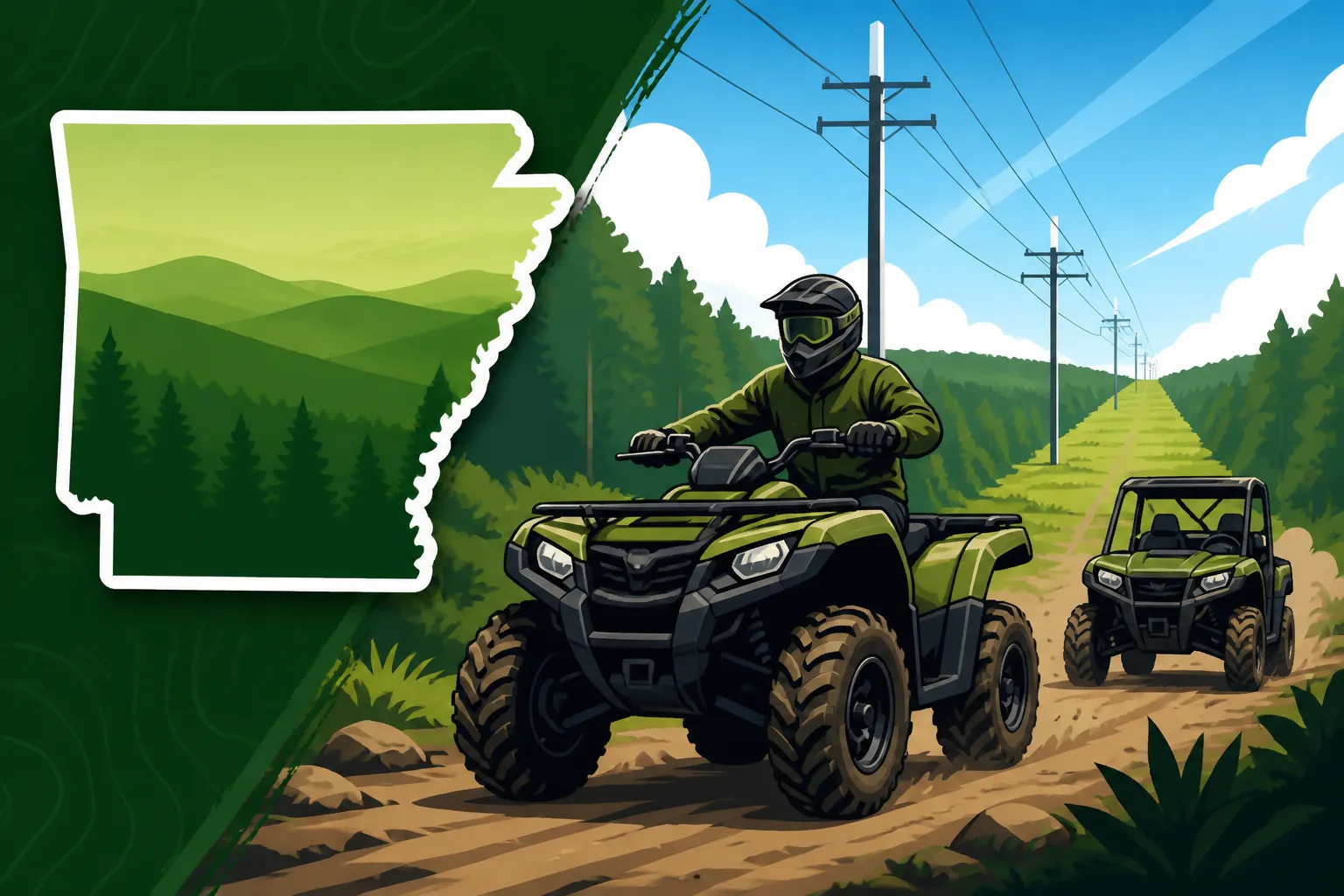
Imagine cruising down a wide, open path, often carved through dense woods, with the rhythmic hum of power lines overhead. Power line cuts can offer a mix of challenges: sometimes it's relatively flat and sandy, other times it's steep and rocky, with deep ruts and creek crossings that test your machine and your skills. The sheer length of some of these cuts means you can really open up your throttle (where safe and permitted, of course) or just enjoy a long, uninterrupted cruise. For many, it's the sense of expansive exploration, the feeling of getting away from crowded designated trails, and the opportunity to encounter diverse natural landscapes that makes these areas so appealing. It feels like an open invitation to ride.
These corridors are designed to keep trees and other obstacles away from critical electrical infrastructure, creating clearings that look custom-made for off-road travel. It’s easy to see why someone might assume that if it’s clear and open, it must be okay to ride. This mindset, while understandable, often overlooks the underlying legal realities that govern land use in Arkansas.
The Core Legal Question: Public vs. Private Land
The biggest misconception about riding on power line cuts is assuming that because a power company maintains the right-of-way, the land becomes "public" or open for recreational use. This is rarely the case. The crucial distinction in Arkansas is whether the land underneath the power line cut is publicly owned or privately owned. The power line itself doesn't change the fundamental ownership of the ground you're riding on.
A power company typically holds an easement, which is a legal right to use a portion of someone else's property for a specific purpose – in this case, for constructing, maintaining, and accessing power lines. This easement does not grant the public the right to traverse that land for recreation. Think of it like a neighbor having an easement to drive across your driveway to get to their garage; it doesn't mean everyone can use your driveway as a shortcut. Therefore, the legality of riding on a power line cut hinges entirely on who owns the land, and what their specific rules or permissions are.
Understanding Land Ownership and Easements
To truly understand if you can ride on a power line cut, you need to dig into the details of land ownership and what an easement actually entails. This is where most riders get tripped up, and it's vital to get it right to avoid legal trouble.
Who Owns the Land Under a Power Line Cut?
More often than not, the land beneath a power line cut remains in private hands. This means it could be part of a farmer's pasture, a timber company's forest, or simply someone's undeveloped acreage. The power company only has a limited right to access and maintain their equipment. They don't own the dirt itself, nor do they typically grant permission for public recreational use on those easements. In fact, utility companies often discourage or even prohibit recreational use on their easements due to safety concerns, liability, and the need for unobstructed access for their maintenance crews.
In some cases, power lines might cross public lands, such as state forests, national forests, or Wildlife Management Areas (WMAs). In these instances, the rules of that specific public land management agency dictate what kind of recreational use is permitted, and where. It’s never a free-for-all just because a power line runs through it.
Navigating Private Property: Permission is Key
This is the most critical takeaway for riding on power line cuts that cross private land: you absolutely must have explicit permission from the landowner. Without it, you are trespassing, plain and simple. Even if a power line cut looks abandoned, unposted, or frequently used by others, that doesn't make it legal for you to ride. Landowners have the right to control who accesses their property, and they can prosecute trespassers under [Arkansas Trespass Law for Riders].
Securing permission can be challenging. Ideally, you should seek written permission, outlining the specific areas you're allowed to ride and for what duration. Verbal permission can be harder to prove if a confrontation arises. To identify landowners, you can often consult county assessor's office records, which are usually public information. Showing respect for their property and clearly understanding their boundaries goes a long way. Never assume silence means consent.
Many private landowners in Arkansas cherish their privacy and the peace of their land. Approaching them with a clear, polite request, and offering to follow any rules they set, is your best bet. If they say no, respect their decision and seek other, legal riding opportunities.
Riding on Public Lands Under Power Lines
If a power line cut happens to cross public land, such as an [Arkansas National Forest Riding Explained] or an [Arkansas AGFC WMA Rules for Riders], then the rules of that particular agency govern your ability to ride there. This means you need to consult their specific regulations, maps, and permit requirements.
For instance, within the Ouachita or Ozark-St. Francis National Forests, designated OHV trails might occasionally cross or run alongside a power line cut. If you're on a designated and marked trail within these forests, and that trail happens to be in a power line corridor, then you're likely fine, provided you have the necessary [Arkansas OHV Permits: Two Forests, Two Prices]. However, simply because a power line runs through the forest doesn't mean the entire cleared area is open for riding. You must stick to the authorized trails.
Similarly, Wildlife Management Areas have very specific rules regarding vehicle access, often restricting ATVs and UTVs to designated roads or only allowing them for specific purposes (like retrieving game during hunting season) and within certain timeframes. Riding across a WMA's power line cut without it being part of an explicitly allowed route could still lead to a citation. Always check the individual WMA's rules, as they vary greatly.
Here's a quick reference on land ownership scenarios:
| Land Ownership Type | Riding Legality on Power Line Cut |
|---|---|
| Private Land | Illegal without explicit landowner permission. Even if unmarked, unposted, or frequently used by others, it's trespassing. |
| National Forest Land | Legal only if it is part of a designated and marked OHV trail. You must have the required forest permit. The entire power line corridor is not open simply because it's in the forest. |
| WMA (Wildlife Mgmt. Area) | Legal only if it is part of a designated road open to ATVs/UTVs, or if specifically allowed for a particular purpose (e.g., hunting) during open seasons and within specific timeframes. Check individual WMA rules carefully. |
| State Park Land | Generally illegal. Most Arkansas State Parks do not permit off-road vehicle use outside of designated parking areas or paved roads. |
| Other Public/Utility Land | Highly restricted; likely illegal for recreational use. Power company land around substations, or other utility-owned properties, are typically not open to the public for recreation due to safety and liability concerns. Do not assume access. |
The "Road" Exception and Power Line Cuts
A common hope among riders is that a well-worn power line cut might somehow qualify as a "road" under Arkansas law, thus allowing for limited or conditional use. Unfortunately, this is almost never the case. Arkansas's definition of a road for ATV/UTV use is very specific and rarely applies to these utility corridors.
Why a Power Line Cut Isn't a Road in Arkansas Law
Arkansas law is quite strict about where ATVs and UTVs can be operated. Generally, it is [What Arkansas Law Forbids on a Public Road] unless one of [Arkansas's Six Statutory Road Exceptions] applies. These exceptions typically involve specific situations like farming or hunting operations, direct crossings, or use by emergency personnel. A power line cut, despite its appearance, does not fit into the legal definition of a "road" or "highway" that would grant general public access for recreational OHV use.
For a path to be considered a public road, it generally needs to be maintained by a government entity, dedicated for public travel, and meet certain engineering standards. A power line cut, even if it has a discernible path, is primarily there for utility access and maintenance, not public thoroughfare. It lacks the legal designation and maintenance required to be classified as a public road in the eyes of the law. You cannot simply decide that because a path exists, it qualifies as an open road. This is a critical distinction that riders often misunderstand, leading to citations.
Local Ordinances and Their Limits
While it's true that [Arkansas Towns Can Open Their Streets to UTVs] under specific state statutes, these ordinances are almost exclusively focused on allowing UTVs on paved or maintained city streets within municipal boundaries, typically with strict conditions like speed limits, insurance, and safety equipment. These local laws do not, and cannot, extend to allowing recreational riding on private land or utility easements, including power line cuts, outside the defined scope of municipal streets.
For example, a city might pass an ordinance allowing UTVs on certain city streets under 35 mph. This has absolutely no bearing on whether you can ride on a power line cut that runs through the edge of town, especially if that cut is on private property. The legal authority granted to cities to open streets for UTVs is very specific and does not apply to off-road trails or utility corridors. Don't confuse a local street-legal ordinance with permission to ride an off-road vehicle just anywhere within city limits, particularly on private easements.
Practical Considerations and Safety
Beyond the legalities, riding on power line cuts presents a unique set of safety and environmental considerations that every responsible rider should be aware of. These areas are not designed for recreational use, and that comes with inherent risks.
Hazards Specific to Power Line Cuts
Power line cuts, by their very nature, are often challenging environments. They are typically cleared periodically, not manicured like dedicated trails. This means you might encounter:
- Uneven Terrain: Expect deep ruts from utility vehicles, sudden dips, hidden rocks, and exposed roots. Erosion can be severe, especially on slopes, creating washouts that can easily damage your machine or cause an accident.
- Hidden Obstacles: Debris from clearing operations, fallen branches, or even discarded equipment can be hidden in tall grass or overgrown sections.
- Downed Lines or Equipment: While rare, electrical hazards are a serious concern. Stay far away from any downed lines or damaged utility infrastructure.
- Maintenance Vehicles: Utility crews frequently use these cuts for access. They are often large, heavy vehicles that might not expect recreational riders. This creates a dangerous collision risk.
- Lack of Signage or Markings: Unlike official trails, power line cuts typically lack warning signs, directional markers, or difficulty ratings, leaving you guessing about what's ahead.
Always prioritize safety over adventure. A challenging section might be exhilarating, but it's not worth risking serious injury or damage to your machine.
Gearing Up and Being Prepared
Given the potential hazards, being thoroughly prepared is not just smart, it's essential. Always wear appropriate safety gear. While Arkansas doesn't have a universal ATV helmet law, wearing one is always a good idea, as highlighted in [Arkansas ATV Helmet Requirements]. Goggles, gloves, sturdy boots, and long pants and sleeves will protect you from scrapes, sun, and flying debris.
Beyond personal protective equipment, consider what your machine might need. Skid plates, robust A-arm guards, and aftermarket suspension upgrades can provide crucial protection against the rough and often rocky terrain found in some power line cuts. Companies like SuperATV offer a range of products designed to enhance machine durability and performance in challenging conditions, which could be invaluable if you're legally riding such terrain. A winch, even if you rarely use it, can be a lifesaver if you get stuck in a deep rut or mud hole, or need to clear an unexpected obstacle. Always carry a first-aid kit, a communication device (though cell service can be spotty in remote areas), water, and basic tools.
Respecting the Environment and Infrastructure
If you do obtain legal permission to ride on a power line cut, it's paramount to practice responsible off-roading. This means adhering to "Tread Lightly!" principles:
- Stay on existing paths: Don't create new trails or widen existing ones.
- Avoid sensitive areas: Stay clear of wetlands, stream banks, and areas with delicate vegetation.
- Respect private property boundaries: If you're on a power line cut that borders private land, be absolutely sure you know where your permitted riding area ends.
- Do not damage infrastructure: Never tamper with power poles, guy wires, or other utility equipment. This is not only dangerous but illegal.
- Pack it in, pack it out: Leave no trace. Take all your trash with you.
These corridors are essential for maintaining our power grid. Riding respectfully ensures you don't interfere with this critical function and helps maintain positive relationships with landowners and utility companies. If you're looking for officially sanctioned riding, explore options like [Arkansas ATV Trails: Where to Ride] for a safer and legal experience. Other types of trails, like [Arkansas Rules for Riding a Ditch] or [Arkansas Rules for Riding a Logging Road], also have their own specific legal frameworks that differ from power line cuts. Always be aware of your surroundings, and never operate your machine under the influence of alcohol or drugs, as [Arkansas DUI Law and Off-Road Machines] applies to all off-road vehicles.
Disclaimer
This article is for general informational purposes only and does not constitute professional advice. Laws, prices and regulations vary by location and change over time. Consult a qualified professional for guidance on your specific situation.