Tread Lightly on Rocky Ground
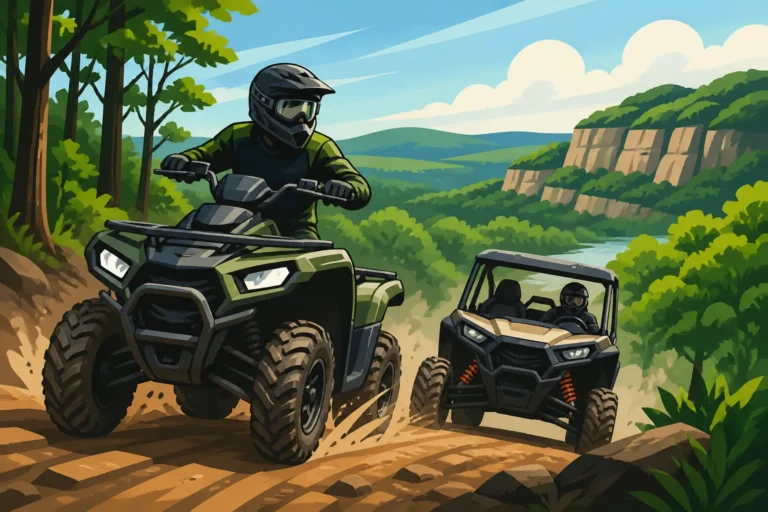
Rocky Arkansas trails can punish rushed riding: sharp stone can damage tires, loose gravel can send a machine sliding, and a shortcut around a muddy rut can start an erosion problem that lasts long after the ride. This guide explains how to ride rocky ground with more control, protect your ATV or UTV, and leave the trail in good shape.
Get ready before you reach the rocky section
Check the route and its conditions
Rocky ground varies from broad, exposed bedrock to loose stone, steep ledges, and gravel scattered across a hard-packed trail. A route that feels manageable when dry may become slick after rain, while fallen leaves can hide rocks and uneven edges. Before heading out, learn what kind of terrain to expect and whether the route is open.
Start with the official information for the riding area, including posted signs and notices at the trailhead. A map can help you understand the route, but it does not prove that a road or trail is open to riders or that you have permission to use it. If you use onX Offroad to review a route, compare what you see with current land-manager information and signs on the ground. Conditions and access rules can change.
This is particularly important in the Ouachita Mountains, where steep slopes, exposed rock, and weather can affect trail conditions. If you are choosing a route for the first time, review Arkansas Trails in the Ouachita Mountains and Arkansas Trail Ratings and What They Mean. Ratings are a planning aid, not a promise that every section will feel easy for your machine or experience level.
Match the machine and tires to the terrain
Before loading up, inspect your tires for cuts, embedded stones, worn tread, and pressure that does not match your machine’s manual or the conditions you expect. Sharp rock can slice or puncture a tire, while an unsuitable pressure can make handling less predictable. Do not assume that airing down is automatically safer; use the manufacturer’s guidance and avoid changes you are not comfortable managing.
Look underneath the machine as well. A skid plate can help shield vulnerable components from direct impacts, but it does not make every rock ledge safe to cross. Check that protective parts are secure and that nothing is hanging loose. For more detailed equipment considerations, see Tires That Work on Sharp Rock and Skid Plates for Rocky Trails.
Pack basic recovery and repair supplies that make sense for your trip, such as a tire repair kit compatible with your tires, a pump, and a tow strap. Carry water and a first-aid kit, too. A small problem is easier to handle when the group is not already tired, dehydrated, or hurrying to get back before dark.
Plan for a pace that leaves room for decisions
A common mistake is planning the day around mileage instead of terrain. On a rocky route, a short section can take longer than expected if riders stop to assess obstacles, help a companion, or wait for safe spacing. Build time into the plan rather than pressuring the group to keep moving.
Share the route and expected return time with someone who is not riding. If you use onX Offroad to organize your route, treat it as one planning tool, not a substitute for a paper or offline backup when reception is poor. Save the riding area’s contact details if they are available, and make sure everyone knows the meeting point if the group becomes separated.
| Before the ride | What to check | Why it matters |
|---|---|---|
| Route | Access, closures, posted restrictions, and trail difficulty | A mapped line may not be open or appropriate for your machine |
| Machine | Tires, brakes, steering, protective parts, and fuel | Rocky sections put extra demands on control and equipment |
| Group | Rider experience, spacing, communication, and return plan | A shared pace reduces pressure and makes assistance easier |
| Conditions | Recent rain, loose rock, visibility, and daylight | Weather can change traction and the time a route takes |
Ride rocky ground with control and courtesy
Keep your speed low enough to choose a line
The safest line is not always the smoothest-looking line. A rock shelf may have a more gradual approach on one side, while a loose cluster of stones can shift beneath a tire. Slow down early, look beyond the front wheels, and choose a path that avoids sudden steering or braking.
Use a steady, controlled pace instead of charging at an obstacle. If you are unsure how a section will behave, stop in a safe place and look it over. On a side-by-side, the driver should consider ground clearance, wheel placement, and the machine’s width. On a quad, make small steering adjustments and stay balanced rather than making a sharp turn on an unstable surface.
Give the rider ahead enough space that you can see the trail and react without being rushed. Dust, engine noise, and uneven terrain can make communication harder, so agree on simple signals before setting out. If someone stops, the riders behind should stop where they can do so safely—not on a blind bend or directly below a steep obstacle.
Avoid spinning tires and pushing through blindly
When tires spin on rock or loose soil, they can scatter stones, dig into the trail edge, and make an obstacle harder for the next rider. If you lose traction, ease off rather than adding more throttle. Pause, assess the machine’s position, and try a safer line if you can do so without leaving the established route.
Do not ride around a difficult spot by cutting across vegetation or creating a fresh track. That shortcut can loosen soil on a slope and encourage water to flow down the new path. A single pass may seem harmless, but repeated detours can widen a trail and damage ground that takes a long time to recover.
If the obstacle exceeds your comfort or ability, turning back is a sound decision. That may be disappointing when the group has traveled a long way, but continuing under pressure can lead to a damaged machine, an injury, or more trail damage. For wider guidance on staying considerate around other trail users, read Arkansas Trail Etiquette Locals Expect.
Treat wet rock and muddy edges with extra care
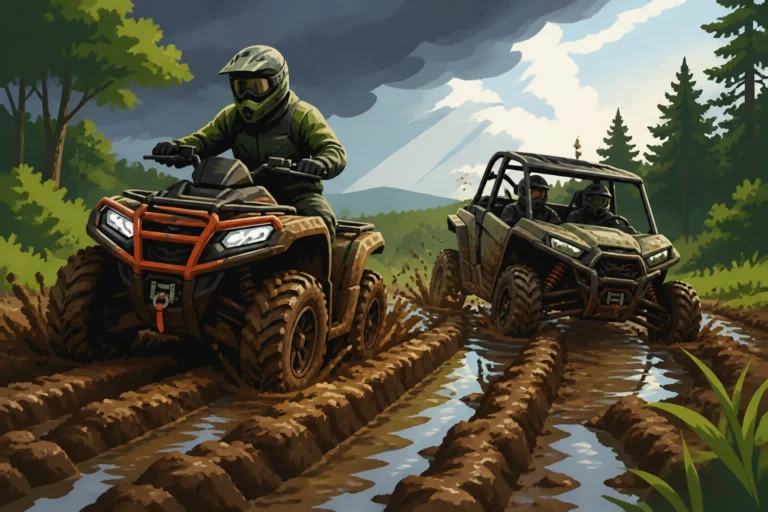
Wet rock can be slippery, and mud near a rocky section can hide holes or soft shoulders. Do not assume that a tire will grip simply because the stone looks rough. Reduce speed before reaching the slick area, avoid abrupt braking, and keep your movements smooth. If you cannot judge the surface from the machine, stop somewhere stable and inspect it without standing in the path of other riders.
The trail edge is especially tempting when a rut or puddle blocks the center. But riding around the obstacle can crush plants, widen the route, and start a new channel for runoff. If the main trail appears unsafe or badly damaged, follow any posted direction and consider turning around rather than improvising a bypass.
After heavy rain, check for closures before traveling and again at the trailhead. Forest roads and riding areas may close to prevent damage, and a familiar route can change after storms. Arkansas Trail Closures After a Storm and Arkansas Trail Conditions Before You Tow are useful reminders to confirm conditions instead of relying on last month’s ride or a saved route. onX Offroad can help you keep track of a planned route, but posted closures and official notices take priority.
Protect the trail and the people sharing it
Stay on the designated route
On rocky ground, it can be hard to tell where a trail ends and a natural opening begins. Follow trail markers and established tracks, and do not assume that an unmarked forest road is open to ATVs or UTVs. Stay behind gates and respect signs, barriers, and private-property boundaries.
Do not widen a narrow route to get around another machine, a rock, or a puddle. If the trail is too tight for your machine, do not force it through vegetation or scrape the sides to make room. Check width restrictions for the riding area before you leave; a machine that fits one trail system may not fit another.
Using onX Offroad to preview terrain can help you prepare for navigation, but a digital route is not a land-use authorization. Confirm that you are on a permitted trail and that the route is open to your vehicle type. For a broader overview of legal riding locations, start with Arkansas ATV Trails: Where to Ride.
Give other trail users a predictable ride
Rocky trails can limit visibility, especially around bends, climbs, and narrow passages. Slow down where you cannot see ahead, and be prepared for another machine, a hiker, or a work vehicle around the corner. Keep to the established track and leave enough room for others to pass where the trail allows it.
When meeting another rider on a steep or narrow section, avoid making a sudden move toward an unstable edge. Communicate calmly and work out which machine can safely move to a wider spot. Do not idle so close that another rider feels pressured to hurry through a difficult obstacle.
If your group stops, pull completely out of the travel path where it is safe to do so. A scenic rock outcrop may look like a convenient place to gather, but a blind curve or narrow ledge is not a good stopping area. Keep noise, litter, and unnecessary idling to a minimum, and pack out everything you brought in.
Understand how small impacts add up
A trail does not need to be visibly destroyed for riding choices to matter. Repeated tire spin can displace soil between rocks. A detour around a puddle can create a wider, bare strip. Water may then follow the disturbed ground, deepen a rut, and carry sediment downhill.
That is one reason to avoid riding closed or saturated routes even when the surface appears firm in one spot. Trail managers may close an area because the underlying soil is vulnerable or because runoff is causing damage beyond the section riders can see. For more context, see Erosion and Why Trails Close.
Good trail habits are practical, not fussy. They help preserve access, reduce repair work, and make the route more enjoyable for the next group. If a trail is damaged, report the issue to the appropriate land manager or riding-area operator rather than trying to make an unauthorized repair.
Handle trouble without making the situation worse
Stop safely when the machine takes a hit
If you hear a hard impact or notice a change in steering, braking, or tire pressure, stop in a safe place and inspect the machine. Look for a cut or bulge in a tire, loose protective parts, fluid leaks, or damage that affects control. Do not keep riding just to reach the next scenic stop if the machine no longer feels predictable.
Choose a stopping point where other riders can see you and pass safely. If you are on a steep slope, avoid parking where the machine could roll or block the route. Let the group know what happened, and keep people clear of unstable terrain while you assess the problem.
A basic repair may be possible on the trail, but only attempt work you understand and can do safely. If the issue affects steering, braking, or structural parts, arrange appropriate help or retrace your route if that can be done safely. Continuing with a serious mechanical problem can turn a manageable delay into an emergency.
Know when to turn around
Turning around is often the best choice when rain makes rock slick, a route is closed, daylight is running short, or the group’s skill level does not match the obstacle. It is also reasonable to reconsider when a passenger feels unsafe or a machine is struggling. No ride is improved by pressuring someone to attempt terrain they cannot confidently handle.
Before reversing direction, consider whether the route behind you is safe and whether other riders are approaching. Move to a stable place, communicate the plan, and avoid turning across a steep or narrow section if there is a safer option nearby. If a group needs to separate, make a clear plan so nobody rides alone without support.
For future trips, use what you learned to choose a better-matched route and prepare more carefully. Review maps, official notices, and rider feedback, while remembering that conditions can change. onX Offroad may be useful for organizing a route you have checked, but keep a backup plan and follow information posted at the riding area.
Leave the area as you found it
Before departing, check your stopping spots for trash, tools, straps, and anything that may have fallen from a machine. Avoid moving rocks, breaking branches, or building an unauthorized bypass. If you find a hazard or significant trail damage, report its location as clearly as you can to the managing agency or park operator.
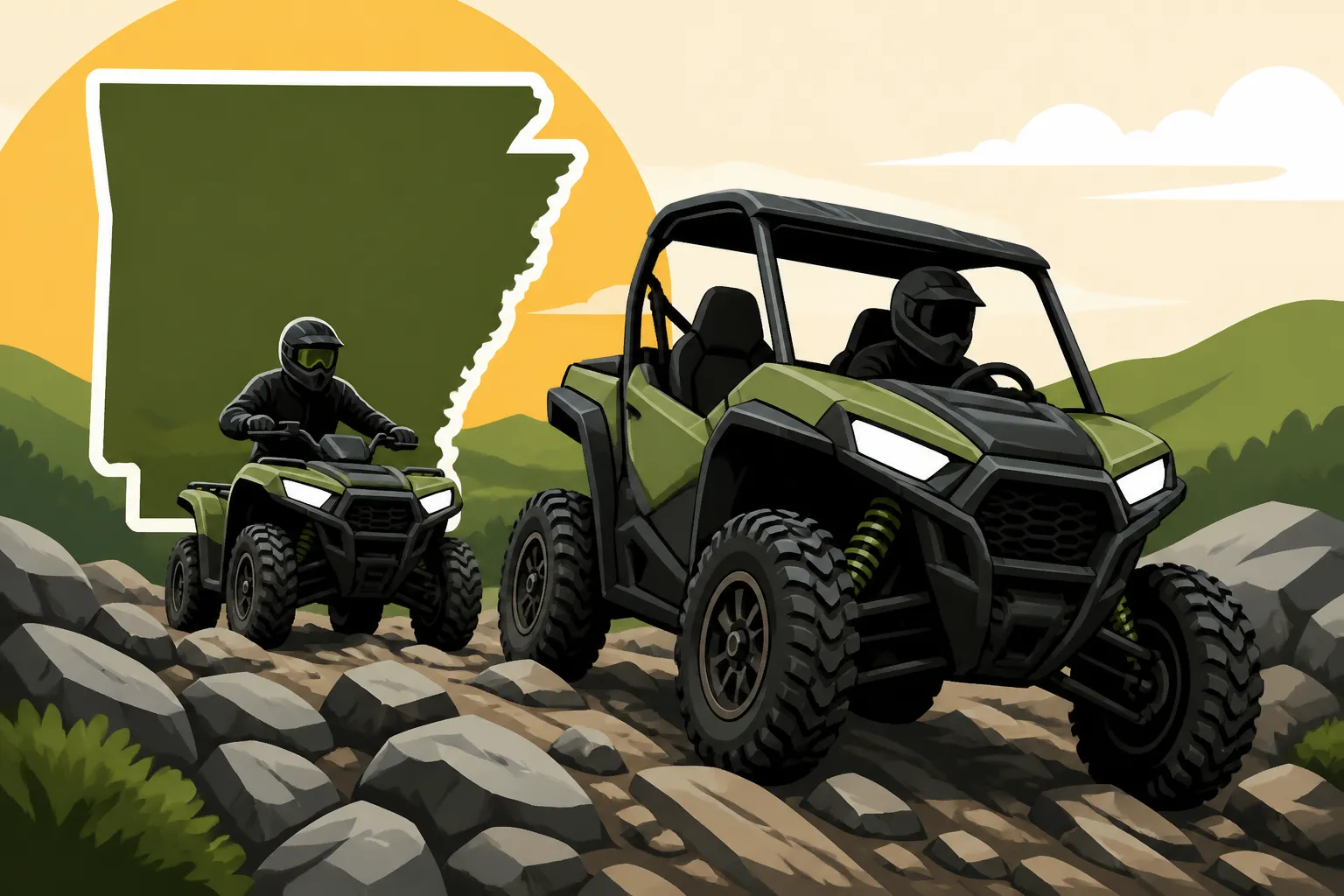
A careful ride on rocky Arkansas ground is mostly about patience: choose a suitable route, keep a controlled pace, stay on the designated trail, and turn back when conditions call for it. Those choices protect your machine, your group, and the trail system that makes the next ride possible.
Disclaimer
This article is for general informational purposes only and does not constitute professional advice. Laws, prices and regulations vary by location and change over time. Consult a qualified professional for guidance on your specific situation.