Arkansas Has No Mandatory ATV Safety Course
Arkansas riders often assume an ATV safety course is required before they can ride, register a machine, or obtain a trail permit. That confusion can lead to unnecessary paperwork—or, more importantly, leave new riders unsure what rules actually apply. This guide explains the statewide course requirement, where separate rules may still apply, and how riders can build practical skills before heading out.
Does Arkansas Require an ATV Safety Course
The statewide course rule
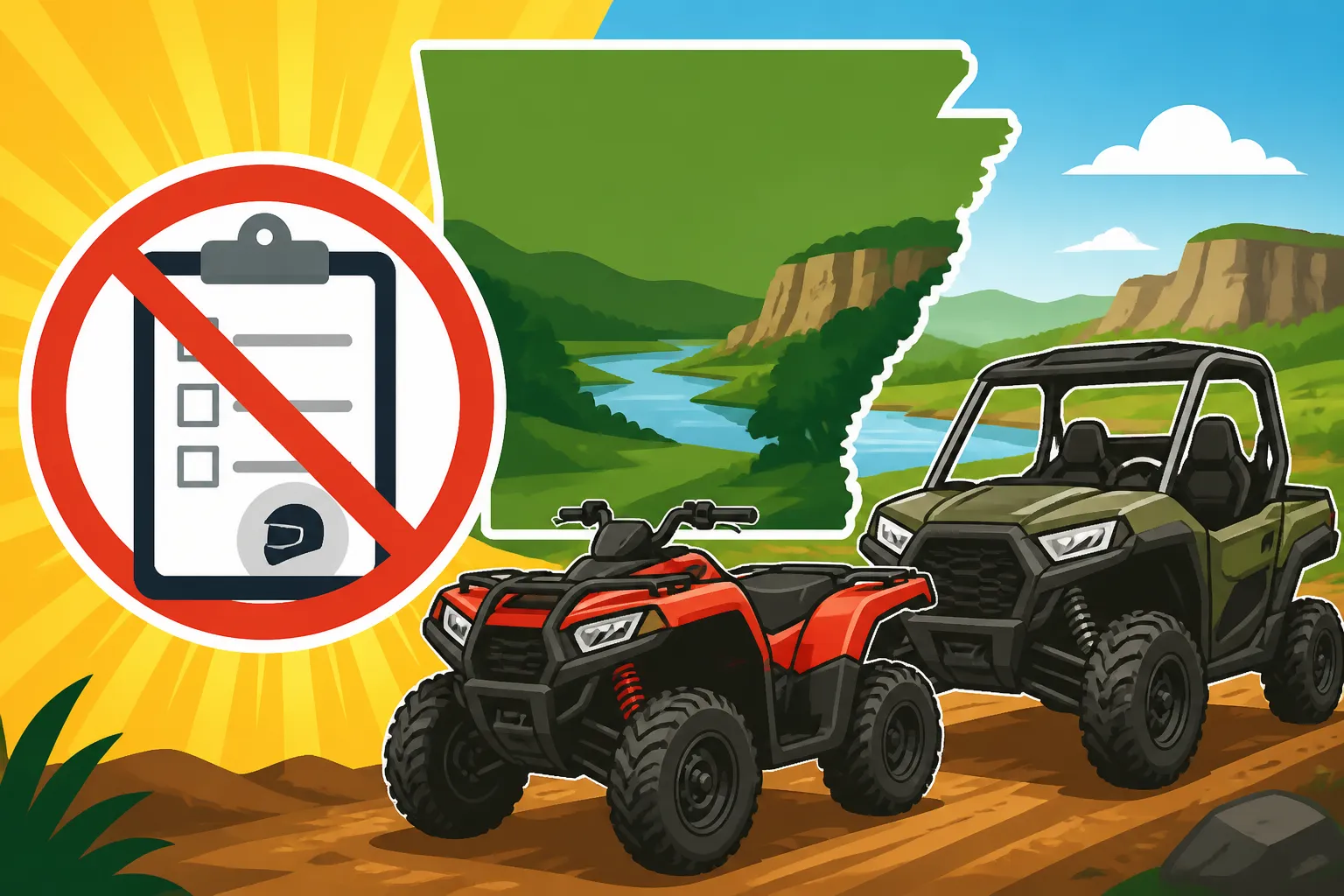
Arkansas does not require every ATV or UTV rider to complete a state-mandated safety course simply to ride an off-highway machine. A course completion card is not a universal prerequisite for owning an ATV, registering one, or riding on every trail. That is the key distinction: there is no single statewide training requirement that applies to every rider in every situation.
This does not mean every riding situation is unrestricted. Age-related rules, landowner requirements, forest permit conditions, and private park policies can all affect where and how someone may ride. A course may also be a condition of a specific program or event, even though Arkansas does not impose it as a general requirement on all riders.
If you have been told that “Arkansas requires a class,” ask what specific law, trail system, park, or organized activity the person is referring to. They may be describing a private venue’s policy or a sensible recommendation rather than a statewide rule. For more context, see Arkansas Safety Courses That Are Voluntary.
What the absence of a mandate does and does not mean
“No mandatory course” is not the same as “no safety rules.” Riders still need to follow the rules for the land they are using, respect age and supervision requirements, and operate a machine that is appropriate for the terrain. A rider can be subject to a trail system’s access rules even when no general state course card is required.
It also does not mean a course is pointless. Training can help a beginner learn how to use the throttle and brakes smoothly, position their body on uneven ground, approach hills, and recognize when a trail is beyond their ability. Those skills matter on Arkansas terrain, where rocky slopes, loose gravel, mud, and changing weather can make a familiar route feel different from one ride to the next.
The practical takeaway is straightforward: do not treat a safety course as a universal Arkansas registration or riding requirement, but do check the specific location’s rules before you go. If you are riding with children, visiting a private park, or joining an organized event, verify the requirements for that situation rather than relying on what a friend heard elsewhere.
Where Safety Course Requirements Can Still Apply
Private parks, rentals, and organized rides
A private off-road park, rental business, tour operator, or organized ride may set its own conditions for participation. Depending on the provider, those rules might involve a minimum age, a driver’s license, a safety briefing, a waiver, or supervision for younger riders. A venue may also require an orientation before it hands over a rented machine, even if it does not require a formal course certificate.
These policies are not automatically statewide laws. They are conditions of using a particular service or property. A park operator might require an adult to accompany a young rider, while another venue may not admit riders below a stated age at all. A rental company may offer a short machine orientation as part of pickup, but that is not necessarily the same thing as completing a recognized safety course.
Before booking, call or check the venue’s own rules and ask direct questions: Is a course card required, or is an orientation enough? Does the rule apply to every rider or only the person driving? Are there different conditions for children, passengers, or rental machines? Related topics include Arkansas Private Park Age Minimums and Arkansas Private Park Helmet Rules.
Forest trails, passes, and local access rules
A forest OHV permit and a safety course serve different purposes. A permit, where required, concerns access to a particular riding area or land system. A course concerns training. Holding one does not automatically satisfy the other, and completing a course does not give you permission to ride on land where you otherwise lack access.
Arkansas riders may encounter different permit rules depending on the forest or trail system. Some requirements are tied to the area and the machine, rather than the rider’s training history. Before towing to a trailhead, check the applicable permit, vehicle, and access conditions for that specific destination. The overview Arkansas Riders Need Two Different Forest Passes helps explain why a pass for one forest does not necessarily cover a different system.
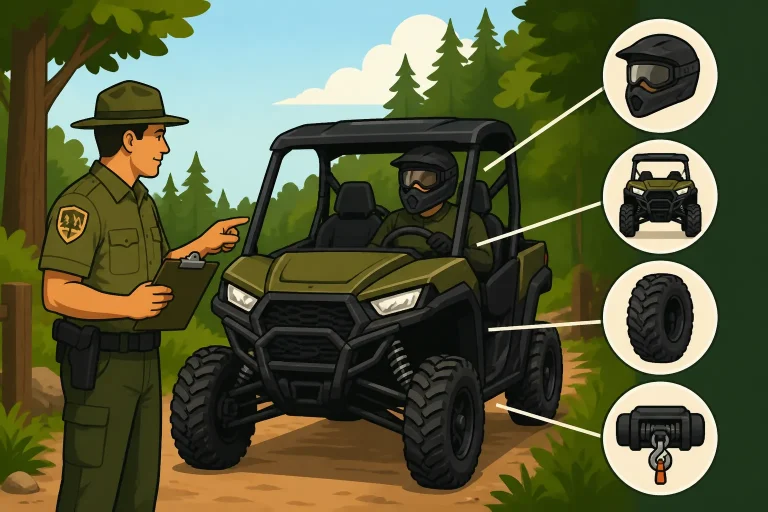
Rules can also differ between public land, private parks, and land used with an owner’s permission. A route that is open on one property may be closed on the next, and permission to cross private land does not automatically authorize riding on nearby public roads or trails. For trailhead expectations, see What a Forest Ranger Checks at an Arkansas Trailhead.
What a Voluntary ATV Course Can Teach
Machine control and terrain awareness
A useful ATV safety course is hands-on or skills-focused, not just a list of warnings. It can help riders become familiar with the machine’s controls, understand how throttle input affects movement, and practice braking in a controlled setting. For a beginner, learning to stop smoothly and keep a steady pace can make a bigger difference than trying to ride quickly to keep up with a group.
Terrain awareness is another central skill. On rocky ground, the safest line may be the one that keeps the machine stable rather than the one that looks shortest. On a hill, a rider needs to recognize when the slope, surface, or machine position is becoming unsafe. A course can introduce these decisions before a rider has to make them under pressure on a crowded or unfamiliar trail.
Training can also help riders understand how a machine’s size and design affect handling. A small youth quad, a full-size ATV, and a side-by-side do not respond identically. Riders should learn the controls and operating guidance for the machine they will actually use, not assume that experience on one model transfers perfectly to another.
Group riding, communication, and emergencies
Many riding problems begin with a group moving at different speeds or assuming everyone knows the plan. A safety class can encourage riders to agree on a pace, identify a lead and sweep rider, and stop in a safe place when someone falls behind. These habits reduce the chance that a new rider feels pressured to ride beyond their ability just to keep the group in sight.
Communication matters when visibility is limited by trees, dust, bends, or changing elevation. Riders can agree on simple signals before setting off and make sure everyone knows what to do if the group becomes separated. It is also wise to establish a turnaround point and a check-in plan, especially where cell service is unreliable.
A course may also cover basic emergency preparation: carrying water, a first-aid kit, a charged phone or other communication option, and a way to share the group’s route. Training cannot prevent every breakdown or injury, but it can help riders respond more calmly. A little preparation is especially useful on long loops where walking back to a trailhead may be difficult.
Choosing a Course That Fits Your Riding
Start with the rider and the machine
A course should match the rider’s experience, age, and machine type. A new adult rider who plans to use a side-by-side may need different instruction from a child learning on a small quad. If a family rides several types of machines, look for instruction that addresses the specific controls and safety concerns relevant to each rider rather than treating every ATV and UTV as interchangeable.
Think about the setting where you will ride. Someone planning short trips on familiar private property may have different training needs from someone preparing for long trail loops in the Ouachita Mountains. The more unfamiliar, remote, or technical the terrain, the more valuable it is to practice foundational skills before the trip.
Ask what the course actually includes. Does it cover practical handling, protective equipment, passenger safety, and terrain decisions? Is there instruction for the machine you use? Is the course designed for beginners, young riders, or experienced riders who want a refresher? A clear description is more useful than a vague promise that the class will “teach ATV safety.”
Online learning and hands-on practice
Online material can be a convenient way to learn basic concepts before a ride. It may help riders review terminology, understand common hazards, or discuss safety topics with children before arriving at a trailhead. For options and expectations, see Arkansas Online Safety Courses. Before enrolling, confirm whether the course is educational only or whether a particular venue recognizes its completion for a specific requirement.
Online learning has limits. It cannot show whether a rider is gripping the controls too tightly, looking down instead of ahead, or struggling to shift their weight on a slope. Those details are easier to address through supervised practice in a safe, open area. A good approach is to use reading or video instruction as preparation, then practice basic starts, stops, turns, and controlled braking away from traffic and obstacles.
If you are comparing courses, focus on the quality and relevance of instruction rather than on whether a certificate is issued. A certificate can be useful for personal records or for meeting a venue’s stated policy, but it does not prove that a rider is ready for every trail. Confidence should come from demonstrated control and sound judgment, not from paperwork alone.
Children, Teen Riders, and Adult Supervision
Do not confuse course rules with age rules
Parents sometimes ask whether a child can ride because Arkansas does not require a general safety course. That is the wrong question to rely on by itself. Course requirements and youth operating rules are separate issues. A child may still be subject to age, supervision, machine, property, or venue conditions regardless of whether a course is mandatory statewide.
Before a child rides, check the rules that apply to the exact location and activity. A private park may set its own age minimums. A rental operator may impose additional restrictions. Public-land rules and the machine’s operating guidance may also matter. The related guides Arkansas Rules for Riders Under Twelve and Arkansas Supervision Rules for Small Children address youth riding considerations in more detail.
The child’s physical size and ability matter just as much as the number on a birthday cake. A young rider needs to reach and operate the controls safely, understand basic instructions, and stop the machine reliably. If the machine is too large or powerful for the child to control, adult presence alone does not make the ride safe.
Make supervision active, not distant
“Supervision” should mean an adult is paying attention and can respond, not simply being somewhere on the property. A child learning to ride should be in a controlled area where the adult can observe speed, turns, stopping, and reactions to uneven ground. A parent who is also riding far ahead on a trail may not be in a position to intervene if the child has trouble.
Set clear expectations before starting: where the child may ride, how fast to go, what signal means stop, and what to do if the machine feels unstable. Practice stopping and turning before moving onto a trail. If a child is tired, frustrated, or overwhelmed, end the practice rather than pushing for one more lap.
A safety course can give adults and children a shared vocabulary for discussing risks, but it does not replace hands-on supervision. It also does not override venue rules or legal requirements. Families should review the park or trail conditions before arrival, and confirm that the child’s machine and riding plan fit those conditions.
Permits, Reciprocity, and the Limits of a Course Card
A course certificate is not a permit
Riders sometimes collect documents and assume they all prove the same thing. They do not. A training certificate may show that someone completed a course. A forest permit may authorize access to a designated riding area under its rules. Registration documents may relate to the machine. Permission from a landowner concerns access to that property. One document cannot be assumed to replace another.
This distinction matters when a rider is visiting from another state. A home-state safety card does not automatically establish that the rider has met Arkansas trail access requirements. Likewise, an Arkansas course certificate would not by itself satisfy another state’s access, registration, or permit rules. Check each destination’s rules separately before traveling.
Out-of-state machines and riders may face questions about registration decals, forest passes, and what proof to carry. Those issues are separate from course completion. See Do Out-of-State Riders Need an Arkansas Registration Decal? for the registration question, and verify the specific land manager’s permit requirements for the trail system you plan to use.
A practical document check before riding
Use this table as a starting point when sorting out what a particular ride may require. It is not a substitute for checking the actual trail, venue, or landowner rules, but it helps prevent the common mistake of treating a course card as an all-purpose pass.
| Item | What it generally addresses | What it does not automatically prove |
|---|---|---|
| Safety course record | Training or course completion | Permission to ride on a specific property |
| Forest OHV permit | Access under that forest or trail system’s rules | Completion of a safety course |
| Registration or decal | A machine-related registration requirement, where applicable | That every trail or road is open to the machine |
| Landowner permission | Permission to use specified private land | Permission to cross other property or ride public roads |
| Park or rental orientation | A provider’s operating instructions or conditions | Compliance with every statewide or land-manager rule |
Before leaving home, confirm that the permit applies to your destination and your machine. Check whether each vehicle needs its own pass, whether the permit must be displayed or carried, and whether there are width or seasonal restrictions. If you are unsure, contact the land manager or park directly rather than relying on an old social media post or a friend’s experience from a different trail.
Keep required documents accessible and protect them from water and mud. A phone screenshot can be useful, but do not assume a digital copy will be accepted where a physical display or printed document is specified. A quick check before loading the trailer can save a long drive that ends at a closed gate.
Building a Safer Ride Without a Legal Course Requirement
Prepare the machine and protective equipment
Start with the machine itself. Check tires, brakes, controls, lights, fuel, and visible damage before riding. Make sure the machine is appropriate for the rider and terrain, and review the owner’s operating guidance. A mechanical problem that seems minor in the driveway can become serious far from the trailhead.
Protective gear should be chosen for the ride, not just for appearance. A properly fitting helmet, eye protection, gloves, sturdy footwear, and clothing suited to the weather can make a ride more manageable. Conditions in Arkansas can shift from dusty to wet, and a comfortable layer for a cool morning may feel too warm by afternoon. Riders should also consider visibility and protection from branches, gravel, and sun.
If you are shopping for replacement gear or basic trail supplies, compare sizing, fit, and the manufacturer’s instructions rather than choosing solely by price or appearance. Riders may find products through local powersports shops or retailers such as Amazon, but a listing cannot confirm that a helmet fits an individual properly. Try equipment on when possible, and replace damaged protective gear rather than continuing to use it.
Plan the route and ride within your ability
A sensible ride plan begins before the engine starts. Check the trail’s access rules, weather, seasonal closures, and machine width limits. Identify the route length and likely difficulty, and make sure the least experienced rider in the group can handle it. A loop that seems modest on a map can feel much longer when the surface is rocky or a rider is nervous.
Tell someone who is not riding where you are going and when you expect to return. Carry enough water and basic supplies for the conditions, and do not assume cell service will be available throughout the route. In remote areas, a paper map or downloaded map can be a useful backup if a phone battery dies or the signal disappears.
On the trail, leave space between machines, slow down when visibility is poor, and stop only where the group can do so safely. Do not let a faster rider pressure a beginner into taking a hill, crossing, or rocky section they are not comfortable with. Turning around is a valid decision. The goal is to finish the ride with everyone and every machine in good shape, not to prove that every obstacle can be conquered.
Consider training as an ongoing habit
Even experienced riders can benefit from reviewing safety basics. Skills can become rusty during a long break, and a new machine may respond differently from the one a rider knows well. A refresher is particularly useful before a family trip, a group ride, or a return to technical trails after months away.
Use practice sessions to build confidence gradually. Start with simple control exercises on appropriate private ground, then progress only when the rider is comfortable. Avoid practicing on roads or property where riding is not allowed. A supervised practice area should be clear of bystanders, traffic, and hazards that could turn a low-speed lesson into an avoidable injury.
Most of all, treat training as one part of responsible riding rather than a box to check. A course can teach useful habits, but safe decisions still depend on the rider, the machine, the terrain, and the conditions that day. Arkansas does not impose one universal ATV safety course requirement, yet careful preparation remains one of the best ways to make a ride safer and more enjoyable.
Disclaimer
This article is for general informational purposes only and does not constitute professional advice. Laws, prices and regulations vary by location and change over time. Consult a qualified professional for guidance on your specific situation.