What a Forest Ranger Checks at an Arkansas Trailhead
Arriving at an Arkansas trailhead, you may be focused on unloading and getting on the trail—not wondering what a ranger might ask to see. The practical basics are a valid pass where required, permission to ride that route, and paperwork that matches your machine. Knowing what may be checked—and what one pass does not cover—can prevent a frustrating start.
The pass and the route you plan to ride
At a public-forest trailhead, the first question is often whether the machine has the permit required for that riding area. Arkansas has riding opportunities in more than one national forest, and a permit for one forest does not automatically authorize riding in another. A private park or a separate OHV area can have its own access system, too.
That distinction matters because an Arkansas registration decal and a forest OHV permit do different jobs. Registration is a state requirement that may apply to a qualifying machine; a forest pass is permission to use a particular public riding system under its rules. Neither should be treated as a substitute for the other. See Arkansas Riders Need Two Different Forest Passes and Arkansas OHV Permits: Two Forests, Two Prices before planning a trip that crosses between riding areas.
A ranger may check that the pass is valid for the place, vehicle and period of use. How the pass must be displayed or carried can depend on the issuing system, so follow the instructions that came with it. If a digital receipt is accepted, keep it accessible offline rather than relying on a phone signal at the trailhead. If the permit needs to be printed or placed on the machine, do that before leaving home.
| What may be checked | What to have ready | Why it matters |
|---|---|---|
| Forest or trail permit | The required pass and its display or proof of purchase | A pass for a different riding area may not be valid there |
| Route access | A current map or clear plan for the open route | Forest roads, trails and gated routes can have different rules |
| Machine size | The machine’s width and model details | Some routes or gates restrict wider machines |
| State paperwork | Registration and proof of ownership, when applicable | A forest pass does not replace state requirements |
| Operating condition | Required equipment and a safe, working machine | Equipment rules and trail conditions can affect whether you may proceed |
If you are riding at Mill Creek, check its instructions separately rather than assuming that a pass from another forest covers the trip. The same principle applies to privately operated riding areas: their admission, waiver and machine rules are separate from public-forest permits. Carrying Your Forest Permit at Mill Creek explains why having the correct proof matters at that trail system.
Do not assume that purchasing a pass gives access to every road or trail in the forest. A pass is not permission to pass a gate, ride a closed route or ignore a seasonal closure. Rangers may direct riders to current maps, closure notices or posted information, and conditions can change after storms, maintenance work or other closures. Before unloading, check both the permit instructions and current trail information. How to Check Wolf Pen Gap Trail Status is useful when that is your destination.
The machine, its size and its paperwork
A ranger may ask what type of vehicle you are riding and whether it is allowed on the route. That can matter when a system has width limits, narrow gates or routes intended for particular vehicle types. A machine that fits a trail elsewhere may not fit through a specific gate, and forcing it through can damage property or injure someone.
Measure the machine at its widest point, including accessories that affect its overall width. Do not rely only on a model name or a sales description. Mirrors, wheels, racks or other additions can change the practical measurement. If you are close to a posted limit, confirm how the trail manager measures width before making the trip. The references Arkansas ATV Trails With Width Limits and Arkansas Gates That Stop 72-Inch Machines help explain why a seemingly small difference can change where a machine can go.
A ranger may also ask for state registration or other ownership information, particularly if there is a question about the machine or its use. The precise paperwork that applies depends on the vehicle and the situation. Arkansas’s definition of an ATV is not simply “anything with four wheels,” so an ATV, side-by-side, dirt bike or other machine may be treated differently. Start with Who Arkansas’s Off-Road Vehicle Law Covers if you are unsure which rules apply to your machine.
Keep paperwork consistent. If a machine’s serial number, registration information or ownership documents do not line up, be ready to explain why and provide supporting records. This is especially important for a used machine, one without a standard purchase receipt, or one with changed ownership details. A forest permit generally does not resolve a state paperwork issue. For the basics, see Arkansas Proof of Ownership for Registration and Arkansas Registration and VIN Verification.
A useful pre-trip check is to compare the number on your documents with the machine’s identification number, if one is present and accessible. Photographing the number and saving a clear image of your registration and receipt can help you locate information quickly. A waterproof pouch can keep paper copies together; if you prefer to buy one online, Amazon is one option, but any secure pouch that keeps documents dry will do.
Do not remove, alter or cover a vehicle identification plate to make it easier to mount an accessory. If the identification plate is damaged or missing, address that paperwork question before riding on public land. A ranger may not be able to resolve a registration problem at the trailhead, and a missing number can make it harder to establish which machine a pass or document belongs to.
Route rules, closures and equipment
A pass does not mean every route is open. Rangers may check whether riders are using an authorized trail or road and may point out a closure, gate or restriction. Some routes are designated for certain vehicle classes, while others may be closed to motorized travel. A barrier is not an invitation to find a way around it: it can mark a closed route, protect a work area or prevent damage to sensitive ground.
Use the map for the riding area, not only a general road map. Confirm that the route is open to your kind of machine and that any posted size restriction is compatible with it. Forest roads can also have different rules from designated OHV trails. If a route is closed, turn around and use an authorized alternative rather than treating the closure as optional. Arkansas WMA Vehicle Rules in Plain English covers wildlife-management areas, which have their own access rules and should not be confused with national forest routes.
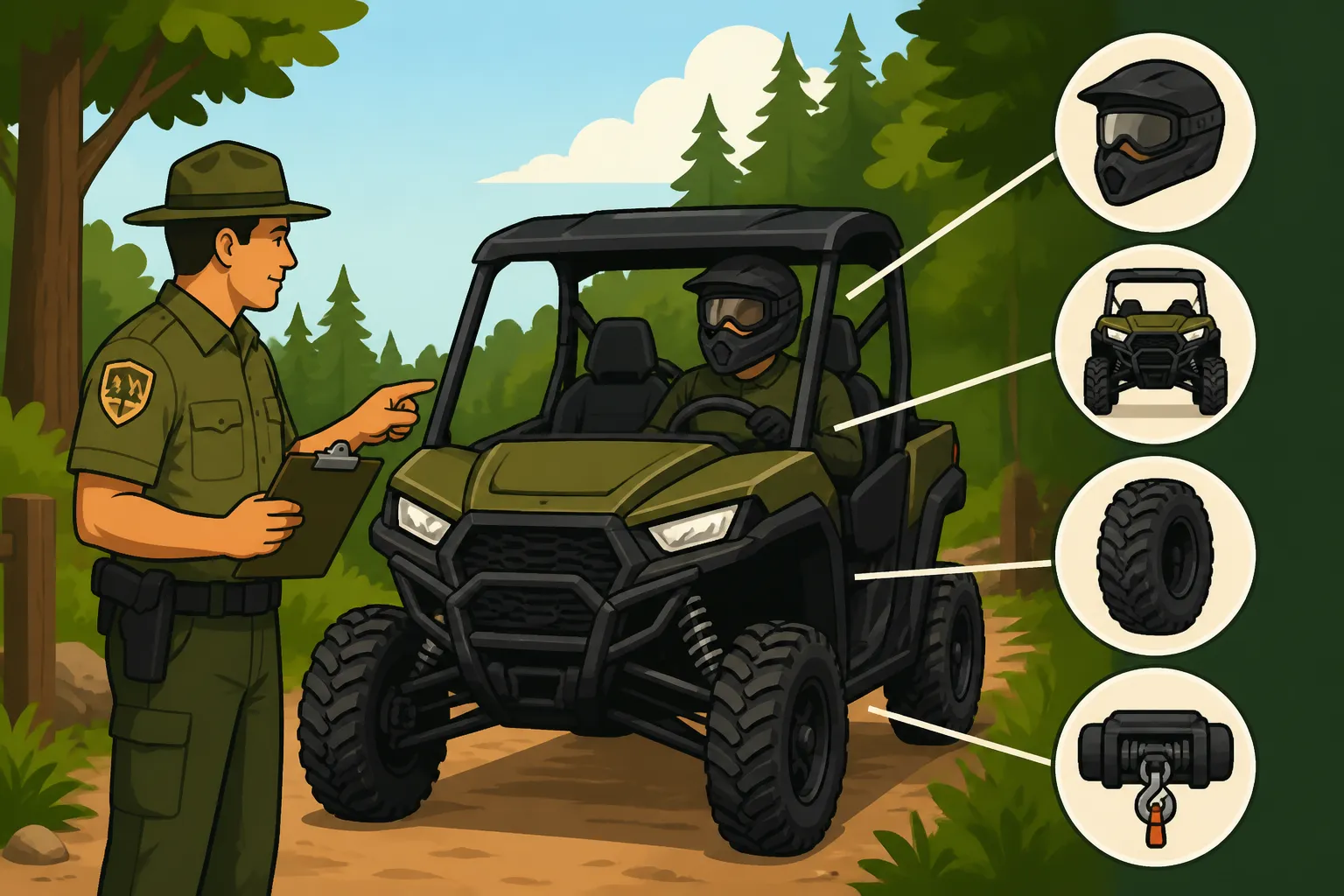
Rangers may also check whether the machine meets equipment requirements that apply to the area. Spark-arrestor requirements and sound limits are examples of rules that can apply on forest land. The exact requirement may depend on the land manager and riding area, so check the current rules before departure rather than relying on a general assumption that a stock machine is automatically compliant. Aftermarket exhaust or engine changes are worth checking in particular.
A good pre-ride check includes the basics that affect safe, responsible operation:
- Make sure lights, brakes, steering and tires are in working condition.
- Secure loose gear so it cannot fall onto the trail.
- Carry any required safety or fire-prevention equipment specified by the riding area.
- Keep exhaust and engine modifications within applicable requirements.
- Check weather and recent conditions; muddy or damaged routes may close to prevent further erosion.
- Pack a map or saved offline directions in case there is no cell service.
These are sensible checks whether or not a ranger asks to inspect the machine. They also reduce the chance that a minor mechanical problem becomes a rescue or recovery problem on a remote route. If the trail system has a specific equipment checklist, use that over a generic packing list.
A ranger’s questions may be brief: where you are headed, what kind of machine you have, or whether you have checked the route status. Answer clearly and follow instructions. If you are uncertain about a closure or boundary, ask before proceeding. Do not assume that an unmarked-looking road is open just because another vehicle has used it.
What to carry and how to avoid delays
The easiest way to handle a trailhead check is to organize the documents before the trip. Keep the pass information, state paperwork and machine details in one place, but do not mix them up: a forest pass proves access under that pass system, while state records address separate requirements.
A compact checklist can help:
- Confirm which forest, trail system or private park you are visiting.
- Buy the correct permit and follow its instructions for display or proof.
- Check current closures, route designations and machine-width limits.
- Bring applicable state registration and proof-of-ownership documents.
- Make sure the machine’s identification information is legible and matches the paperwork.
- Check required equipment, sound and spark-arrestor rules for that riding area.
- Save the map and permit information somewhere accessible without cell service.
- Keep documents dry and secure while unloading and riding.
If a ranger asks for information you cannot immediately find, stay calm and explain what you have. A receipt in an email account may be difficult to retrieve if there is no signal, so save it locally or print it when the permit instructions call for that. Keep a paper copy protected from rain and mud. If the question concerns a registration record or ownership issue, the trailhead is not the best place to sort out incomplete paperwork; contact the appropriate office before returning.
A common source of confusion is relying on another rider’s pass or on a prior trip’s rules. A pass may be tied to a particular vehicle, location or time period, and rules can differ between trail systems. Read the permit itself and verify its scope. For questions about whether a permit covers more than one machine, Arkansas Permits Are Per Vehicle is a useful related resource.
Rangers are not necessarily there to provide a complete legal review of every vehicle or document. Their role at a trailhead may involve confirming access, explaining restrictions and addressing safety or compliance issues within their authority. A quick check does not guarantee that every other requirement has been met. Riders remain responsible for following state law, land-manager rules and posted instructions throughout the trip.
When in doubt, ask the land manager or permit issuer before you travel. That is especially worthwhile if you have a wide side-by-side, a modified machine, an unusual ownership history or plans to ride in more than one area. A short call or a careful review of official permit information can save a long drive that ends at a gate.
Frequently Asked Questions
Does an Arkansas forest pass replace state ATV registration?
No. A forest pass provides access under the rules of the relevant riding area. State registration, when required for the machine, is a separate matter.
Will a ranger check every ATV for paperwork?
Not necessarily. Checks vary by location and circumstances. Carry applicable documents and be prepared to show proof if asked.
Can I use one forest pass in every Arkansas riding area?
Do not assume so. Different forests, OHV systems and private parks can have separate permits. Confirm the rules for each destination before leaving.
What if my machine is too wide for a gate?
Do not try to force it through or bypass the gate. Check the route’s width limits and choose a route designed for the machine.
Disclaimer
This article is for general informational purposes only and does not constitute professional advice. Laws, prices and regulations vary by location and change over time. Consult a qualified professional for guidance on your specific situation.