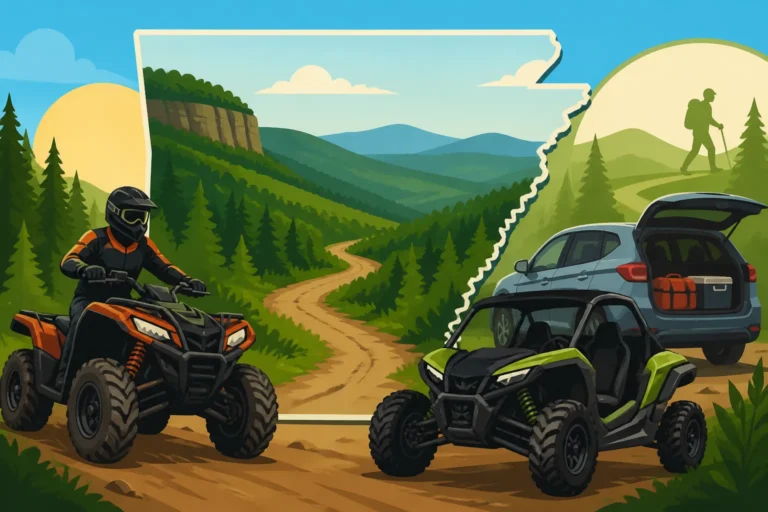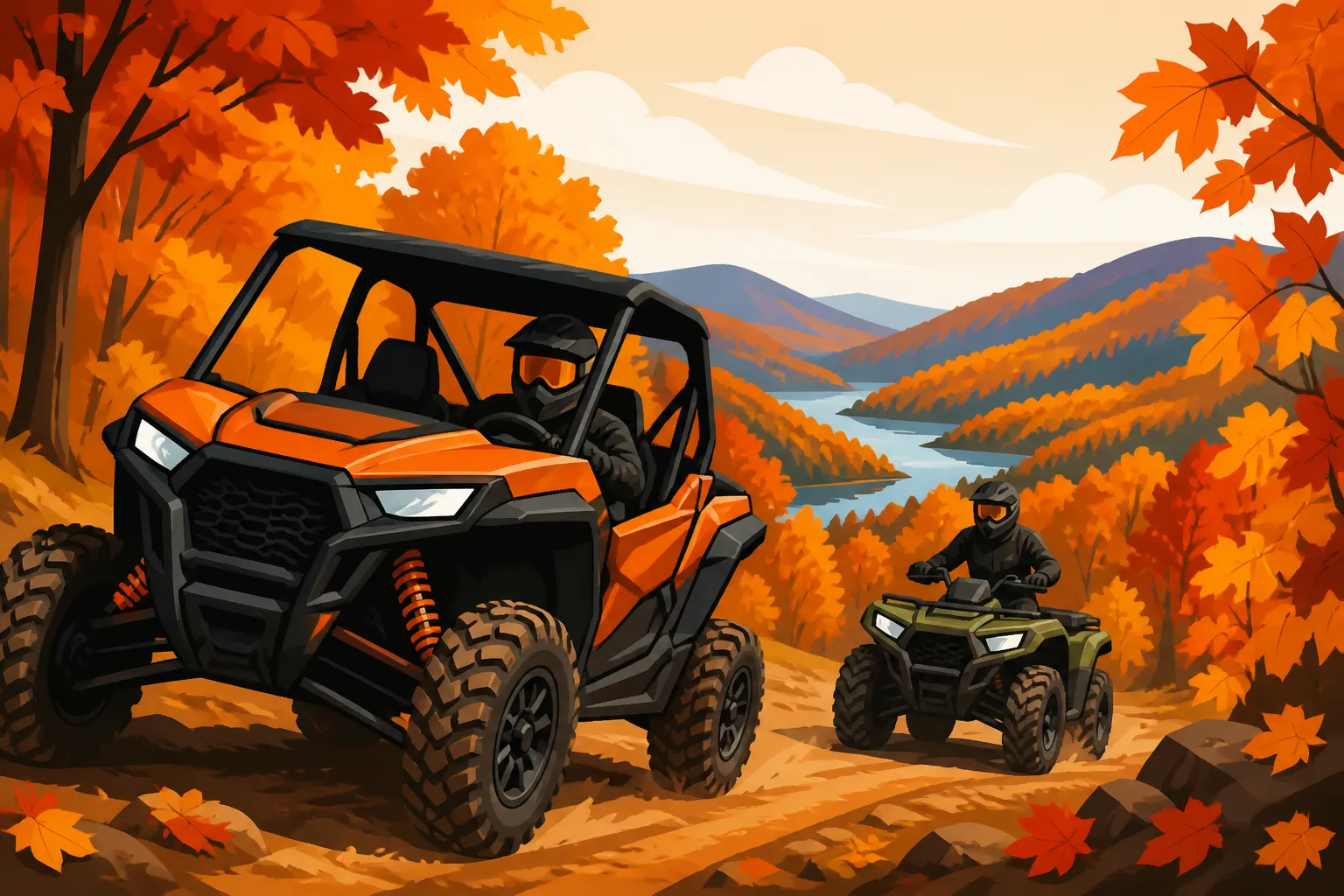
Arkansas Riding in Fall Color
Fall color makes an Arkansas ATV or UTV ride feel special, but a beautiful overlook does not guarantee an easy day: wet leaves can hide rocks, trail access can change, and daylight disappears sooner than expected. This guide helps you choose an area, plan a sensible autumn route, prepare for changing conditions, and enjoy the scenery without treating public trails like open roads.
Choose an Arkansas riding area for fall color
Autumn color can be rewarding across both the Ozarks and the Ouachita Mountains, but the experience differs by area. Elevation, weather, and the timing of seasonal change all affect what you see, so it is better to plan around the kind of ride you want than to depend on a particular weekend for peak color.
Compare the Ozarks and the Ouachitas
The Ouachitas offer a mountain setting for rides around the Mena area, including the well-known [Wolf Pen Gap: Arkansas's Best Known OHV Complex]. The Ozarks provide a different backdrop, with riding options such as [Mill Creek OHV Trail System in Arkansas] near Ozark. Neither region guarantees a particular color display on a specific day. A warm spell, wind, or rain can change the look of a hillside quickly.
| Area | What to consider for a fall ride | Planning reminder |
|---|---|---|
| Ouachita Mountains near Mena | Mountain roads and wooded slopes make for a scenic outing, with riding options in the region | Check access, trail status, and machine-width limits before hauling |
| Ozarks near Ozark | A good base for exploring trails in the Ozark region and planning a day around a nearby riding area | Confirm which roads and trails are open to your vehicle |
| Private off-road parks | A more managed setting may suit riders who want a defined riding area | Review the park’s current rules, fees, and hours before leaving home |
If you are choosing between the two regions, think about the whole day rather than only the color. How long are you comfortable towing? Do you want a full trail loop or a short outing with time for a scenic stop? Is your group experienced with uneven terrain? Those answers can narrow the choice more reliably than trying to predict exactly when leaves will turn.
For a broader look at regional differences and trip ideas, see [Arkansas Trails in the Ouachita Mountains] and [Arkansas Trails in the Ozarks]. These are useful starting points when you are deciding where to base a fall weekend.
Check access before you build your route
A trail shown on a map is not automatically open to every vehicle or available in every season. Forest roads, designated OHV trails, private property, and local roads can have different rules. A route that looks connected on a screen may cross a closed gate or include a segment that is not legal for your machine.
Before you tow, confirm the riding area’s current conditions through the appropriate land manager or park operator. Check for closures, construction, storm damage, seasonal restrictions, width limits, and required passes. If your route crosses more than one managed area, make sure you understand each area’s requirements; a pass for one forest may not cover another. [Arkansas Riders Need Two Different Forest Passes] explains why it is worth checking that detail instead of assuming one permit covers the whole trip.
You can use a mapping app such as onX Offroad to organize possible routes and keep track of landmarks, but treat it as a planning aid rather than permission to ride. Confirm the legal route and current access with the land manager. If you expect weak cell service, save the maps and essential trip information before leaving coverage, then carry a paper map as a backup.
Prepare for autumn trail conditions
Fall riding can bring comfortable temperatures and gorgeous views, but it can also bring slippery leaves, mud, early darkness, and quick changes in weather. A route that felt straightforward in dry conditions may require more care after rain. Plan for the ground you might encounter, not just the forecast you hope for.
Expect hidden obstacles and changing traction
A layer of leaves can conceal rocks, roots, ruts, and branches. In a shaded section, the surface may stay damp long after an exposed area has dried. That makes it harder to judge traction, particularly on slopes, turns, and uneven ground. Slow down when you cannot see the trail surface clearly, leave extra space between machines, and avoid sudden steering or braking.
Mud can also be deceptive. A puddle may be shallow, or it may cover a rut deep enough to catch a tire. If you cannot see the bottom and do not know the route, do not charge through to find out. Look for a safe way around only when the surrounding ground is open and riding there is permitted. Cutting a new line around a puddle can damage the trail and create a wider muddy section for everyone.
Trail conditions deserve a fresh check even if you have ridden the same route before. Rain, wind, and maintenance work can change what is passable. Use [Arkansas Trail Conditions Before You Tow] as a reminder to check ahead rather than relying on last season’s experience. For more wet-weather perspective, [Arkansas Riding in Winter Mud] covers challenges that can also be useful to keep in mind during a rainy autumn outing.
Pack for shorter days and cool evenings
Afternoons may feel mild while the machine is moving, but shaded trail sections and a ride back to camp can feel chilly. Dress in layers so you can adjust as conditions change. Wear closed-toe shoes, gloves, and eye protection, and bring a rain layer that can be reached without unloading the entire machine.
A useful fall packing list includes:
- Warm and rain-resistant layers for each rider.
- Water and snacks, even for a route that seems short.
- A first-aid kit and any personal medication.
- A charged phone, backup battery, and offline route information.
- A basic recovery kit suited to the machine and the terrain.
- A flashlight or headlamp in case a delay pushes the return into dusk.
- A paper map or written directions as a backup to electronic navigation.
Check your lights before departure, and do not assume that a trail will be as quick to ride on the way back as it was on the way out. Slippery surfaces, a stuck machine, or a longer-than-expected stop can all add time. Pick a turnaround point that leaves a comfortable margin before dark rather than stretching the day to reach one more overlook.
Plan a scenic ride without losing sight of safety
A fall-color outing is not a race between trailheads. The best plan gives your group time to ride within its abilities, pause at appropriate places, and adjust if the weather or trail conditions are different from what you expected.
Build a route around your group
Start with the least experienced rider, not the most confident one. A route that is manageable for a seasoned local may be stressful for a new rider, a family group, or a passenger who has never been on an ATV or UTV. Choose a distance that allows for breaks and minor delays. If you are unsure about difficulty, ask the riding area or park operator what to expect rather than guessing from a map.
Before the ride, agree on a simple plan: who leads, who follows, where the group will stop, and what everyone should do if the machines become separated. Keep enough space between vehicles for dust, braking, and unexpected obstacles. At a stop, pull fully out of the active trail when it is safe to do so; a blind corner is not a good place for a photo break.
When using onX Offroad or another navigation tool, save the intended route and identify a few obvious landmarks in advance. Check that the route follows permitted trails, not just the most direct line between two points. Tell someone who is not riding where you plan to go and when you expect to return. That small step matters if your group runs late or loses communication.
Make scenic stops responsibly
Fall color encourages people to pull over, take photos, and linger. Choose a location where you can stop without blocking the trail or creating a hazard for riders coming around a bend. Keep machines on designated surfaces, avoid trampling vegetation, and do not cross a fence or gate to reach a viewpoint. A roadside shoulder or trail edge is not automatically an authorized place to ride or park.
Respect private property and posted closures even when a route seems to offer a better view. Gates may protect land, repair work, or sensitive areas; they are not invitations to find another way around. If you are unsure whether a side route is open, stay on the confirmed route and ask the land manager later.
A scenic pause is also a good chance to check the group. Ask whether everyone is warm, hydrated, and comfortable continuing. If someone is tired or uneasy about the terrain, shorten the ride. A planned turnaround is far better than pressuring a rider to continue because the group hopes to see one more stretch of color.
Make the day run smoothly from driveway to trail
A successful fall ride starts before the trailer is hitched. A little preparation can prevent the common frustrations: arriving to find a closure, discovering the machine will not fit through a gate, or realizing the group has no backup plan when service drops.
Check the machine and the trail requirements
Inspect tires, brakes, steering, lights, fluids, and any recovery equipment before leaving. Pay attention to tire condition and pressure appropriate to the machine and its manual; worn tires are especially unhelpful on wet leaves or slick ground. Secure loose cargo so it cannot shift on rough sections, and make sure passengers have the protective gear and seating the machine is designed for.
Verify that your vehicle is allowed in the riding area. Width matters in places with gates or narrow trail sections, and a machine that is legal to own is not necessarily allowed on every trail. If you have a side-by-side, confirm the posted width limits rather than relying on a rough estimate. The guide to [Arkansas ATV Trails With Width Limits] can help you identify why this check belongs on your pre-trip list.
Also confirm the required permits and how they must be displayed or carried. Keep proof of purchase, registration documents when applicable, and any land-use pass where you can reach them. Different authorities may ask for different documents, so do not assume the same paperwork covers every part of your trip.
Have a fallback plan
Autumn weather can change quickly, and trail conditions can make a planned loop unsuitable. Identify a shorter alternative, a nearby place to stop, or a different riding day before you leave. Check whether the area has limited cell service, and download any route information you will need while offline. onX Offroad can help you prepare navigation details before you lose signal, but keep a second way to understand your location in case your phone battery dies or the app cannot provide the information you need.
If a trail is closed, do not go around a barrier or follow another rider onto an unmarked route. Turn around and use your backup plan. If rain makes a section unsafe, choose the conservative option even if it means missing a planned viewpoint. Leave room in your schedule to wash and inspect the machine afterward; wet leaves and grit can cling to tires, underbody panels, and other components.
For a broader sense of how the riding calendar changes through the year, see [Arkansas Riding Season Month by Month]. It can help you think beyond a single fall weekend and choose another outing if conditions do not cooperate. And if your priority is scenery, [Arkansas Trails With Overlooks] offers another useful angle when you are comparing ride ideas.
Disclaimer
This article is for general informational purposes only and does not constitute professional advice. Laws, prices and regulations vary by location and change over time. Consult a qualified professional for guidance on your specific situation.