Arkansas Trail Riding After Heavy Rain
Heavy rain can turn an Arkansas trail from a pleasant ride into a muddy, rutted route with hidden washouts and unsafe creek crossings. The hard part is knowing whether conditions are merely messy or genuinely risky—and whether the trail is open at all. This guide explains how to check conditions, decide when to ride, and protect yourself and the trail.
Why heavy rain changes Arkansas trails
Mud, ruts, and erosion can make a route harder than it looks
Rain affects trails differently depending on the soil, slope, drainage, and how much water has already fallen. A firm gravel road may drain quickly, while a narrow trail on a hillside can turn slick and unstable. In the Ozarks and Ouachitas, rocky sections may shed water, but the soil between rocks can still become muddy and lose traction.
The first concern is rutting. When tires spin or dig into saturated ground, they can carve channels that collect more runoff. Those ruts may deepen with each passing vehicle, making the route harder to use and more vulnerable to erosion. A trail that seems passable for one machine can be damaged quickly if a group keeps pushing through the same soft section.
Wet conditions also change how a machine handles. Tires can slide sideways on a slope, and mud can hide rocks, roots, holes, or sharp edges. On a side-by-side, the added weight can make a muddy climb or descent especially difficult. If your tires are spinning, the machine is sliding, or you need repeated throttle to get through a section, that is a good reason to turn around rather than force it.
Trail design and terrain matter as much as the amount of rain. A low-lying stretch may hold water long after nearby ground dries. A steep trail can channel runoff across the riding surface, while a rocky route may look manageable but contain slick, uneven patches. Read about the differences between [Arkansas Ozark and Ouachita Riding Compared](Arkansas Ozark and Ouachita Riding Compared) before planning a trip in an unfamiliar area.
Creek crossings and low spots deserve extra caution
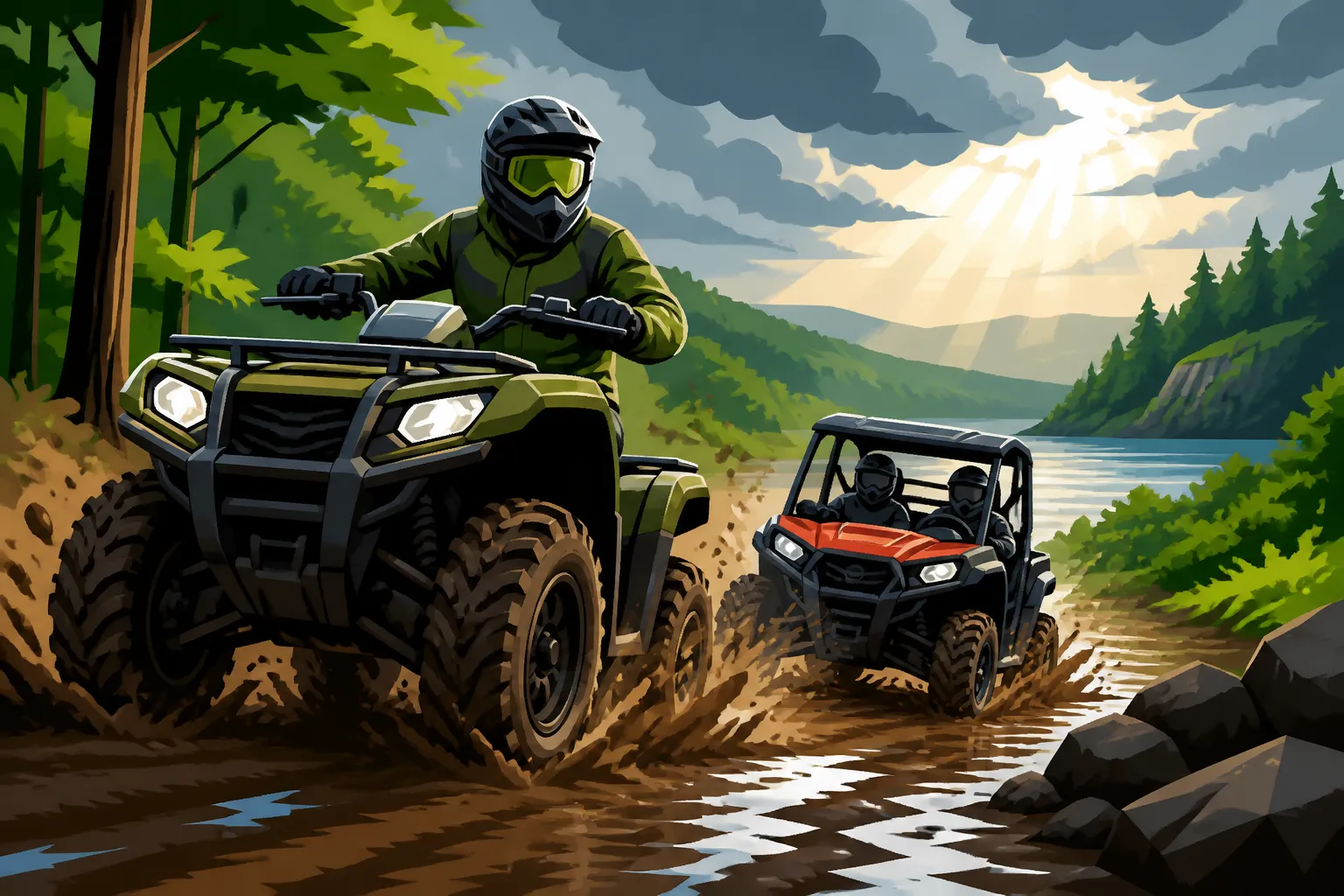
A creek that was easy to cross before a storm may rise, run faster, or carry debris afterward. The water can obscure the bottom, making it difficult to judge depth, footing, or the location of a drop-off. Even if the water looks shallow from the bank, the current may push a machine off line or sweep a rider’s feet out from under them.
Never assume a crossing is safe because another rider has just made it through. Water levels can change, and the route they used may not be the safest line for your machine. If you cannot clearly assess the crossing, do not enter it. Look for a safe way back, wait for conditions to improve, or choose another ride.
Low trail sections can also conceal soft ground. A patch of standing water may cover a rut, a washed-out edge, or debris carried in by runoff. Avoid charging through puddles just to find out what is underneath. If a route requires you to gamble on depth or traction, it is not a good place to continue.
How to check trail conditions before you leave
Confirm that the riding area is open
A map showing a trail does not establish that it is open today. Forest roads, trail segments, and riding areas may close temporarily because of storm damage, maintenance, seasonal restrictions, or unsafe conditions. Check the managing agency or riding area’s official notices before loading the machine, and check again close to departure if rain is in the forecast.
This matters at popular areas such as [Wolf Pen Gap: Arkansas's Best Known OHV Complex](Wolf Pen Gap: Arkansas's Best Known OHV Complex) and [Mill Creek OHV Trail System in Arkansas](Mill Creek OHV Trail System in Arkansas). Do not treat an old trip report, a map line, or a social media post as confirmation that a route is currently open. Conditions can change between a rider’s visit and yours.
A trail permit and an open trail are separate questions. Having the required permit does not override a closure, and a trail being open does not mean every vehicle can use every route. Check vehicle-width limits and access rules as well as status. For background on closures and post-storm changes, see [Arkansas Trail Closures After a Storm](Arkansas Trail Closures After a Storm) and [Arkansas Trail Conditions Before You Tow](Arkansas Trail Conditions Before You Tow).
Use maps as planning tools, not as proof of current conditions
A mapping app can help you understand the route, identify access roads, and save a map for areas with limited cell service. onX Offroad can be useful for reviewing mapped routes and planning where you might turn around, but a map should not be treated as a real-time report of trail conditions or official permission to ride. Confirm open status and current restrictions with the land manager or riding area.
Before leaving home, download or save the information you will need offline. Cell service can be unreliable in parts of the Ouachitas and Ozarks, so do not assume you can look up a detour once you are deep into a riding area. Carry a paper map as a backup, and tell someone where you plan to ride and when you expect to return. [Carrying a Paper Map as Backup](Carrying a Paper Map as Backup) is a sensible habit even when you normally navigate by phone.
Use more than one source when the weather has been severe. Check the official trail or forest notice, look for recent reports from the riding area, and call ahead if the status is unclear. A report that says “muddy but open” may still leave important questions unanswered: Are creek crossings passable? Are certain trails closed? Are wide machines allowed on the route you want? Ask specific questions rather than relying on a general description.
| What to check | Why it matters | What to do if unclear |
|---|---|---|
| Official closure or access notices | A mapped route may be temporarily closed | Contact the land manager or riding area |
| Recent rainfall and forecast | Additional rain can worsen already saturated ground | Postpone if heavy rain or storms are expected |
| Creek and low-water crossings | Water depth and current can change quickly | Avoid any crossing you cannot assess safely |
| Trail width and machine limits | Some routes or gates restrict wider machines | Confirm the route fits your vehicle |
| Cell coverage and navigation | Service may disappear away from main roads | Save maps offline and carry a backup |
Deciding whether to ride after the rain
Make the call based on conditions, not a fixed waiting period
There is no single number of hours that makes every Arkansas trail ready after rain. A short shower over dry, well-drained ground is different from repeated storms on already saturated soil. The same amount of rain can also affect nearby trails differently because of slope, shade, soil, and drainage.
Consider the full picture: How much rain fell? Is more on the way? Are there steep sections, creek crossings, or soft low areas on the route? Has the trail manager reported damage or closure? If you cannot answer those questions, choose a less exposed route or postpone. A disappointing change of plans is easier to manage than a stranded machine or an injury.
Be especially cautious when a trail has standing water, fresh runoff, visible washouts, or deep tire tracks filled with mud. If the ground deforms under your tires or the trail edge is breaking away, continuing can make the damage worse. Turn around before reaching a section you cannot safely reverse out of. On a narrow trail, that may mean leaving extra room to maneuver rather than riding until the route becomes impassable.
A practical way to plan is to decide on a conservative turnaround point before the ride. If the first muddy climb is already demanding, do not assume the rest of the route will be easier. And if weather changes while you are out, shorten the ride rather than trying to complete the loop at all costs.
Adjust your route and riding style
After rain, choose a route that matches your experience and your machine. A familiar trail with easy exits may be a better choice than an unfamiliar loop with steep slopes or water crossings. If you are riding with beginners, children, or a mixed group, agree in advance that anyone can call for a stop or turnaround without being pressured to continue.
Keep a greater distance between machines so you can see what the rider ahead encounters and avoid bunching up on slick ground. Use smooth throttle and braking, and avoid spinning tires. On descents, reduce speed before the slope rather than relying on sudden braking in mud. If a section looks unstable, stop somewhere safe and assess it instead of attempting it at speed.
Do not bypass a closure by creating a new route around a gate, barrier, or damaged section. Riding off the established trail can damage vegetation, widen the route, and create additional erosion. For more guidance on leaving trails in good shape, read [Tread Lightly on Rocky Ground](Tread Lightly on Rocky Ground) and [Rutting After a Wet Weekend](Rutting After a Wet Weekend).
If trail conditions are mixed, consider shortening the trip or choosing a managed area where staff can answer questions about current access. Some private parks may have their own closures, rules, or riding restrictions after storms, so confirm directly with the park before driving there. The general advice in [Arkansas Private Off-Road Parks Compared](Arkansas Private Off-Road Parks Compared) can help you think through the differences between riding areas.
Staying safe and reducing trail damage
Prepare for getting stuck or having to turn back
A wet-weather ride calls for practical preparation, not just a more aggressive tire. Bring recovery gear suited to your machine, such as a tow strap and appropriate attachment points, and know how to use it before you need it. Keep recovery gear accessible rather than buried under camping supplies. A winch can help in some situations, but it is not a reason to enter a steep, flooded, or unstable section.
Carry drinking water, basic first aid supplies, a charged phone, and a backup navigation option. Let someone know your route and expected return time. If you ride in a group, establish a simple plan for keeping everyone together and for handling a machine that cannot move. A rider who is stuck on a remote trail may need help from the group, not a rushed attempt to keep going.
Avoid recovery efforts that put people in the path of a sliding machine or under a loaded strap. If the machine is wedged near water, on a steep slope, or in unstable ground, pause and reassess. Getting a vehicle out is not worth creating a second emergency. For longer trips, [Carrying a Tow Strap in the Hills](Carrying a Tow Strap in the Hills) and [First Aid Worth Carrying on a Long Loop](First Aid Worth Carrying on a Long Loop) offer useful preparation ideas.
Leave the trail in better shape than you found it
If your tires are digging deep ruts, stop and turn back when it is safe. Do not widen the trail to get around mud, cut through vegetation, or drive around a closure. Those shortcuts can turn one damaged section into several, and water may use the new tracks as channels during the next storm.
Respect gates, signs, and barriers even when the route appears passable. A closure may protect a damaged section while it recovers or allow crews to make repairs. If you encounter damage, note the location and report it through the appropriate trail or land-management channel. Do not move barriers or assume a trail is open because other riders have gone around them.
When you return, inspect the machine before loading it. Mud and grit can hide damage, and packed debris may affect moving parts or cooling components. Clean the machine where permitted and dispose of mud responsibly rather than washing it into a stream or drain. The simple choices made during and after a wet ride can help keep Arkansas trails usable for the next person.
Finally, remember that a trail can be open but still unsuitable for your group that day. Turning around is not a failed ride. It is a sensible decision when water, traction, visibility, or trail damage makes the route unsafe. A little flexibility protects your machine, your riding companions, and the places you came to enjoy.
Disclaimer
This article is for general informational purposes only and does not constitute professional advice. Laws, prices and regulations vary by location and change over time. Consult a qualified professional for guidance on your specific situation.