Arkansas Utility Company Crews on ATVs
There's a common misconception that ATVs and UTVs are absolutely forbidden from touching any public road in Arkansas. For many riders, that's a frustrating reality, making simple tasks or access to trails a logistical nightmare. But for the essential work done by utility companies, those rules can be a serious impediment. This guide will clarify the specific, often misunderstood exception that allows utility company crews to use their ATVs and UTVs on Arkansas public roads, ensuring they can keep our lights on and our services running.
Understanding the General Ban on ATVs/UTVs on Arkansas Roads
Let's face it, the general rule is pretty clear, and it can be a real head-scratcher for many ATV and UTV enthusiasts in Arkansas. For the most part, operating an off-highway vehicle (OHV) like an ATV or UTV on a public road, street, or highway in the state is simply not allowed. This isn't some arbitrary local ordinance; it's codified in Arkansas state law. The legislature has designated these machines as "nonhighway vehicles," primarily designed for off-road use, and therefore not suited for the speed, traffic, and safety requirements of public roadways.
This overarching prohibition exists for a few key reasons. First, ATVs and UTVs often lack the standard safety equipment found on street-legal vehicles, such as turn signals, brake lights that meet highway standards, or even the appropriate tires for paved surfaces. Riding non-highway tires on asphalt can be dangerous, affecting handling and braking significantly. Secondly, there are concerns about the speed differentials between ATVs and regular traffic, which can lead to hazardous situations. Finally, the state wants to ensure that vehicles on public roads are properly registered, titled, and often insured, which ATVs typically aren't for road use. We dive deeper into this topic in [What Arkansas Law Forbids on a Public Road].
It’s easy to feel the frustration if you just need to cross a paved county road to get to your deer lease or move from one section of your farm to another. The law can feel restrictive, forcing riders to trailer their machines for even short distances on public land. This general ban sets the stage for why specific exceptions are so crucial, especially for those whose livelihoods depend on accessing challenging terrains that only an ATV or UTV can handle effectively. Without these carefully carved-out exceptions, critical work would be severely hampered, if not impossible.
The Specific Exception for Utility Company Crews
Now, here's where we get to the heart of the matter and ease some of that frustration for those doing vital work. While the general rule prohibits ATVs and UTVs on public roads, Arkansas state law does provide specific exceptions. Among these critical allowances is one designed for utility company crews. This isn't just a loophole; it's a recognition that certain jobs require specialized equipment that can traverse rough terrain and often needs to cross or briefly use public roadways to reach those remote work sites. You can find a broader overview of these specific allowances in [Arkansas's Six Statutory Road Exceptions].
The statute explicitly states that the prohibition against operating an ATV or UTV on a public road does not apply to "an employee of a public utility or other company engaged in the maintenance of public utilities when the employee is engaged in the course of his or her employment." This language is precise and intentional. It acknowledges that utility workers—whether they're fixing a downed power line after a storm, maintaining a remote gas pipeline, or servicing communications infrastructure—often operate in areas inaccessible by conventional trucks or vans. Their ATVs and UTVs are not recreational vehicles in these scenarios; they are essential tools for critical infrastructure maintenance and repair.
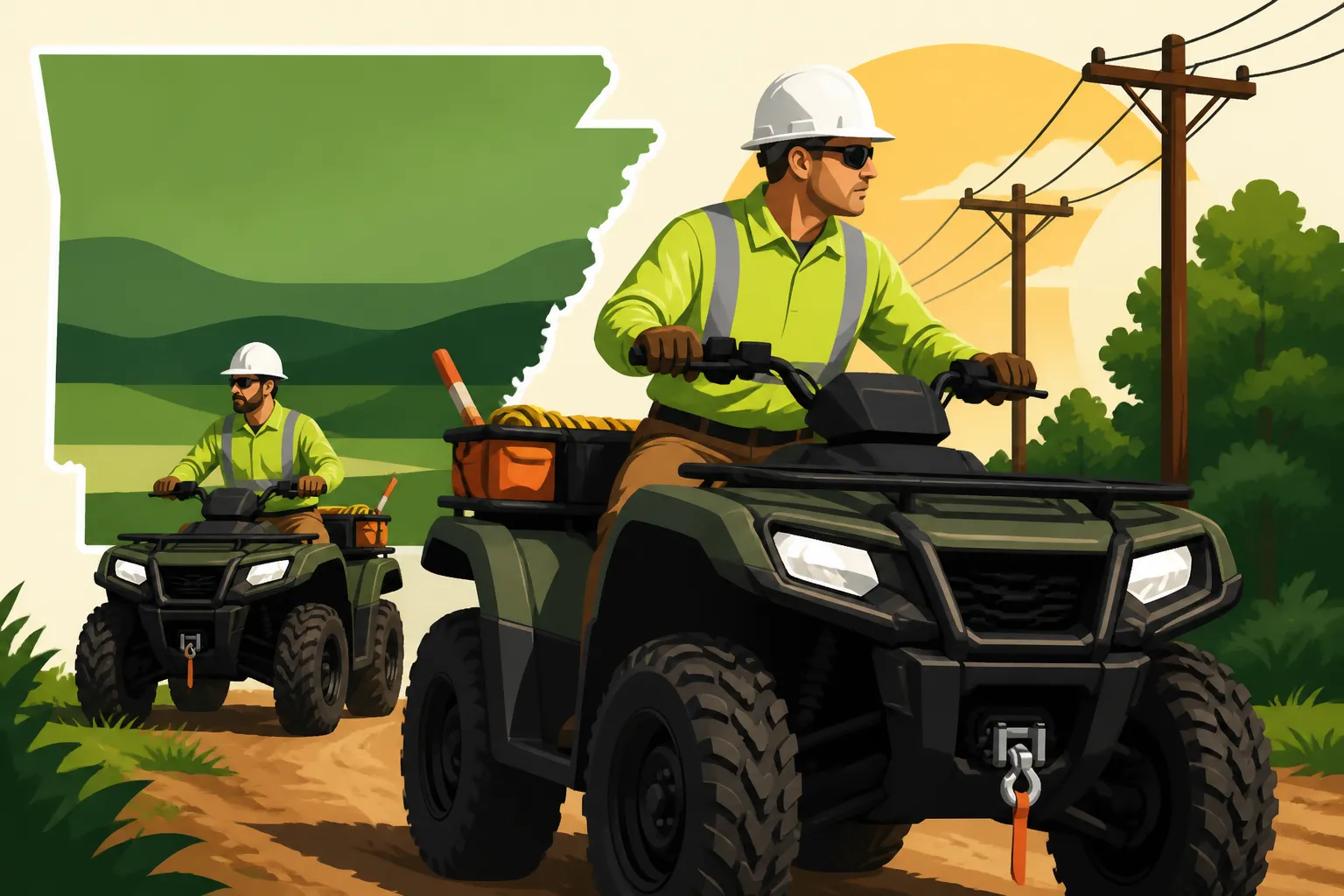
Think about a crew trying to restore power to a rural community after a storm has knocked out lines deep in the woods. Their trucks can only go so far. An ATV or UTV, perhaps outfitted with heavy-duty tires and a winch from a company like SuperATV, becomes indispensable for navigating muddy trails, fallen trees, and creek beds to reach the damage. Without this statutory exception, these essential workers would either be severely delayed, unable to perform their duties, or forced to break the law to do their jobs. It’s a pragmatic solution to a very real operational challenge.
Who Qualifies as a "Utility Company Crew"?
Understanding that an exception exists is one thing, but knowing who precisely falls under its umbrella is another. The Arkansas statute is quite specific, even if the wording leaves a little room for interpretation in the real world. It refers to "an employee of a public utility or other company engaged in the maintenance of public utilities." Let's break down what that typically means in practice.
Public Utility Employees
This category is usually the most straightforward. It includes individuals directly employed by established public utilities. We're talking about the folks working for electrical co-ops, municipal power companies, large regional power providers, water and sewer departments, and natural gas distribution companies. These are the employees who are out there day-to-day, often in company vehicles, performing routine maintenance, emergency repairs, and infrastructure upgrades. Their work is directly tied to providing essential services to communities, and their ATVs or UTVs are extensions of their toolkits, necessary for reaching poles, pipelines, and pumping stations in challenging terrain.
Imagine a crew from your local electric company needing to access a power pole located in a field or along a remote right-of-way. Their bucket truck can't get across the muddy pasture, but a utility-focused UTV, perhaps equipped with a heavy-duty cargo bed, can carry the necessary tools and equipment right to the base of the pole. This allows them to quickly assess damage or perform routine checks, minimizing service interruptions for residents.
Contractors Engaged in Utility Maintenance
The "other company engaged in the maintenance of public utilities" part is crucial. This extends the exception beyond direct utility employees to qualified contractors. Many utility companies outsource specific tasks, especially large-scale construction, specialized repairs, or vegetation management. If you're a contractor hired by an electric company to clear brush from power lines or by a gas company to inspect pipelines, and you're using an ATV or UTV as part of that contracted work, you generally fall under this exception.
Consider a tree trimming service that specializes in maintaining clear zones around power lines. They might use side-by-sides to haul their equipment and personnel through dense underbrush to get to specific sections of the line. The key here is that their work must be directly "engaged in the maintenance of public utilities." They aren't just joyriding; they are actively contributing to the functionality and safety of critical infrastructure. It's not enough to simply say you're doing utility work; there must be a clear, verifiable contract or directive from a utility company.
Conditions and Limitations for Utility ATV Road Use
Even with a clear exception, it’s not a free-for-all. Like all legal allowances, this one comes with specific conditions and implicit limitations. Utility crews aren't suddenly "street legal" in the same way a car or truck is. They are granted a very particular scope of operation, and understanding these boundaries is key to staying compliant and safe. This contrasts with broader discussions around [Arkansas UTV Street Legal Rules by Town], which have their own distinct sets of requirements.
Engaged in the Course of Employment
The most critical condition is that the ATV or UTV use must be "in the course of his or her employment" and directly related to the "maintenance of public utilities." This isn't permission for a utility worker to take their personal ATV out for a spin on their lunch break or to run errands. It's strictly for work-related tasks. If a worker is transporting equipment to a job site, inspecting lines, or responding to an emergency, that falls within the scope. If they're using the company ATV to pick up groceries on the way home, it does not.
This distinction is vital for law enforcement, who might stop a utility vehicle on a public road. The operator needs to be able to clearly articulate and demonstrate that they are actively performing utility maintenance duties. This could involve carrying work orders, company identification, or tools specific to the task at hand. It reinforces that the ATV is a functional piece of work equipment, not a personal conveyance.
Reasonable and Necessary Use
While not explicitly stated as a separate clause in the statute, the spirit of the law implies "reasonable and necessary" use. This means utility crews should only use public roads when there is no practical alternative to reach their work site, or when crossing a road is the most direct and safest path to continue their work off-road. They shouldn't be traveling extended distances on major highways if there's a feasible off-road alternative or if trailering would be more appropriate for a longer segment. The goal of the exception is to facilitate access, not to create a new form of road vehicle.
For example, a crew might need to cross a two-lane county road to get from one section of a power line easement to another. This direct crossing, after [Arkansas Stop Before You Cross], would be considered reasonable and necessary. However, driving five miles down that county road to the next turn-off might not be, especially if they could have easily trailered the machine. It’s about minimizing public road exposure while maximizing the efficiency of their essential work.
Safety Equipment and Operation
While utility ATVs aren't required to meet full street-legal vehicle standards, common sense and general safety principles still apply. Many utility companies equip their ATVs and UTVs with additional safety features suitable for road interaction, even if brief. This might include bright strobes or warning lights, reflective tape, and often a brightly colored flag. Some utility companies will install aftermarket mirrors, similar to those found on street-legal UTVs, to enhance visibility. A company like SuperATV offers a range of durable, high-visibility accessories that can enhance safety for utility vehicles operating near or on public roads.
Operators are also expected to drive safely, respecting speed limits, traffic flow, and other road users. This isn't an exemption from reckless driving laws. If a utility ATV is stopped on a public road, deputies will still check for things like impairment or dangerous operation. The exception allows access, not irresponsible behavior. The focus remains on getting the job done safely and efficiently.
| Aspect | General ATV Road Rule | Utility Company Crew Exception |
|---|---|---|
| Legality on Public Roads | Generally Prohibited | Allowed under specific conditions |
| Purpose of Use | Recreational, hunting, farming (with specific rules) | Engaged in the course of employment for utility maintenance |
| Who Qualifies | Any ATV owner/operator | Employee of public utility or contractor for utility maintenance |
| Required Equipment | No specific road equipment generally required | Often equipped with additional safety lights, flags, etc. by employer |
| Duration of Road Use | Limited to direct crossings or specific local ordinances | Reasonable and necessary for accessing work sites and tasks |
| Legal Basis | Arkansas Code § 27-21-106 | Arkansas Code § 27-21-106 (Specific Exemptions) |
Ensuring Compliance and Safety for Utility Operations
For utility companies and their crews, navigating this exception isn't just about knowing it exists; it's about consistently demonstrating compliance and prioritizing safety. There's a significant responsibility that comes with this privilege, and companies often have robust internal policies to guide their teams.
Company Policies and Training
Responsible utility companies don't just hand over the keys to an ATV or UTV and send their crews out. They typically have strict internal policies and comprehensive training programs that go beyond basic OHV operation. This training often includes specific modules on safe road crossing procedures, defensive driving techniques when sharing roads with other vehicles, and how to interact with law enforcement if stopped. Crews are usually instructed on the exact parameters of their allowed road use – for instance, "only to cross paved roads at designated points" or "brief travel on gravel county roads to access specific easements."
These internal guidelines are crucial for protecting both the employees and the public. They ensure that every worker understands the gravity of operating these machines, especially when interacting with public infrastructure. Regular refreshers on these policies, coupled with robust incident reporting and review, help maintain a high standard of safety and compliance. It’s an ongoing commitment, not a one-time check box.
Vehicle Marking and Identification
To assist both the public and law enforcement in recognizing utility vehicles operating under this exception, many companies outfit their ATVs and UTVs with clear identification. This often includes company logos prominently displayed, vehicle numbers, and sometimes specific utility markings. As mentioned before, flashing amber lights, reflective striping, and safety flags are also common additions. These visual cues help differentiate a utility work vehicle from a recreational ATV, reducing confusion and potential scrutiny.
Imagine a citizen seeing a UTV driving on a county road and calling 911. If that UTV is clearly marked with "ABC Electric Co." and has amber warning lights flashing, it immediately signals that it's likely a legitimate work vehicle operating under a specific exemption. This proactive identification is a simple yet effective way to manage public perception and facilitate smoother operations, especially in rural areas where such sightings might otherwise raise concerns.
Communication with Local Law Enforcement
While not a statutory requirement, responsible utility companies often maintain good communication with local law enforcement agencies, especially in the rural counties where much of this work takes place. Letting local sheriff's departments know about ongoing projects that might involve ATV/UTV road use can head off misunderstandings. A quick call or email can inform deputies that crews will be working in a certain area, potentially crossing roads frequently, and that their ATVs are legitimate work vehicles.
This proactive communication can save time and prevent unnecessary stops for utility crews. It fosters a collaborative relationship between essential service providers and those who enforce the law, ensuring everyone is on the same page. It’s about building trust and clarity, making the work environment safer and more efficient for everyone involved.
Beyond the Statute: Practical Considerations for Utility Crews
While the legal framework provides the foundation, real-world utility work involves a host of practical considerations that go beyond simply checking a box on the statute. For crews operating in Arkansas's diverse landscapes, maximizing the effectiveness and safety of their ATVs and UTVs requires careful planning and the right equipment.
Equipping for the Job
Utility vehicles aren't just stock ATVs; they're often purpose-built or heavily modified to perform specific tasks. This might involve installing specialized cargo systems to haul tools, materials, or even small generators. Winches are almost universally critical for recovering stuck vehicles or moving obstacles, and companies like SuperATV offer robust, high-capacity winches designed for the kind of heavy-duty use utility work demands. Enhanced lighting, both for visibility during low-light operations and for illuminating work areas, is also common.
Consider the diverse terrain across Arkansas – from the rugged Ozark mountains to the swampy Delta lowlands. The tires needed for rocky, uphill climbs are different from those for navigating deep mud. Utility crews often choose aggressive, durable off-road tires that can withstand punctures and provide maximum traction, recognizing that a flat tire in a remote location can halt critical work. Skid plates and heavy-duty bumpers also become essential protection against rough terrain, ensuring the vehicle can get to and from the job site without mechanical issues.
Navigating Remote and Diverse Terrain
Arkansas is known for its natural beauty, but that also means utility lines often run through challenging, remote areas. Crews might encounter steep inclines, deep ravines, thick forests, and countless creek crossings. Their ATVs and UTVs must be capable of handling these conditions reliably. This capability is paramount, as failure to reach a site quickly can mean extended power outages or service disruptions.
Furthermore, these crews often work in all weather conditions – from the sweltering heat and humidity of summer to freezing rain and snow in winter. Their machines need to be reliable in extreme temperatures, and operators must be trained to handle the unique challenges each season presents. [Arkansas Riding in Spring Rain] or [Arkansas Riding in Winter Mud] provides a glimpse into the kinds of conditions these professionals face, highlighting the need for specialized equipment and skilled operators.
Emergency Response and Preparedness
A significant portion of utility work is emergency response – whether it's after a severe thunderstorm, an ice storm, or even a localized equipment failure. In these scenarios, speed and access are paramount. The ability to quickly deploy ATVs and UTVs to assess damage, clear obstructions, and begin repairs directly impacts how fast services can be restored. This exception allows them to use the most efficient means possible to get to the source of the problem.
For this reason, utility crews are also well-versed in personal preparedness. They often carry extensive first-aid kits, communication devices that work in remote areas, and emergency repair supplies for their vehicles. Their training often includes wilderness survival basics and advanced navigation techniques, ensuring they can operate safely and effectively even when cut off from traditional support. It’s a demanding job that requires both legal clarity and practical resilience.
Conclusion
The legal landscape surrounding ATVs and UTVs on public roads in Arkansas can be complex and, for recreational riders, often frustrating. However, the specific exception carved out for utility company crews serves a critical purpose. It acknowledges that these machines are indispensable tools for maintaining and repairing the essential infrastructure that powers our homes, delivers our water, and provides our communications. This allowance ensures that when a storm hits or a fault occurs, the dedicated men and women of our utility companies can access the most remote locations quickly and efficiently, using their specialized ATVs and UTVs to keep our communities running. It’s a clear example of how thoughtful legislation can support vital public services while maintaining overall road safety standards.
Disclaimer
This article is for general informational purposes only and does not constitute professional advice. Laws, prices and regulations vary by location and change over time. Consult a qualified professional for guidance on your specific situation.