Bono and the First Arkansas UTV Ordinance
The open road calls, but for years, if you owned a UTV in Arkansas, that call was often met with confusion, frustration, and the looming threat of a ticket if you dared to roll your machine off your private property. Many of us have felt that pinch, wanting to simply drive our side-by-sides a short distance to a friend's house, a local store, or even just to the nearest trail, only to be stopped by unclear laws. This guide is here to untangle the journey of UTVs onto Arkansas's city streets, specifically focusing on how the town of Bono became a true trailblazer, crafting the state's very first UTV ordinance and setting a precedent for communities statewide.
The Frustration of Unclear Road Rules for UTVs in Arkansas
For many years, the idea of legally driving your UTV on public roads in Arkansas was largely a pipe dream, or at best, a legal gray area fraught with uncertainty. It was a common source of frustration for UTV owners, who saw their versatile machines as perfect for quick errands or short trips, yet were legally confined to private land or dedicated off-road parks. This disconnect between the practical utility of a side-by-side and its legal status on community streets was a constant headache. You'd spend good money on a machine designed for utility and recreation, only to find its use severely limited by local statutes.
Imagine wanting to grab a bag of ice from the convenience store a mile down the road or just visit your neighbor across the way. For most vehicles, this is a non-issue. For UTV owners, however, it often meant loading the machine onto a trailer, driving a short distance, unloading, and then repeating the whole process in reverse. It felt incredibly inefficient and, frankly, a bit silly for such a short hop. This pervasive feeling of being unnecessarily constrained by antiquated laws was a shared experience across the state, making the prospect of street-legal UTVs a highly desired, yet seemingly out-of-reach, goal for many.
Why Street Legality Was a Head-Scratcher for UTV Owners
At its core, the problem stemmed from how UTVs were classified—or, more accurately, not classified—within Arkansas's existing vehicle codes. They weren't cars, trucks, or motorcycles, and while they shared some characteristics with ATVs, their size and passenger capacity often put them in a different category entirely. This left a void in legislation, leading to a default assumption that if it wasn't explicitly allowed, it was forbidden on public roads. This "default ban" meant that unless a specific exception was carved out, your UTV was considered an off-highway vehicle, period.
The desire to ride locally was immense. Many UTV owners live in rural or semi-rural areas where the distances between homes, small businesses, or even recreational access points are short and manageable for a UTV. The machines are rugged, easy to maneuver, and can carry gear or passengers comfortably. Denying them access to these short stretches of road felt like an oversight, especially when the same roads often saw golf carts or low-speed vehicles in other states. The challenge of having to haul your UTV on a trailer every single time you wanted to move it from point A to point B, even if A and B were just a stone's throw apart, was a major deterrent to fully enjoying your investment. This forced inconvenience was a real frustration point, and many wondered, "Why can't I just drive it down the street?" You might find yourself asking, [Can You Drive an ATV on the Road in Arkansas?], only to discover the answer was almost universally "no" without specific local allowance.
The Pre-Ordinance Landscape: A Patchwork of Uncertainty
Before cities began to adopt their own specific UTV ordinances, the legal landscape for riding side-by-sides on public roads in Arkansas was less a clear path and more a tangled briar patch. There was no statewide allowance for UTVs on local streets, which meant that any venturing onto a county road or city street was almost certainly illegal, leading to the potential for traffic citations and fines. The uncertainty was compounded by varying interpretations of general traffic laws by different law enforcement agencies. What one deputy might overlook, another might write a ticket for, simply because there wasn't a clear, uniform rule for UTVs.
This lack of clarity created a situation where many riders simply took the risk, hoping to avoid detection or relying on the local officer's discretion. This wasn't a sustainable or safe solution. Riders needed definitive guidelines, not just for their own legal protection but also for the safety of others on the road. The ambiguity also impacted local businesses, like those near popular riding areas, who might have benefited from UTV riders being able to access their shops directly. Without a legal framework, the economic and recreational potential of UTVs within communities remained largely untapped, leaving both riders and local economies in a state of limbo.
How Arkansas Cities Gained Local Authority Over UTVs
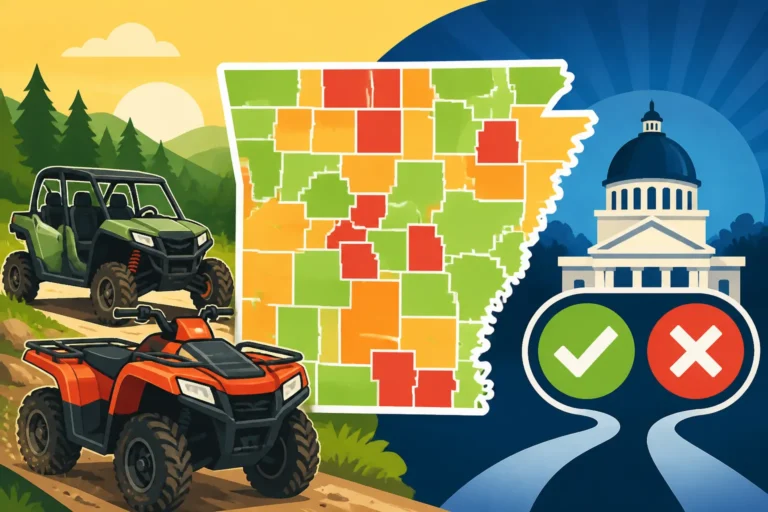
The turning point for UTV street legality in Arkansas didn't come from a sweeping statewide allowance, but rather from a legislative shift that empowered local communities to make their own decisions. This was a crucial development, recognizing that what works for a bustling urban center might not be appropriate for a small, rural town, and vice versa. It was a pragmatic approach to a complex issue, allowing individual cities and towns to tailor regulations to their specific needs and community character. This move acknowledged the diverse landscapes and lifestyles within Arkansas, paving the way for a localized solution to a statewide problem.
For years, many felt that a blanket state law was either too restrictive or too permissive, unable to account for the unique characteristics of Arkansas's many towns. Giving local governments the reins meant that residents could lobby their city councils directly, advocating for rules that made sense for their own streets and their own brand of recreation or utility. It was a bottom-up approach that finally started to address the frustrations UTV owners had been vocalizing for so long, offering a path forward that felt more democratic and responsive to local desires.
The Legislative Shift: Act 922 and Local Control
The game-changer arrived in the form of Act 922, a piece of legislation that fundamentally altered the legal landscape for UTVs in Arkansas. Prior to this act, the power for cities and towns to regulate UTVs on their streets was largely nonexistent or, at best, extremely limited and open to legal challenge. Act 922 explicitly granted municipalities the authority to pass ordinances allowing UTVs to operate on their public streets, under specific conditions outlined by the local government. This legislative move was a significant victory for UTV enthusiasts and local advocates who had been pushing for more localized control.
The passage of Act 922 meant that the decision-making power shifted from a general state prohibition to a local option. Cities and towns were no longer bound by a blanket ban but could, through their own legislative process, create rules that permitted UTV access. This was a monumental step, as it provided the legal foundation for places like Bono to even consider such an ordinance. Without Act 922, any local attempt to make UTVs street legal would have likely been quickly overturned. Understanding [How a Bill Became Arkansas Act 922] is key to appreciating the foundation upon which these local ordinances were built. The act effectively opened the door for cities to respond directly to the needs and desires of their residents regarding UTV use. While the effective date was a specific moment in time, the lasting impact was the ongoing ability for cities to create their own rules. You might be interested in the precise details of [August 5, 2025 and What Changed] to see the exact timeline of this legislative shift.
Empowering Towns to Craft Their Own Rules
With the passage of Act 922, towns across Arkansas were suddenly empowered to craft ordinances that reflected their unique circumstances. This newfound autonomy meant that a small town surrounded by hunting leases and dirt roads could consider allowing UTVs on its streets, while a larger city might choose to maintain a stricter ban. It removed the "one size fits all" dilemma and replaced it with a flexible framework. City councils, which had previously been unable to entertain requests for street-legal UTVs, now had the legal backing to explore these possibilities.
This empowerment was more than just a legal technicality; it was a way for communities to enhance recreational opportunities, support local businesses, and provide alternative transportation options for residents. It meant that towns could, for instance, define specific hours of operation, designate certain streets, or impose equipment requirements that suited their local infrastructure and safety concerns. This allowed for a much more nuanced and responsive approach to UTV regulation, ensuring that any new rules genuinely served the community. It also fostered a sense of civic engagement, as residents could now directly petition their local representatives, paving the way for ordinances like Bono's to come into being. Learning [How an Arkansas City Council Opens Streets to UTVs] became a roadmap for many communities interested in following suit.
Bono's Trailblazing UTV Ordinance: A First Look
In the wake of Act 922, while many towns were still scratching their heads or cautiously observing, Bono stepped forward, becoming a true pioneer. This small Arkansas town didn't just consider the possibility of street-legal UTVs; it embraced it, drafting and passing the very first UTV ordinance in the state. This wasn't merely a bureaucratic exercise; it was a reflection of the town's character and a response to the practical needs and desires of its residents. Bono's initiative served as a significant beacon, proving that it was indeed possible for a community to integrate UTVs safely and legally into its street fabric.
The path wasn't without its challenges, of course. Being the first meant there was no established template to follow, no other Arkansas town's ordinance to simply adapt. Bono's leaders and citizens had to thoughtfully consider every aspect, from safety implications to enforcement practicalities. Their willingness to take this leap of faith, to craft a set of rules from the ground up, not only benefited their own community but also provided an invaluable blueprint for other Arkansas towns looking to do the same. This bold move solidified Bono's place in the history of Arkansas's off-road vehicle regulation.
Why Bono Stepped Up: Community Needs and Vision
Bono, like many smaller communities in Arkansas, likely saw a clear benefit to allowing UTVs on its streets. For residents who might use their UTVs for quick trips to the hardware store, to visit neighbors, or even as part of farming or hunting operations, the convenience was undeniable. The vision was likely rooted in fostering a more accessible and recreational environment, where UTVs could serve as a legitimate mode of local transportation rather than just off-road toys. This pragmatic approach probably resonated deeply within the community, especially given the rural leanings of many Arkansas towns.
The town leadership recognized that a significant portion of their population already owned UTVs, and rather than constantly having to police illegal road use, it made more sense to establish a controlled, legal framework. This would not only improve safety by mandating certain equipment and driver behaviors but also legitimize a common practice. Furthermore, allowing UTVs on local streets could potentially boost local commerce, as riders might be more inclined to stop at town businesses if they could easily access them without having to trailer their machines. Bono's decision was a strategic blend of community demand, practical utility, and forward-thinking local governance. This dedication led to [Bono and the First Arkansas UTV Ordinance], a landmark moment for the state.
Key Provisions of Bono's Groundbreaking Ordinance
Bono's ordinance, as the first of its kind, had to be comprehensive, addressing various aspects of UTV operation on public roads. It didn't just open the floodgates; it established clear parameters to ensure safety and order. At its heart, the ordinance laid out essential requirements: drivers needed to be of a certain age and possess a valid driver's license, and the UTVs themselves had to meet specific equipment standards. These included basics like headlights, tail lights, and brake lights, but also extended to turn signals, rearview mirrors, and a horn.
Additionally, the ordinance specified where UTVs could and could not operate, typically restricting them from higher-speed state highways and multi-lane roads, while generally allowing them on local streets with lower speed limits. A permit system was also introduced, requiring UTV owners to register their machines with the city and display a decal. This helped the city track compliant vehicles and provided a revenue stream for administration and enforcement. These provisions formed the backbone of [Bono's Street Rules for UTVs in Arkansas], creating a comprehensive framework for safe and legal UTV use within the city limits. This trailblazing document set a high standard for subsequent ordinances across the state.
Here’s a snapshot of some typical requirements found in such pioneering ordinances:
| Requirement | Typical Provision (Bono Example) | Why It Matters |
|---|---|---|
| Driver Age | 16 years old and licensed | Ensures drivers have basic road experience and knowledge. |
| Driver's License | Valid state-issued driver's license | Confirms driver identity and legal driving privilege. |
| Insurance | Proof of liability insurance | Protects against financial burden in case of accident. |
| Equipment | Headlights, taillights, brake lights, turn signals, horn, rearview mirrors, seat belts | Enhances visibility and allows for safe communication with other traffic. |
| Speed Limit | Limited to streets with posted speed < 55 mph | Keeps UTVs off high-speed roads where they are less safe. |
| Street Access | Generally permitted on city streets; excluded from multi-lane roads and state highways | Balances accessibility with safety for all road users. |
| Permit | Annual city permit and decal required | Helps identify legal UTVs and funds administration. |
| Occupancy | Limited to manufacturer's seating capacity | Prevents overloading and ensures passenger safety. |
Navigating Bono's Specific UTV Street Rules
Once Bono's ordinance was established, it wasn't enough to simply know that UTVs could be street legal; residents needed to understand the how. The details truly matter when it comes to road safety and legal compliance. Bono's rules, while groundbreaking, were also quite specific, reflecting the need to integrate these machines safely into existing traffic flows. This meant UTV owners couldn't just throw on a permit and go; they had to ensure their machines were properly outfitted and that they, as drivers, met all the necessary qualifications.
This level of detail could sometimes feel overwhelming to new UTV owners or those used to only off-road riding. It required a shift in mindset, treating the UTV with the same respect and adherence to traffic laws as any other street-legal vehicle. But the effort was well worth it, as it meant newfound freedom and convenience for those who complied. It transformed the UTV from an exclusively recreational vehicle into a truly multi-purpose machine capable of navigating both trails and town roads.
Equipment Requirements for Bono Street UTVs
For your UTV to be truly street-legal in Bono, it had to be equipped with a specific array of safety features, moving beyond what might be sufficient for off-road trails. These requirements were put in place to ensure that UTVs could be seen, heard, and communicate their intentions clearly to other drivers, just like any other vehicle on the road. This meant a significant upgrade for many standard off-road models. Without these additions, a UTV, even with a permit, wouldn't meet the legal standard for street use.
You'd need functional headlights and taillights for visibility, especially during dawn, dusk, or nighttime hours. Brake lights were non-negotiable, signaling when you're slowing down or stopping. Crucially, turn signals were required for indicating lane changes or turns, a critical piece of equipment for safe road sharing. Many off-road UTVs don't come stock with turn signals, making aftermarket kits, like those available from SuperATV, a popular and necessary purchase for compliance. A working horn was also mandatory, offering a crucial audible warning. Lastly, rearview mirrors were essential for situational awareness, allowing the driver to see traffic behind them, and of course, seat belts for all occupants, aligning with basic vehicle safety standards. These additions were not optional; they were the bare minimum to ensure the UTV could safely operate alongside cars and trucks. For more on this, check out [Arkansas Turn Signal Requirements for Street UTVs] and [Arkansas Equipment for a Street-Permitted Machine].
Driver Qualifications and Insurance Mandates
It wasn't just about the machine; the person behind the wheel also had to meet specific criteria to drive a UTV legally on Bono's streets. The ordinance made it clear that operating a UTV on public roads was akin to driving any other motor vehicle, and therefore, required similar responsibilities and qualifications. This prevented underage or unlicensed individuals from using UTVs as an easy bypass around traditional driving laws, maintaining a consistent standard of safety for all road users.
The primary qualification was a minimum age requirement for drivers, typically set at 16 years old, coupled with the necessity of possessing a valid state-issued driver's license. This ensured that anyone operating a street-legal UTV had undergone the proper training, passed driving tests, and understood fundamental traffic laws. Beyond the license, proof of liability insurance was a non-negotiable mandate. This crucial requirement protected all parties in the event of an accident, ensuring that financial responsibilities could be met. Riders often had to provide proof of this insurance when applying for their city permit. These two provisions — age/license and insurance — were pillars of responsible UTV integration, safeguarding both the driver and the wider community. You'll find more details on these topics in [Arkansas Insurance for a Street-Permitted UTV] and [Arkansas Driver's License at 16 for Street UTVs].
Speed Limits, Street Restrictions, and Highway Exclusions
Bono's ordinance thoughtfully addressed where UTVs could and could not operate, recognizing that these machines, while fun and useful, are not designed for high-speed highway travel. The goal was to integrate them into the slower-paced, local street environment where they could safely coexist with other traffic. This meant specific limitations on speed and geography, ensuring that UTVs were used appropriately within the city's infrastructure. It protected both UTV riders, who are more vulnerable at higher speeds, and other motorists who might not expect a slower-moving vehicle on a major thoroughfare.
The most significant restriction was typically that UTVs were only permitted on streets with posted speed limits below a certain threshold, often 55 miles per hour. This immediately excluded them from most state highways and major arterial roads that traverse cities. Furthermore, multi-lane streets, especially those with undivided traffic, were usually off-limits due to the inherent dangers of slower vehicles attempting to merge or cross multiple lanes. Bono specifically delineated which roads were open and which were closed, notably including a specific exclusion for larger state highways running through or near the town. For instance, you could ride on many local streets, but [Why Highway 63 Stays Off Limits in Bono] highlights the practical and safety reasons for these exclusions. Understanding [Arkansas Streets Under 55 mph for UTVs] and the reasons [Arkansas Four-Lane Streets Stay Closed] is crucial for any UTV owner planning to ride legally in such permitted areas.
The Permit Process and Ongoing Compliance in Bono
Once you had your UTV outfitted and knew you met the driver qualifications, the next step in Bono was navigating the permit process. This wasn't just a formality; it was how the city managed and kept track of the street-legal UTVs operating within its jurisdiction. For many, it represented the final hurdle before truly enjoying the freedom of street-legal riding. It also meant a commitment to ongoing compliance, ensuring that once you had your permit, you continued to adhere to all the rules.
This process required a bit of legwork, gathering documents and visiting the city office, but for the convenience and expanded use of their UTV, most residents found it a worthwhile investment of time. It also instilled a sense of responsibility, knowing that you were part of a regulated system designed for community safety and order. This wasn't about simply paying a fee; it was about integrating UTVs respectfully into the local traffic ecosystem, a key part of Bono's pioneering approach.
Obtaining Your Bono UTV Street Permit
The journey to street-legal UTV riding in Bono culminated in obtaining the necessary city permit. This wasn't an online click-and-print affair; it required a visit to the city clerk's office, usually at Bono City Hall, armed with all the required documentation. Think of it like registering a small vehicle, where the city needed to verify your machine and your eligibility. This direct interaction ensured that all questions could be answered and all requirements met accurately.
Typically, you'd need to bring proof of ownership for your UTV, your valid driver's license, and evidence of current liability insurance. The city clerk would then guide you through the application form, which often collected details about your UTV's make, model, VIN, and your personal contact information. There was also a permit fee, which contributed to the administrative costs of maintaining the program and enforcing the rules. This fee, while modest, was an important part of the city's ability to offer this new privilege. Once approved, you'd receive a distinct city-issued permit and a decal that needed to be prominently displayed on your UTV. It was important to remember that this permit was typically an annual requirement, meaning it would need to be renewed each year to maintain street-legal status. For more on the associated costs and renewal cycle, you might want to look into [Arkansas UTV Street Permits and Annual Fees].
Displaying Your Permit and Staying Compliant
Once you'd successfully navigated the application process and paid your fee, receiving your UTV street permit and decal was a moment of victory. But the job wasn't quite done. The decal wasn't just a badge of honor; it was a clear signal to law enforcement and other residents that your UTV was legally authorized for street use. Proper display was therefore essential for compliance and avoiding unnecessary stops or questions from local authorities.
Bono's ordinance, like most others, specified exactly where the decal should be placed on your UTV, usually in a highly visible location such as the front windshield or a designated area on the body. This ensures that it's easily spotted by a passing officer. What happens if your decal gets damaged, peels off due to weather, or you simply lose it? The ordinance usually had provisions for obtaining a replacement, often for a nominal fee. Staying compliant also meant more than just the decal; it meant ensuring all your required equipment (lights, turn signals, mirrors, etc.) remained in good working order. Common mistakes included forgetting to renew the permit annually or letting a crucial piece of equipment fall into disrepair. Being diligent about these ongoing requirements ensured a smooth and legal riding experience. The guidance on [Displaying a City UTV Permit Sticker on Your Windshield] offers great advice on this often-overlooked detail.
Understanding Enforcement and Penalties
Even with a valid permit and a compliant UTV, understanding the enforcement aspects and potential penalties was crucial for any Bono rider. The city's ordinance was a legal document, and like all laws, it carried consequences for non-compliance. This wasn't about trying to catch people out, but about ensuring the safety of everyone on the road and maintaining the integrity of the UTV program. Local law enforcement, typically the Bono Police Department, was tasked with upholding these rules.
If you were stopped while operating your UTV on city streets, officers would typically look for a few key things: first and foremost, the visible city permit decal. They would also check for your valid driver's license, proof of insurance, and ensure that your UTV met all the required equipment standards (working lights, turn signals, mirrors, etc.). Riding an unregistered UTV, operating one without proper equipment, or driving without a valid license could result in citations, fines, or even the impoundment of your machine. The penalties could vary depending on the severity and nature of the violation, but they were certainly designed to be a deterrent to illegal operation. Familiarizing yourself with [Arkansas Penalties for Illegal Road Riding] is a good idea, as it provides a broader context for the types of consequences you might face. Adhering strictly to Bono's rules was the best way to ensure your UTV adventures remained legal and enjoyable.
Beyond Bono: The Influence and Evolution of Local UTV Rules
Bono's decision to pass the first UTV ordinance in Arkansas was more than just a local triumph; it was a pivotal moment that sent ripples across the state. Suddenly, what seemed impossible or too complex became a tangible reality. Other towns, observing Bono's success and the positive reception from its residents, began to realize that they too could implement similar frameworks. This created a ripple effect, sparking discussions in city council meetings and inspiring UTV advocates in communities far and wide.
However, the path forward wasn't simply a matter of copying Bono's ordinance verbatim. Each town had its own unique characteristics, traffic patterns, and community priorities. While Bono provided an excellent starting point, the subsequent evolution of local UTV rules saw a variety of approaches, some mirroring Bono closely, others diverging significantly to suit their specific needs. This adaptability underscored the genius of Act 922, which fostered a localized, rather than a monolithic, solution to UTV street legality.
Bono as a Blueprint for Other Arkansas Towns
Once Bono successfully implemented its UTV ordinance, it effectively became a practical case study for other Arkansas towns. No longer was the concept of street-legal UTVs a theoretical discussion; there was now a real-world example operating successfully. City planners, council members, and interested citizens from other municipalities could examine Bono's ordinance, learn from its structure, and understand the practical implications of its rules. This significantly streamlined the process for other towns that were considering similar measures.
Many communities began by asking, "How did Bono do it?" and then adapted those lessons to their own context. This meant adopting similar equipment requirements, driver qualifications, and permit systems. The public hearing processes in Bono provided insights into addressing community concerns, and the enforcement experiences offered valuable lessons for maintaining order. While no two towns are identical, Bono's initiative provided a solid, tested foundation upon which other municipalities could build their own ordinances, accelerating the statewide movement towards localized UTV access. It showed them that it was not only possible but also beneficial, prompting many [Arkansas Towns Weighing a UTV Ordinance] to move forward.
Contrasting Approaches: Where Other Towns Diverged
While Bono set a precedent, it wasn't a universal template that every town copied exactly. As other Arkansas municipalities began to craft their own UTV ordinances, natural variations emerged, reflecting their distinct local characteristics and priorities. Some towns might have had different concerns about traffic density, existing infrastructure, or the predominant uses of UTVs within their communities, leading them to adopt slightly different rules. This diversity in local ordinances highlighted the flexibility granted by Act 922 and the responsiveness of local governance.
For example, some towns might have implemented stricter width or engine displacement limits, perhaps to better integrate UTVs with existing vehicle types or to address specific safety concerns on narrower roads. Other towns might have chosen to exclude UTVs from certain historic districts or highly pedestrianized areas. On the other end of the spectrum, some communities decided against allowing UTVs on their streets entirely, or only permitted golf carts, keeping traditional ATVs and UTVs off-limits. An example of a contrasting approach is seen in places like [Cotter's Ordinance Banning ATVs in Arkansas], which opted for a different regulatory path. Similarly, some towns, when drafting their ordinances, drew a clear line between golf carts and UTVs, as detailed in [When an Arkansas Golf Cart Ordinance Leaves Quads Out], demonstrating varying comfort levels with different types of recreational vehicles on their streets. This meant riders couldn't assume that what was legal in Bono would automatically be legal everywhere else; checking local ordinances remained paramount.
The Future of Street-Legal UTVs in Arkansas
The initial success and widespread adoption of UTV ordinances, starting with Bono, firmly established a new paradigm for off-road vehicle use in Arkansas. The future looks promising for UTV enthusiasts, as more communities continue to evaluate and implement their own rules. The momentum created by these pioneering towns suggests a continuing trend toward greater local control and more opportunities for responsible UTV use on community roads. This evolution reflects not only changes in legislation but also a growing understanding and acceptance of UTVs as versatile vehicles with legitimate roles beyond just the trails.
However, the landscape will likely continue to evolve. As more UTVs take to city streets, towns may refine their ordinances based on experience, perhaps adjusting permit fees, clarifying equipment standards, or modifying designated routes. The dialogue between riders, law enforcement, and local government will remain crucial in shaping these rules. What's clear is that the groundwork laid by Bono has provided a robust framework, and while specifics may vary from one town to the next, the overall trend is toward thoughtful integration rather than outright prohibition. For riders, this means continued diligence in checking local rules and ensuring their machines, including any aftermarket accessories from brands like SuperATV, are fully compliant. The freedom to ride from your driveway to a local destination is becoming an increasingly common reality, enriching both the riding experience and community life across Arkansas.
Disclaimer
This article is for general informational purposes only and does not constitute professional advice. Laws, prices and regulations vary by location and change over time. Consult a qualified professional for guidance on your specific situation.