Arkansas’s 50-Inch, 1,000cc ATV Definition
Buying an off-road vehicle in Arkansas often feels like a straightforward transaction until you pull up to the state revenue office or approach a restricted trailgate in the Ouachita Mountains. Many riders discover too late that the state classifies machines strictly based on physical dimensions and engine displacement, leaving many side-by-sides and oversized quads in a legal gray area. This comprehensive guide clarifies how state statutes define off-road vehicles, how those definitions shape your registration process at the counter, and what physical limits you will encounter on Arkansas public land.
Deconstructing the Legal Definition of an ATV in Arkansas
Understanding how state law defines an all-terrain vehicle requires taking a close look at the specific technical criteria established in the statutes. When legislators drafted the state’s off-road vehicle regulations, they established clear boundaries to separate light, nimble recreational machines from larger commercial or automotive-style utility vehicles. What Arkansas’s ATV Statute Covers outlines these boundaries explicitly, setting maximum width metrics, engine displacement ceilings, tire specifications, and wheel configurations. If a machine strays outside any single parameter, its legal status shifts, affecting how the state taxes, registers, and regulates its use.
For decades, these definitions remained largely unchallenged because most factory quads fell easily within small dimensional footprints. However, as manufacturers expanded production lines to include heavy-duty sport quads and high-displacement utility models, the gap between traditional definitions and actual showroom inventory widened. Today, understanding these core technical criteria is the first step toward avoiding costly clerical delays or trailside enforcement actions.
The 50-Inch Maximum Width Benchmark
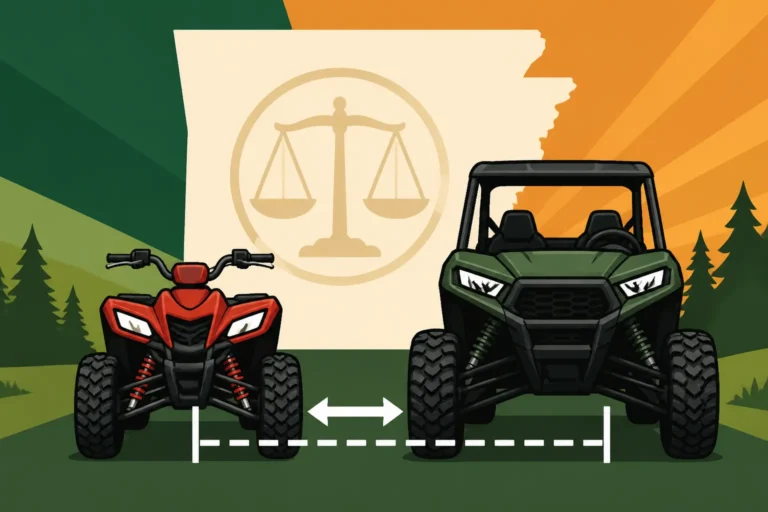
The 50-inch maximum width measurement serves as the foundational boundary line in Arkansas off-road legislation. When measuring a vehicle to see if it meets this specific standard, state guidelines evaluate the machine at its widest point, which typically spans from the outer wheel hub or tire sidewall on one side to the corresponding point on the opposite side. This measurement must be taken when the tires are inflated to standard operating pressure and the suspension rests at normal ride height without compression.
This 50-inch limitation was originally implemented to ensure that registered light vehicles could safely navigate narrow, traditional single-track and dual-track trail networks without causing structural bank erosion or habitat destruction. If you purchase a quad that features aftermarket wheel spacers, wider suspension A-arms, or deep-dish offset rims, those modifications can easily push a standard 48-inch machine beyond the legal 50-inch threshold.
Riders who unknowingly exceed this threshold often find themselves holding a machine that no longer qualifies under standard quad registration rules. When your vehicle exceeds fifty inches, the Department of Finance and Administration (DFA) clerk must process the machine under alternative off-highway vehicle categories, which can alter taxation structures and titling pathways. Always double-check factory specifications or take a manual tape measure to the outer tread before attempting to register a modified machine.
The 1,000cc Engine Displacement Ceiling
Beside physical footprint, engine displacement represents the second major pillar of the state’s traditional off-road vehicle definition. The statute establishes a clear ceiling: the internal combustion engine powering the unit must feature a total cylinder displacement of 1,000 cubic centimeters (1,000cc) or less. This rule applies regardless of whether the engine configuration is a single-cylinder, twin-cylinder, or multi-cylinder layout, and regardless of whether it operates on a two-stroke or four-stroke combustion cycle.
This displacement cap was designed to draw a firm distinction between recreational off-road vehicles and highway-capable automotive engines or heavy industrial machinery. In recent years, high-performance sport models and large multi-passenger utility rigs have pushed right up against this 1,000cc limit, with some modern engines technically measuring 999cc specifically to remain fully compliant with state statutory boundaries.
If an off-road machine incorporates an engine that exceeds 1,000cc, it moves outside the legal definition of a standard all-terrain vehicle. Machines powered by automobile engine swaps, custom high-displacement crate motors, or electric drivetrains with equivalent high-output kW ratings require special administrative review. Knowing your machine’s exact displacement listed on the manufacturer statement of origin ensures you submit correct details during registration.
Wheel Configurations and Nonhighway Tire Designations
Beyond width and engine displacement, the statute sets physical standards regarding how a machine makes contact with the ground. To fit the primary statutory definition, the vehicle must travel on three, four, or six wheels equipped exclusively with specialized nonhighway tires. These tires are designed specifically for low-pressure operation over uneven terrain, soft soil, mud, and rock, featuring aggressive tread patterns and carcass construction distinctly different from highway-rated DOT tires.
The requirement for three, four, or six wheels deliberately excludes two-wheeled off-road motorcycles, which fall under separate dirt bike registration rules, as well as specialized tracked vehicles or custom multi-axle rigs featuring eight or more wheels. Furthermore, the explicit callout for nonhighway tires means that retrofitting a standard quad with smooth street tires or commercial truck tires can raise red flags during formal inspections or law enforcement stops on public land access roads.
When reviewing a machine, state officials look at the manufacturer’s original design intent. If a vehicle leaves the factory with low-pressure off-highway tires mounted on three, four, or six wheels, maintains a width of fifty inches or less, and stays under 1,000cc, it represents the textbook example of a standard off-road machine under state law.
ARKANSAS OHV STATUTE BOUNDARIES
| STATUTORY CRITERIA | STANDARD ATV DEFINITION | OVERSIZED / UTV CLASS |
|---|---|---|
| Maximum Overall Width | 50 Inches or Less | Exceeds 50 Inches |
| Engine Displacement Cap | 1,000cc Maximum | May Exceed 1,000cc |
| Wheel Count | 3, 4, or 6 Wheels | Typically 4 or 6 Wheels |
| Tire Type | Low-Pressure Nonhighway | Off-Highway / All-Terrain |
| Primary Seating Style | Straddle Seat / Handlebars | Side-by-Side Bucket/Bench |
How Arkansas Categorizes Side-by-Sides and Oversized Machines
As utility terrain vehicles (UTVs) and side-by-sides have grown in market popularity, state regulators have had to reconcile these larger, heavier machines with statutory definitions drafted years prior. Most modern side-by-sides feature bucket or bench seating, automotive-style steering wheels, seat belts, and rollover protective structures (ROPS). Crucially, almost every full-sized side-by-side available today exceeds the historic 50-inch width threshold, immediately pushing it into a distinct legal bucket.
Understanding where your machine lands in the regulatory framework is essential before spending money on upgrades, trail passes, or private purchase paperwork. Reviewing Registering a Side-by-Side in Arkansas helps clarify how administrative agencies process these broader machines compared to conventional straddle-seat quads.
When a UTV Crosses the 50-Inch Line
When a side-by-side measures wider than 50 inches across the outer tire walls, it officially leaves the standard quad classification. Arkansas handles these machines as off-highway utility vehicles or broad-category recreational off-highway vehicles (ROVs). While this distinction might seem like mere semantics, it directly impacts how the state records ownership records and how local authorities manage road access exceptions.
For example, a machine measuring 60, 64, or 72 inches wide provides enhanced stability over rough ground and allows for side-by-side passenger seating, but it cannot legally squeeze through standard 50-inch trail gates maintained on certain public lands. At the revenue office, clerks recognize these wider footprints through the vehicle identification number (VIN) and the model descriptions provided on the original paperwork.
If you are dealing with Arkansas Machines Wider Than 50 Inches, you must ensure your paperwork accurately reflects the unit’s make, model, and physical specifications. Attempting to register a 64-inch side-by-side as a standard narrow quad to bypass fees or regional restrictions creates inconsistencies in state database records that can complicate future sales or insurance claims.
DIMENSIONAL IMPACT ON REGISTRATION & TRAILS
| FEATURE | UNDER 50 INCHES | OVER 50 INCHES |
|---|---|---|
| Standard Quad Status | Full Statutory Compliance | Exceeds Standard Class |
| Narrow Forest Trail Gate | Access Allowed | Physical Blocked |
| 72-Inch Gate Access | Access Allowed | Access Allowed |
| DFA Registration Category | Standard Off-Road Decal | UTV / ROV Classification |
| Street Permit Eligibility | Highly Restricted | Dependent on Town Rules |
Machines Over 1,000cc and Large Off-Road Vehicles
The market expansion of high-horsepower off-road rigs has led to the development of machines featuring multi-cylinder engines that push past the traditional 1,000cc ceiling. When evaluating Arkansas Machines Over 1,000cc, state guidelines separate these heavy units from conventional light recreational quads. High-displacement units often weigh significantly more, carry higher payload capacities, and generate speed profiles that require distinct safety protocols.
From an administrative perspective, an off-road vehicle featuring an engine larger than 1,000cc may be scrutinized to determine whether it should be titled as a custom utility vehicle, commercial equipment, or a specialized off-road rig. When taking ownership documentation to the revenue office, owners of these high-displacement units must present clear documentation proving the vehicle was designed by the manufacturer exclusively for off-highway use.
If you own a custom-built machine or a sand rail with a motor exceeding 1,000cc, be prepared for additional verification steps. Revenue office clerks may need to confirm that the unit possesses a valid, standardized 17-digit VIN and that the original Manufacturer’s Statement of Origin (MSO) specifies its off-road character rather than highway passenger vehicle status.
The Role of Manufacturer Statements of Origin (MSO)
The Manufacturer’s Statement of Origin (MSO)—sometimes referred to as the Manufacturer’s Certificate of Origin (MCO)—is the single most important document when establishing the original factory classification of an off-road machine. This document, generated at the factory when the vehicle is assembled, explicitly details the engine size, net weight, maximum overall dimensions, body style, and VIN.
When a brand-new quad or UTV is sold, the dealership completes the assignment section on the back of the MSO and transfers it to the buyer. Revenue office clerks rely on this document to determine whether a vehicle falls within the 50-inch, 1,000cc window. The MSO explicitly states whether the vehicle complies with off-road standards or federal motor vehicle safety standards (FMVSS).
If you purchase a used machine where the MSO has been lost over time, proving whether the unit fits within standard statutory definitions requires additional administrative steps. In such cases, clerks reference state-approved physical vehicle databases based on the model year and VIN, or require specific bill-of-sale detail confirming the machine’s factory engine capacity and frame measurements.
Registration and Titling Implications at the Revenue Office
Registering an off-road vehicle in Arkansas is a unique process compared to registering a standard automobile. One of the defining features of the state system is that off-road registrations do not expire annually. Once you register the machine, pay the required state and local taxes, and receive your decal, you never have to pay a renewal fee for as long as you own that specific machine. Understanding how the state processes these applications ensures a fast, painless visit to your local revenue counter.
Because off-road vehicles are handled through the Department of Finance and Administration (DFA) rather than a traditional DMV framework, all paperwork must align cleanly with statutory guidelines. Preparing your documents before standing in line prevents unnecessary trips back home for missing signatures or incomplete forms.
ARKANSAS DFA REGISTRATION CHECKLIST
[ ] Proof of Ownership (Title, MSO, or Sworn Bill of Sale)
[ ] Completed State DFA Application Form
[ ] Valid Photo ID of the Registered Owner
[ ] Payment for Applicable State and Local Sales/Use Taxes
[ ] One-Time Off-Road Registration Fee
[ ] Physical Machine Specifications (Width & Displacement Verification)
Navigating DFA Requirements for Standard Quads vs. UTVs
When presenting your application at a local revenue office counter, the clerk will request specific legal documents to initiate the file. You must complete Arkansas DFA Form 10-381 Explained, which serves as the official state application for vehicle registration and title operations. This form requires detailed technical data, including the engine displacement in cubic centimeters, total vehicle weight, fuel type, and frame serial number or VIN.
For standard quads that strictly honor the 50-inch and 1,000cc limits, the process moves quickly. The clerk enters the machine into the state database under the standard off-road vehicle umbrella. Once processed, the owner receives a physical registration certificate and a durable identification decal that must be applied directly to the machine.
For side-by-sides that exceed 50 inches, the administrative steps remain similar, but the vehicle classification code assigned in the system reflects its status as a UTV or utility vehicle. This classification distinction ensures that if your local municipality allows street riding for utility vehicles, your state registration records correctly match local permit logs.
Tax Considerations and Paperwork Requirements
One critical aspect of off-road vehicle registration in Arkansas involves sales and use tax calculation. Unlike highway vehicles, which feature specific tax caps on certain transactions, off-road machines are subject to standard state sales tax combined with applicable city and county tax rates based on where the buyer resides. Learning about Arkansas Sales Tax on an ATV Purchase ensures you bring the correct amount of funds to the counter.
When you purchase a new or used machine, the taxable amount is calculated from the total purchase price listed on the invoice or bill of sale. If you traded in a qualifying vehicle during the transaction at a licensed dealership, the trade-in allowance can reduce the net taxable amount. However, in private party transactions, trade-in deductions are generally not recognized, meaning tax is assessed on the full purchase price.
Failure to register an off-road vehicle within thirty days of purchase can result in statutory late penalties and accrued interest charges added to your tax bill. Bringing complete, legibly written documentation to the revenue office ensures that taxes are assessed accurately on the first attempt without administrative delays.
Documenting Private Sales and Ownership Transfers
Private transactions account for a massive percentage of quad and side-by-side sales across the state. Because used off-road machines do not always carry formal titles, creating a comprehensive, legally binding paper trail is mandatory for smooth registration. Reviewing Arkansas ATV Bill of Sale Requirements provides a clear roadmap for drafting documents that state clerks will accept without hesitation.
To satisfy revenue office requirements, a private bill of sale must include the full legal names and signatures of both buyer and seller, physical street addresses, the exact date of sale, the total purchase price, the vehicle make, model, year, engine size in cc, and the full 17-digit VIN or serial number. If the document lacks critical details like engine size or VIN, the clerk may refuse to process the registration.
To avoid formatting errors or missing required legal declarations, many buyers and sellers use customizable legal contract templates, such as those available through LawDepot, to draft a clear, professional bill of sale. Using an established contract platform ensures that all statutory identifiers are clearly displayed, protecting both parties and giving the revenue office clerk unambiguous proof of ownership transfer.
Trail Width Restrictions and State-Wide Riding Accessibility
Understanding Arkansas’s statutory definitions is not just an administrative exercise for tax clerks—it directly governs where you can physically ride your machine across the state’s public lands. Federal agencies, such as the United States Forest Service (USFS), and state park managers use these dimensional classifications to establish trail designations, preserve natural ecosystems, and protect public safety.
If you purchase a machine that exceeds statutory width boundaries, you must plan your riding trips carefully. A wide side-by-side offers exceptional stability and passenger comfort, but taking a 64-inch or 72-inch wide vehicle to a trail system restricted strictly to 50-inch quads will result in turnarounds at the trailhead or costly property damage citations.
PUBLIC TRAIL SYSTEM WIDTH COMPARISON
| RIDING COMPLEX | NARROW GATES (50 INCH) | WIDE GATES (72 INCH) |
|---|---|---|
| Wolf Pen Gap | Select Primitive Loops | Primary Main Loops |
| Mill Creek OHV Area | Specific Technical Sections | Main Corridor Trails |
| Huckleberry Mountain | Access Controlled Barriers | Major Forest Road Loops |
| Private Off-Road Parks | Rare | Standard Throughout |
Width Restrictions on Ouachita and Ozark-St. Francis Trails
The two largest national forests in Arkansas—the Ouachita National Forest and the Ozark-St. Francis National Forests—host hundreds of miles of premier off-highway vehicle trails. However, these trail systems feature strict, non-negotiable width restrictions designed to prevent road erosion, protect sensitive watersheds, and maintain rustic trail conditions.
Before loading your trailer, consult Arkansas ATV Trails With Width Limits to verify whether your target trail system accommodates your vehicle’s physical profile. Many legacy trails in the Ouachita Mountains were carved out specifically for narrow quads under 50 inches wide. These narrow corridors wind through tight tree stands, hug steep mountain ledges, and feature sharp switchbacks that cannot safely accommodate wide multi-passenger side-by-sides.
Conversely, newer trail segments and designated multi-use forest roads are designed to accommodate modern side-by-sides up to 64 or 72 inches wide. Riding an oversized machine on a trail designated exclusively for 50-inch vehicles damages trail structures and leads to sudden trail closures that penalize the entire off-road community.
Gate Systems and Physical Barriers on Public Land
To enforce dimensional width limits, forestry managers install heavy-duty steel restrictive gates at trailheads and key trail intersections. These gates are precision-engineered to act as physical filters. If your machine is even one inch too wide, the outer tires will wedge against the steel bollards, physically preventing entry onto the trail segment.
At popular destinations like Wolf Pen Gap: Arkansas’s Best Known OHV Complex near Mena, trail access points feature clear signage paired with physical gate barriers. Standard narrow loop entrances feature 50-inch opening clearances, while broader multi-use corridors feature 72-inch gate openings. Attempting to bypass these barriers by driving over earthen berms, bypassing rock armor, or cutting down vegetation is a federal offense that carries steep fines.
Riders should measure their vehicle’s exact outer footprint—including aftermarket fender flares, door bags, spare tire carriers, and wide-offset wheels—before traveling to public trailheads. A machine rated at 50 inches on factory spec sheets may measure 52 inches after installing aggressive aftermarket mud tires, rendering it incapable of clearing narrow gate barriers.
Selecting the Right Machine for Arkansas Off-Road Parks
Choosing between a narrow, sub-50-inch quad and a wider side-by-side largely depends on where you intend to spend most of your time riding. If your primary goal is exploring primitive, backcountry national forest loops in western and northern Arkansas, a standard quad that meets the traditional statutory definition provides unrestricted access to almost every mile of public trail.
On the other hand, if your riding style centers around private off-road parks, large commercial riding facilities, or wide county forest roads, a wider side-by-side offers superior suspension travel, cargo capacity, and comfort. Commercial parks generally build wide trails, bypass obstacles, and open mud pits specifically designed to cater to high-horsepower 64-inch and 72-inch machines.
Evaluating your local terrain, transport capabilities, and long-term riding goals ensures you buy a machine that balances legal compliance, registration simplicity, and physical trail access across the Natural State.
Road Use, Local Ordinances, and Public Thoroughfares
One of the most frequently misunderstood areas of off-road vehicle ownership in Arkansas is whether quads and side-by-sides can be driven on public roads. Under baseline state legislation, riding an off-road machine on public streets, highways, and rights-of-way is strictly unlawful by default. However, state law contains specific, narrow statutory exceptions, and recent legislative updates allow individual municipalities to create local street access programs for select vehicles.
Understanding the boundary between state highway bans and local street permissions keeps you safe from costly traffic tickets and ensures your vehicle operates strictly within legal parameters.
STATEWAY vs. LOCAL ROAD ACCESS
| ROADWAY TYPE | BASELINE STATE LAW | LOCAL ORDINANCE ACCESS |
|---|---|---|
| Interstate Highways | Strictly Prohibited | No Local Authority |
| Multi-Lane State Routes | Prohibited | Prohibited |
| Two-Lane State Highways | Prohibited (Except Cross) | Restricted |
| Municipal Streets | Prohibited by Default | Allowed if City Passes |
| County Dirt/Gravel Roads | Prohibited (Except Farm) | Allowed in Select Areas |
Statutory Road Restrictions and Six Legal Exceptions
Under primary state law, off-road vehicles are prohibited from operating on public streets and highways. However, state legislation establishes six explicit statutory exceptions where road use is legally permitted:
- Farming Operations: Agricultural workers actively engaged in farming or ranching operations may operate machines on public roads to transport equipment or travel between adjacent fields.
- Hunting Operations: Hunters actively traveling between hunting grounds or retrieving harvested game during open hunting seasons may use public roads within reasonable proximity to hunting areas.
- Disabled Riders: Individuals possessing a verified medical certificate documenting a severe walking disability may operate off-road vehicles on select public roads to access outdoor activities.
- Utility Company Crews: Utility employees and contractors performing maintenance, emergency repairs, or grid inspections are authorized to ride along public rights-of-way.
- Government and EMS Personnel: State park employees, forestry officials, law enforcement agencies, and emergency response teams are exempt while performing official duties.
- Direct Highway Crossings: Riders may cross a public road or highway at a 90-degree angle, provided they come to a complete stop first and yield right-of-way to all oncoming traffic.
Outside these six specific operational conditions, riding a standard quad down a public road violates state vehicle codes unless a local municipal ordinance explicitly authorizes the activity.
How Local Municipalities Grant UTV Street Access
Recognizing the practical transportation value of utility terrain vehicles in rural communities, state lawmakers passed legislation giving cities and towns authority to open local municipal streets to select off-road vehicles. Understanding Arkansas UTV Street Legal Rules by Town is vital, as street permissions vary significantly from one town border to the next.
Under this local-option framework, a city council can pass an official municipal ordinance opening local streets posted under 55 miles per hour to UTVs and side-by-sides. However, state law places strict limits on local authority: municipalities cannot open four-lane state highways, interstates, or high-speed controlled-access corridors to off-road traffic.
Furthermore, a city ordinance granting street access to UTVs typically applies only to side-by-sides equipped with rollover protection and seat belts—standard straddle-seat quads under 50 inches are frequently excluded from street access programs. Always contact the local city clerk or police chief to verify exact local rules before driving a side-by-side on city streets.
Safety Equipment Requirements for Street-Permitted Machines
When a town opens its streets to side-by-sides, the local ordinance will require specific safety equipment installed on the vehicle. Operating a machine on municipal roads requires meeting clear equipment standards to ensure public safety and driver visibility.
Common equipment requirements mandated by local street access ordinances include:
- Operational headlights and taillights visible from extended distances.
- Functional brake lights that illuminate when foot pedals are applied.
- Side-view mirrors or a center rearview mirror providing clear rear visibility.
- Seat belts securely anchored for driver and all onboard passengers.
- Mechanical turn signals or clear, visible hand signal compliance.
- A durable city-issued permit sticker displayed clearly on the front windshield or frame bumper.
In addition to physical equipment requirements, drivers must possess a valid state driver’s license, maintain active liability insurance coverage on the machine, and obey all posted municipal speed limits and traffic control devices.
Buying, Selling, and Transferring Non-Standard Off-Road Vehicles
Buying or selling a quad or side-by-side in the private market requires attention to legal paperwork, physical measurements, and clear documentation. Because used off-road machines often pass through multiple owners over their operational lives, missing titles and incomplete transfer documents are common issues facing buyers across Arkansas.
Taking proactive steps during a sale protects both parties from legal disputes, tax assessment errors, and registration rejections at the revenue office counter.
Verifying Machine Dimensions Before a Purchase
When evaluating a used off-road vehicle listed for sale by a private seller, never rely solely on verbal descriptions or seller claims regarding machine dimensions. Bring a flexible steel tape measure to inspect the vehicle in person before handing over payment.
Measure the total overall width from the outermost tread block of the left tire to the outermost tread block of the right tire at both the front and rear axles. Check whether the owner installed aftermarket wheel spacers, offset rims, long-travel suspension kits, or wide fender flares that push a factory 48-inch machine over the statutory 50-inch line.
Similarly, check the vehicle manufacturer plate or engine casting marks to confirm total cylinder displacement in cc. Verifying these physical realities on-site ensures you know exactly how the state revenue office will classify the machine, what taxes will apply, and which local trail networks will remain accessible after purchase.
Draft Agreements and Proof of Ownership Documentation
When completing a private transaction, providing undeniable proof of ownership transfer is critical. If the machine lacks a formal title certificate, state revenue office clerks will scrutinize the bill of sale to verify that the transaction is legitimate and that the seller possessed lawful title to the vehicle.
If you encounter Arkansas Machines With No Paperwork, do not complete the transaction without creating a comprehensive bill of sale signed by both parties. The buyer should request a photo of the seller’s driver’s license and verify that the frame VIN on the machine matches the bill of sale exactly.
PRIVATE SALE DOCUMENTATION STEPS
Step 1: Physical Inspection & VIN Verification on Frame Rail
Step 2: Measure Overall Width (Tire Outer Sidewall to Sidewall)
Step 3: Complete Comprehensive Bill of Sale with Full Technical Specifications
Step 4: Utilize LawDepot Document Generation for Custom Sales Agreements
Step 5: Execute Signatures in Duplicate (Buyer & Seller Copies)
Step 6: Submit Completed Paperwork to Local State Revenue Office
Using legal template platforms like LawDepot allows buyers and sellers to generate comprehensive sales agreements, liability waivers, and gift affidavits tailored to state transaction standards. A properly formatted contract drafted through LawDepot clearly records purchase pricing, engine displacement, frame serial numbers, and explicit statements confirming the machine is free of outstanding liens, giving state clerks clean documentation during registration.
Handling Out-of-State Machine Titles and Registration
Purchasing an off-road machine from a neighboring state like Missouri, Oklahoma, Texas, or Tennessee adds a layer of administrative paperwork. Because surrounding states maintain different titling laws and registration rules for off-road vehicles, paperwork formats vary widely when bringing a machine back across state lines.
If you purchase a machine in a state that issues formal titles for ATVs, you must obtain the original title signed over to you by the previous owner, with all lien releases completed. If you purchase from a state that does not title off-road machines, you must secure the original Manufacturer Statement of Origin (MSO) or a notarized bill of sale combined with the seller’s previous state registration record.
When presenting out-of-state paperwork at an Arkansas revenue office, clerks verify that state sales tax was paid during the original transaction. If out-of-state tax was not paid or was paid at a lower rate, you will be required to pay the difference in state and local use taxes before receiving your registration certificate and identification decal.
Summary Comparison of Arkansas Off-Road Vehicle Classifications
Navigating state off-road vehicle regulations requires balancing physical vehicle specifications, tax requirements, and land access rules. The following comparative summary illustrates how traditional narrow quads, wide utility terrain vehicles, and oversized custom rigs align across key statutory and operational categories.
OFF-ROAD VEHICLE CLASSIFICATION MATRIX
| CATEGORY / FEATURE | STANDARD ATV (UNDER 50″/1,000CC) | UTV / SIDE-BY-SIDE (>50″) | OVERSIZED / CUSTOM |
|---|---|---|---|
| Overall Max Width | 50 Inches or Less | Typically 60, 64, or 72 Inches | Exceeds 72 Inches |
| Engine Capacity Ceiling | 1,000cc Maximum | Up to 1,000cc (Factory Specs) | Exceeds 1,000cc |
| Seating & Controls | Straddle Seat / Handlebars | Bench/Bucket / Steering Wheel | Custom / Automotive |
| Decal Renewal Frequency | One-Time Fee (Never Expires) | One-Time Fee (Never Expires) | Specialized Review |
| 50-Inch Trail Gate Access | Full Access Allowed | Blocked by Physical Barriers | Blocked Entirely |
| 72-Inch Trail Gate Access | Full Access Allowed | Full Access Allowed | Restricted by Gates |
| Baseline Road Access | Prohibited (6 Exceptions) | Local Town Ordinance Option | Highly Restricted |
| Required Bill of Sale Data | VIN, cc, Width, Purchase Price | VIN, cc, Width, ROPS Status | Custom Frame Review |
By measuring your machine accurately, preparing clear bill-of-sale paperwork through platforms like LawDepot, paying required sales taxes promptly at your local revenue office, and adhering strictly to posted trail width gates, you ensure your off-road adventures across Arkansas remain safe, enjoyable, and fully compliant with state law.
Disclaimer
This article is for general informational purposes only and does not constitute professional advice. Laws, prices and regulations vary by location and change over time. Consult a qualified professional for guidance on your specific situation.