What Counts as a Nonhighway Tire
It’s easy to get lost in the weeds when it comes to registering an ATV or UTV in Arkansas, and one of the most head-scratching phrases people encounter is "nonhighway tires." This isn't just bureaucratic jargon; it’s a critical distinction that can affect whether your machine can even be registered as an ATV in the first place, and where you’re legally allowed to ride it. This guide is here to untangle the confusion, helping you understand exactly what the Natural State considers a nonhighway tire and why it matters to you.
Why Arkansas Defines Nonhighway Tires
When you're looking at Arkansas's laws concerning ATVs and UTVs, you'll quickly discover that the state has very specific ideas about what an all-terrain vehicle actually is. This isn't just for fun; it's about classification, safety, and determining appropriate places for these machines to operate. The type of tires on your machine is a huge part of that classification, signaling its primary design and intended use. The state wants to differentiate between vehicles built for tearing up trails and those designed for smooth pavement. It helps delineate responsibilities, manage public land use, and enforce safety regulations. Without these clear definitions, it would be a free-for-all, leading to more accidents and confusion on both trails and roads.
The Core Definition for Registration Purposes
Arkansas law, specifically in its definition of an all-terrain vehicle, explicitly mentions "nonhighway tires." For a machine to officially be considered an ATV under state statute – which is often the first step toward getting it registered – it must, among other things, be equipped with these specialized tires. The statute typically describes an ATV as a motorized vehicle designed for off-highway use, having three or more wheels, weighing a certain amount, and, crucially, having "nonhighway tires." This term implies tires that are clearly not suitable for sustained highway speeds or everyday road use. The state's focus is on ensuring that vehicles classified as ATVs are truly meant for off-road adventures, not as alternative street vehicles. Understanding [Arkansas's 50-Inch, 1,000cc ATV Definition] will give you a broader picture of how your machine is categorized.
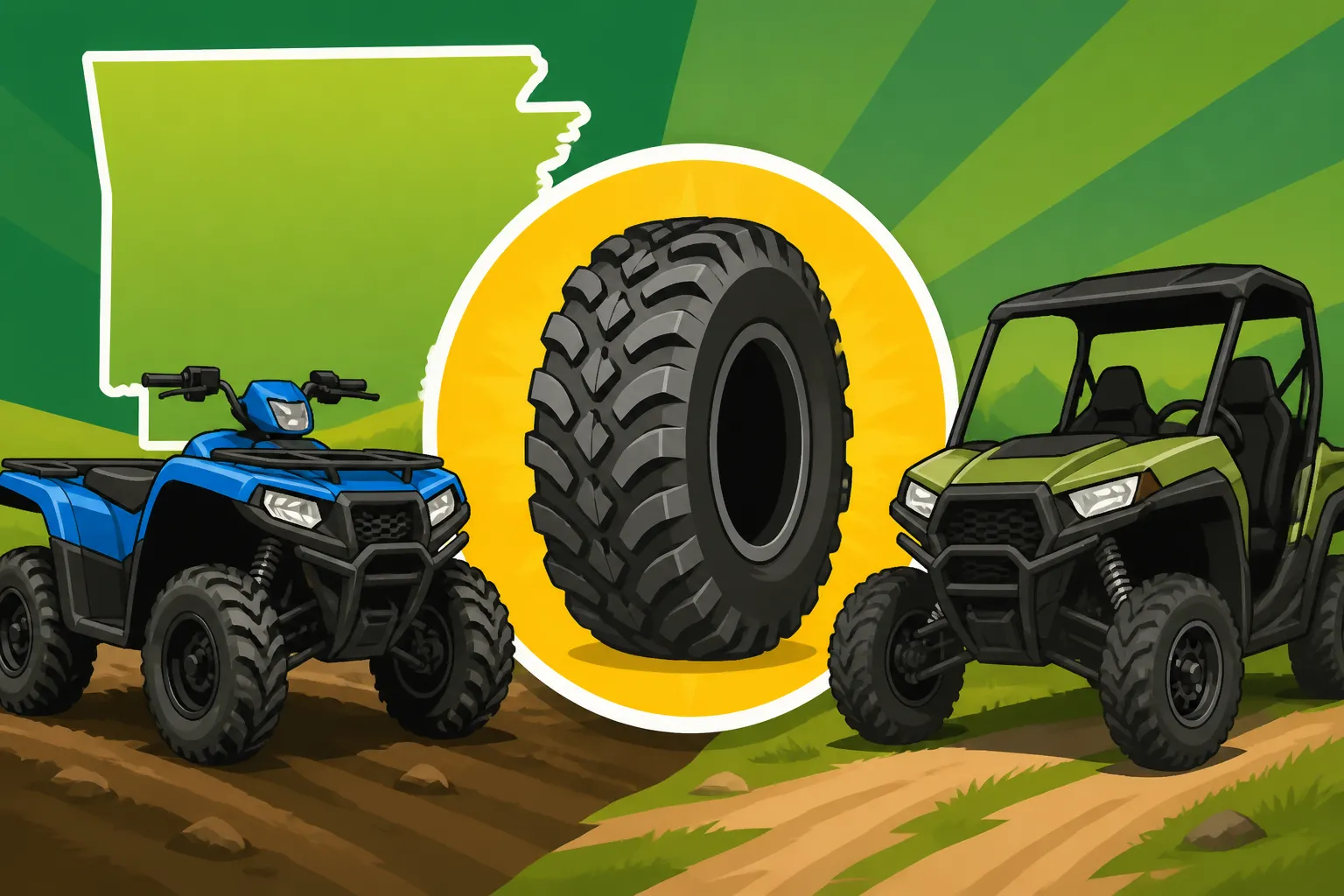
What exactly does that mean for your tires? Generally, it refers to tires with an aggressive, open-block tread pattern that provides superior traction on loose, uneven, or soft surfaces like dirt, gravel, mud, and sand. These tires are characterized by deep lugs and widely spaced knobs. They are specifically engineered to grip natural terrain, shed mud, and provide flotation over soft ground, rather than to maximize fuel efficiency or provide a smooth, quiet ride on asphalt. When you're heading to the revenue office, the expectation is that your machine will visibly have these types of tires, aligning with its off-road designation for [Arkansas ATV Registration: One Time, Never Renewed].
Beyond Just Registration: Road Legality
The type of tires on your ATV or UTV isn't just a checkbox on a registration form; it's a fundamental aspect that dictates where your machine can legally go. Arkansas state law generally prohibits ATVs and UTVs from operating on public streets and highways. This prohibition is directly tied to their design, and nonhighway tires are a key indicator of that design. These tires, while fantastic for gripping the gnarliest trails, perform poorly on paved surfaces. They wear out extremely fast, offer limited traction for braking and turning on asphalt, and can make a vehicle feel unstable at road speeds.
This is where many riders face a dilemma, especially UTV owners. While some cities and counties in Arkansas have passed ordinances allowing UTVs on certain municipal roads, these ordinances often come with specific equipment requirements that can include DOT (Department of Transportation) approved tires. DOT-approved tires are explicitly not nonhighway tires; they are designed for road use, with different tread patterns, construction, and speed ratings. So, if you're out riding your UTV on a gravel road, your nonhighway tires are perfect. But if you’re hoping to cruise through a town that has a local UTV ordinance, you might find that your aggressive off-road tires actually prevent you from being street legal, even if you meet other requirements. It’s a classic Catch-22 for some enthusiasts who want the best of both worlds. For more on this, check out [Can You Drive an ATV on the Road in Arkansas?].
Common Tire Types and Their Classification
Let's break down the different types of tires you might encounter and how they fit into Arkansas's "nonhighway" definition. This can help you understand what your machine rolls on and what implications that has for registration and riding.
Aggressive Off-Road Tread
These are the tires that immediately come to mind when you picture an ATV or UTV tearing through the woods. They are the epitome of "nonhighway tires." These tires are characterized by:
- Deep Lugs and Knobby Patterns: The tread blocks are tall and widely spaced, designed to dig into loose terrain, clear mud, and provide maximum grip on rocks and roots.
- Reinforced Sidewalls: Often built with multiple plies to resist punctures from sharp rocks and sticks, which are common hazards on trails.
- Bias-Ply Construction: Many ATV/UTV tires are bias-ply, meaning the cords run at an angle to the bead. This construction is robust for off-road impacts but can feel squirmy and less stable at higher speeds on pavement compared to radial tires.
- Non-DOT Rated: Crucially, these tires typically do not have a "DOT" stamp on the sidewall, indicating they have not met federal safety standards for highway use.
Examples include specialized mud tires with extreme tread patterns, aggressive all-terrain tires (the kind that look more like tractor tires than car tires), and dedicated rock-crawling tires. These tires excel where the pavement ends. They provide the traction needed to climb steep hills, traverse muddy bogs, and navigate rocky creek beds. However, putting them on asphalt for extended periods will result in rapid wear, a noisy ride, and reduced handling and braking performance. These are precisely the tires Arkansas identifies when it refers to [Nonhighway Tires in the Legal Definition], signaling a vehicle designed solely for challenging off-road conditions.
DOT-Approved Street Tires for UTVs
On the complete opposite end of the spectrum are DOT-approved street tires. These are not nonhighway tires in the eyes of Arkansas law, and for good reason. These tires are designed with entirely different priorities:
- Tighter Tread Patterns and Siping: The tread blocks are generally smaller, closer together, and often feature siping (small slits) to enhance grip on wet pavement. They are designed to dissipate water efficiently and provide a smooth, quiet ride.
- Radial Construction: Most DOT-approved street tires are radial construction, where the cords run perpendicular to the direction of travel. This offers a more flexible sidewall, leading to better heat dissipation, a smoother ride, and longer tread life on pavement.
- DOT Stamped: They will clearly have a "DOT" marking on the sidewall, indicating they comply with federal motor vehicle safety standards for on-road use.
- Higher Speed Ratings: These tires are engineered to safely handle the speeds encountered on public roads.
Many UTV owners who live in areas with local ordinances that permit street use will equip their machines with these tires. This modification is usually a requirement to get a street permit from the city. The contrast is stark: these tires are terrible for deep mud or serious rock crawling, as their tread fills quickly and offers minimal grip. But they are essential for safe and legal street operation in permitted areas. It's vital to understand that simply having a UTV does not automatically grant you road access; the equipment, including your tires, must meet local requirements. This is a key detail when considering [Arkansas UTV Street Legal Rules by Town].
Here's a quick comparison of the two types:
| Feature | Nonhighway Tires | DOT-Approved Street Tires |
|---|---|---|
| Tread Pattern | Aggressive, deep lugs, widely spaced, knobby | Tighter, smaller blocks, siping, designed for pavement |
| Construction | Often bias-ply, robust for impacts | Typically radial, smoother ride, better heat dissipation |
| Intended Use | Off-road: dirt, mud, rocks, sand | On-road: asphalt, concrete, paved surfaces |
| Road Legality | Generally prohibited on public roads | Required for street-legal UTVs in permitted areas |
| DOT Marking | Absent | Present (e.g., "DOT" on sidewall) |
| Wear on Pavement | Very high, rapid degradation | Moderate, designed for longevity on road |
| Traction | Excellent off-road, poor on-road | Excellent on-road, poor off-road |
Practical Implications for Arkansas Riders
Knowing the difference between nonhighway tires and DOT-approved street tires has real-world consequences for every ATV and UTV owner in Arkansas. It's not just an academic exercise; it affects where you can ride, whether you face fines, and even the validity of your machine's registration.
Verifying Your Machine's Classification
So, how do you verify if your tires fit the definition? For the most part, it's pretty obvious. If your tires look like they belong on a tractor or a rock crawler, with deep, aggressive treads, they’re almost certainly nonhighway tires. If they have a more car-like appearance, shallower treads, and a "DOT" stamp, they are street tires. When you register an ATV at an Arkansas Revenue Office, the clerks aren't typically inspecting your tires with a magnifying glass. However, the machine's overall design, including the tires, contributes to its classification as an "all-terrain vehicle." The assumption is that you are registering a machine designed for off-highway use.
However, if you're ever stopped by a game warden in a Wildlife Management Area (WMA) or a deputy on a county road, the type of tires you have could become a point of inquiry. They are looking to ensure that the machine is being used in accordance with its design and the law. For example, if you're riding a UTV that's been modified with aggressively deep mud tires and you're pulled over on a paved county road, a deputy will quickly see that your vehicle is equipped for off-road use, making its presence on the pavement questionable. This is part of [What a Deputy Can Ask to See] when you're out riding. When dealing with official documentation, such as ensuring your bill of sale accurately reflects your machine's characteristics, services like LawDepot can provide templates that help you clearly define your vehicle, including a description of its components like tires, for future reference.
Consequences of Misinterpretation
Mistaking your tire type, or choosing to ride inappropriately for your tires, can lead to several problems:
- Registration Issues: While less common for ATVs, if you tried to register a UTV that had been extensively modified with street-legal components, including DOT tires, as a standard ATV, it might cause confusion or rejection at the revenue office. The state wants to ensure the machine meets the statutory definition of an ATV for proper classification. You might need to be prepared to explain [What Arkansas Requires of an ATV Owner] regarding their machine's intended use.
- Fines and Citations: The most immediate and common consequence is getting a ticket. If you're caught operating a machine with nonhighway tires on a public road where it's not explicitly permitted (either by a very specific state exception like crossing a highway, or a local UTV ordinance that you don't meet), you could face fines. These penalties can add up quickly. It's far better to be safe than sorry and ensure your machine's tires match where you're riding. Review [Arkansas Penalties for Illegal Road Riding] to understand the potential costs.
- Insurance Problems: In the unfortunate event of an accident, your insurance company might scrutinize how your vehicle was being used and its configuration. If you were riding on public roads with nonhighway tires, in violation of state law, your claim could potentially be complicated, or even denied, if the insurer determines the machine was being operated outside of its intended and legal use.
- Safety Risks: Beyond legal and financial repercussions, nonhighway tires simply aren't safe for road use. Their design makes them prone to hydroplaning on wet asphalt, they have a larger contact patch for off-road grip but can feel "squishy" on hard surfaces, and their aggressive tread can make steering unpredictable. Choosing the wrong tire for the terrain isn't just illegal; it's dangerous.
To sum it up, Arkansas’s definition of "nonhighway tires" is a foundational piece of its ATV and UTV regulations. It helps classify machines, guide where they can be legally operated, and ensure public safety. As a rider, understanding this distinction is key to enjoying the trails responsibly and legally. Whether you're filling out registration paperwork or evaluating where to ride your side-by-side, knowing your tires is just as important as knowing your machine's horsepower. When preparing any legal documents related to your machine's ownership or use, like a bill of sale or an agreement for private land access, remember that resources like LawDepot can provide valuable templates to ensure clarity and compliance with definitions like these.
Disclaimer
This article is for general informational purposes only and does not constitute professional advice. Laws, prices and regulations vary by location and change over time. Consult a qualified professional for guidance on your specific situation.