Arkansas Penalties for Illegal Road Riding
It's an age-old dilemma for many ATV and UTV owners in Arkansas: you've got this incredible machine, perfect for navigating rugged trails or getting chores done on the back forty, but what about those tempting stretches of paved road or county blacktop? The confusion is real, and the desire to just zip down the road to a neighbor's house or cross a highway can be incredibly strong. However, misunderstanding Arkansas's laws around road riding can lead to some truly frustrating and costly experiences. This guide is here to untangle the legal complexities, lay out the severe penalties for illegal road riding, and help you understand how to stay on the right side of the law in the Natural State.
The Core Rule: Arkansas Law Forbids Most ATV/UTV Road Use
Let's cut right to the chase: the default position of Arkansas law is that ATVs and UTVs are not permitted on public streets and highways. It's a hard pill to swallow for many, especially those who see their machines as versatile tools or convenient transportation. You might see others doing it, or you might hear anecdotes about leniency in certain areas, but the letter of the law is quite clear, and ignoring it can land you in a heap of trouble. This isn't just a suggestion; it's a statute designed to protect public safety, given the inherent differences between off-road vehicles and those designed for street travel.
Why Public Roads Are Generally Off-Limits
The primary reason Arkansas, like many other states, restricts off-highway vehicles (OHVs) from public roads boils down to safety and vehicle design. ATVs and UTVs are built for dirt, mud, rocks, and uneven terrain. Their tires, suspension, braking systems, and overall handling characteristics are optimized for off-road conditions, not for sustained high-speed travel on asphalt alongside cars and trucks. The knobby tires that give you great traction on the trail can be a significant liability on wet pavement, reducing grip and increasing stopping distances. Furthermore, these machines often lack the essential safety equipment required for street-legal vehicles, such as turn signals, proper headlights and taillights for road use, windshields, and often robust occupant protection in the event of a collision with a full-size vehicle. The risk of serious accidents, not just for the OHV rider but for other motorists, is significantly higher when these machines are on public roads.
Imagine a scenario: you're just trying to cross a two-lane highway to get to another section of your property. You might think it's a quick, harmless dash. But then a car comes over a blind hill, not expecting a low-profile, slow-moving ATV with no brake lights or turn signals to be in the roadway. The potential for a catastrophic collision is enormous. This is why the law errs on the side of caution, even for what seems like a short, innocent trip. [What Arkansas Law Forbids on a Public Road] explains this in more detail.
Defining "Road" and "Street" in Arkansas Law
When the law talks about "public roads" or "highways," it's not just referring to bustling interstates. In Arkansas, this definition is broad and generally encompasses most publicly maintained thoroughfares. This includes state highways, federal routes, county roads, and even most city streets. If it's a paved or gravel road that the public has a right to access and is maintained by a governmental entity (state, county, or municipality), chances are it falls under the "public road" designation. This can be a point of confusion, especially for rural residents who view their local county gravel roads as "back roads" or less official. However, a county road, even if it's just two tracks through the woods, is typically considered a public road if it's maintained by the county.
It’s crucial to understand that simply because a road isn't heavily trafficked doesn't mean it isn't regulated. Many riders mistakenly believe that if they're on a quiet gravel road in a sparsely populated area, the rules don't apply, or enforcement will be lax. While enforcement may vary, the law itself does not. The statute doesn't differentiate between a county road with ten cars a day and a state highway with thousands. The definition hinges on public access and governmental maintenance, not traffic volume or surface material. [Arkansas ATV Road Rules: What 27-21-106 Says] outlines the specific statute.
The Legal Basis: Arkansas Statute 27-21-106 Explained
The foundational legal framework for ATV and UTV road use in Arkansas is primarily found in Arkansas Code Annotated Title 27, Chapter 21, Section 106, often referred to as Act 1251 of 2001. This statute explicitly makes it unlawful to operate an "all-terrain vehicle" or "off-highway vehicle" on any public street, road, or highway in the state. The statute's language is precise, aiming to prevent these machines from intermingling with conventional traffic. It provides the backbone for why law enforcement can, and often will, issue citations for illegal road riding.
This law establishes the "unlawful by default" principle: if your ATV or UTV is on a public road, it is presumed to be there illegally unless it meets one of the statutory exceptions (which we'll discuss next) or, in the case of UTVs, a local ordinance allows it. It places the burden on the rider to ensure they are operating within the bounds of the law, rather than expecting broad allowances. Understanding this statute is the first step in avoiding costly penalties, as it's what officers will cite if they pull you over for illegal road use.
Navigating Arkansas's Statutory Road Exceptions
While the general rule is "no public roads," Arkansas law does recognize specific, limited circumstances where ATVs and UTVs can legally operate on roads. These aren't loopholes but carefully carved-out exceptions designed to accommodate practical needs without undermining public safety. However, they are often misunderstood or stretched beyond their intended scope by riders, leading to legal trouble. It's critical to know these exceptions precisely and adhere to their conditions.
Specific Exemptions for Farming and Hunting Operations
One of the most common exceptions people try to invoke is for farming or hunting. Arkansas law allows for the operation of ATVs and UTVs on public roads when actually engaged in a farming or hunting operation. This isn't a blanket pass to ride your machine to the grocery store if you also happen to hunt, or to cruise through town after planting season. The key phrase here is "actually engaged." This means you must be actively involved in transporting equipment, feed, game, or moving between fields or hunting areas that necessitate road travel as part of the operation.
For instance, if you're driving your UTV from one field to another that's separated by a county road, with farming implements or feed in the bed, that would likely qualify. Similarly, if you've harvested a deer and are transporting it back to your camp via a short stretch of public road, that could fall under the hunting operation exception. However, driving your UTV to a friend's house for a social visit, even if your friend lives on land where you occasionally hunt, would likely not qualify. Law enforcement officers are trained to look for evidence that you are genuinely engaged in these activities. You might be asked to explain your purpose and show proof of your hunting license or farming activity if stopped. [Arkansas Farming Operation Road Use] and [Arkansas Hunting Operation Road Use] provide further clarity on these specific exemptions.
Emergency, Utility, and Disability Exceptions
Beyond farming and hunting, the statute also provides exceptions for specific public service and personal needs. Law enforcement, emergency medical services (EMS), and utility company personnel are typically exempt when operating ATVs or UTVs in the course of their official duties. This makes sense; you wouldn't want to hinder an officer responding to an incident or a utility worker restoring power during an outage. These are operational necessities where the benefit to public safety or infrastructure outweighs the general road restriction.
There's also an exception for individuals with a "serious walking disability." This is not a general disability clause; it specifically addresses mobility challenges that make walking difficult or impossible, requiring the use of an ATV or UTV for necessary transportation. This would typically require some form of documentation or visible indication of the disability. This exception is not intended for casual riding, but for essential travel. Each of these categories is narrowly defined to prevent misuse and ensure that only truly necessary road use occurs.
The Ninety-Degree Crossing Rule
Perhaps one of the most frequently misunderstood and abused exceptions is the "ninety-degree crossing" rule. This exception allows an ATV or UTV to cross a public road or highway, provided the crossing is made at an angle of approximately ninety degrees to the road and at a location where the crossing can be made safely and quickly. You must also come to a complete stop before entering the roadway. [Arkansas Direct Crossing at Ninety Degrees] outlines this specific rule.
This rule is only for crossing from one side of a road to the other, perhaps to access private property or a trail that continues on the opposite side. It is absolutely not an excuse to ride down the road for any distance, even a short one. Many riders get this wrong, believing they can ride along the shoulder or even in the ditch parallel to the road for a short distance before crossing. This is incorrect and illegal. The moment you deviate from a straight, ninety-degree path of travel across the road, you are likely in violation of the law. You must stop, look both ways, and proceed directly across without lingering or traveling lengthwise. This is another area where enforcement can be strict because misuse of this rule poses a direct hazard to other motorists.
Local Ordinances: A Glimmer of Hope for UTVs (But Not ATVs)
For many years, the "no road riding" rule was essentially absolute across Arkansas. However, recent legislative changes have introduced a significant shift, particularly for UTV owners. Act 922 of 2025 (which became effective August 5, 2025) granted Arkansas cities and towns the authority to create their own ordinances allowing the operation of "utility-type vehicles" (UTVs) on certain public streets. This is a game-changer for UTV owners in participating municipalities, but it comes with strict conditions and does not apply to traditional ATVs.
How Act 922 Empowered Arkansas Cities
Act 922 was a response to the growing popularity of UTVs and the desire of many communities to allow their use on local streets, often to support tourism, provide easier access to businesses, or simply enhance the quality of life for residents. The Act gives individual city councils the power to decide if and how UTVs can be operated on their city streets. This means that a UTV that is perfectly street-legal in one Arkansas town might be completely illegal to operate on the streets of a neighboring town that hasn't passed such an ordinance, or has different rules. [Arkansas Towns Can Open Their Streets to UTVs] covers this in detail.
This shift created a patchwork of regulations across the state. It put the onus on each city to weigh the benefits against the safety concerns and establish its own framework. For UTV owners, this means diligent research is required. You cannot assume that because one town allows street UTVs, all do. You must check the specific ordinances of every city you plan to ride in.
Understanding City-Specific UTV Street Legal Rules
If a city passes an ordinance allowing UTVs on its streets, it will invariably come with a host of specific requirements and restrictions. These commonly include:
- Designated Streets: Often, UTVs are restricted to streets with posted speed limits below a certain threshold (e.g., 35 mph or 55 mph) and typically excluded from four-lane streets or state highways passing through the town.
- Permit Requirements: Many cities require an annual permit or sticker, often for a fee, to be displayed on the UTV. This permit process usually involves an inspection of the vehicle to ensure it meets safety standards.
- Driver Requirements: The driver typically must be at least 16 years old and possess a valid driver's license.
- Operating Hours: Some ordinances might restrict UTV operation to daylight hours or have specific curfew times.
- Passenger Limits: Following the manufacturer's passenger capacity is usually a rule.
Bono, Arkansas, was one of the first cities to adopt such an ordinance, and its rules are often cited as an example. Other towns like Cotter have taken different approaches, sometimes even banning ATVs while allowing golf carts. The bottom line is that you need to read the specific ordinance for the town you're in. A quick call to the city clerk's office can save you a lot of grief. [Arkansas UTV Street Legal Rules by Town] is a vital resource for this.
Key Equipment Requirements for Street-Permitted UTVs
For cities that do allow UTVs on their streets, the ordinances will almost always mandate specific safety equipment to bring the UTV closer to street-legal vehicle standards. While the exact list can vary slightly by municipality, common requirements include:
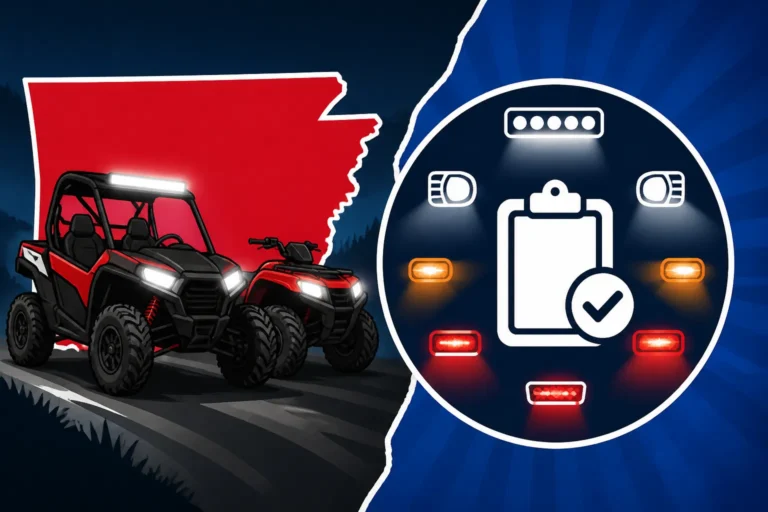
- Headlights and Taillights: Operational headlights, taillights, and brake lights are universal.
- Turn Signals: Both front and rear turn signals are usually required. Companies like SuperATV offer conversion kits that make adding turn signals, horns, and other street-legal accessories relatively straightforward for many UTV models.
- Rearview Mirrors: At least one, often two (side mirrors), are typically required.
- Horn: An audible warning device (horn) is standard.
- Seat Belts: All occupants must be wearing factory-installed seat belts.
- Windshield: A windshield is often required, which might necessitate aftermarket installation for many UTVs.
- DOT-Approved Tires: Some ordinances might specify that tires must be DOT-approved, although this can be less common than other requirements.
Failure to have the required equipment, even if you have a city permit, can still result in a citation. It's not enough to simply have the permit; your vehicle must also comply with all the equipment mandates. Riders looking to equip their UTVs for street use should explore reputable aftermarket parts manufacturers like SuperATV for lighting kits, mirrors, and other accessories designed for UTV applications. [Arkansas Equipment for a Street-Permitted Machine] offers more specific guidance.
The Harsh Reality: Penalties for Illegal Road Riding
So, what happens if you're caught riding your ATV or UTV illegally on an Arkansas road? The consequences are far from trivial. It's not just a slap on the wrist; the penalties can hit your wallet hard, inconvenience you significantly, and even jeopardize your ability to own or insure such a machine in the future. It’s crucial to understand these potential outcomes to fully grasp the importance of legal riding.
Fines and Court Costs for a Citation
The most immediate consequence of being caught riding illegally is a citation, which typically carries a fine. While specific fine amounts can vary based on the jurisdiction (city, county, or state police) and the officer's discretion, you can generally expect a fine in the range of a few hundred dollars. This is not just the face value of the ticket, however. Arkansas courts also add substantial "court costs" and fees to virtually every citation. So, a $100 fine could easily balloon to $200-$300 or more once court costs, administrative fees, and state surcharges are factored in.
Beyond the initial financial hit, there might be other legal repercussions. Depending on the specifics of the charge or if it's a repeat offense, there could be points added to your driving record (if the citation is linked to your driver's license), although this is less common for OHV violations unless other infractions like reckless driving are also involved. However, the financial burden alone is usually enough to make most riders think twice. [Arkansas Ticket Cost for Road Riding] provides a general idea of these expenses.
Impoundment, Vehicle Seizure, and Recovery Fees
This is where things can get truly unpleasant. Law enforcement officers in Arkansas have the authority to impound or seize an ATV or UTV that is being operated illegally on a public road. This means your machine could be loaded onto a tow truck and taken to an impound lot. The process of recovering your vehicle from impound can be an absolute nightmare, and it's almost always expensive.
Impoundment typically involves:
- Towing Fees: Charged by the tow company, often hundreds of dollars, especially if it's after hours or from a remote location.
- Storage Fees: Daily fees accrue for every day your machine sits in the impound lot. These can quickly add up, turning a one-day impound into a week-long financial drain if you can't retrieve it immediately.
- Proof of Ownership: You'll need to provide clear proof of ownership (title or registration) to claim your vehicle.
- Paying All Fines and Fees: In many cases, you'll need to resolve all outstanding citations, towing fees, and storage fees before the impound lot will release your machine.
Imagine getting a ticket and then having to pay hundreds more to get your ATV back, on top of the original fine. It's a massive headache and a significant financial drain that far outweighs the convenience of a short road ride. This potential for impoundment is a powerful deterrent for a reason.
Insurance Implications and Liability Risks
Even if you avoid impoundment, illegal road riding can have serious implications for your insurance. Most ATV and UTV insurance policies are written specifically for off-road use. If you have an accident while operating your machine illegally on a public road, your insurance company may deny your claim. They could argue that you were operating the vehicle outside the scope of its intended use or in violation of the law, thereby voiding coverage.
Consider this nightmare scenario: you're riding illegally on a paved road, and you hit a car or injure a pedestrian. Without insurance coverage, you would be personally liable for all damages, medical bills, and legal fees. This could amount to tens or even hundreds of thousands of dollars, potentially ruining you financially. A standard ATV policy typically wouldn't cover this. Even if you have a street-legal UTV permit in a city, you still need to verify that your insurance policy explicitly covers road use. [Arkansas Insurance for a Street-Permitted UTV] is crucial reading. The liability risk alone should be enough to discourage any illegal road riding. It's simply not worth gambling your financial future for a brief, unauthorized ride.
Beyond the Law: Practical Consequences and Risks
While legal penalties and financial costs are certainly motivating factors, the consequences of illegal road riding extend beyond what a judge or insurance company might impose. There are significant practical risks to your safety, your machine's longevity, and your relationship with the wider community. Ignoring these can lead to equally frustrating and damaging outcomes.
Safety Hazards of Riding Off-Road Machines on Pavement
As mentioned earlier, ATVs and UTVs are not designed for pavement. This isn't just a legal distinction; it's a fundamental engineering reality that impacts safety dramatically.
- Tire Traction: Knobby off-road tires, while excellent in dirt, offer significantly reduced grip on hard, wet, or sandy pavement. This can lead to loss of control, especially during braking or turning. Imagine trying to stop quickly on a busy street with tires designed for mud; it's a recipe for disaster.
- Suspension: Off-road suspensions are often softer and have more travel to absorb bumps and jumps. On pavement, this can lead to excessive body roll in turns, making the machine feel unstable and prone to tipping, especially in UTVs with a higher center of gravity.
- Braking Distances: The braking systems on many ATVs and UTVs are not calibrated for the demands of road speeds and friction. Stopping distances can be much longer than those of a typical car, increasing the risk of rear-ending another vehicle or being unable to stop for an unexpected obstacle.
- Visibility: ATVs and UTVs are generally much smaller and lower to the ground than passenger vehicles. They can be incredibly difficult for other drivers to see, especially in blind spots, at dawn or dusk, or in heavy traffic. The lack of standard turn signals and brake lights only exacerbates this problem.
- Collision Outcomes: In the event of a collision with a car or truck, the occupants of an ATV or UTV are at a severe disadvantage. These machines offer minimal crash protection compared to enclosed vehicles.
Riding your machine on pavement, even for a short distance, introduces a level of risk that it was never designed to handle, putting yourself and others in danger.
Damage to Your Machine and Voided Warranties
Beyond the human element, your ATV or UTV itself suffers when ridden on pavement.
- Tire Wear: Those aggressive, expensive off-road tires will wear down incredibly quickly on asphalt. The soft rubber compound designed for grip on loose surfaces gets shredded by the abrasive pavement, leading to premature tire replacement. This is a recurring, significant cost.
- Suspension and Drivetrain Strain: Constant riding on hard, unforgiving surfaces like asphalt can put undue stress on your machine's suspension components, bearings, and drivetrain. Parts designed for flexing over terrain can suffer from the vibrations and rigidity of pavement, potentially leading to premature wear and failure.
- Engine Overheating: Some machines, especially those primarily air-cooled or with limited cooling capacity, might struggle with sustained high-speed operation on pavement without the benefit of constant airflow and varying engine loads experienced off-road.
- Voided Warranties: Many manufacturers' warranties specifically exclude damage or failures resulting from operating the machine in ways inconsistent with its intended design, which includes road use. If you have a major component failure after a history of illegal road riding, your warranty claim could be denied, leaving you with a massive repair bill.
The cost of premature wear, frequent repairs, and potentially voided warranties can far outweigh any perceived convenience of using your ATV or UTV on the road.
Community Relations and Landowner Issues
Illegal road riding can also sour community relations and create problems with landowners, even those who were previously friendly to riders. When ATVs and UTVs are constantly seen flouting the law on public roads, it generates negative perceptions. Residents might complain about noise, dust, or perceived recklessness, which can lead to:
- Increased Enforcement: More complaints mean more law enforcement presence and stricter enforcement of OHV laws in general, making it harder for all riders, even those abiding by the rules.
- Lost Riding Opportunities: Negative public perception can lead to calls for more restrictions, fewer designated riding areas, or even the closure of existing trails.
- Landowner Hostility: If you ride illegally on a public road that borders private property, it can annoy landowners who might then become less willing to grant permission for access to their land, even for legitimate purposes. They might start posting "No Trespassing" signs or become less tolerant of riders in general.
Responsible riding is about more than just personal enjoyment; it's about preserving the sport for everyone. Abusing road access jeopardizes that.
Staying Legal: Tips for Responsible Arkansas Riders
Navigating the rules for ATV and UTV use in Arkansas might seem complex, but it boils down to understanding the law, respecting the rules, and planning your rides. Being a responsible rider means more than just avoiding a ticket; it means ensuring safety, protecting your investment, and preserving access for the entire riding community.
Knowing Your Local Ordinances Inside Out
If you own a UTV and have aspirations of street use, your first and most crucial step is to be intimately familiar with the specific ordinances of any city or town you wish to ride in. As we've discussed, Act 922 has created a diverse landscape of regulations.
- Check with City Hall: The most reliable source of information is the city clerk's office. A quick phone call or visit can confirm whether an ordinance exists, what it entails, and what the latest requirements are. Don't rely on hearsay or what a friend of a friend told you.
- Permit Applications: Understand the application process for any required UTV street permits. What documentation do you need? What are the fees? When does it need to be renewed? [Arkansas UTV Street Permits and Annual Fees] will be different from town to town.
- Maps and Restrictions: Get a map of the city and identify which streets are open to UTVs and which are explicitly closed (e.g., state highways, four-lane roads). Pay attention to speed limits.
- Equipment Checklist: Make a detailed checklist of all required safety equipment, from turn signals and horns to mirrors and seatbelts.
Always assume that if you're riding a UTV on a city street, you need a specific permit and your machine must be fully compliant.
Trailering Smartly and Staging Legally
For all other situations where your ATV or UTV is not permitted on the road (which is most of the time), the solution is simple: trailer your machine.
- Invest in a Good Trailer: A reliable trailer is an essential piece of equipment for any serious off-road rider. It allows you to transport your machine legally and safely to designated riding areas, private land, or locations where street permits are valid.
- Secure Your Load: Always ensure your ATV or UTV is securely tied down on the trailer. Loose machines are a hazard on the road and can lead to accidents or damage.
- Plan Your Staging: When you arrive at your riding destination, identify legal staging areas. These are places where you can safely and legally unload your machine without impeding traffic or trespassing. Avoid unloading directly on public roadways or blocking access points.
- Consider a Cargo Carrier for Smaller Machines: For smaller ATVs, a hitch-mounted cargo carrier might be an option, but always check weight limits and ensure the machine is properly secured and does not obscure your vehicle's lights.
Trailering is the most straightforward way to avoid penalties and ensure you're always riding legally. It's an investment that pays off in peace of mind and protection from citations and impoundment.
Equipping Your UTV for Permitted Street Use
If you're fortunate enough to live in or ride in a city that allows UTVs on its streets, take the time to properly equip your machine. This isn't just about avoiding a ticket; it's about making your UTV safer for road use.
- Aftermarket Accessories: Many UTVs can be outfitted with street-legal conversion kits. Companies like SuperATV specialize in these, offering integrated turn signal kits, horns, mirrors, and even DOT-approved windshields that can help you meet local requirements. Make sure any accessories you add are durable and properly installed.
- Regular Maintenance: Keep all your safety equipment in top working order. Check your lights, horn, and brakes regularly. A permit is only valid if your vehicle remains compliant.
- Visibility Enhancements: Even with required lighting, consider adding additional reflective tape or brighter LED accessories to increase your UTV's visibility to other motorists, especially if riding near dusk or dawn. This extra step can significantly improve safety.
- DOT-Approved Tires (if required): While not universally mandated, some ordinances may specify DOT-approved tires. If so, ensure you have them. These tires often offer a better compromise between off-road grip and on-road performance than purely off-road knobbies.
By taking these proactive steps, you can enjoy your ATV or UTV responsibly in Arkansas, knowing you're adhering to the law and contributing to a positive image for all riders.
Summary of Arkansas Road Riding Rules and Penalties
To help clarify the various scenarios and potential outcomes, here's a table summarizing key aspects of Arkansas ATV/UTV road use and the associated penalties.
| Scenario | Legal Status | Common Enforcement Action/Penalty | Key Considerations |
|---|---|---|---|
| Riding ATV on any public road | Illegal | Citation (fines + court costs), potential impoundment | No city ordinances allow ATVs on streets. Only statutory exceptions apply. |
| Riding UTV on State/Federal highway | Illegal | Citation (fines + court costs), potential impoundment | No city ordinances can override state law for these routes. |
| Riding UTV on city street (no ordinance) | Illegal | Citation (fines + court costs), potential impoundment | Cities must pass a specific ordinance. Check before you ride. |
| Riding UTV on city street (with ordinance & permit) | Legal (if compliant) | – None (if fully compliant) – Citation (if non-compliant or expired permit) |
Driver must be licensed, UTV must meet all equipment and permit requirements. |
| Crossing a road at 90 degrees (ATV/UTV) | Legal (if conditions met) | – None (if safe stop & crossing) – Citation (if travelling along road) |
Must be a complete stop, direct 90-degree crossing, no travel along roadway. |
| Farming/Hunting Operation (ATV/UTV) | Legal (if actively engaged) | – None (if genuinely operating) – Citation (if not genuinely operating) |
Must be directly related to the operation, not casual use. |
| Emergency/Utility Use (ATV/UTV) | Legal | None | Must be official personnel in the course of duty. |
| Disability Use (ATV/UTV) | Legal (if serious walking disability) | – None (if documented) – Citation (if not meeting criteria) |
Specifically for documented serious walking disabilities, not general use. |
| Accident during illegal road riding | Illegal operation | Citation, insurance denial, personal liability | Huge financial risk; insurance likely won't cover damages/injuries. |
| Damage to machine from road riding | (No direct legal penalty, but consequences) | Premature wear, voided warranty, costly repairs | Off-road tires wear fast, suspension/drivetrain strain, manufacturer might deny claims. |
Disclaimer
This article is for general informational purposes only and does not constitute professional advice. Laws, prices and regulations vary by location and change over time. Consult a qualified professional for guidance on your specific situation.