Moving to a Town With No Ordinance
Moving to an Arkansas town with no ATV or UTV ordinance can make your usual ride feel suddenly uncertain. A machine that was welcome on local streets elsewhere may not be allowed on the road in your new town. This guide explains the statewide starting point, how to check local rules, and what to confirm before riding.
Start With Arkansas’s Statewide Road Rule
No town ordinance means no local street permission
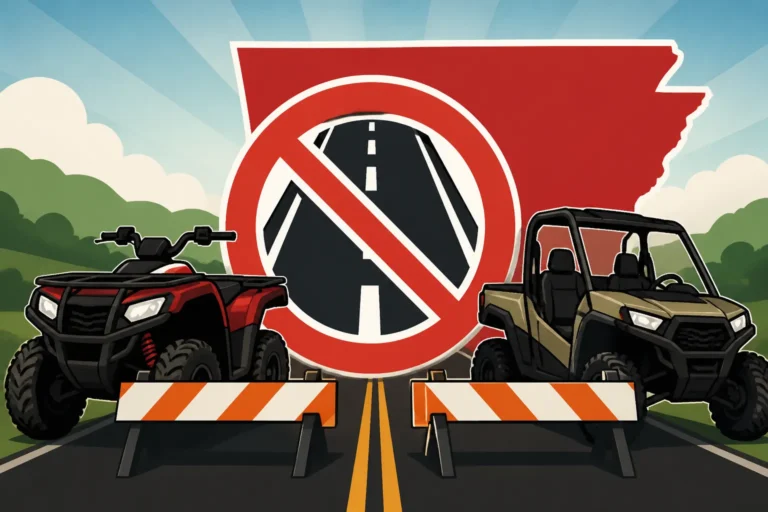
Arkansas generally does not allow off-highway vehicles to travel on public roads just because a rider is registered, has a decal, or lives nearby. A town may adopt an ordinance allowing certain UTVs on specified streets, but that local permission is not automatic. If your new town has not adopted an ordinance, do not assume you can ride a UTV on its streets.
This can be frustrating when you have just moved from a place where riding to a store, a neighbor’s house, or a trail entrance was routine. In Arkansas, the important question is not simply whether your machine is called a side-by-side or UTV. You need to know whether state law and the specific local rules allow that machine on that particular road. Start with [Arkansas Makes Road Riding Unlawful by Default] and [How Arkansas's Local-Option Rule Works] to understand the difference between the statewide rule and a town’s choice to allow limited UTV use.
Also distinguish a town’s streets from roads outside its boundaries. A county road, a state highway, and a street maintained by a municipality may be subject to different rules or authorities. A town’s decision—or lack of one—does not necessarily answer what applies on a nearby road outside town limits. Check the road’s location and governing authority before planning a route.
Exceptions are limited and do not create general permission
Arkansas law has narrow situations in which an off-highway vehicle may be used on or across a road. These can include specific work-related or operational circumstances, as well as direct highway crossings under defined conditions. They are not a general allowance to ride around town because your destination is nearby or because traffic is light.
For example, a permitted crossing is different from traveling along a road for several blocks. A rider may need to stop before crossing and cross directly rather than use the roadway as a route. Other exceptions depend on the activity and the circumstances. Read [Arkansas's Six Statutory Road Exceptions] before relying on an exception, and avoid stretching language intended for a particular situation into routine road access.
A practical rule for a recent arrival is to treat every public road as off-limits unless you have verified a specific legal basis for riding there. A neighbor’s recollection, a route shown on a phone map, or the fact that other machines use the road is not reliable proof that your ride is allowed. If the exception seems unclear, ask the appropriate local or state authority before you ride.
Find Out Exactly What Your New Town Allows
Verify whether an ordinance exists
Start with the town or city clerk. Ask whether the municipality has an ordinance allowing UTVs on public streets, and request the ordinance text or the official way to find it. Be precise: ask about UTVs, not just “ATVs,” and ask whether the rule applies to your machine type and the streets you plan to use.
A quick phone call can prevent an expensive misunderstanding, but try to get the answer in writing or locate the actual ordinance. Local rules may set conditions involving approved streets, machine specifications, permits, safety equipment, insurance, driver qualifications, or where a permit sticker must be displayed. A casual answer such as “people ride them here” does not tell you whether your vehicle qualifies or whether your route is permitted. See [Reading Your Town's Ordinance Before You Ride] and [Asking a City Clerk What Applies] for a more careful way to check.
If a clerk says there is no ordinance, ask whether the town has ever considered one and whether a county or neighboring municipality controls any nearby roads you are thinking of using. Do not treat a proposed ordinance, an informal practice, or a neighboring town’s rule as permission in your own town.
A neighboring town’s ordinance does not travel with you
Arkansas’s local-option approach means street access can vary between municipalities. One town may allow qualifying UTVs on certain streets while the next town does not. A permit or sticker issued by one municipality should not be assumed to authorize riding elsewhere, and permission in one town does not automatically extend to county roads between towns.
That matters when a familiar route crosses a town boundary. You might be allowed on a particular street inside one municipality and then reach a stretch where local permission ends. Even if the road looks continuous, the governing rules can change at the boundary. [Arkansas Towns Can Open Their Streets to UTVs] explains why local permission needs to be checked town by town.
When you map a route, identify each road and jurisdiction in advance. If your trip involves leaving town, crossing a highway, or entering another municipality, confirm the rules for every segment rather than relying on the most permissive part of the route. If you cannot establish that a segment is allowed, choose a legal transport option instead of riding through it.
| What you are checking | Why it matters | What to confirm |
|---|---|---|
| Whether your town has an ordinance | No local ordinance means no local street authorization | Ask the city or town clerk for the ordinance or confirmation that none exists |
| Vehicle type | A rule for UTVs may not cover every ATV or off-highway machine | Check the ordinance’s definition and your machine’s specifications |
| Street or road location | Rules can change at town limits or on a different road authority’s route | Verify every road segment and boundary |
| Permit and equipment conditions | Local permission may depend on meeting specific requirements | Confirm permit, safety equipment, insurance, and display rules |
| Road classification | Some roads may remain off-limits even where local use is authorized | Check speed, lane, and other restrictions in the ordinance |
| State registration or decal | Registration is not the same as permission to ride on a public road | Confirm registration separately from street-use rules |
Pay attention to street and vehicle restrictions
Where a town does allow UTV use, the permission may be narrower than “all streets, all machines.” Local ordinances can limit eligible roads by speed or road type, set machine-width limits, or require the vehicle to meet specified safety standards. Some restrictions may apply even if your UTV is already registered for off-highway use.
Do not rely on the name on the sales paperwork alone. Check the ordinance’s definition and compare it with your machine’s actual specifications. A vehicle that seems close to the town’s size limit may still fall outside the permitted category. In particular, confirm whether the ordinance covers the machine’s width and design, and whether the street you have in mind qualifies. Relevant background includes [Arkansas Streets Under 55 mph for UTVs] and [Arkansas Four-Lane Streets Stay Closed].
If you have added accessories, do not assume they make the vehicle eligible. Aftermarket mirrors, lights, or other equipment may address an equipment requirement, but they do not create local permission where no ordinance exists. If you are considering parts from SuperATV or another supplier, compare the item with the exact requirements in your town’s ordinance and confirm that the installed machine meets them. An accessory listing is not the same as legal approval for road use.
Check Your Machine and Paperwork Before Riding
Registration and street permission are separate questions
Arkansas off-highway registration and a town’s street-use authorization serve different purposes. A registration decal or proof of ownership may be important for operating an eligible machine off-road, but neither automatically makes the machine street legal. Likewise, a town permit—if the town issues one—does not replace any separate state registration requirement that applies to your machine.
This distinction trips people up because paperwork can look official and a decal can feel like a general license to ride. Keep the documents organized, but check what each one actually authorizes. For the state registration side, review [How to Register an ATV in Arkansas] and [Arkansas ATV Registration Requirements]. For road use, rely on the applicable law and the ordinance for the municipality where you plan to ride.
Before moving, keep your ownership documents, machine identification details, registration records, and any local permits together. After the move, update records when required and ask the relevant office what address documentation or vehicle information it needs. If you bought the machine out of state or inherited it, resolve any ownership paperwork questions separately from the road-use question.
Equipment upgrades do not override the law
A street-use ordinance may require equipment such as lights, mirrors, signals, or other safety features. The precise list depends on the controlling rule, so read the ordinance rather than building a checklist from a forum post or a neighbor’s vehicle. Equipment can be incomplete, incorrectly installed, or unsuitable for the specific requirement even when the vehicle appears road-ready.
If you are comparing add-ons, SuperATV is one example of a brand riders may encounter while researching off-road vehicle accessories. That does not mean a product is required by Arkansas law, approved by your town, or sufficient to satisfy an ordinance. Confirm requirements with the municipality, and check that any component you buy fits your vehicle and performs the function the rule requires.
Keep records of equipment purchases and installation details, especially if you are preparing to apply for a municipal permit. Take clear photos of the machine and its identifying information for your own files. If an official inspection or application is required, ask what must be shown and whether modifications affect eligibility. SuperATV parts, like any aftermarket equipment, should be treated as components to evaluate—not proof that the vehicle qualifies for public-road use.
Make a Safe Plan for Your First Ride
Use a verification routine before each route
Once you have moved, make a short route-check routine part of your planning. First, identify whether the destination can be reached without using a public road. Then mark every road you would need to travel and determine whether it is inside town limits, outside them, or under another authority. Finally, check the ordinance and any road-specific restrictions for each segment.
A simple written note can help if you are unfamiliar with the area: list the street names, intersections, jurisdiction boundaries, and the source of the permission you confirmed. Do not assume that a route is legal because a navigation app labels it as a road suitable for vehicles. Ordinary route directions do not establish that an off-highway machine can use that road.
If your regular destination is a trail, consider hauling the machine to a legal access point rather than riding through town. Before setting out, also confirm the rules at the riding area itself; road permission and trail access are separate matters. A forest or trail permit does not authorize an otherwise prohibited trip along a public street.
Ask before the rules change or the route crosses a boundary
Local ordinances can be amended, and boundaries may be less obvious on the ground than they look on a map. Recheck the rules if the town changes its ordinance, if you move again, or if you begin using a different route. If you hear that a neighboring municipality has adopted a new rule, verify whether it covers your machine and where its limits apply instead of assuming your town has done the same.
A good question to ask the clerk is: “Does this town have an ordinance that permits my specific type of UTV on public streets, and which streets or conditions apply?” Have the make, model, width, and other relevant specifications available. If the answer depends on a feature of the machine, ask how the town determines that the vehicle meets the definition.
If the town has no ordinance, the safest practical answer is to keep the machine off public roads except where a clearly applicable legal exception allows a specific use or crossing. SuperATV or another accessory provider cannot change that baseline. Treat equipment, registration, local permits, and road authorization as separate checks—and do not ride until the road itself is clearly permitted.
Disclaimer
This article is for general informational purposes only and does not constitute professional advice. Laws, prices and regulations vary by location and change over time. Consult a qualified professional for guidance on your specific situation.