Arkansas Four-Lane Streets Stay Closed
It can be incredibly frustrating to see friends or online communities buzzing about street-legal UTVs in Arkansas towns, only to find out that the major roads you need to cross, or even just drive down, are still strictly off-limits. Navigating the ever-evolving rules for riding your ATV or side-by-side on public roads in the Natural State feels like solving a complex puzzle, especially when you encounter the seemingly arbitrary restrictions on four-lane streets. This guide is here to untangle the confusion, explaining precisely why Arkansas four-lane streets often remain closed to ATVs and UTVs, even in cities that have embraced the street-legal movement.
Understanding Arkansas's Default Road Ban for OHVs
For years, the law in Arkansas was pretty straightforward, if a bit of a bummer for off-road enthusiasts: ATVs and UTVs simply weren't allowed on public roads. This wasn't because the state wanted to spoil anyone's fun, but primarily due to safety concerns. These machines are designed for off-pavement performance, not for the speed, traffic, and specific demands of public highways. Their tires, suspension, lack of certain safety features common to cars, and visibility issues made them a poor fit for road use in the eyes of state lawmakers.
The General Prohibition on State Highways
Arkansas state law, specifically Arkansas Code Annotated § 27-21-106, establishes the general prohibition against operating an off-highway vehicle (OHV) on a public street or highway. This foundational rule is critical to understanding all subsequent exceptions and local ordinances. The intent was to keep powerful, fast-accelerating, and often wider machines off roads where they could pose a hazard to themselves and other motorists. Imagine a compact ATV trying to merge onto a busy four-lane highway with cars traveling at 60 mph – the inherent danger is clear. This blanket ban meant that even if you just wanted to cross a road to get to another section of trail, it was technically illegal without a specific exception. You can learn more about this general rule by reading [Arkansas Makes Road Riding Unlawful by Default].
Limited State-Level Exceptions
While the general rule was a firm "no," the state did carve out a few very specific exceptions to allow limited road use for ATVs and UTVs, mostly for practical purposes rather than recreational street riding. These exceptions are critical for those who use their machines for work or specific activities. For example, farmers might need to cross a road to get from one field to another, or a hunter might need to briefly use a county road to access their deer lease. These allowances are not a free pass for joyriding on public roads but are narrowly defined to address legitimate needs. They include things like crossing at a 90-degree angle after coming to a complete stop, or specific uses by utility workers, law enforcement, or for agricultural purposes. You can dive deeper into these specific allowances by checking out [Arkansas's Six Statutory Road Exceptions]. These state-level exceptions are distinct from the city-level ordinances that later emerged, and it's vital not to confuse them.
The Rise of Local UTV Ordinances and Act 922
For many years, this strict state law meant that towns and cities had no power to allow ATVs or UTVs on their streets, even low-speed residential ones. This created a lot of frustration, especially for UTV owners who felt their machines were perfectly capable of safely navigating neighborhood roads, particularly if they were modified with appropriate safety equipment. Residents in many communities saw golf carts legally zipping around but couldn't understand why their UTV, often equipped with more safety features, was banned.
How Arkansas Cities Gained Local Control
Everything changed with Act 922, which became effective on August 5, 2025. This landmark legislation empowered Arkansas cities and incorporated towns to create their own ordinances allowing the operation of "utility vehicles" (UTVs) on certain public streets within their municipal boundaries. This was a game-changer, shifting some of the regulatory power from the state to local governments. Suddenly, towns that saw the economic benefit or community desire for street-legal UTVs could act. This allowed places like Bono, Arkansas, to be among the first to open their streets to UTVs, paving the way for other communities. For a deeper understanding of how this change occurred, check out [How Arkansas Cities Got the Choice on UTVs].
Defining "Utility Vehicles" for Street Use
It's important to note that Act 922 specifically granted cities the power to regulate "utility vehicles," which generally refers to side-by-sides. While some local ordinances might include ATVs (quads), the focus of the state law enabling cities was primarily on UTVs, recognizing their greater stability, seating capacity, and potential for additional safety features like seatbelts and roll cages. These local ordinances often come with specific requirements: the UTV must be equipped with things like headlights, taillights, brake lights, turn signals, and often a horn and rearview mirrors. Many riders turn to aftermarket suppliers like SuperATV for these crucial safety and street-legal accessories, ensuring their machines meet the local requirements for mirrors, turn signal kits, or even full cabs that improve visibility in traffic.
Permitting and Age Requirements
Beyond the equipment, cities adopting UTV ordinances also typically implement a permitting system. This means you can't just slap on some turn signals and hit the road. You'll need to apply for a permit, which often involves an annual fee and proof of insurance. Furthermore, most ordinances require the operator to possess a valid driver's license, often with a minimum age of 16, consistent with standard driving laws. These measures are designed to ensure that those operating UTVs on public streets are responsible, insured, and capable drivers. Understanding your specific town's ordinance is crucial, as requirements can vary significantly. You can find more specific details on what might be required in your area by looking into [Arkansas UTV Street Legal Rules by Town].
The Unyielding Barrier: Four-Lane Streets
Even with the advent of local UTV ordinances, there's a recurring theme: almost universally, these ordinances prohibit UTVs from operating on four-lane streets, state highways, and streets with speed limits above a certain threshold, often 35 mph or 45 mph, or definitely 55 mph and above. This is where many riders encounter a significant planning hurdle.
Why Four-Lane Streets Remain Off-Limits
The primary reason four-lane streets remain largely closed to UTVs, even in cities with local ordinances, boils down to a continued focus on safety and traffic flow. These types of roads are typically arterial routes designed for higher traffic volumes and speeds. Introducing slower-moving UTVs onto such roads can create significant speed differentials, increasing the risk of accidents.
Consider a UTV, even one accessorized with SuperATV lights and mirrors, traveling at 35 mph on a four-lane road where the posted speed limit is 45 or 55 mph. This speed difference forces other vehicles to slow down, potentially creating congestion, or to make unsafe passing maneuvers. The intent of Act 922 was to allow UTVs on local streets, often residential or downtown areas, where traffic is slower and volumes are lower, and where UTVs can integrate more seamlessly and safely with other vehicles. It was never intended to turn UTVs into general-purpose highway vehicles. This restriction is often explicitly stated in local ordinances, echoing the spirit of the state's original ban for higher-speed, higher-volume roads. The underlying principle is that while UTVs can be safe on slower, less congested municipal roads, they simply don't belong on thoroughfares built for faster, more extensive vehicle traffic.
The 55 mph Speed Limit Constraint
Many, if not most, local ordinances will include a clause explicitly stating that UTVs are prohibited on any street with a posted speed limit of 55 mph or greater. This is a common-sense measure reinforcing the safety concerns associated with higher speeds and the capabilities of UTVs. While some UTVs can reach speeds well over 55 mph, their design characteristics – such as shorter wheelbases, higher centers of gravity, and suspension tuned for off-road terrain – make them less stable and predictable at highway speeds compared to conventional automobiles. Furthermore, the wind noise and open cabin design of many UTVs can make it harder for operators to hear and respond to surrounding traffic at higher speeds. This specific speed limit cap often correlates directly with the types of four-lane streets that are designed for faster transit rather than local access. [Arkansas Streets Under 55 mph for UTVs] covers this aspect in greater detail.
Impact on Route Planning and Connectivity
The restriction on four-lane streets and high-speed roads creates significant challenges for UTV riders trying to navigate across or through cities. Imagine you're in a town like Hot Springs or Bentonville, and you want to get from one side of the city to another, or from your lodging to a specific restaurant. If the most direct route involves a multi-lane highway or a busy four-lane road, your UTV journey will require careful planning to avoid these forbidden routes. You'll often find yourself taking circuitous routes on smaller, two-lane side streets, adding significant time and distance to your trip. This can be particularly frustrating if a major four-lane road is the only practical way to bridge two parts of a community, effectively fragmenting where a UTV can legally go. It really emphasizes the "local street" intent of these ordinances, limiting the machine's utility for longer urban commutes.
Practical Implications for Riders and Town Residents
For riders, understanding these distinctions is not just about avoiding a ticket; it's about staying safe and respecting the rules put in place for everyone's benefit. For residents, these rules define the kind of traffic they can expect in their neighborhoods.
Navigating Around Restricted Roads
When planning a route within a city that has a UTV ordinance, it's absolutely essential to consult a map and identify any four-lane streets or roads with high-speed limits. Your GPS might give you the quickest car route, but it won't know the specific UTV restrictions. You'll need to manually plot a course that sticks to the approved two-lane, lower-speed streets. This often means driving through residential areas, which brings its own set of considerations like noise and courtesy to homeowners. Always have a backup plan, and if you're unsure about a particular road, it's best to err on the side of caution and find an alternative. Carrying a local map or having a mapping app that allows you to identify road classifications can be incredibly helpful.
The Dilemma of Crossing Major Thoroughfares
Sometimes, avoiding a four-lane street isn't an option if it's the only way to get from one part of town to another, or to access an approved riding area. In these scenarios, many local ordinances will permit direct crossings of such roads. This typically means you must come to a complete stop, yield to all traffic, and cross the multi-lane road at the nearest intersection, traversing it as directly as possible (often at a 90-degree angle) to an approved street on the other side. This is not an invitation to drive on the four-lane road, but rather a strictly defined maneuver to get across it. Always check your specific city's ordinance for exact rules on crossings. Failing to adhere to these rules can lead to serious legal consequences, including fines and potential impoundment of your machine. You can learn more about general crossing rules in [Crossing a Highway on an ATV in Arkansas].
| Road Type | UTVs Allowed in Ordinance Cities | Why or Why Not |
|---|---|---|
| Two-Lane Residential | Yes, generally | Lower speeds, less traffic, suitable for local access. Requires permit/equipment. |
| Two-Lane Commercial | Yes, generally | Often under local speed limits, provides access to businesses. Requires permit/equipment. |
| Four-Lane Arterial | No, almost universally | Higher speeds, greater traffic volume, safety concerns for speed differential. State highway implications. |
| State Highway | No, except for statutory use | Governed by state law; only specific exceptions (farm, utility, direct crossing) apply. |
| Roads > 55 mph | No, universally | Speed differential creates significant safety hazards. |
Enforcement and Penalties
Law enforcement in Arkansas takes these road rules seriously. If you're caught operating your UTV illegally on a four-lane street or a restricted highway, you could face significant penalties. These can range from monetary fines to having your machine towed and impounded. Beyond the immediate legal repercussions, there's the risk of civil liability if you're involved in an accident while illegally operating your UTV on a public road. Your insurance might not cover you in such a situation, leaving you personally responsible for damages and injuries. Ignorance of the law is rarely a valid defense, so it's paramount to be informed. You can explore the potential costs and consequences by reading [Arkansas Penalties for Illegal Road Riding].
Staying Safe and Legal: More Than Just Four-Lane Streets
Beyond the specific restriction on four-lane streets, there are broader aspects of street-legal UTV operation in Arkansas that riders need to be acutely aware of. These encompass both equipment and responsible riding behavior.
Essential Equipment for Street-Permitted UTVs
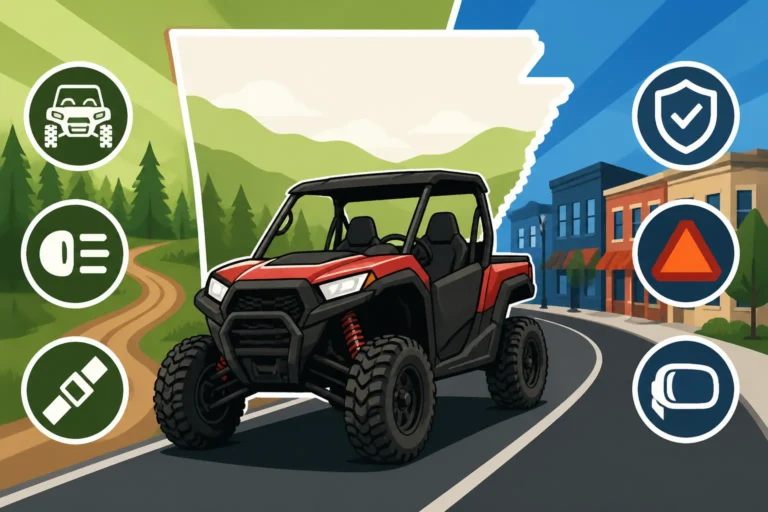
For any UTV to be considered for street-legal status, even on approved local roads, it must be outfitted with specific safety equipment. This isn't just a suggestion; it's a requirement outlined in both Act 922 and the local ordinances derived from it. Typically, this includes:
- Headlights: Essential for visibility, especially during dawn, dusk, or adverse weather.
- Taillights and Brake Lights: Crucial for signaling your presence and braking to traffic behind you.
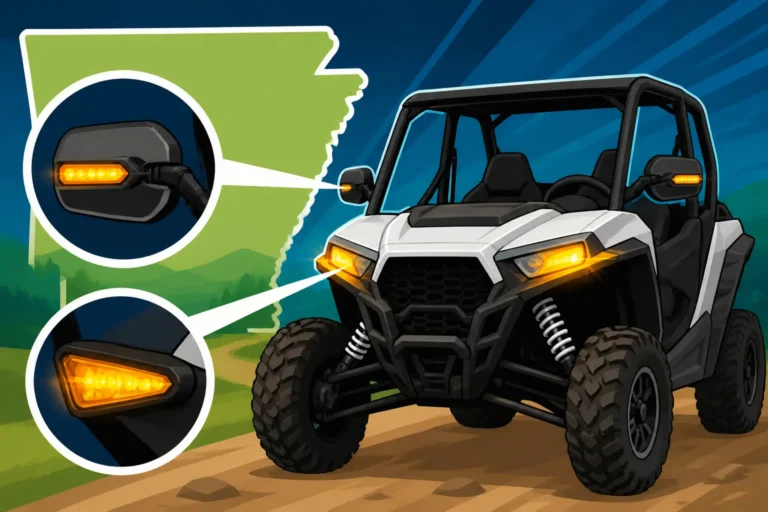
- Turn Signals: Required for clearly indicating your intentions to turn or change lanes, a fundamental aspect of safe road sharing. Many riders look for robust, easy-to-install turn signal kits, often from brands like SuperATV, to ensure compliance and reliability.
- Rearview Mirrors: Typically one on the left side, and often a center mirror, to provide adequate visibility of traffic approaching from the rear.
- Horn: A signaling device to alert other drivers or pedestrians to your presence.
- Windshield: While not always explicitly stated, many ordinances prefer or require a windshield for operator safety.
- Seatbelts: For all occupants, and often required to be worn.
Without these crucial components, your UTV will not be granted a street permit, and even if you ride it on an approved street, you could be cited for equipment violations. For a comprehensive checklist, refer to [Arkansas Equipment for a Street-Permitted Machine].
Insurance and Licensing Requirements
Having the right equipment is only one piece of the puzzle. Cities that allow street-legal UTVs almost universally require proof of liability insurance. This isn't just about protecting yourself; it's about protecting others on the road in case of an accident. The minimum coverage amounts are typically similar to what's required for automobiles. Without valid insurance, you won't get a permit, and riding uninsured is a serious offense with severe penalties. Furthermore, as mentioned earlier, operators generally must hold a valid driver's license. This ensures a basic level of driving competence and familiarity with road rules. Check [Arkansas Insurance for a Street-Permitted UTV] for more details.
Local Ordinances: Your Go-To Guide
Remember, while Act 922 set the framework, the specific rules for street-legal UTVs vary from town to town. Just because a UTV is street-legal in Bono doesn't mean the same rules apply in Ozark or Hot Springs. Before you venture onto any public street, you must read and understand the specific ordinance of the city you're in. These ordinances will detail:
- Which streets are allowed (and which are explicitly forbidden, like four-lane streets).
- Required equipment.
- Permit application process and fees.
- Operator age and licensing.
- Hours of operation (some cities restrict night riding).
- Any other unique local rules.
Don't rely on hearsay or what someone told you at the gas station. Go directly to the city clerk's office, check the city's official website, or call the local police department for the definitive information. [Reading Your Town's Ordinance Before You Ride] is an excellent resource for this.
Planning Your Ride in Arkansas
With all these rules in mind, planning your ATV or UTV adventure in Arkansas requires a bit more foresight than just loading up the machine and heading out. Whether you're trail riding or hoping to cruise local streets, a good plan ensures a fun, safe, and legal experience.
Trailering for Longer Distances
Given the restrictions on four-lane streets and state highways, trailering your ATV or UTV is almost always the best and safest option for covering longer distances or reaching designated riding areas. Even if a town has a UTV ordinance, using your machine to drive to a trail system miles away is generally not practical or legal. Trailer your machine to the vicinity of your chosen trails, like Wolf Pen Gap or Mill Creek, and then enjoy the legal riding opportunities there. Many riding areas, especially national forest trails, have specific permit requirements as well, so be sure to check those out in advance.
Combining Street and Trail Riding
For those who enjoy a mix of street cruising and off-road adventure, look for towns that have UTV ordinances and are close to trail systems. In such cases, you might be able to ride your permitted UTV from your lodging to a local restaurant, then trailer it a short distance to the trail system. This allows you to experience both aspects of UTV ownership. However, always be mindful of where the permitted streets end and where the restricted roads or private property begins. A quick turn onto the wrong road can quickly put you in violation of the law.
Always Check Local Regulations
The key takeaway is constant vigilance regarding local regulations. Arkansas is seeing more and more towns consider and adopt UTV ordinances, but each one is tailored to that specific community. What's allowed in Bono might not be allowed in Mena, or even in a neighboring town like Waldron. The rules are dynamic, so a quick check of the relevant city's website or a call to the local city hall is always a good idea before you hit the road. This ensures you're riding legally and safely, respecting both the law and the communities you're riding in.
Disclaimer
This article is for general informational purposes only and does not constitute professional advice. Laws, prices and regulations vary by location and change over time. Consult a qualified professional for guidance on your specific situation.