Arkansas Law Enforcement and EMS Exceptions
Riding ATVs and UTVs in Arkansas is a fantastic way to explore the Natural State's rugged beauty, but navigating the rules for public roads can be incredibly confusing, leaving many riders unsure if they're breaking the law simply by moving from one trail to another. This guide aims to demystify Arkansas's off-road vehicle road laws, focusing specifically on the crucial exceptions that allow law enforcement and emergency medical services (EMS) personnel to use these machines on public thoroughfares, while also touching on other vital exceptions and local ordinances that impact all riders.
The General Rule: Why ATVs and UTVs Are Usually Off-Limits on Arkansas Roads
Let's be real: when you buy an ATV or a side-by-side, your first thought probably isn't "how can I drive this on a paved highway?" These machines are built for dirt, mud, rocks, and navigating tough terrain. And for good reason, Arkansas law reflects this. The default position is that your beloved off-road vehicle (OHV) is simply not allowed on public roads, highways, or streets. It's a fundamental starting point that causes a lot of head-scratching for folks who just want to get from their deer stand to their camp across a county road.
Understanding Arkansas's Default Stance
The statute itself is pretty clear: [Arkansas Makes Road Riding Unlawful by Default]. It considers ATVs and UTVs as "off-highway vehicles" (OHVs), which are distinct from street-legal automobiles, motorcycles, or even golf carts in many contexts. This isn't just an arbitrary rule; it's rooted in safety and infrastructure concerns. These machines lack many of the safety features, like crumple zones, advanced turn signal systems, or standardized headlights and taillights, that are mandatory for vehicles sharing the road with 70 mph traffic. Their tires are designed for traction off-road, not for high-speed, sustained pavement use, which can lead to rapid wear and even dangerous blowouts.
Imagine trying to navigate rush hour in Little Rock on your quad. It sounds ridiculous, right? That's the core thinking behind the ban. The law sets a clear boundary: roads are for road vehicles, and off-road vehicles are for off-road environments. This distinction is crucial, even for short distances. Many riders get caught off guard, thinking a quick hop across the blacktop won't matter, only to find themselves facing a citation. Understanding this default ban is the first step in truly grasping the exceptions.
The Dangers and Concerns Behind the Ban
The state's reluctance to allow widespread ATV and UTV road use isn't just about technicalities; it's deeply tied to public safety. When an ATV, designed for low speeds and maneuverability over uneven ground, encounters a full-size pickup truck on a paved road, the ATV and its rider are at a severe disadvantage. The stability, braking capabilities, and visibility of ATVs and UTVs are simply not engineered for the demands of public roadways.
Consider the braking distance required for a UTV loaded with hunting gear versus a passenger car at 55 mph. There's a significant difference. Furthermore, the lack of standard turn signals, side mirrors, and even basic occupant protection found in typical road vehicles creates inherent risks. For instance, a quick stop might send unsecured items (or even passengers) flying, or another driver might simply not see your relatively small machine on a busy road. Even when you're just crossing, the speed differential can be perilous. This is why the state prioritizes keeping these machines in their intended environment, where they shine. Ignoring these dangers is not only unlawful but can lead to tragic consequences, which is something no rider wants.
Exploring the Six Statutory Exceptions to the Road Ban
While the general rule is "no ATVs or UTVs on public roads," Arkansas law recognizes that there are specific, limited circumstances where it's not only necessary but permissible to operate these machines on public ways. These are known as the [Arkansas's Six Statutory Road Exceptions], and understanding each one is critical for any OHV owner in the state. These aren't loopholes; they are carefully defined allowances for particular purposes.
Here's a quick overview of these exceptions:
| Exception Category | Primary Purpose | Key Conditions |
|---|---|---|
| Law Enforcement/EMS | Official duties, emergency response | Authorized personnel, official business, emergency situations |
| Farming Operations | Conducting farm-related tasks | Must be for bona fide farming, travel short distances, low speed |
| Hunting Operations | Accessing hunting areas during season | Must be for bona fide hunting, travel short distances, low speed |
| Disability | Transport for individuals with specific disabilities | Must possess a valid disability parking placard or identifying tag |
| Utility Company Crews | Performing utility maintenance/repair | Must be for official utility work |
| State Parks Employees | Performing duties within state parks | Must be for official state park business |
| Direct Crossing | Safely crossing a road to access another section | Must stop, yield, cross at 90 degrees, travel less than one-half mile |
We'll dive deeper into the specifics, especially the role of law enforcement and EMS.
Law Enforcement and EMS: Serving and Protecting
This is perhaps one of the most straightforward and universally understood exceptions. When it comes to public safety and emergency response, common sense dictates that law enforcement and emergency medical services need every tool at their disposal, and that often includes ATVs and UTVs. These machines are invaluable in situations where traditional patrol cars or ambulances simply cannot go.
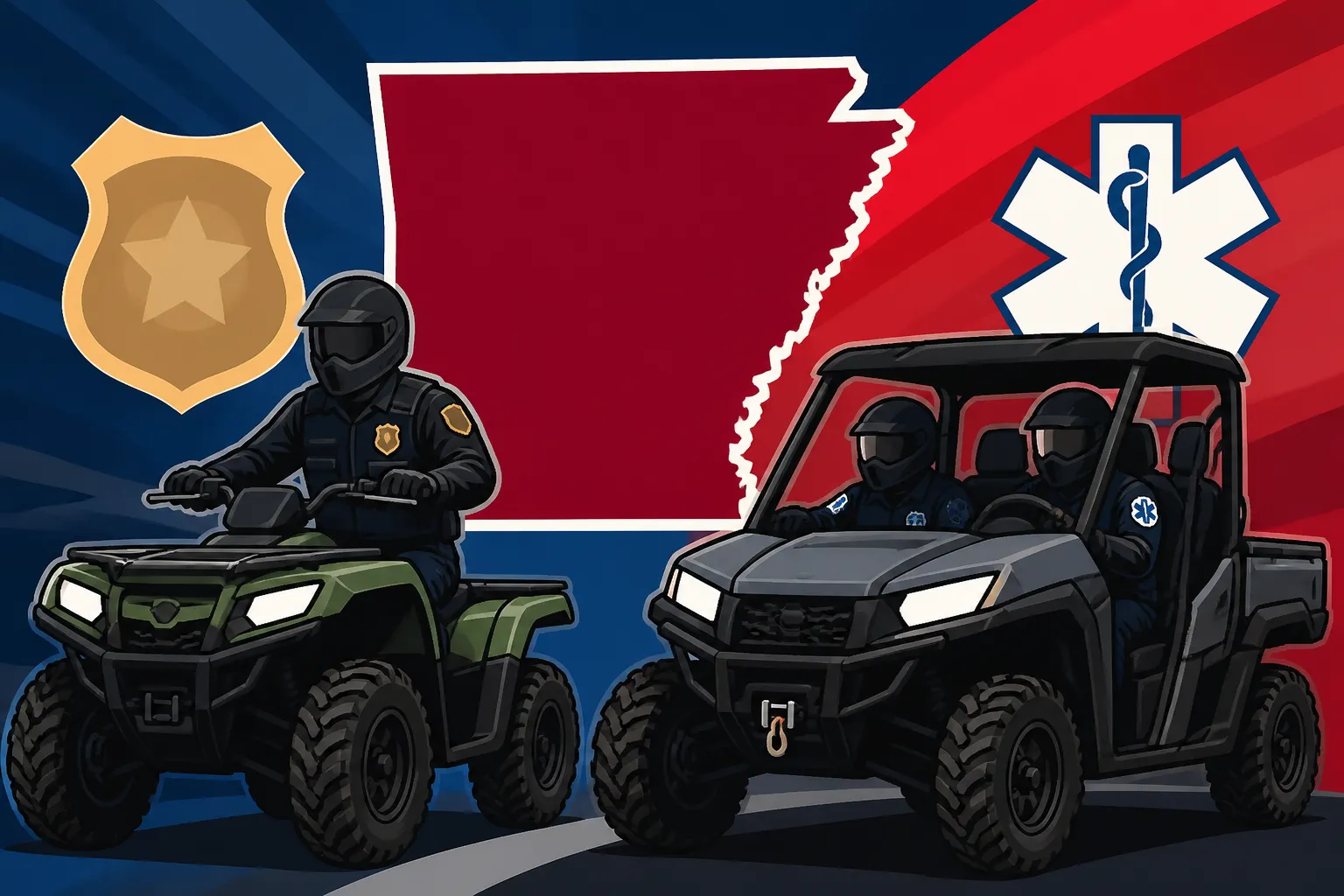
Think about a search and rescue operation in the rugged terrain of the Ozarks or Ouachitas. A sheriff's deputy or an EMS responder trying to reach an injured hiker or locate a lost person deep in the woods would be severely hampered without the agility and off-road capability of an ATV or UTV. These machines allow them to traverse muddy trails, navigate dense forests, and climb steep inclines that would be impassable for other vehicles. [Arkansas Law Enforcement and EMS Exceptions] specifically permit these agencies and their authorized personnel to operate ATVs and UTVs on public roads when performing their official duties. This might include patrolling rural areas, responding to accidents in remote locations, or providing medical assistance where conventional access is limited. They are quite literally serving and protecting, and their ability to quickly access remote areas can be the difference between life and death. For these professionals, ensuring their machines are equipped with reliable tires, winches, and lighting, perhaps even specialized equipment from a company like SuperATV, is paramount for their safety and effectiveness in critical situations.
Farming and Hunting Operations: Essential Rural Use
Arkansas is a state with deep agricultural roots and a strong hunting culture, and the law acknowledges the practical necessity of using ATVs and UTVs for these activities. If you're a farmer in Stuttgart trying to move equipment or check fences on your land, which might be bisected by a county road, it's often more efficient and less disruptive to use your side-by-side than to load it onto a trailer. Similarly, a hunter in Polk County might need to cross a paved road to get from their truck to their deer lease.
The [Arkansas Farming Operation Road Use] and [Arkansas Hunting Operation Road Use] exceptions are designed for these exact scenarios. The key here is "bona fide operation." This means the use of the ATV or UTV must be directly related to farming or hunting activities. It's not an excuse to take a joyride down the highway. The law expects these uses to be for short distances and at speeds appropriate for the specific task and machine. You can't just drive your ATV five miles to the convenience store because you're "hunting." It needs to be a direct, necessary part of the farming or hunting activity, such as checking cattle, hauling feed, or accessing a specific hunting blind during open season. These exceptions recognize the unique needs of rural communities where these machines are often integral to daily life and livelihood. Many farmers and hunters outfit their machines with heavy-duty components from companies like SuperATV to ensure they can handle the demanding work required, often pushing the limits of what a stock machine can do.
Disability and Direct Crossings: Specific Situations
Beyond official duties and essential rural activities, there are two other specific statutory exceptions that allow for limited road use: for individuals with certain disabilities and for direct crossings. These exceptions are highly conditional and require strict adherence to the rules.
The [Arkansas Disability Exception for Road Riding] allows individuals with a physical disability that impairs their ability to walk to operate an ATV or UTV on a public road. However, this isn't a blanket permission. The individual must possess a valid disability parking placard or an identifying tag that indicates their disability. This exception is designed to provide necessary mobility for those who genuinely need assistance due to a walking impairment, ensuring they can access areas that might otherwise be inaccessible. It's about providing reasonable accommodation, not enabling recreational road riding.
Then there's the [Arkansas Direct Crossing at Ninety Degrees] exception, which is probably the most commonly utilized (and misunderstood) by everyday riders. This allows an ATV or UTV to cross a public road or highway, provided it's done safely and directly. The rules are very specific: you must [Arkansas Stop Before You Cross], yield to all oncoming traffic, and cross at an angle of approximately ninety degrees to the roadway. The distance traveled on the roadway must also be less than one-half mile. This exception is not for cruising down the road; it's purely for traversing a road to get from one section of off-road property or trail to another. It's designed to minimize the time spent on the public road, thus minimizing risk. Failing to stop, not yielding, or attempting to ride parallel to the road for even a short distance violates this exception and can lead to a citation. Both of these exceptions highlight the state's cautious approach to road use, only permitting it under very specific and controlled circumstances.
Local Ordinances: A New Era for UTVs on City Streets
While the state law generally prohibits ATVs and UTVs on public roads, a significant change occurred that specifically impacts UTVs: [Arkansas Rules That Changed in 2025]. This legislative shift opened the door for individual cities and towns to decide for themselves whether to allow UTVs (but generally not ATVs) on their local streets. This has created a patchwork of regulations across the state, making it critical for riders to know the specific rules of the town they're in.
How Cities Can Open Their Streets to UTVs
Before this change, the default state ban meant no UTVs on city streets. Now, under Act 922 (which became effective on August 5, 2025), local municipalities have the authority to pass ordinances specifically allowing UTVs on certain public streets within their jurisdiction. This power is detailed in statutes like [How Arkansas Cities Got the Choice on UTVs]. This is not a statewide mandate; it's a local option. A city council must actively pass an ordinance to permit UTV street use, and even then, they can set their own conditions.
For example, a town like Bono, Arkansas, was an early adopter of such an ordinance, allowing UTVs on many of its streets (though notably excluding certain state highways like Highway 63). These ordinances typically define which streets are open (often those with speed limits under 55 mph and usually excluding four-lane state highways), what permits are required, and what equipment the UTV must have. It's a progressive step for communities that see the value in UTVs for local transportation, recreation, and supporting businesses, but it puts the onus on the rider to research the specific rules for each town. Don't assume that because UTVs are allowed on city streets in one town, they're allowed in the next. Always check the local municipal code.
Equipment and Driver Requirements for Street-Legal UTVs
If a city does pass an ordinance allowing UTVs on its streets, it's not a free-for-all. These ordinances typically come with a stringent list of requirements to ensure the UTV is as safe as possible for road use. These requirements are usually designed to bring the UTV closer to the safety standards of a conventional street-legal vehicle.
Common requirements often include:
- Lights: Headlights, taillights, brake lights, and often turn signals. Companies like SuperATV offer robust aftermarket lighting kits that include all necessary components, making it easier to comply with these local regulations.
- Mirrors: A rearview mirror, and often side mirrors, are required to provide the driver with adequate visibility of surrounding traffic. SuperATV also carries various mirror options for different UTV models.
- Windshield: A DOT-approved windshield might be necessary, offering protection from road debris.
- Horn: A working horn for signaling.
- Seat Belts: All occupants must be wearing factory-installed or equivalent seat belts.
- Permit/Sticker: The city will usually require an annual permit and often provide a sticker to display on the UTV.
- Insurance: Proof of liability insurance is almost always a must. [Arkansas Insurance for a Street-Permitted UTV] is critical.
- Driver's License: The operator must typically possess a valid driver's license, and often there's an age minimum, commonly 16 years old, as per [Arkansas Driver's License at 16 for Street UTVs].
It's a lot to remember, and the specifics can vary significantly from one town to the next, as highlighted in articles like [Arkansas UTV Street Legal Rules by Town]. Before you even think about riding your UTV on a city street, you need to verify not only that the city allows it but also that your machine meets all their specific equipment demands, and you possess the required permits and insurance. Investing in quality accessories from a reputable brand like SuperATV can help ensure your UTV meets the necessary safety and legal standards, saving you headaches down the road.
Practical Realities and Staying Compliant
Understanding the law is one thing; living it is another. For ATV and UTV riders in Arkansas, the practical realities of road use often come down to avoiding trouble, knowing what law enforcement is looking for, and understanding the potential consequences of non-compliance. It's about being prepared and responsible.
What Deputies Look For When You're Pulled Over
Let's face it, getting pulled over is never fun, especially if you're unsure whether you're breaking a law you didn't even know existed. When an Arkansas deputy or state trooper spots an ATV or UTV on a public road, their primary concern is usually safety and legality. They're trained to recognize the general prohibition and will immediately look for an exception.
What are they checking?
- Purpose of Travel: Are you clearly engaged in farming or hunting operations? Is it obvious you're an EMS or law enforcement professional on duty? Are you just making a direct crossing? If you're joyriding, that's a red flag.
- Location: Are you on a state highway or a county road? If it's a city street, does that specific city have an ordinance allowing UTVs, and are you on an approved street?
- Equipment: For UTVs on city streets, does your machine have all the required safety equipment like [Arkansas Turn Signal Requirements for Street UTVs], mirrors, and lights?
- Permits/Documentation: Do you have any required city permits, proof of insurance, or your driver's license? For farm/hunt exceptions, can you articulate a clear, legitimate reason for your road use?
- Crossing Protocol: If you're just crossing, did you come to a complete stop, yield, and cross directly?
A polite and clear explanation of your purpose, coupled with proper documentation and a compliant machine, can go a long way. But ignorance of the law is never an excuse, and deputies are well-versed in [Arkansas Penalties for Illegal Road Riding]. Having robust parts and accessories from SuperATV can help ensure your machine is up to par if you plan to use it under a local ordinance.
Penalties and Avoiding Costly Mistakes
The consequences of riding an ATV or UTV unlawfully on an Arkansas public road can range from a simple warning to a significant fine, and potentially even impoundment of your machine in some cases. It's not a risk worth taking. Violations are typically considered misdemeanors, and while specific fine amounts can vary, they can quickly add up with court costs.
To avoid these costly mistakes:
- Know the Law: Don't just assume. Research state statutes and, crucially, any local ordinances in the towns you plan to ride near. If you're unsure, call the city clerk or the local sheriff's department.
- Stick to Exceptions: If you're relying on a statutory exception (like farming or hunting), make sure your actions clearly fall within its defined scope. Don't push the boundaries.
- Equip Your UTV Properly: If you plan to ride your UTV on city streets where an ordinance permits it, invest in the necessary safety equipment. Think about quality aftermarket accessories from companies like SuperATV to ensure your machine meets requirements for lights, mirrors, and safety features.
- Carry Documentation: Always have your driver's license, proof of insurance, and any city permits on hand.
- Educate Yourself on Changes: Laws can change. Keep an eye on updates, especially concerning local ordinances. The [Arkansas Rules That Changed in 2025] article is a good example of how legislation can alter the landscape for riders.
By being informed, equipping your machine appropriately, and respecting the law, you can enjoy your ATV or UTV without the stress and expense of an unexpected run-in with law enforcement. It’s all about being a responsible rider in the beautiful state of Arkansas.
Disclaimer
This article is for general informational purposes only and does not constitute professional advice. Laws, prices and regulations vary by location and change over time. Consult a qualified professional for guidance on your specific situation.