Arkansas Rules for Towing With a UTV
Many UTV owners in Arkansas dream of the versatility their machine offers, from hauling feed around the farm to pulling a small trailer to a favorite hunting spot. But the moment you consider hitching something to your side-by-side and taking it anywhere near a public road, a cloud of confusion often settles in. It's a real headache trying to decipher the complex rules surrounding UTV use, let alone towing, on Arkansas's thoroughfares. This guide aims to clear up that confusion, offering a realistic look at Arkansas's rules for towing with a UTV, ensuring you understand when, where, and how you can do it legally and safely.
The Foundational Rules: When Can an Arkansas UTV Even Be on a Road to Tow?
Before we even get to the specifics of towing, it’s absolutely critical to understand the primary legal framework that governs UTVs on public roads in Arkansas. If your UTV isn't allowed on a particular road in the first place, then towing anything with it on that road is, by extension, also prohibited. This is where most of the confusion and potential for citations come into play for riders across the state.
Arkansas's Strict Default for UTVs on Paved Roads
Let's get this out of the way upfront: by default, Arkansas law generally makes it unlawful to operate an ATV or UTV on a public street or highway. This is a crucial starting point because it sets the stage for every other rule. Unless a specific exception applies, or a local ordinance has changed things, your UTV isn't meant for street use. This often comes as a shock to new owners or those visiting from states with more lenient rules, but it’s the reality here in the Natural State.
This default ban means that pulling a utility trailer with firewood, or even a small boat to a nearby ramp, is generally off-limits if it requires travel on a state highway or county road. The state views these machines as off-highway vehicles, designed for trails, private land, and specific exempted uses, not general road transportation. Understanding [Arkansas ATV Road Rules: What 27-21-106 Says] is the very first step to avoiding trouble.
Even if you have the beefiest hitch and the most capable UTV, like some of the robust models that could easily handle heavy loads, if the machine itself isn't legally on the road, then neither is whatever it's towing. It's a foundational principle that dictates all other considerations. Riders often get frustrated by this, feeling like their versatile machines are needlessly restricted, but the law is quite clear.
Navigating Local City Ordinances for Street-Legal UTVs
Here's where things get a little more nuanced, and where the possibility of legal road use – and thus, legal towing – opens up in certain areas. Arkansas law provides a mechanism for cities and towns to pass their own ordinances allowing UTVs on specific public streets within their municipal boundaries. This legislative change has been a game-changer for many communities, granting them local control over how these machines integrate into their daily life.
These local ordinances often come with their own set of rules regarding speed limits, required equipment (like turn signals, mirrors, or insurance), and permit requirements. If your UTV is street-legal under a city ordinance, meaning you've followed all the steps to obtain a permit and equipped it properly, then the door opens for you to potentially tow on those designated city streets. Check out [Arkansas UTV Street Legal Rules by Town] for more details on how this works.
However, it's absolutely vital to remember that these city ordinances generally apply only within that specific city's limits and only on the streets they designate. They do not magically make your UTV street-legal on state highways or county roads outside that town. So, if you live in a town like Bono that has embraced UTVs on its streets, you might be able to tow your yard cart to a neighbor's house, but you couldn't drive it down Highway 63 with that same cart attached.
Brief Road Crossings and Agricultural Exemptions
Beyond specific city ordinances, Arkansas law does carve out a few narrow exceptions where UTVs can legally interact with public roads, even without being fully street-legal. These exceptions are particularly relevant for those who use their UTVs for agricultural purposes or for accessing hunting land, and they can sometimes extend to towing. It's important to differentiate these from general road use.
One key exception allows for direct crossings of a public road, typically at a ninety-degree angle, after coming to a complete stop and yielding to traffic. While you might be able to cross a road while towing a small implement to get from one field to another, this is a very brief maneuver and not an excuse for traveling down the road. Another vital area is [Arkansas Farming Operation Road Use] and [Arkansas Hunting Operation Road Use]. These exemptions permit UTVs to be operated on public roads only for the purpose of moving between fields, working agricultural land, or accessing hunting leases.
For farmers and hunters, this means you can often tow equipment or game carts on specific public roads if that travel is directly incidental to your farming or hunting operation. However, this is not a blanket permission slip for recreational towing on public roads. You can't just tow a trailer full of camping gear because you're "going hunting" if that's not the primary purpose of the UTV's presence on the road. The intent and nature of the activity are paramount here.
Arkansas Towing Specifics: What the Law Says About Your UTV
Once you've established that your UTV is legally allowed on a particular road (either through an exception or a local ordinance), the next layer of complexity involves the actual act of towing. Arkansas law, while not always explicitly detailing "UTV towing," has general vehicle statutes that apply to any vehicle operating on its roads, and these statutes certainly come into play when you hitch something to your side-by-side.
Understanding Weight Limits and Vehicle Capacity for Towing
Unlike a truck or even a car, UTVs have specific design limitations when it comes to towing. They are powerful, yes, but their chassis, suspension, and braking systems are typically engineered for off-road performance and smaller payloads, not heavy-duty towing. While Arkansas law doesn't typically specify a maximum tow capacity for UTVs on public roads, it implicitly requires that any vehicle operating on its roads be capable of safely handling its load.
This means you need to consult your UTV's owner's manual for its factory-rated tow capacity. Exceeding this limit is not only dangerous but could be considered negligent if an accident occurs. Imagine trying to pull a 2,000-pound boat trailer with a UTV rated for 1,000 pounds. The strain on the drivetrain, the lack of effective braking, and the instability would be a serious hazard to yourself and others. Many aftermarket accessories, like those from SuperATV, offer enhanced hitches or suspension components, but these upgrades don't magically increase your UTV's rated tow capacity.
Even if you're within the weight limit, consider the tongue weight of the trailer. Too much tongue weight can lift the front wheels, affecting steering, while too little can cause dangerous trailer sway. Always distribute your load properly on the trailer, keeping the heaviest items over or slightly forward of the trailer's axle. Overloading a UTV, even if it's "just for a short distance," is a recipe for disaster, risking damage to your machine, a potential loss of control, and serious injury.
Essential Equipment for Safe and Legal Towing
When you're towing anything on an Arkansas public road, even under an exemption or city ordinance, certain equipment becomes mandatory, just as it would for a car or truck. This is not just about safety; it's about legality. Ignoring these requirements can lead to citations, regardless of whether your UTV itself is permitted on the road.
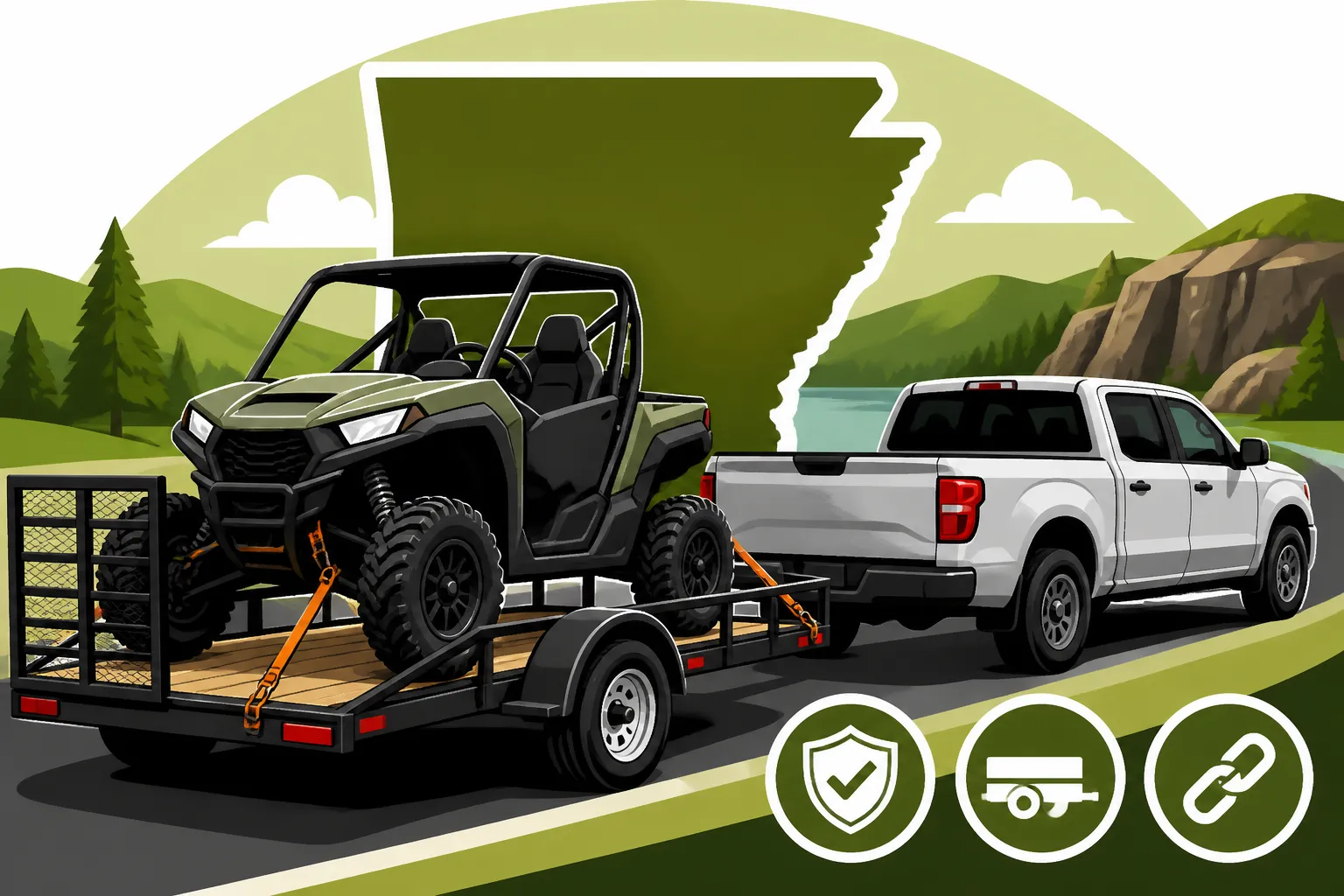
First and foremost, you need a proper hitch and tow ball. Ensure the hitch receiver on your UTV is designed for towing and that the tow ball rating matches or exceeds the weight you intend to tow. A simple pin-style hitch might be fine for a small yard cart on private land, but for public road use, you'll likely need a ball hitch. Additionally, safety chains are required. These chains act as a backup in case the primary hitch connection fails, preventing the trailer from detaching completely and becoming a runaway hazard.
| Equipment Type | Requirement for Public Road Towing (Arkansas) |
|---|---|
| Hitch & Ball | Rated for load, securely attached, proper size. |
| Safety Chains | Required; cross-connected to prevent full detachment. |
| Trailer Lights | Tail lights, brake lights, turn signals (if trailer obstructs UTV's). |
| Reflectors/Tape | Required on trailer sides and rear. |
| Fenders (Trailer) | Generally required to prevent debris kick-up. |
| Brakes (Trailer) | Required if gross weight exceeds 3,000 lbs. |
Your trailer must also have functional tail lights, brake lights, and turn signals if the towed vehicle obscures your UTV's own lights. If you're towing after dark or in low visibility, this is non-negotiable. Many UTVs, especially if they are street-legal under a city ordinance, will have their own turn signals already installed. For example, some UTVs might have aftermarket kits from SuperATV that integrate turn signals and a horn, which is great, but your trailer also needs to display these if it's long enough to cover your UTV's. Reflectors on the trailer's sides and rear are also generally required to enhance visibility. These simple additions can make a huge difference in preventing rear-end collisions, especially on roads where UTVs are less expected.
Towing Agricultural Implements or Hunting Gear
The exemptions for agricultural and hunting operations are where UTV towing often makes the most sense and is most commonly seen on Arkansas roads. For farmers, moving a small seed spreader, a sprayer, or even a post-hole digger from one field to another using a UTV can be far more efficient than firing up a tractor or truck for a short trip. Similarly, hunters often use UTVs to haul deer carts, portable stands, or even small trailers with decoys and gear to their hunting spots.
When utilizing the [Arkansas Farming Operation Road Use] or [Arkansas Hunting Operation Road Use] exemptions, the UTV and the towed implement must be used exclusively for those specific activities. This means you can't use the farming exemption to tow a jet ski to the lake, even if you just finished planting a field. The spirit of the law is to facilitate the specific work, not to grant general road use. The same equipment rules (lights, safety chains) still apply to your towed implements if they are on a public road, even if it's just a short distance.
It's also important to consider the dimensions of what you're towing. If your implement is wider than the UTV or significantly longer, it can present challenges for turning, visibility, and safe passage on narrow county roads. Be mindful of [Arkansas Machines Wider Than 50 Inches] and how the width of your towed item might interact with other traffic or tight turns. Always err on the side of caution, slow down, and use appropriate signaling (even hand signals if necessary) to alert other drivers to your presence and intentions.
Practical Considerations for Safe UTV Towing in Arkansas
Even when you've confirmed the legality of towing with your UTV in a specific scenario, the practical aspects of safe towing cannot be overlooked. A UTV handles very differently with a trailer attached, and understanding these changes is vital for maintaining control and preventing accidents, whether you're on a dirt path or a paved county road.
Ensuring Stability and Control with a Trailer
Towing significantly alters your UTV's center of gravity, braking distance, and acceleration. When you add a trailer, especially a loaded one, your UTV becomes inherently less stable. Turns that were once easy can become much wider, and sudden stops can lead to loss of control or jackknifing. This is why it's so important to drive defensively and adjust your driving style dramatically when towing.
Always maintain slower speeds than you typically would, especially on uneven terrain or around corners. Your UTV's engine will work harder, and its brakes will have to overcome the inertia of both the UTV and the trailer. Downshifting to use engine braking on descents can help prevent your brakes from overheating. Remember, a UTV is not a full-size truck designed for heavy towing; it requires a much more cautious approach. Investing in quality suspension components or heavier-duty tires can help with stability, but they don't negate the need for careful driving.
Another critical factor is tire pressure. Ensure your UTV tires are inflated to the manufacturer's recommended pressure for carrying loads, and check the tire pressure on your trailer as well. Underinflated tires can lead to excessive sway and instability. If you're using a side-by-side with a passenger, their weight also needs to be factored into the overall load and how it affects handling.
Visibility, Lighting, and Signaling When Towing
Visibility is paramount when towing, and UTVs already sit lower than many other vehicles on the road. Adding a trailer, especially one that's long or tall, can severely restrict your rearward visibility. Always use your mirrors diligently and, if necessary, consider adding aftermarket wider mirrors to your UTV, perhaps from a brand like SuperATV, to give you a better view of your trailer and the traffic behind you.
As mentioned earlier, proper lighting on your trailer is a legal requirement for road use. Beyond the legal aspect, it's a critical safety measure. Make sure your trailer's tail lights, brake lights, and turn signals are all functioning correctly before every trip. A wiring harness that connects to your UTV's electrical system is usually required for this. Consider adding reflective tape to the sides and rear of your trailer, particularly if you're towing anything that might be hard to see in dim light or at dusk.
Communicating your intentions to other drivers is also vital. Use your UTV's turn signals well in advance of a turn or lane change. If your UTV is permitted on city streets, it will likely have required turn signals. If you're on a county road under a farming or hunting exemption, where turn signals might not be required for the UTV itself, be extra mindful. Consider using clear hand signals if your electrical signals aren't visible or available. For more on what's required, review [Arkansas Turn Signal Requirements for Street UTVs].
Protecting Your Machine and What You're Hauling
Towing can put significant strain on your UTV. It's a good idea to perform a quick check of your machine before and after any substantial towing job. Look for loose hitch connections, worn tires, or any signs of stress on your suspension or frame. Regular maintenance, including checking your fluids and brakes, becomes even more important when your UTV is routinely tasked with hauling loads.
When securing your load on the trailer, always use appropriate tie-downs, straps, or chains. An unsecured load can shift during transit, throwing off the trailer's balance, or worse, fall off completely and create a dangerous road hazard. Cover your load if necessary to prevent debris from flying out, especially on gravel roads. For example, if you're hauling brush or tools, a tarp can save you from losing items and protect other vehicles from damage.
Finally, consider the financial implications. While Arkansas doesn't mandate insurance for off-road vehicles on private land, if your UTV is street-legal under a city ordinance, you will likely need [Arkansas Insurance for a Street-Permitted UTV]. This insurance is essential not only for liability in case of an accident but also to protect your investment if your UTV or trailer is damaged while towing. Understanding the full scope of what you can and can't do, and how to do it safely, is the best way to enjoy the full versatility of your UTV in Arkansas.
Disclaimer
This article is for general informational purposes only and does not constitute professional advice. Laws, prices and regulations vary by location and change over time. Consult a qualified professional for guidance on your specific situation.