Six Exceptions to Arkansas’s Ban on Road Riding
It's incredibly frustrating when you just want to take your ATV or side-by-side from one property to another, or maybe access a distant part of your hunting lease, but you're constantly worried about getting a ticket for riding on the road. The rules around off-highway vehicles (OHVs) and public roads in Arkansas can feel like a tangled mess of "can I?" and "can't I?". This guide is here to untangle that knot, specifically breaking down the six very distinct, very limited situations where Arkansas state law actually permits you to ride your ATV or UTV on a public road.
Understanding Arkansas's Default Ban on Road Riding
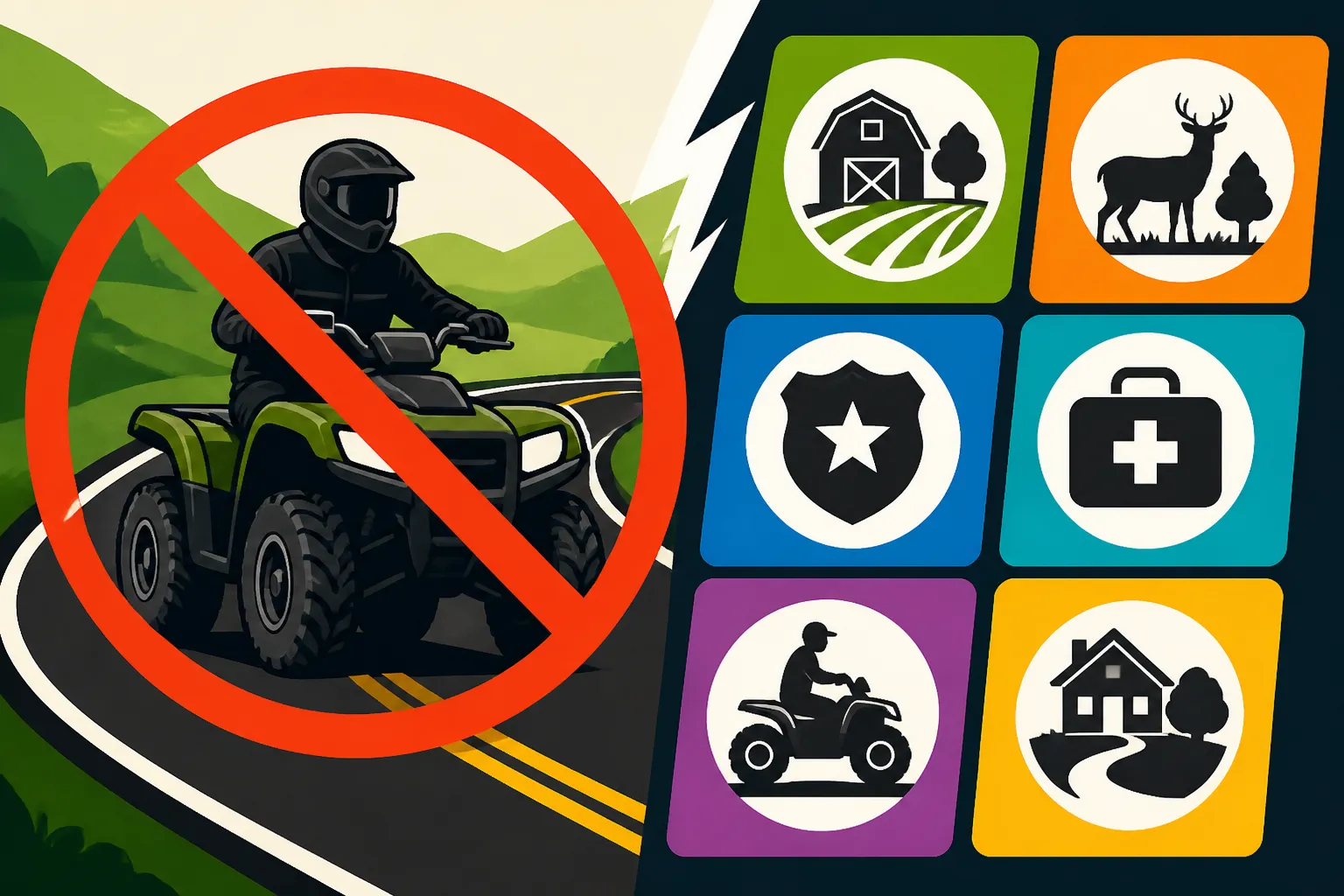
Let's clear the air right upfront: the general rule in Arkansas is that ATVs and UTVs are not allowed on public roads. This isn't just some suggestion; it's enshrined in state statute. Many folks move to Arkansas from states with different rules, or they simply get conflicting information from friends, and that's totally understandable. But the baseline is clear: if you're on an ATV or UTV, assume public roads are off-limits unless you meet a very specific exception.
Why the Rules Exist: Safety and Infrastructure Concerns
You might wonder why these rules are so strict. It boils down to a couple of key factors: safety and the nature of these machines. ATVs and UTVs are designed for off-road conditions – dirt, mud, rocks, trails – not paved asphalt. Their tires, suspension, and steering systems aren't built for sustained highway speeds or the precise handling required in traffic. They often lack basic road-legal equipment like turn signals, rearview mirrors, and proper headlamps or taillamps that meet Department of Transportation (DOT) standards. This makes them inherently less safe when mixing with cars and trucks that are traveling at much higher speeds.
Beyond safety, there's the issue of infrastructure wear and tear. While a single ATV might not seem like much, a widespread allowance of OHVs on roads could lead to increased maintenance costs for roads not designed for them. It also creates enforcement challenges for local law enforcement, who need clear guidelines to ensure everyone's safety. The state wants to protect both riders and other motorists, and these regulations are how they attempt to do that. It's not about singling out ATV riders; it's about trying to maintain a safe and orderly transportation system for everyone.
The General Rule: Stay Off Paved Roads
So, to reiterate, the general rule is simple: stay off paved roads. This applies to state highways, county roads, and city streets. If it's a road maintained by the public, it's generally off-limits for your quad or side-by-side. This includes the shoulder, the ditch, and any median. You can't just hug the side of the road and assume you're okay. The law considers any part of the public right-of-way as "on the road." This can be a tough pill to swallow, especially if you have a short stretch of road that connects your house to a great riding spot or a hunting property. But understanding this fundamental restriction is the first step to knowing when you can legally ride. For more details on what the statute says, you can look up [What Arkansas's ATV Statute Covers].
What "Road Riding" Actually Means: Highways, County Roads, City Streets
When the statute talks about "public roads," it's not being vague. It encompasses the full spectrum of publicly maintained thoroughfares. This includes multi-lane state highways (like Highway 67 or I-40), two-lane state highways that crisscross rural areas, and the countless county roads, both paved and gravel, that weave through Arkansas's landscapes. Even city streets fall under this general prohibition, although, as we'll discuss later, there are nuances with local ordinances for UTVs.
The key is public maintenance and access. If it's a road that's open to the general public for vehicular travel and is maintained by a governmental entity (state, county, or city), then it's considered a "public road" for the purposes of this law. This means that charming gravel road leading to your favorite fishing spot is just as off-limits as a busy highway unless one of the six specific exceptions applies. Many riders get confused about gravel county roads, thinking they are "off-road enough" to be exempt, but under state law, they are still public roads.
The Six Statutory Exceptions: When It's Actually Legal
Okay, now for the good news: there are indeed six specific situations carved out in Arkansas law where operating an ATV or UTV on a public road is permissible. It's crucial to understand that these are narrow exceptions, not broad licenses to ride anywhere. Each one comes with its own conditions and intent. Think of them as very specific keys that unlock the road for a very specific purpose, and only for that purpose. These exceptions are critical for many folks in rural Arkansas, especially those involved in agriculture or hunting.
Exception 1: Farming Operations (Connecting Fields, Hauling Equipment)
This is one of the most common and important exceptions, particularly in Arkansas's agricultural regions. The law permits the operation of an ATV or UTV on a public road "for agricultural purposes between the various fields of the owner's farm." This means if you're a farmer, and you need to take your side-by-side from one field to another that's separated by a public road, you can legally do so. This also extends to hauling equipment, tools, or even livestock feed within the context of your farming operation.
However, this isn't a free pass to drive your ATV to town for groceries. The intent is strictly for agricultural purposes and between your own fields. It's not for recreational riding, even if you happen to be a farmer. A deputy might ask you to explain your purpose if they see you on the road, so be prepared to articulate how your travel directly supports your farming activities. This exception is vital for the efficiency and practicality of farming in areas where land parcels are often separated by public rights-of-way. It recognizes the machine as a tool, not just a toy. [Arkansas Farming Operation Road Use] provides more context on this.
Exception 2: Hunting Operations (Accessing Leased Land, Deer Stands)
Similar to farming, hunting is a significant part of life for many Arkansans, and the law recognizes the utility of ATVs and UTVs in these operations. You are allowed to operate your machine on a public road "for hunting purposes on land leased or owned by the operator." This exception allows hunters to access their hunting land, move between different parts of a large lease, or even transport harvested game or hunting equipment to and from their stands, as long as it's within the boundaries or directly adjacent to the land they own or lease for hunting.
Again, the key here is "hunting purposes." You can't use this exception to just go for a joyride down a county road because you're also a hunter. The travel must be directly related to the act of hunting, accessing your leased or owned hunting property, or supporting that activity. This typically applies to riding from a main road to a gate, or along a short stretch of road that connects one part of a hunting lease to another. It's not meant for long-distance travel on public roads, and officers will be looking for a clear, direct connection to hunting activities on your land. Learn more about [Arkansas Rules for Riding to a Deer Stand].
Exception 3: Disability Exception (Mobility Assistance)
Arkansas law also makes an allowance for individuals with mobility challenges. An ATV or UTV can be operated on a public road "by a person with a walking disability," provided the vehicle is being used for the purpose of aiding that disability. This is about providing essential mobility, not general recreation. It's designed to help individuals who genuinely need the assistance of such a vehicle to navigate or access areas that would otherwise be difficult or impossible for them to reach on foot.
This exception is likely to be viewed strictly. If you're using this exception, you should probably have some form of documentation, like a disability placard or doctor's note, that confirms your walking disability, although the statute itself doesn't explicitly require it to be carried on the machine. The intent is clearly to facilitate mobility for those with genuine need, not to create a loophole for general riding. The machine is serving as a mobility aid, similar to a wheelchair or scooter in its purpose.
Exception 4: Direct Crossing of a Highway (90-Degree Rule, Complete Stop)
This is perhaps the most frequently misunderstood, yet incredibly useful, exception for many riders. You are allowed to "directly cross a public road or highway at roughly a ninety-degree angle" if you first "come to a complete stop" before entering the roadway. This exception is critical for trail systems, private properties, or hunting lands that are bisected by a public road. It allows you to get from one side of the road to the other without having to load your machine onto a trailer.
However, there are strict conditions:
- Complete Stop: You must come to a full and complete stop before you even enter the roadway, looking both ways for traffic. This isn't a rolling stop; it's a full halt.
- Ninety-Degree Angle: The crossing must be as perpendicular to the road as possible. You cannot angle down the road, even for a short distance, to get to another access point. It's a straight shot across.
- Direct Crossing: This means the shortest possible distance across the road. You can't ride down the road a bit to find a better spot to cross. You cross where you meet the road.
Violating any of these conditions could negate the exception and lead to a citation. It's about minimizing the time your ATV or UTV is on the main roadway for safety reasons. Always prioritize safety, yielding to all traffic. [Crossing a Highway on an ATV in Arkansas] provides more detailed guidance.
Exception 5: Law Enforcement and Emergency Services (Official Duties)
This exception is pretty straightforward and applies to official personnel. Law enforcement officers, emergency medical services (EMS) personnel, and fire department staff are permitted to operate ATVs and UTVs on public roads "in the performance of their official duties." These machines are often invaluable tools for search and rescue operations, accessing remote areas during emergencies, or patrolling parks and rural areas where traditional vehicles might struggle.
This exception is not for personal use or off-duty riding. It's strictly for professional responders when they are actively engaged in their work. These agencies often have specific training and protocols for using OHVs in public spaces, further ensuring safety during their critical operations.
Exception 6: Utility Company Employees and State Parks (Official Work)
Similar to law enforcement, this exception covers employees of public utility companies and those working for the Arkansas State Parks, when they are performing their official duties. "Employees of a public utility company" can use ATVs and UTVs on public roads "to perform maintenance and service functions." This is essential for maintaining power lines, pipelines, and other utility infrastructure that often runs through or alongside remote areas accessible only by OHV.
Likewise, "employees of the Arkansas State Parks" are permitted to operate these vehicles on roads "in the performance of their official duties." This allows park rangers and maintenance staff to patrol trails, perform upkeep, or respond to incidents within state parks, many of which encompass roads that connect different park areas or lead to trailheads. As with the emergency services exception, this is strictly for official work and not personal recreation.
Practical Considerations and Local Ordinances
Understanding these six state-level exceptions is vital, but the real world can sometimes add layers of complexity. It's important to blend this knowledge with practical safety measures and be aware of how local regulations might further shape your riding options.
Navigating the Direct Crossing Rule Safely
The "direct crossing" rule is arguably the most common exception that private riders will use. But using it safely means more than just following the letter of the law. You need to exercise extreme caution. Before you even approach the edge of the pavement, listen for traffic. Visually clear the road in both directions. Remember that your machine is smaller and less visible than a car, and other drivers might not expect to see you. Using bright flags on your machine, especially if you're crossing a blind curve or crest, is a wise safety precaution, even if not legally mandated.
Consider the surface you're crossing. Some road shoulders can have a significant drop-off or soft gravel, making it tricky to maintain control as you transition to and from the pavement. Always approach and exit the pavement squarely to avoid rollovers or loss of steering. And if traffic is heavy, be patient. Waiting for a truly clear window is always better than rushing and putting yourself in a dangerous situation. Think of yourself as a pedestrian with a powerful, fast machine – you want to cross quickly and safely. [Crossing at a Complete Stop] emphasizes this safety aspect.
What About City Streets and UTVs? Act 922 and Local Control
While the six exceptions we just discussed are state-level laws that apply everywhere, there's another important layer for UTVs, specifically regarding city streets. Act 922, which became effective on August 5, 2025, made a significant change. It now allows cities and towns in Arkansas to pass their own local ordinances permitting the operation of UTVs (but generally not ATVs) on certain city streets. This means that if you live in a town like Bono, which passed an ordinance, you might be able to ride your UTV on their specific city streets, even if none of the state's six exceptions apply.
However, this isn't a blanket rule. Each city has to individually choose to pass such an ordinance, and they can set their own conditions. These often include things like:
- Speed limits for UTVs on city streets (often capped at 35 mph or 45 mph, or only on streets posted under 55 mph).
- Required equipment (turn signals, mirrors, horn, windshield, seat belts – perhaps even a full roll cage, which many SuperATV products can help you enhance).
- Proof of insurance.
- A valid driver's license for the operator.
- An annual permit or decal issued by the city.
- Exclusions for state highways that pass through the city, or for four-lane streets.
So, before you hop on your UTV and cruise down Main Street, you must check with your local city hall or police department to see if such an ordinance exists, and what its specific rules are. You can't assume. A town right next door might have completely different rules, or no rules at all. [How Arkansas Cities Got the Choice on UTVs] has more information on this legislative change.
Essential Gear and Mindset for Permitted Road Use
Even when legally operating your ATV or UTV on a public road under one of these exceptions, maintaining a safety-first mindset and having appropriate gear is paramount.
- Visibility: Make yourself as visible as possible. Wear bright colors. Consider adding reflective tape to your machine. If you're using your UTV for agricultural or hunting purposes, make sure your headlights and taillights are clean and functional. Adding a whip flag can also increase visibility, especially in hilly terrain or when crossing.
- Lights and Signals: While not always required by state law for the six exceptions, if you're riding a UTV under a local ordinance, you'll almost certainly need proper turn signals, brake lights, and a horn. Many aftermarket providers, like SuperATV, offer kits to make your UTV more compliant with these types of requirements.
- Mirrors: For UTVs, especially, mirrors are a huge safety booster. Being able to see traffic approaching from behind without twisting around is critical. Again, SuperATV has options for side-view and rearview mirrors that can easily be added to most side-by-sides.
- Protective Gear: Helmets are not legally mandated for ATVs/UTVs in Arkansas (unlike motorcycles), but they are always a good idea. Eye protection (goggles or a face shield) is essential to protect against dust, debris, and wind. Long pants, long sleeves, and gloves can protect against scrapes and sun exposure.
- Documentation: Always carry proof of ownership, like your [Arkansas ATV Bill of Sale Requirements] or registration documentation, as well as your driver's license and any permits required by a local ordinance. Be ready to explain which exception you are operating under if stopped by law enforcement.
| Exception Category | Primary Purpose | Key Conditions/Limitations | Common Users |
|---|---|---|---|
| Farming Operations | Connecting fields, moving equipment for agriculture | Strictly for agricultural purposes, between owner's fields | Farmers, ranchers |
| Hunting Operations | Accessing hunting land, transporting game/gear | Strictly for hunting purposes, on leased/owned land | Hunters |
| Disability Exception | Mobility assistance for a walking disability | Must be used to aid a genuine walking disability | Individuals with mobility impairments |
| Direct Crossing | Getting from one side of a road to another | Complete stop, cross at ~90-degree angle, shortest distance | Any rider whose land/trail is bisected by a road |
| Law Enforcement/EMS | Official duties, emergency response | Only when performing official law enforcement or EMS duties | Police, fire, paramedics |
| Utility/State Parks | Official maintenance, park duties | Only when performing official utility service or state park duties | Utility workers, park rangers |
Consequences of Riding Outside the Rules
Ignoring Arkansas's ATV and UTV road rules, or misinterpreting the exceptions, can lead to more than just a stern talking-to. There are tangible legal and financial consequences that can quickly turn a fun day of riding into a very expensive headache.
What a Deputy Can Ask to See
If you are stopped by a deputy, state trooper, or park ranger while operating your ATV or UTV on a public road, they are likely to ask you a few key questions and for specific documentation. First, they'll want to know why you're on the road. Be prepared to clearly articulate which of the six exceptions you believe you are operating under and how your current activity fits that exception. For example, if you claim the farming exception, they might ask where your fields are located.
They will also ask for your driver's license (if you have one, which you should if you're on a public road, even under an exception). They will want to see proof of ownership for your machine, such as a bill of sale or registration paperwork. For UTVs operating under a local city ordinance, they will definitely ask for your city-issued permit or decal, and proof of insurance. Having all your paperwork readily accessible and being able to calmly explain your situation can go a long way in de-escalating the stop. [What a Deputy Can Ask to See] is a good resource for this.
Penalties for Illegal Road Riding
Operating an ATV or UTV on a public road when not covered by one of the explicit exceptions is generally considered a misdemeanor. This can result in a significant fine, often in the hundreds of dollars, plus court costs. A first offense might be lighter, but repeated offenses can lead to higher fines, and in some cases, even impoundment of your vehicle.
Beyond the immediate financial hit, there's the inconvenience and stress of dealing with a court date, potential points on your driving record (depending on how the citation is written), and the loss of riding time. It's a risk that most riders would agree isn't worth taking for a casual ride on the road. The penalties are designed to deter riders from jeopardizing public safety. [Arkansas Penalties for Riding Unregistered] might also apply if you haven't registered your machine properly.
Why Knowing the Law Protects You
Ultimately, taking the time to truly understand Arkansas's ATV and UTV road laws, including these six exceptions, is your best defense. It's not about finding loopholes, but about knowing exactly where you stand legally. When you understand the rules, you can make informed decisions about where and when you ride, protecting yourself from citations, accidents, and unnecessary stress.
Being knowledgeable means you can ride confidently when you're within the bounds of the law, and you'll know to avoid public roads when you're not. It also means you can advocate for more sensible legislation if you feel the current laws are too restrictive in certain situations, based on a clear understanding of what they actually say. Don't rely on hearsay; empower yourself with the facts.
Disclaimer
This article is for general informational purposes only and does not constitute professional advice. Laws, prices and regulations vary by location and change over time. Consult a qualified professional for guidance on your specific situation.