An 80-Inch Width Cap in Local Rules
Navigating the ever-evolving rules for riding your ATV or UTV on public roads in Arkansas can feel like trying to hit a moving target while blindfolded. For years, the default answer was a flat no, but recent legislative changes have introduced a glimmer of hope, albeit with a fresh layer of complexity: local town ordinances. One of the most common points of confusion within these local rules is the vehicle width cap, often set at 80 inches, which can make or break your street-legal dreams. This guide aims to clear up that confusion, explaining what the 80-inch width cap means, why it matters, and how to ensure your machine complies with local regulations.
The Shifting Landscape of Arkansas ATV & UTV Road Laws
For many years, the idea of legally cruising down a main street in Arkansas on your ATV or UTV was largely a pipe dream. State law generally prohibited these off-highway vehicles (OHVs) from public roads, leading to a lot of frustration for riders who just wanted to get from their home to the local store or a nearby trail without trailering. It was a common complaint that many other states had more flexible laws, leaving Arkansas riders feeling unnecessarily restricted.
A History of Restrictions and Recent Changes
Historically, Arkansas's stance on ATVs and UTVs on public roads was quite clear: they simply weren't designed for it, and thus, weren't allowed. This blanket prohibition often forced riders to trailer their machines for even short distances, or risk a citation for illegal road use. However, the landscape began to change significantly with the passage of [How a Bill Became Arkansas Act 922]. This pivotal legislation marked a new era for OHV enthusiasts, recognizing the growing popularity of UTVs for both recreation and utility, and acknowledging the need for more localized control over their use.
The real game-changer came with the effective date of [August 5, 2025 and What Changed]. This date officially put into motion the provisions of Act 922, which fundamentally shifted the power from a blanket state-level ban to individual cities and towns. It meant that while the state still generally restricted OHVs from public roads, municipalities now had the authority to pass their own ordinances allowing and regulating UTV use within their corporate limits. This change was met with both excitement and a new set of challenges, as riders now had to keep track of rules that could literally change from one town line to the next.
How Arkansas Cities Got the Choice on UTVs
So, how exactly did this happen? Essentially, the state legislature passed a law that didn't automatically make UTVs street legal statewide. Instead, it created a framework that allows cities and towns to make that decision for themselves. It's a "local option" approach. This means that if you live in or want to ride through an Arkansas city, it's entirely up to that city's council to vote on and pass an ordinance that permits UTVs on certain public streets. Without such a local ordinance, the state's default prohibition still stands.
This local option has led to a patchwork of rules across the state. Some towns, recognizing the economic and recreational benefits, have eagerly adopted ordinances to welcome UTV riders. Others have chosen to maintain the ban, citing concerns about safety, noise, or traffic congestion. This system requires riders to be vigilant and informed about the specific rules of each community they plan to operate a UTV within. You can't just assume that because one town allows it, the next one over does too.
Understanding the 80-Inch Width Cap in Local Ordinances
One of the most frequently encountered stipulations in these new local UTV ordinances is a width restriction, and 80 inches is a very common cap. This might seem like an arbitrary number, but it's deeply rooted in practical considerations for road safety and shared infrastructure.
Why Width Matters for Street Legal UTVs
The width of your UTV is a critical factor when it comes to road use, far more so than for pure off-road trails. On public streets, UTVs need to share space with cars, trucks, and sometimes even bicycles and pedestrians. An overly wide vehicle can impede traffic flow, make passing difficult, and increase the risk of collisions, especially on narrower residential streets or in parking lots. The 80-inch cap is often chosen because it generally aligns UTVs with the width of many standard passenger vehicles, helping them integrate more safely into existing traffic patterns.
It's important to differentiate this width cap from other ATV/UTV definitions in Arkansas. For registration purposes, the state has a specific definition, outlined in [Arkansas's 50-Inch, 1,000cc ATV Definition], which dictates what qualifies as an ATV. However, for street legality, especially for UTVs, the width cap is a separate and additional requirement imposed by local ordinances, focusing on the practicalities of sharing public roads rather than just the vehicle's classification.
How to Measure Your UTV and Verify Compliance
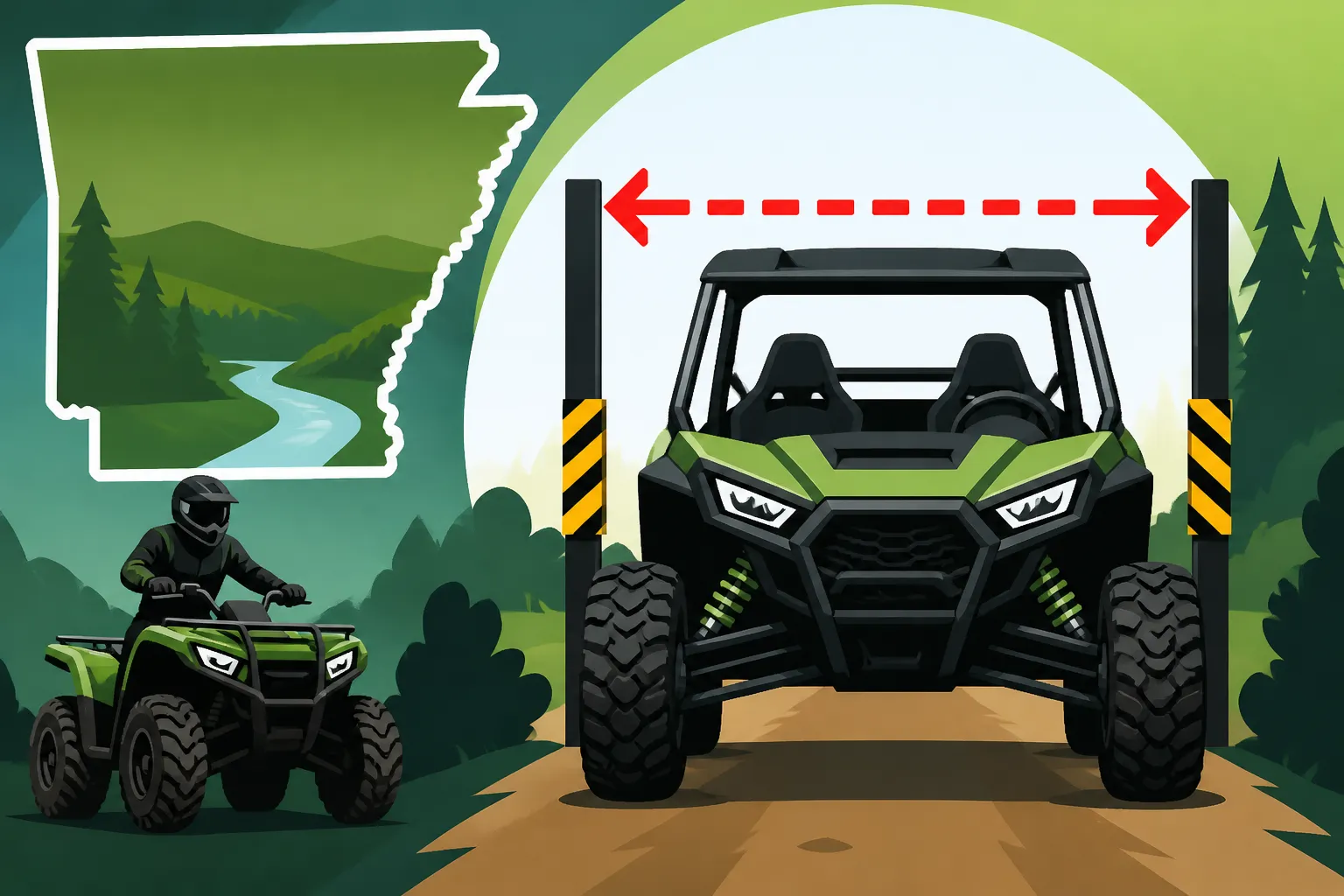
If your city has an 80-inch width cap, accurately measuring your UTV is absolutely essential. Don't just rely on the manufacturer's specifications, especially if you've made any modifications. The measurement should be taken from the widest point of the vehicle, which almost always means from the outside edge of one tire to the outside edge of the other tire. This includes any part of the tire tread, sidewall, or even protruding lug nuts.
Here’s a step-by-step guide to measuring your UTV:
- Park on a Level Surface: Ensure your UTV is on flat ground to get an accurate, unskewed measurement.
- Use a Long Tape Measure: A standard household tape measure might not be long enough. A construction tape measure or even a string that you can then measure is ideal.
- Measure Tire-to-Tire: Place the end of the tape measure against the outermost edge of one front tire. Extend it straight across to the outermost edge of the opposite front tire. Do the same for the rear tires. Take the larger of the two measurements.
- Consider Accessories: If you have any aftermarket accessories that protrude beyond your tires, such as wheel spacers, wider A-arms, rock sliders, or even certain fender flares, these might need to be included in your "widest point" measurement. For instance, if you've added wider wheels or a lift kit with wider stance components from a company like SuperATV, you absolutely need to re-measure. A modification that was great for the trails could make your machine non-compliant for street use.
Exceeding the 80-inch limit, even by an inch or two, can lead to a citation if a local law enforcement officer pulls you over. It's not worth the risk, so be precise with your measurements!
What the 80-Inch Cap Means for Riders
For riders, the 80-inch width cap has significant implications, primarily impacting your choice of machine and how you might outfit it. Many modern UTVs, especially popular sport models and some larger utility machines, can come from the factory very close to or even exceeding this 80-inch mark. Some of the wider, more aggressive sport UTVs might be 72 inches or even 77 inches wide, leaving little room for error if you add offset wheels or tire setups.
This cap means that if street legality is a priority for you, you need to consider vehicle width carefully when purchasing a new UTV or modifying an existing one. It might steer you towards more compact models or force you to be selective about aftermarket parts. Even if your town has passed an ordinance allowing UTVs on its streets and you have all the other required equipment, if your machine is too wide, it's still not compliant. The 80-inch cap is a hard limit, and there's no wiggle room.
Beyond Width: Other Key Requirements for Street-Permitted UTVs
While the 80-inch width cap is crucial, it's just one piece of the puzzle. Cities that allow UTVs on their streets typically impose a range of other requirements to ensure safety and conformity with standard vehicle regulations. Failing to meet any of these can be just as problematic as being too wide.
Essential Equipment for Street Riding
To be truly street legal in a town that allows it, your UTV will need to be equipped similarly to a low-speed vehicle or even a standard car in some respects. The common list of mandatory equipment includes:
- Headlights: Must be operational and provide sufficient illumination.
- Taillights: Required for visibility from the rear.
- Brake Lights: Essential for signaling when you slow or stop.
- Turn Signals: [Arkansas Turn Signal Requirements for Street UTVs] are typically explicit, requiring front and rear indicators that flash to signal turns. Many UTVs don't come with these from the factory, so an aftermarket kit is often necessary.
- Horn: A functional horn for signaling other drivers or pedestrians.
- Mirrors: At least one rearview mirror, and often two (one on each side), is required. Check [Mirrors on a Side-by-Side] for specific guidance.
- Windshield: Often required, and sometimes it must be made of safety glass or a similar shatter-resistant material.
- Seatbelts: For all occupants, matching the number of seats.
- Spark Arrestor: While primarily for off-road use to prevent fires, a functional exhaust system is a given for any street-legal machine.
Companies like SuperATV offer comprehensive street-legal kits that bundle many of these necessary components, making it easier for riders to bring their UTVs into compliance with local ordinances. These kits are often designed to be relatively straightforward to install, addressing multiple requirements at once.
Driver Licensing, Insurance, and Permits
Operating a street-legal UTV isn't just about the machine; it's also about the operator. Most local ordinances will require the driver to possess a valid driver's license, meaning no provisional licenses or learner's permits. Generally, this means the driver must be at least 16 years old. For detailed information, you'll want to review [Arkansas Driver's License at 16 for Street UTVs]. This is a common-sense requirement, as you're sharing the road with licensed drivers in other vehicles.
Furthermore, insurance is almost always a prerequisite. Just like with your car, if you're involved in an accident on public roads, you'll need liability coverage at a minimum. Cities will often specify the minimum coverage levels they expect. Make sure to check [Arkansas Insurance for a Street-Permitted UTV] and confirm with your insurance provider that your policy covers UTV use on public roads, as some off-road policies may not extend to street legal operation.
Finally, even after equipping your UTV and having the right license and insurance, you'll likely need a local permit. Many cities that allow UTVs on their streets require an annual permit or sticker that must be visibly displayed on the machine. There's often an associated fee, which helps cover administrative costs and perhaps local road maintenance. Look into [Arkansas UTV Street Permits and Annual Fees] for specifics, as these permits usually need to be renewed each year.
Road Types and Speed Limits
Just because a city allows UTVs doesn't mean you can drive them anywhere. Local ordinances often come with very specific restrictions on which roads are accessible. The most common limitation is on speed: UTVs are typically only permitted on streets with posted speed limits under 55 mph. [Arkansas Streets Under 55 mph for UTVs] is a common clause in these ordinances, designed to keep UTVs off high-speed arterial roads where they might be a hazard.
Moreover, certain types of roads, particularly multi-lane highways, are almost always off-limits. For instance, [Arkansas Four-Lane Streets Stay Closed] to UTVs, regardless of the local ordinance. This is a safety measure, as UTVs are not designed for the sustained speeds and traffic volumes of multi-lane state highways.
It's also worth noting that different towns might have wildly different approaches. You might find a town like Bono with specific rules like [Bono's Street Rules for UTVs in Arkansas], outlining permitted streets and times, while a neighboring community might have a strict ban, such as [Cotter's Ordinance Banning ATVs in Arkansas]. Understanding these nuances is critical for legal riding.
Navigating Local Ordinances and Staying Informed
The decentralized nature of UTV road laws in Arkansas means that staying informed is an ongoing responsibility for riders. It’s not a one-and-done check; rules can evolve, and ignorance is rarely an acceptable defense.
How to Research Your Local Town's Rules
The absolute best way to understand the UTV rules in a specific Arkansas town is to go straight to the source. Don't rely on hearsay or what a friend of a friend heard. Here's how to get the most accurate information:
- Contact the City Clerk's Office: This is usually your first and best point of contact. The city clerk is responsible for maintaining all official city records, including ordinances. They can tell you if an ordinance exists, provide you with a copy, and explain its key provisions, including any width caps, equipment requirements, or restricted roads.
- Check the City's Official Website: Many cities now publish their municipal code and ordinances online. Look for sections related to "vehicles," "traffic," or "off-road vehicles." A quick search might reveal the full text of the ordinance.
- Consult Local Law Enforcement: While the city clerk has the official documents, local police or sheriff's deputies are the ones who enforce these rules on the street. They can provide practical insights into enforcement, though it's always best to verify specific legal points with the city clerk.
Remember, [Reading Your Town's Ordinance Before You Ride] isn't just a suggestion; it's a necessity. These rules are hyper-local, meaning they can vary significantly from one jurisdiction to the next, even between adjacent towns. An ordinance passed last year might be amended or repealed this year, so it pays to stay current.
What Happens When You Ride Between Two Towns
The reality of this patchwork of regulations becomes especially clear when you consider riding your UTV across municipal boundaries. What if you live in a town that allows UTVs but want to visit a store in a neighboring town that doesn't? Or what if both towns allow them, but with different width caps or equipment requirements?
This scenario highlights the challenges of [Riding Between Two Towns]. As soon as you cross into a jurisdiction without a permissive ordinance, or one with stricter rules your machine doesn't meet, you are immediately in violation of the law. There's no grace period or "I didn't know" exemption. It's like driving from a state where you don't need a front license plate into one where you do – the rules change the moment you cross the line. This means you must know the ordinances for every city or town that your intended route traverses. For many riders, this complexity can lead them to simply avoid street riding outside of their immediate municipality or choose routes that stay entirely within compliant zones.
Potential Penalties for Non-Compliance
Operating a UTV on public roads in Arkansas without adhering to all state and local regulations can lead to a variety of consequences. The most immediate is a citation from law enforcement. [Arkansas Penalties for Illegal Road Riding] can include fines, which can add up quickly, especially if court costs are factored in. These fines might be comparable to minor traffic infractions, but they are still a hassle and an expense you want to avoid.
In more severe cases, or for repeat offenses, an officer might have the authority to impound your UTV. This means your machine is towed and stored at your expense, adding towing fees, storage fees, and the headache of retrieval to your troubles. Beyond legal penalties, there's also the risk of an accident. If you're involved in a collision while operating a non-compliant UTV, your insurance might deny coverage, leaving you financially responsible for damages and injuries. It's a risk that far outweighs the convenience of taking a shortcut down a restricted street.
Disclaimer
This article is for general informational purposes only and does not constitute professional advice. Laws, prices and regulations vary by location and change over time. Consult a qualified professional for guidance on your specific situation.