Arkansas Court Costs for a Riding Citation
It's incredibly frustrating to be out enjoying the Arkansas backroads or trails on your ATV or UTV, only to find yourself facing a riding citation. What often follows is a bewildering maze of court appearances, paperwork, and perhaps the most confusing part: understanding exactly what "court costs" entail. This guide aims to clear up that confusion, breaking down the typical components of these costs and what you can expect when dealing with a citation for off-highway vehicle (OHV) riding in Arkansas.
Understanding the Initial Citation and the 'Fine' Versus 'Costs' Confusion
When an Arkansas law enforcement officer hands you a citation for an ATV or UTV violation, it's easy to look at the "fine" amount and think that's the whole story. But often, the stated fine is just one piece of a much larger financial puzzle. The justice system, like any system, has its own operational expenses, and these are often passed on to those involved in court proceedings, regardless of the severity of the infraction. This distinction between the "fine" and "court costs" can catch many riders off guard, leading to unexpected expenses.
The Difference Between a Fine and Court Costs
Let's clarify what each of these terms truly means in the context of an Arkansas ATV or UTV citation. The fine is essentially the punitive monetary penalty assessed for violating a specific law or ordinance. For instance, if you're cited for operating your UTV on a public road where it's prohibited, the local ordinance or state statute will prescribe a specific fine amount for that offense. This is the amount intended to punish the act itself.
Court costs, on the other hand, are the various fees and charges levied by the court system to cover administrative expenses. These are not directly tied to the severity of your violation but rather to the process of handling your case. Think of them as the service charges for the justice system. These costs can include things like processing fees, docket fees, judicial administration fees, victim compensation fund contributions, and even fees for maintaining court records. They are often statutory, meaning state law dictates certain minimums or types of fees that must be collected, and local jurisdictions can add their own. It’s crucial to understand that even if a judge reduces your fine or dismisses parts of your case, court costs are almost always still assessed, and sometimes they can even exceed the initial fine amount, which can be a real shocker for folks.
Common Scenarios Leading to a Citation
Riders in Arkansas can face citations for a variety of reasons, especially when it comes to navigating public roads and properties. One of the most frequent scenarios involves operating an ATV or UTV on a public road where it is explicitly forbidden. While [Arkansas's Six Statutory Road Exceptions] do exist for specific circumstances like farming or hunting operations, or direct ninety-degree crossings, many riders mistakenly believe these apply to recreational cruising. Without a local ordinance specifically opening streets to UTVs, as some towns like Bono have done, riding on county roads or state highways can quickly lead to a ticket. You might be pulled over simply for driving your side-by-side down a main street to get gas or reach a friend's house, not realizing you're in violation.
Another common issue arises from modifications made to machines. If a local ordinance does allow street-legal UTVs, it often comes with a list of required equipment, such as turn signals, mirrors, or specific lighting. A machine that isn't properly equipped, even if the town generally allows UTVs, could result in a citation for equipment violations. Imagine you've outfitted your UTV for trail riding, perhaps with a lift kit and aggressive tires, but haven't considered road-specific accessories. If you then venture onto a street in a town that requires those features, you could be cited. Ignorance of the law, unfortunately, is rarely a valid excuse in court, and the sheer complexity of local ordinances and state statutes regarding OHVs can make it a real challenge for even the most well-intentioned rider to stay fully compliant.
Breaking Down Typical Arkansas Court Costs for a Riding Citation
When you receive a riding citation in Arkansas, the process isn't just about paying the base fine. There's a labyrinth of fees that often accompany it, each with its own purpose and contributing to the overall cost. These fees are not arbitrary but are typically mandated by state law or local county and city ordinances, designed to fund various aspects of the justice system and state programs.
State-Mandated Fees and Surcharges
Arkansas has several state-mandated fees and surcharges that are often added to a conviction, even for minor traffic or OHV infractions. These can include:
- Judicial Administration Fees: These are statewide fees that help fund the administration and operation of Arkansas's judicial system. Every court case, no matter how small, contributes to this fund.
- Victim Compensation Fund Surcharge: This is a small but important fee that goes towards the state's victim compensation fund, which provides financial assistance to victims of violent crimes. While your ATV citation might seem unrelated, this surcharge is often applied across many types of convictions.
- Court Automation Fund Fees: Many courts, both state and local, have transitioned to electronic record-keeping and case management systems. A portion of court costs often goes to maintaining and upgrading these essential technological infrastructures.
- Law Enforcement Training Fund Surcharge: Sometimes, a portion of the citation revenue contributes to funds dedicated to training and continuing education for law enforcement officers across the state.
These state-level additions mean that no matter where you get your citation within Arkansas – be it in a small municipal court in the Ozarks or a district court in a larger city – you're likely to see these components on your total bill. They represent a baseline cost of engaging with the legal system. It's not just about the specific law you broke; it's about the machine of justice itself.
Local Court Fees and Administrative Charges
Beyond the state-mandated fees, individual counties and municipalities in Arkansas often add their own specific local court fees and administrative charges. These vary widely and can be a significant part of your overall cost. Local courts need to cover their own operational expenses, from clerk salaries to maintaining the courthouse building.
These can include:
- Docket Fees: A fee for placing your case on the court's calendar.
- Clerk Fees: Charges for the services provided by the court clerk, such as filing paperwork, processing payments, and maintaining records.
- Service Fees: If you were served with papers or a summons, there might be a fee associated with that service.
- Bond Fees: If you had to post a bond for any reason, there might be associated administrative fees, though this is less common for a simple riding citation unless you failed to appear.
- Local Ordinance Surcharges: Some cities or counties may have specific surcharges on certain types of violations to fund local programs or initiatives. [Arkansas UTV Street Permit Cost in a City] might give you an idea of what local governments consider reasonable for permits, which can sometimes mirror the fees seen in citations.
The exact breakdown of these fees will be specific to the court handling your citation. For example, if you're cited in Garland County versus Washington County, the local components of your court costs could be quite different. It truly depends on the specific jurisdiction and its local ordinances. When you receive your citation, you might not see an itemized list, but rest assured, the clerks at the court office will be able to provide one if you ask.
Additional Costs: Driver's Education, Restitution, or Community Service
Sometimes, beyond the fine and standard court costs, a judge might impose additional penalties or requirements that come with their own financial implications. These are often tailored to the circumstances of the case or as a way to address broader community concerns.
- Driver's Education or Safety Courses: For some ATV or UTV violations, especially those involving reckless behavior or if the rider is young, a judge might mandate completion of a certified OHV safety course. While the course itself isn't a "court cost," the enrollment fee for such a course (which can range significantly) becomes a required expense to fulfill the court's order. This is often seen as an educational component, aimed at preventing future incidents.
- Restitution: If your riding activity caused damage to private property – for example, tearing up a farmer's field, damaging public lands, or knocking over a fence – the court might order you to pay restitution to the property owner. This amount would be determined by the cost of the damages and would be paid through the court, separate from your fine and court costs. This can be a substantial sum, depending on the extent of the damage.
- Community Service Conversion: In some cases, a judge might allow you to convert a portion of your fine or court costs into community service hours. While this doesn't involve direct cash payment, it does represent a significant investment of your time. If you miss your assigned community service hours, the original financial penalty might be reinstated, along with potential additional penalties for non-compliance. It's a trade-off: your time for your money.
It's important to remember that these additional costs are not universal but are often discretionary, depending on the specific judge, the nature of the offense, and any mitigating or aggravating circumstances presented in your case. They underscore the importance of understanding the full scope of potential consequences when dealing with an ATV or UTV citation.
Here's a simplified, hypothetical breakdown of how a riding citation's costs might look, illustrating the difference between the fine and various fees. Please remember, these are illustrative and not actual figures, as costs vary widely by jurisdiction and specific circumstances:
| Cost Type | Description | Example (Illustrative, Not Actual) |
|---|---|---|
| Base Fine | Monetary penalty for the specific violation (e.g., illegal road riding). | Varies widely by specific offense and jurisdiction. |
| State Judicial Admin Fee | Funds the statewide court system. | Percentage of fine or flat fee. |
| Victim Compensation Surcharge | Contributes to state fund for crime victims. | Small, flat surcharge. |
| Court Automation Fee | Supports court technology and electronic records. | Small, flat fee. |
| County/City Docket Fee | Fee for processing the case on the local court's calendar. | Varies by local jurisdiction. |
| County/City Clerk Fee | Administrative costs for clerk services (filing, payments). | Varies by local jurisdiction. |
| Total Court Costs | Sum of all fees and surcharges, excluding the base fine. | Can be significant, often exceeding the fine. |
| Grand Total Due | Base Fine + Total Court Costs | Entire amount you'd pay. |
Navigating the Payment Process and Potential Consequences
Receiving an ATV or UTV citation can feel overwhelming, but understanding the process for handling it – from payment options to the repercussions of non-payment – is crucial. Ignoring the problem will only make it worse, leading to increased costs and more severe legal issues.
Options for Paying Your Citation
Once you've received an ATV or UTV citation in Arkansas, you'll generally have a few avenues for resolving it, depending on the issuing jurisdiction and the nature of the offense. Most minor violations, often those where you simply pay the fine and court costs without needing to appear before a judge, offer several payment methods:
- Online Payment: Many municipal and district courts in Arkansas now offer secure online portals where you can pay your citation with a credit or debit card. This is often the most convenient option, allowing you to resolve the matter from home, sometimes within a few days of receiving the ticket. You'll typically need the citation number and your date of birth or driver's license number to access your record.
- Mail-In Payment: For those who prefer traditional methods or live in areas with less digital infrastructure, mailing a check or money order is usually an option. The citation itself should provide an address where payments can be sent. Always make sure to include your citation number clearly on the check or money order to ensure it's applied correctly. It's also a good idea to send it certified mail if you're concerned about proof of delivery.
- In-Person Payment: You can always go directly to the court clerk's office during business hours to pay your citation. This allows you to pay with cash, check, or card and receive an immediate receipt. It's also an opportunity to ask the clerk any questions you might have about the breakdown of fees or upcoming court dates. They can be invaluable resources for understanding the specifics of your case.
- Payment Plans: In some situations, especially if the total amount of the fine and court costs is substantial, you might be able to request a payment plan from the court. This is not guaranteed and usually requires you to appear before a judge to explain your financial hardship and propose a payment schedule. If granted, failure to adhere to the plan could result in further penalties.
Always check the specific instructions on your citation for accepted payment methods and deadlines. Failing to pay by the due date or missing a scheduled court appearance can trigger significant additional problems, which we'll discuss next.
What Happens if You Don't Pay on Time
Ignoring an ATV or UTV citation in Arkansas can lead to a snowball effect of legal and financial woes. The consequences for non-payment or failure to appear in court are serious and often far more severe than the original penalty.
- Additional Fines and Fees: The most immediate consequence is usually the assessment of late fees and additional administrative charges. These can quickly inflate the total amount you owe, sometimes doubling or tripling the original sum. Courts operate on strict timelines, and they will penalize you for not adhering to them.
- Warrant for Arrest: For more serious infractions, or repeated failures to appear or pay, the court may issue a bench warrant for your arrest. This means that if you have any interaction with law enforcement – even a routine traffic stop – you could be arrested and taken into custody. This is a terrifying prospect that can disrupt your life, lead to bail costs, and leave you with a criminal record, depending on the underlying offense.
- License Suspension (for certain violations): While many ATV/UTV citations might not directly impact your driver's license if they were off-road, some violations, especially those involving operating on public roads without proper registration or in a reckless manner, can be linked to your driving record. Failure to resolve such a citation might result in the suspension of your state-issued driver's license. This is a severe consequence for anyone who relies on a vehicle for work or daily life.
- Collections and Credit Impact: Unpaid fines and court costs can eventually be sent to collections agencies, which will negatively impact your credit score. This can make it difficult to secure loans, rent housing, or even affect employment opportunities in the future. The court is often tenacious in collecting what is owed, and they have various legal mechanisms at their disposal.
- Increased Legal Complications: A simple ATV citation can become a complex legal headache if left unaddressed. You might find yourself needing to hire an attorney to resolve outstanding warrants or navigate license reinstatement, adding substantial legal fees to your already mounting debt. It's a prime example of how a small problem can quickly become a much larger one.
Seeking Legal Counsel and Challenging a Citation
While it might seem excessive for an ATV citation, there are absolutely times when seeking legal counsel is a wise decision. An attorney specializing in traffic or municipal law can be an invaluable asset, especially if you believe the citation was issued in error, if the penalties are severe, or if you simply don't understand the legal process.
An attorney can:
- Explain Your Rights and Options: The legal jargon on a citation or from a court clerk can be confusing. A lawyer can clearly explain the charges against you, the potential penalties, and all your available options, including whether challenging the citation is feasible.
- Negotiate on Your Behalf: Often, an attorney can negotiate with the prosecutor to reduce the fine, lower court costs, or even get the citation dismissed, especially if there are procedural errors or insufficient evidence. They understand the nuances of the law and how to present your case most effectively.
- Represent You in Court: If you decide to plead not guilty and contest the citation, a lawyer can represent you in court. This is particularly beneficial if the case is complex, involves witness testimony, or requires an understanding of specific statutes like [Arkansas ATV Road Rules: What 27-21-106 Says] or [Arkansas Towns Can Open Their Streets to UTVs]. Having professional representation can significantly improve your chances of a favorable outcome.
- Address Underlying Issues: Sometimes, a citation is just the tip of the iceberg. An attorney can help identify and address any underlying issues, such as clarifying [Arkansas Rules for Riding a County Road] or understanding specific local ordinances that might have led to the stop. They can also help you understand [What a Deputy Can Ask to See] during a stop and if your rights were violated.
If you decide to challenge a citation yourself, be prepared to do your homework. You'll need to understand the specific law you're accused of violating, gather any evidence (photos, witness statements), and be ready to present your case clearly and respectfully to the judge. Whether you hire an attorney or represent yourself, approaching the situation proactively and knowledgeably is always the best strategy to minimize the long-term impact of a riding citation.
Minimizing Your Risk: Riding Legally in Arkansas
The best way to avoid the stress, fines, and court costs associated with an ATV or UTV citation in Arkansas is, of course, to ride legally and responsibly. Understanding the rules, both state and local, and ensuring your machine is compliant can save you a world of trouble.
Knowing Arkansas's Road Rules and Exceptions
Arkansas's laws regarding ATVs and UTVs on public roads can be a bit of a patchwork, creating confusion for even seasoned riders. The general rule is that ATVs and UTVs are not street legal on public roads in Arkansas. However, there are crucial exceptions and variations you need to be aware of:
- State Law Exceptions: State law (specifically Arkansas Statute 27-21-106) provides six specific exceptions where an ATV or UTV can legally operate on public roads. These include [Arkansas Farming Operation Road Use], [Arkansas Hunting Operation Road Use], for utility company employees, law enforcement/EMS, state parks employees, and for direct crossings of a highway at a ninety-degree angle after coming to a complete stop. These exceptions are very specific and don't grant broad permission for recreational road riding.
- Local Ordinances for UTVs: A significant change in Arkansas law allows individual cities and counties to pass ordinances permitting UTVs (but typically not ATVs) on certain public streets. This means what's legal in one town might be illegal in another just a few miles down the road. For example, Bono, Arkansas, was one of the first to implement such an ordinance, while Cotter, Arkansas, explicitly bans ATVs on its streets. It's critical to research [Arkansas UTV Street Legal Rules by Town] for any area where you plan to ride on streets. [Reading Your Town's Ordinance Before You Ride] is not just a suggestion; it's a necessity.
- Crossing Highways: Even with an exception, you must follow strict rules for [Crossing a Highway on an ATV in Arkansas]. This generally means coming to a complete stop before entering the roadway and crossing directly, usually at roughly a ninety-degree angle, to get to another private property or trail access point. You cannot ride down the highway for any significant distance, even to turn.
- County Roads vs. State Highways: While some county roads might feel less regulated, state law generally applies equally to them. The exceptions and local ordinances are the primary factors in determining legality. [Arkansas Rules for Riding a County Road] are generally the same as for other public roads unless a specific local ordinance overrides them.
Always assume that public roads are off-limits unless you have explicit confirmation otherwise, either through a specific state exception that applies to your situation or a local ordinance that opens streets to UTVs. A quick call to the city clerk's office or sheriff's department in an unfamiliar area can save you a citation and all the associated costs.
Outfitting Your Machine for Compliance
If you live in an area where local ordinances allow UTVs on specific public streets, you'll likely need to modify your machine to meet specific equipment requirements. These requirements are put in place for safety and to make UTVs more visible and predictable in traffic. Ignoring these can lead to equipment violation citations, even if you're otherwise legally on the road.
Common equipment requirements for street-legal UTVs where allowed by local ordinance often include:
- Headlights and Taillights: These are universal for night visibility, but some ordinances might specify minimum brightness or position.
- Brake Lights: Essential for signaling stops to traffic behind you.
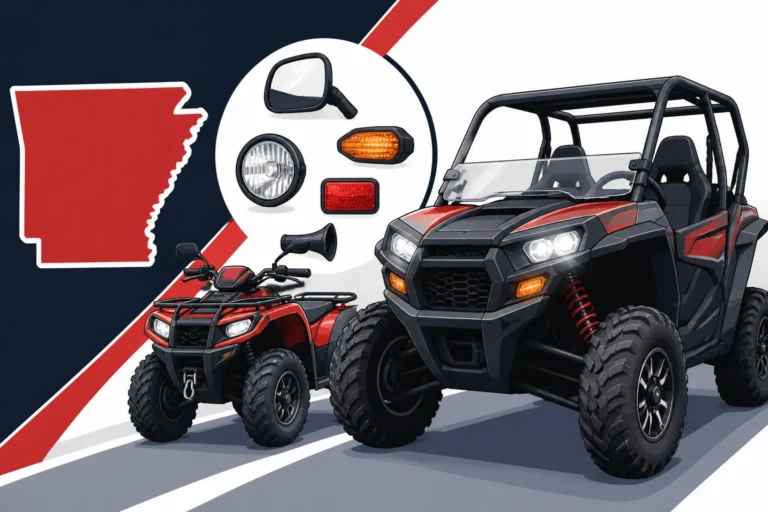
- Turn Signals: Often required, even if your UTV didn't come with them from the factory. Companies like SuperATV offer a wide range of aftermarket turn signal kits specifically designed for various UTV models, making it easier to meet this requirement.
- Horn: A signaling device to alert others.
- Rearview Mirrors: Typically at least one, but often two (one on each side). Again, SuperATV is a great resource for robust, off-road-ready mirrors that can withstand trail riding while also providing street legality.
- Windshield: Some ordinances may require a full windshield made of safety glass.
- Seatbelts: Always a good idea for safety, but often a mandatory requirement for street use.
- License Plate or City Permit Display: While Arkansas doesn't issue ATV/UTV license plates, if your town has a UTV ordinance, they will almost certainly issue a special [Arkansas UTV Street Permit Cost in a City] sticker or decal that must be displayed prominently on your machine.
Beyond equipment, don't forget the administrative side:
- Registration: While ATVs in Arkansas have a one-time registration, UTVs generally follow the same rules as ATVs regarding registration if used on trails or for specific purposes. This registration is a decal, not a license plate, and does not make your machine street legal.
- Insurance: Many local UTV ordinances will mandate specific liability insurance coverage for any UTV operating on public streets. Always carry proof of insurance with you.
- Driver's License: The driver of a street-legal UTV will almost always be required to hold a valid state-issued driver's license.
Before spending money on accessories, always consult your local city or county clerk's office for a copy of their specific UTV ordinance to ensure you're meeting all the requirements. Investing in the right gear from reputable sources like SuperATV and understanding the specific rules for [Arkansas Equipment for a Street-Permitted Machine] can keep you safe, legal, and away from costly citations.
Disclaimer
This article is for general informational purposes only and does not constitute professional advice. Laws, prices and regulations vary by location and change over time. Consult a qualified professional for guidance on your specific situation.