Arkansas Gates That Stop 72-Inch Machines
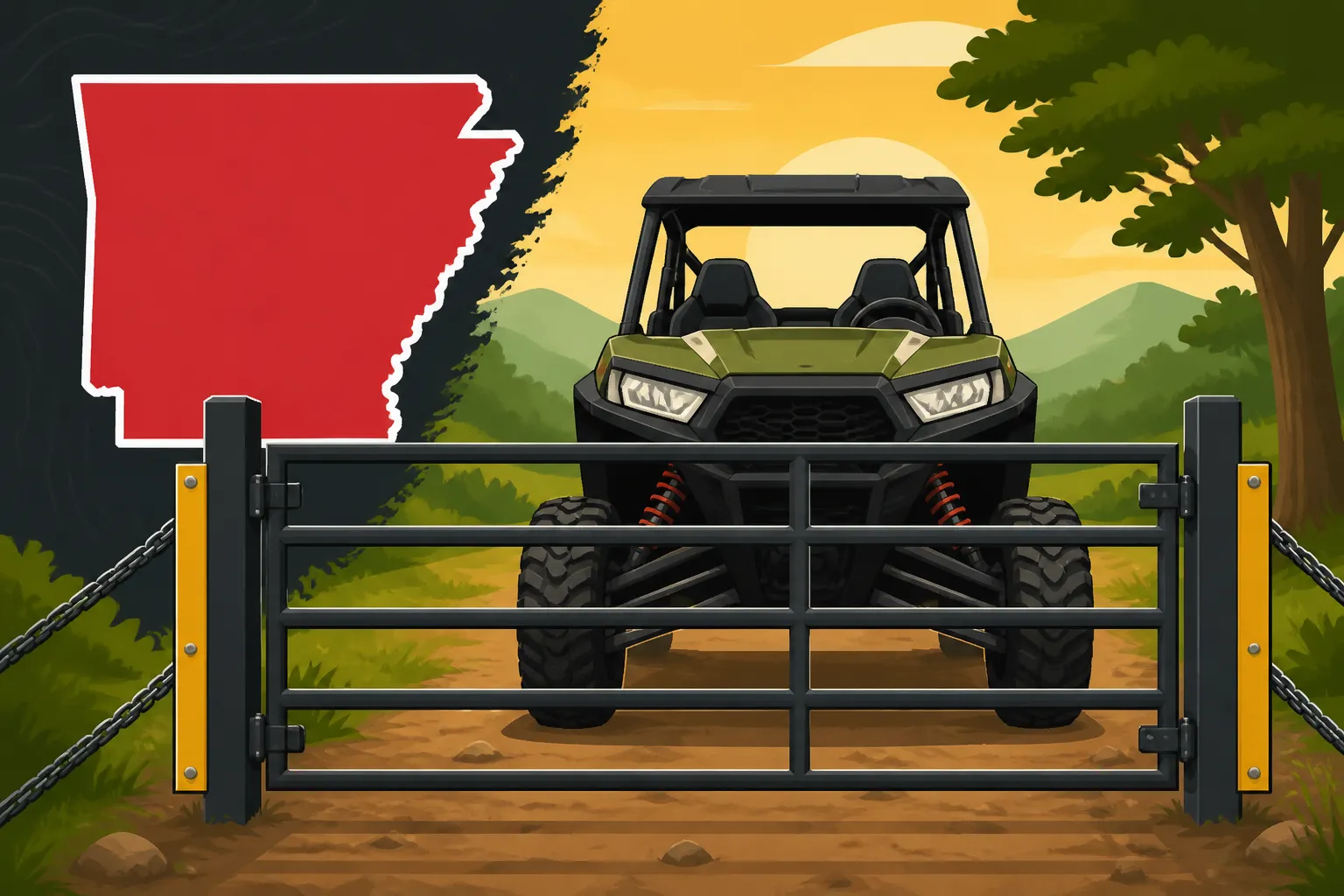
A 72-inch side-by-side can look like a perfect fit on paper and still be too wide for a trail gate once you account for mirrors, tires, and the gate’s actual opening. This guide explains how to think about Arkansas trail gates, what to check before towing to a riding area, and how to avoid discovering a width problem at the trailhead.
What a 72-inch trail gate does and does not tell you
A gate opening is not always a published vehicle-width limit
A narrow gate can keep larger machines off a trail, but its opening measurement and a trail’s official vehicle-width limit are not necessarily the same thing. A gate may be narrower than the route’s stated maximum, or it may leave little room for a machine advertised at the same width. Treat the physical barrier as a practical constraint, not as proof that every vehicle under a particular measurement is allowed.
That distinction matters when you are planning a trip with a 72-inch side-by-side. A published machine width generally describes the vehicle in a specified configuration. The space you need to pass safely may be affected by mirrors, aftermarket wheels, fender extensions, cargo racks, or how the gate is angled. A vehicle that measures close to the opening might technically line up but still have no safe margin for steering.
If a trail reference mentions gates around 72 inches, do not assume that a 72-inch machine will pass comfortably. Read the trail’s posted rules, look for a separate width restriction, and contact the managing office if the information is unclear. For a broader comparison of routes with restrictions, see [Arkansas ATV Trails With Width Limits] and [Arkansas ATV Trails That Allow Side-by-Sides].
The posted restriction and the physical opening both matter
The most useful planning question is not simply, “Is my machine 72 inches wide?” Ask two questions: “What is the trail’s permitted vehicle width?” and “Can my machine physically pass the access points on the route I intend to ride?” Both answers matter. A route could have a posted width limit that your machine meets, while a tight gate still makes access impractical.
Conversely, a gate that appears wide enough does not give permission to ride a vehicle that exceeds a posted restriction. Rules apply even when a machine can squeeze through. Trying to force a large side-by-side through a narrow opening can also damage a gate, scrape the vehicle, or leave you stuck where turning around is difficult.
For Arkansas riding, treat trail signs and the managing agency’s information as the authority on access. Use maps and rider reports to identify questions worth asking, not to override a closure or restriction on the ground. Trail layouts and access conditions can change, so check again shortly before you leave.
How to measure your machine before you go
Measure the widest part, not just the number in a brochure
Start with the manufacturer’s listed width, but do not stop there. Find the machine’s widest point in the configuration you will actually ride. Depending on the model and accessories, that could be the tires, fenders, mirrors, or another component. If you have changed the wheels or added accessories, the original specification may no longer describe your machine accurately.
Measure from the outermost point on one side to the outermost point on the other, with the vehicle on level ground and the tires set as they will be for the ride. If mirrors can fold safely and are designed to do so, note both the folded and normal riding width—but do not assume folding them makes an otherwise prohibited vehicle eligible for a route. Follow the trail’s stated method for measuring if one is provided.
It is also sensible to leave a clearance margin. A tape measure may show a vehicle barely under an opening, but a gate can have uneven ground, narrow posts, a hinge that projects into the path, or a tight approach angle. A few inches of theoretical clearance can disappear when you are steering around a rock or trying to keep a tire out of a rut.
Measure the gate and approach, not only the narrowest gap
If you can get reliable information about a gate, ask how its width was measured. The open space between posts is different from the distance between the gate panels when they are partly open. A gate may also require a turn immediately before or after it, which means the vehicle needs more room to maneuver than the opening measurement alone suggests.
A photo can help you spot a tight approach, but it rarely gives a dependable measurement. Camera angles distort scale, and a vehicle in a photo may be a different model or width from yours. If someone reports that a machine “fit,” ask which machine, whether it had aftermarket accessories, and whether it passed without contact or was squeezed through.
Do not try to widen a gate, remove a barrier, or drive around it. Gates are there to control access, protect the route, or prevent certain vehicles from entering. If the opening is too tight for your machine, turn around safely and contact the trail manager for clarification. Planning a legal alternative is much better than damaging property or getting stranded beyond a barrier.
| What to check | Why it matters | A sensible next step |
|---|---|---|
| Official trail width limit | A machine may physically fit but still exceed the allowed width | Find the rule for the specific route |
| Machine width in your current setup | Accessories and wheel changes can alter the original measurement | Measure the widest point on level ground |
| Gate opening and approach | Posts, hinges, turns, and uneven ground reduce usable clearance | Ask the managing office about tight access points |
| Current closures and conditions | Gates or route access can change | Check shortly before departure |
| Room to turn around | A blocked route may leave little safe space beyond the gate | Plan a turnaround or alternate route in advance |
Keep a record of your measurements
Write down the machine’s measured width and the details of the setup: model, tire size, mirrors, and any wide accessories. If you ride with friends, record each vehicle separately. “Our UTV is about 72 inches” is not precise enough when one machine has stock wheels and another has aftermarket offsets.
Photographs of the tape measure at the widest point can help when you call a ranger office or trail operator. Take clear pictures from above or straight across, and include the measurement. That does not replace an official decision, but it gives staff more useful information than a model name alone.
A compact note on your phone can also prevent confusion when you are comparing routes later. Keep the trail’s width rule, the source of the information, and the date you checked it together. This is especially helpful for a group trip: one person can share the verified details before everyone loads up.
Arkansas riding areas and width planning
Huckleberry Mountain deserves a specific pre-trip check
Huckleberry Mountain is a well-known riding area in the Ozarks, and its trail layout and access details deserve careful checking if you have a wide side-by-side. A reference to gates at the ends of a route is a reason to investigate the actual access conditions—not a guarantee that every machine near that width will pass. Confirm which entrance and trail segment you plan to use, and check the applicable width rules before towing there.
When you review information about [Huckleberry Mountain Trail in Arkansas], pay attention to the particular route, not just the trail system’s general reputation. A trailhead, loop, or connecting route may have different access details. A gate at one end can also matter differently from a barrier along a route where a rider might otherwise have room to turn around.
The trail system’s loops can make route planning more important, too. Before choosing one, consider whether your machine can pass every access point on the planned loop and whether you can retreat if a gate or closure blocks the way. The overview in [Huckleberry Mountain's Three Interconnecting Loops] can help frame your route research, while the details in [72 Inch Gates at Both Ends] point to the gate question that wide-machine owners should resolve directly before departure.
Do not assume every Arkansas trail has the same gate dimensions
Arkansas riding areas differ in terrain, management, and access controls. A machine that works well at one private off-road park may not be suitable for a narrow forest trail. Even routes in the same general region may have different restrictions, gate layouts, or seasonal access conditions.
That is why a statewide list of “gates that fit a 72-inch machine” would not be enough for safe planning. You need to match the vehicle to the exact trail, entrance, and route. If you are comparing options, use [Arkansas ATV Trails With Width Limits] as a starting point, then confirm the details with the land manager or park operator.
Also check whether your intended route is designed for side-by-sides at all. Some trails are narrower, more technical, or otherwise unsuitable for larger machines, regardless of whether a gate opening looks passable. [Arkansas Trails That Allow Side-by-Sides] is a useful companion topic when you are choosing a place to ride rather than just checking one barrier.
Compare trail types before committing to a destination
A private off-road park, a national forest route, and a designated OHV trail can have very different access arrangements. Private parks may publish vehicle rules and answer questions about their own gates. Public-land routes can involve agency rules, closures, and access points that are not controlled by a nearby business. Do not assume a trail operator can speak for an adjacent public route, or that one permit or rule applies everywhere.
When choosing between destinations, compare the machine restrictions, trail difficulty, access conditions, and the likelihood of finding an alternate route if a gate stops you. A route with a little more driving distance may be the better choice if it has a clearly documented width limit and an entrance suited to your machine.
If your group includes both quads and wide side-by-sides, confirm that the chosen area works for the widest vehicle. It is frustrating to arrive after a long tow and learn that only part of the group can ride. Agree on a backup plan before leaving home, especially if the trip depends on a single narrow access point.
How to verify gate and trail information
Start with the managing agency or park operator
The most reliable answer usually comes from the person or agency responsible for the specific road or trail. When you contact them, ask direct questions: Is the route open to my type of vehicle? Is there a posted maximum width? Are there narrow gates at the entrance or along the planned loop? Is there an alternate trailhead for wider machines?
Give them your actual measured width and identify the route by name or trail number if you know it. “Will a UTV fit?” can lead to a vague answer because UTVs vary widely. “My machine measures this wide at the tires, with these accessories; can it legally and safely use this entrance?” is much more useful.
Ask whether the answer applies to the whole route or just the entrance. Also ask whether a recent closure, maintenance project, or gate change affects access. If the information is uncertain, choose another route rather than treating a guess as permission.
Use maps as planning tools, not as permission
Digital maps can help you understand route connections, trailheads, and possible alternatives. onX Offroad can be useful for reviewing a planned route and keeping map information handy while you are organizing a trip. Still, a map layer cannot guarantee that a gate is open, measure its usable clearance, or replace posted rules.
Before relying on a mapped route, compare it with the land manager’s current information and any signs at the trailhead. Check that your selected route does not quietly connect to a segment with a different restriction. If you download a map for offline use, do it before leaving reliable service; cell coverage can be limited in parts of the Ozarks and Ouachitas.
onX Offroad may help you spot where to ask questions and how a route connects to nearby roads, but it should be treated as one planning resource among several. Keep an official map or written route information where available, and do not continue through a closed gate just because a digital track appears to go onward. For additional planning context, see [Arkansas ATV Trail Map Downloads].
Recheck conditions close to your ride date
A route that was open during a previous trip may be closed or altered later. Weather, maintenance, fire restrictions, seasonal management, and damage from heavy use can all affect access. A gate may be closed temporarily even when the trail is normally open, and a trailhead may have changed conditions since an older post or map update.
Make a final check shortly before you leave, especially if the trip requires a long drive or overnight stay. [Arkansas Trail Conditions Before You Tow] is a useful reminder to verify the basics before committing to the trip. If you are considering Wolf Pen Gap as an alternative, use [How to Check Wolf Pen Gap Trail Status] for the specific status-check process rather than assuming conditions match another riding area.
At the trailhead, read every sign before unloading. Signs may identify a route-specific width limit, a closure, or a condition that is not obvious from the parking area. If the information conflicts with something you saw online, follow the posted restriction and contact the manager for clarification before proceeding.
What to do if your machine cannot pass
Stop before the gate and avoid forcing the issue
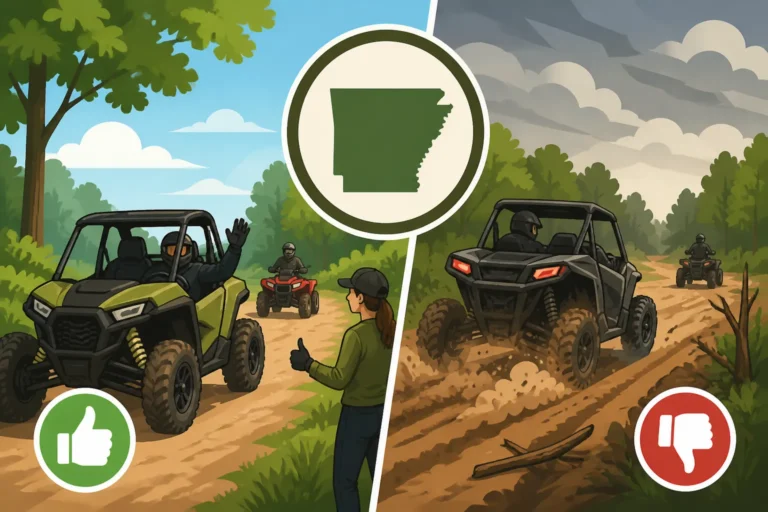
If your side-by-side looks too wide, stop well before the barrier and assess the situation safely. Do not build speed, climb a bank, or try to pass through at an angle that risks tipping or damaging the vehicle. A gate that leaves only a narrow gap is not an invitation to test whether the mirrors will fold or the tires will squeeze through.
Do not move, cut, unchain, or bypass a gate. Barriers may protect sensitive ground, separate vehicle classes, or mark a closed route. Riding around one can damage vegetation and create a new track, and it may put you on land or a route where vehicle use is prohibited.
If you are already beyond the barrier and discover another restriction, do not improvise a bypass. Turn around only where it is safe, ask for assistance if needed, and follow directions from the trail manager. If the gate is damaged or obstructed, report it rather than attempting repairs yourself.
Have an alternate destination or route ready
A good backup plan is a real destination, not simply “we’ll see what happens.” Before loading, identify another legal trail or riding area that accepts your machine’s width. Check its access rules, parking, permits, and current conditions so that you can make a practical change without scrambling for information at the gate.
For group rides, the widest machine should determine the route choice. A narrower quad may fit through a barrier that stops a side-by-side, but splitting up can create safety and communication problems. Decide together whether the group will switch destinations or choose a route suitable for every vehicle.
Finally, confirm the tow and staging arrangements for the backup area. Trailer parking, local road access, and distance between the parking area and trail entrance can all affect whether the alternative will work. Planning those details in advance is less exciting than packing the cooler, but it can save the whole weekend.
Disclaimer
This article is for general informational purposes only and does not constitute professional advice. Laws, prices and regulations vary by location and change over time. Consult a qualified professional for guidance on your specific situation.