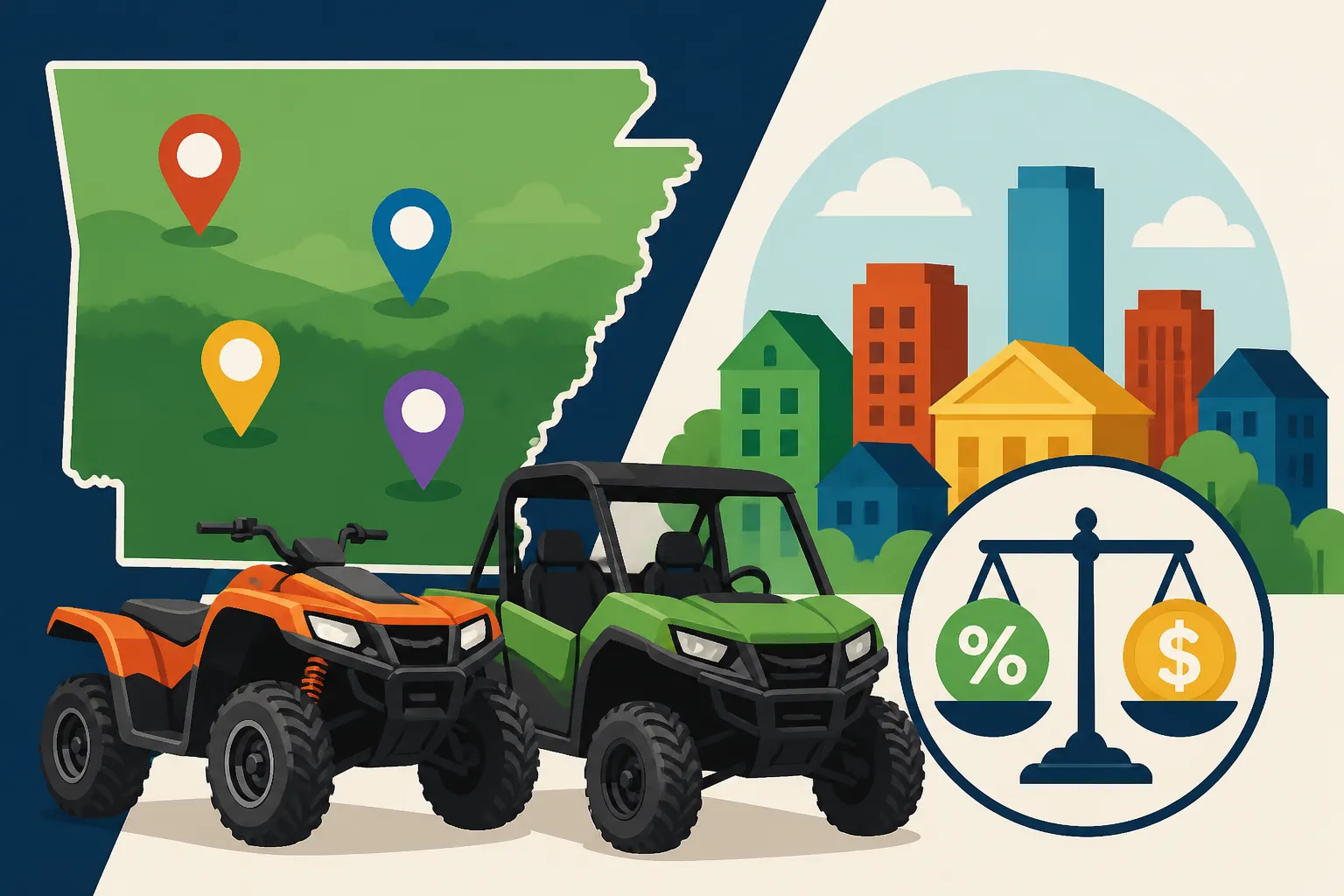
Arkansas Local Tax Rates That Vary by City
Buying an ATV or UTV in Arkansas is an exciting prospect, but when it comes to figuring out how much you'll actually pay, the sales tax can quickly turn that excitement into a headache. Many riders are surprised to learn that beyond the statewide sales tax, there's a whole other layer of local taxes that vary dramatically depending on where you make your purchase and even where you intend to register and use your machine. This guide aims to demystify the complex world of Arkansas local sales tax for ATVs and UTVs, helping you understand how these varying rates impact your final cost.
The Confusing Landscape of Arkansas Local Sales Tax on ATVs
Let's be honest, trying to understand sales tax can feel like navigating a maze blindfolded, and in Arkansas, it's particularly tricky because the rates aren't uniform across the state. You might walk into a dealership or meet a private seller, get a price for that shiny new (or new-to-you) quad, and then be hit with a sales tax figure that's much higher than you anticipated. This isn't just a state thing; it's often a combination of state, county, and city sales taxes all stacked on top of each other.
The biggest frustration here is the sheer inconsistency. Someone buying the exact same machine a few miles down the road, perhaps across a county line or in a different city, could pay a significantly different total sales tax. This isn't just a few pennies either; these local taxes can add hundreds of dollars to the final price of an ATV or UTV. It leaves many folks wondering if they should drive to a different town just to save on tax, which is a completely valid thought when you're looking to stretch your budget. It's a system that truly benefits from a bit of homework before you commit to a purchase.
Why Local Rates Vary So Much
The reason for these discrepancies boils down to local governance. Counties and cities in Arkansas have the authority to levy their own sales taxes to fund local services, infrastructure, and projects. These local taxes are then added to the statewide sales tax rate. So, while the state portion of the sales tax remains constant no matter where you are in Arkansas, the county and city portions are dynamic.
Think about it like this: your city might be investing in new parks, road improvements, or public safety services, and those funds often come directly from local sales tax collections. Another city nearby might have different priorities or a different tax base, leading them to set a lower or higher local sales tax rate. This localized approach, while beneficial for community development, creates a patchwork of rates that can be bewildering for consumers trying to calculate the true cost of their new machine. It's why two towns, seemingly close together, can have wildly different final sales tax percentages.
State Sales Tax: The Foundation
No matter where you are in Arkansas, the statewide sales tax is always applied to your ATV or UTV purchase. This is the baseline, the non-negotiable part of the equation. However, this state rate is only a piece of the puzzle. Understanding that this is just the beginning of your sales tax calculation is crucial. Many people mistakenly believe this is the only tax they'll pay, only to be surprised when the final bill arrives.
It's also important to remember that for ATVs and UTVs, [Arkansas Sales Tax With No Vehicle Tax Cap] means there's no limit to how much sales tax you'll pay based on the purchase price. Unlike some other vehicle categories, the full sales price is subject to taxation. This makes those varying local rates even more impactful, as they're applied to the entire purchase amount, no matter how high it goes. You can learn more about [Arkansas Sales Tax on an ATV Purchase] in our other articles.
How to Pinpoint the Exact Local Sales Tax Rate for Your ATV Purchase
Given the variation, simply guessing or relying on general information isn't going to cut it when you're budgeting for a new ATV or UTV. You need to know the specific combined rate that applies to your situation. This requires a bit of detective work, but thankfully, there are reliable ways to get the correct information. The goal is to avoid any nasty surprises at the registration office or dealership.
It's a common scenario: you find the perfect used quad in a neighboring county, or a great deal at a dealer a couple of hours away. You mentally add the state sales tax, but forget about the local components. When you go to [Registering an ATV at an Arkansas Revenue Office], or when the dealer does the paperwork, suddenly your total out-the-door cost jumps. Taking the time to research the local tax rate before you commit can save you a significant amount of money and stress.
Using Online Resources from the Arkansas Department of Finance and Administration
The most accurate place to find current sales tax rates is directly from the Arkansas Department of Finance and Administration (DFA). They typically provide online tools or publications that list the combined state, county, and city sales tax rates for every jurisdiction in Arkansas. This is your go-to source for reliable, up-to-date information.
These resources are designed to help taxpayers and businesses, but they're equally valuable for consumers. You'll usually be able to search by specific city name, zip code, or county to see the breakdown of the total sales tax rate. This will show you the state percentage, the county percentage, and any applicable city percentage, which all add up to your total [Arkansas Local Sales Tax on a Machine]. Make sure you're looking at the sales tax rates, as other types of taxes exist. This way, you can accurately calculate the full sales tax on your [Arkansas Sales Tax Rate on a Quad] before you buy.
Checking With the Dealership or Seller
If you're buying from a licensed dealer, they are legally required to collect and remit the correct sales tax. They should be able to tell you the exact combined sales tax rate that applies to your purchase. When they calculate your final price, the sales tax will be clearly itemized. Don't hesitate to ask them to break down the state, county, and city portions for clarity.
However, if you're buying from a private seller, the responsibility often shifts to you to correctly calculate and pay the sales tax when you register the machine. This is where your research with the DFA resources becomes critical. A private seller might not even know the intricacies of local sales tax, or they might mistakenly tell you only the state rate applies. Always do your own verification, especially for a private sale, to avoid issues when you get to the revenue office. For private sales, having a proper [Arkansas ATV Bill of Sale Requirements] can sometimes help clarify the purchase price for tax assessment.
Understanding the Components: State, County, and City
Let's break down how these layers stack up. Imagine you're looking at a machine, and you've found the relevant tax information. It might look something like this:
| Taxing Authority | Rate Example (Hypothetical) | Notes |
|---|---|---|
| State of Arkansas | 6.5% | Applies statewide to all purchases. |
| County A | 1.0% | Varies by county; some counties have no local tax. |
| City B | 1.5% | Varies by city; some cities have no local tax. |
| Total Combined Rate | 9.0% | This is what you'd pay on the purchase price. |
As you can see, even a few percentage points added by local jurisdictions can significantly increase the total. If you're buying a $10,000 ATV, a 9% combined rate means $900 in sales tax, whereas if you were in an area with just the state 6.5% rate, you'd pay $650. That's a $250 difference! This table shows why it's so important to know the specific rates for your purchase.
Navigating Local Sales Tax: Purchase Location vs. Residency
This is where things can get a little complex and often lead to confusion for ATV and UTV buyers. Does the sales tax rate apply based on where you buy the machine, or where you live and will eventually register it? In Arkansas, for most vehicle purchases including ATVs, the sales tax is generally determined by the point of sale for dealer transactions, or the buyer's county of residence for private sales where the buyer remits the tax directly. But there are nuances.
This particular detail often catches people off guard. You might intentionally buy in a rural county with a lower combined sales tax, thinking you've found a loophole. Or, conversely, you might buy from a dealer in a high-tax city but live somewhere with a much lower rate. Understanding which local rates apply to your specific transaction is key to avoiding overpayment or, worse, underpayment which could lead to penalties later. The rules around [Arkansas Use Tax on a Machine Brought Home] can sometimes apply if you bring a machine from out-of-state or have a unique situation.
Sales Tax for Dealer Purchases
When you buy an ATV or UTV from a licensed dealer in Arkansas, that dealer is responsible for collecting the appropriate sales tax. Generally, this means they will collect the state, county, and city sales tax rates that apply to their business location. So, if the dealership is located in "XYZ City," you'll pay the combined state, county, and city sales tax rate for XYZ City, regardless of where you, the buyer, live.
This simplifies things for the buyer in some ways, as the dealer handles the calculation and remittance. However, it also means that if you're trying to minimize your sales tax, you might consider shopping at dealerships located in areas with lower overall combined sales tax rates. Just be sure to verify the rates for their specific address, as even dealerships within the same metropolitan area but in different towns could have different rates. [Dealer-Collected Tax Versus Office-Collected] can explain this further.
Sales Tax for Private Sales and Registration
This is where the rules often shift. If you purchase an ATV or UTV from a private seller in Arkansas, the sales tax is typically paid by you, the buyer, directly to the Arkansas Department of Finance and Administration when you go to register the machine. In this scenario, the sales tax is usually calculated based on the sales tax rates of your own county and city of residence.
So, for example, if you live in "ABC City" (which has a county and city sales tax) but you buy a used quad from a private seller in "Rural Township" (which might only have a county sales tax, or no local tax at all), you would still owe the state sales tax plus ABC City's county and city sales tax rates when you register it. This is a crucial distinction and one that can lead to unexpected costs if you haven't budgeted for your local rates. Always be prepared to pay the sales tax that applies to your address when buying from a private party. You can read more about [Buying From a Private Seller in Arkansas] to understand the process.
The Real Impact of Local Sales Tax on Your ATV Budget
It's easy to overlook the sales tax when you're caught up in the excitement of a new ATV or UTV. But as we've seen, those local sales tax rates, when combined with the state rate, can add a substantial amount to your total out-of-pocket expenses. This isn't just a minor line item; it can be hundreds, sometimes even thousands, of dollars depending on the purchase price of your machine. Understanding this impact upfront is essential for responsible budgeting.
Many people think only about the price of the machine itself, maybe adding in registration fees, but often forget to accurately account for the total sales tax. This can lead to financial strain or having to cut corners elsewhere in your budget, like on essential accessories or riding gear. Being informed means you can make better purchasing decisions and truly understand your [Arkansas ATV Registration Cost].
Budgeting for the Total Cost
When you're planning your ATV or UTV purchase, don't just look at the sticker price. Build a realistic budget that includes all potential costs. Here’s a simple checklist:
- Purchase Price: The agreed-upon cost of the ATV/UTV.
- Sales Tax: This is where the local rates come in. Calculate the combined state, county, and city sales tax based on the appropriate location (dealer's location or your residence, as discussed). For example, if your chosen city's combined rate is 8.5% and the machine costs $12,000, you're looking at $1,020 in sales tax. You'll need to know what [Invoice Totals and What Gets Taxed].
- Registration Fees: Arkansas has a one-time registration fee for ATVs. While not usually a huge sum, it's still an added cost. Find out more about [What Arkansas Charges to Register an ATV].
- Dealer Fees (if applicable): If buying from a dealer, they may have additional documentation fees or processing charges. These vary widely.
- Accessories & Gear: Helmets, gloves, riding boots, cargo boxes, winches – these can add up quickly.
By considering all these factors, you get a clear picture of the true cost of getting your machine ready to ride.
Comparing Costs Across Jurisdictions
Once you understand how local sales taxes work, you can strategically compare prices. If you're buying from a dealer, and there are multiple dealerships selling the same model, it might be worth looking at the total out-the-door price from dealers in different cities or counties. A dealership in a rural area with a lower local tax might offer a better overall deal, even if their advertised machine price is similar to one in a higher-taxed urban area.
This comparison isn't about evading taxes, but rather making an informed consumer decision within the legal framework. You're simply choosing to make your purchase in a location that offers a lower legal combined sales tax rate. It's a smart financial move that many savvy buyers employ, especially for larger purchases like vehicles. Keep in mind, however, that the cost of driving to a far-off dealer for a marginal tax saving might not always be worth it, so calculate the total difference.
The Paperwork and Payment Process
Whether you buy from a dealer or a private seller, you'll eventually interact with the Arkansas Department of Finance and Administration (DFA) or a local revenue office. If you're buying from a dealer, they will typically handle the sales tax collection and remittance, and you'll pay it directly to them. They'll give you documentation showing the sales tax paid, which you'll need for registration. For more on this, check out [Paying Tax at the Counter].
If you buy from a private party, you'll be responsible for bringing your proof of purchase (like a bill of sale) and payment for the sales tax to the revenue office when you go to register the machine. They will then calculate the sales tax based on the purchase price and your residential address. Be prepared with the correct forms and payment methods to make the process smooth. [Arkansas Registration Paperwork Checklist] can help you prepare everything you need.
Disclaimer
This article is for general informational purposes only and does not constitute professional advice. Laws, prices and regulations vary by location and change over time. Consult a qualified professional for guidance on your specific situation.