Arkansas Riders Need Two Different Forest Passes
Arkansas riders can travel between the Ouachita and Ozark-St. Francis National Forests and assume one forest pass covers both. It doesn’t. The two forests use separate off-highway vehicle permit systems, and an Arkansas registration decal or out-of-state paperwork is not a substitute for either one. Here’s how to tell which pass you need, where it applies and what to check before unloading.
Why Arkansas riders need to think about two forest passes
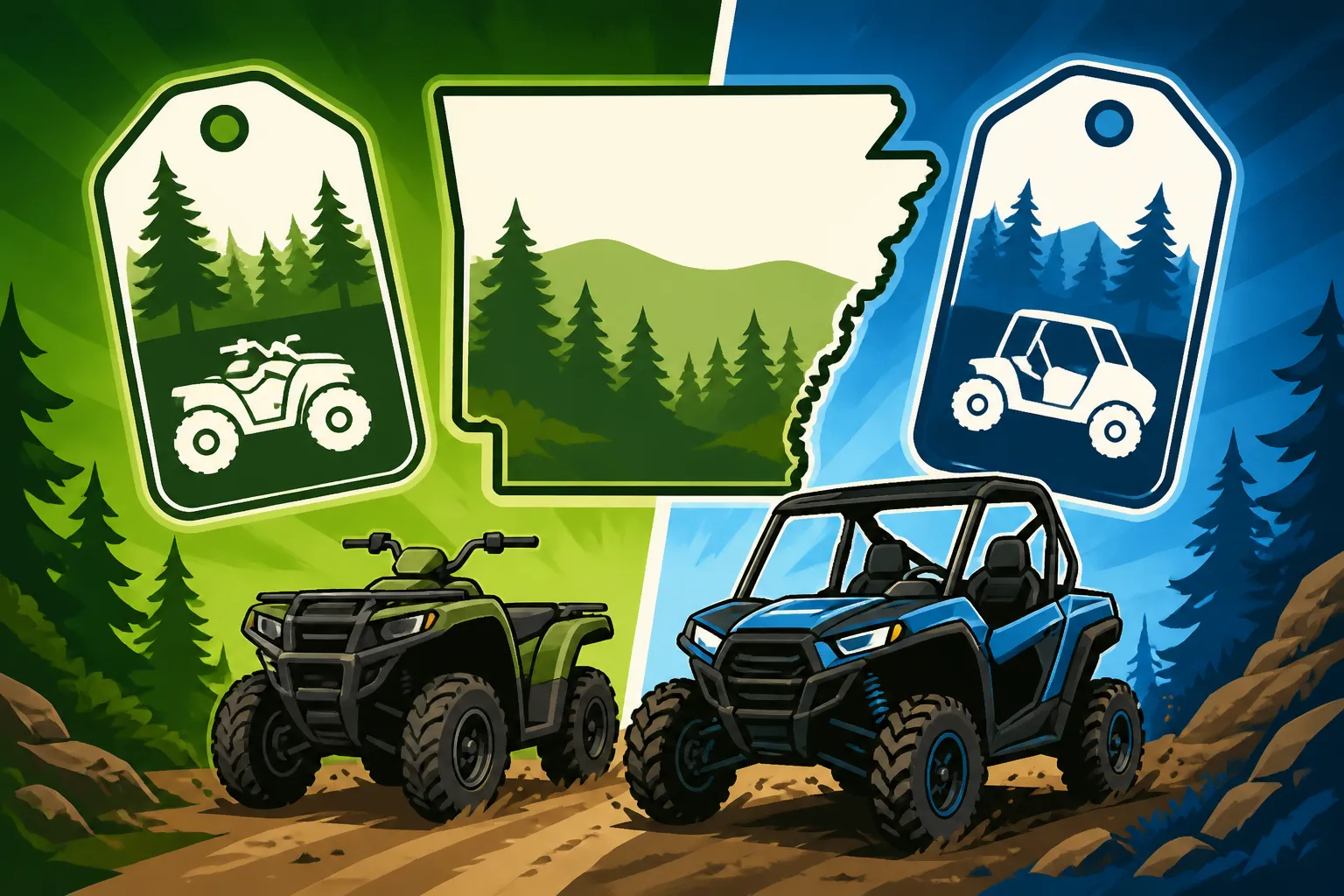
Arkansas’s designated off-highway riding areas include trails in two different national forests: the Ouachita National Forest and the Ozark-St. Francis National Forests. They are separate public land units, with separate trail systems and permit arrangements. A pass connected to riding in one forest does not automatically cover an outing in the other.
That distinction matters most when planning a trip that includes more than one riding area. The Ouachita side is associated with popular destinations such as Wolf Pen Gap. On the Ozark-St. Francis side, Mill Creek is a well-known OHV trail system. A rider who bought a pass for one destination should not assume that it works at the other.
These are forest access permits, not interchangeable statewide ATV licenses. They are also different from Arkansas’s state registration decal. A decal may satisfy a state registration requirement for a particular machine, but it does not pay for or replace a forest OHV permit when one is required. Likewise, a forest pass does not register your ATV with the state or make it legal to ride on roads where riding is otherwise prohibited.
It helps to keep the three ideas separate:
- State registration concerns whether your machine must be registered under Arkansas rules and whether you need to display the state decal.
- Forest OHV permits concern access to specific designated riding areas on national forest land.
- Local rules and trail restrictions determine where you can ride, which machines a trail accommodates and whether a route is open.
Those requirements can apply at the same time. A rider might need the correct state registration, the permit for the forest trail system and compliance with that trail’s posted restrictions. Visitors from another state should check the forest permit rules even if their machine is registered at home. Do Out-of-State Riders Need an Arkansas Registration Decal? can help clarify the state-registration side, but the forest permit remains a separate question.
For a broader overview of how the two forest systems differ, see Arkansas OHV Permits: Two Forests, Two Prices. The practical takeaway is simple: identify the actual trail system on your itinerary, then buy the permit that belongs to that system. Don’t choose a pass based only on the phrase “Arkansas forest permit.”
What each pass covers
A permit is tied to the land manager and riding area named in its current terms. The Ouachita National Forest permit is for the relevant Ouachita OHV riding opportunities. The Ozark-St. Francis system has its own permit arrangement for its designated OHV area, including Mill Creek. These are not a single Arkansas-wide pass sold under two names.
That distinction can be easy to miss because both permits are used for off-highway riding and both involve federal forest land. But one pass is not a substitute for the other. If your trip includes a Ouachita trail and Mill Creek, plan on checking the requirements for each area rather than buying one pass and hoping it transfers. Why One Forest Pass Does Not Cover the Other explains the difference in more detail.
The pass also does not give you permission to ride anywhere within a forest. Forest boundaries include land, roads and routes that may not be open to motorized recreation. A paid permit is not an all-access pass. You still need to follow the designated trail network, posted closures, machine-width limits and seasonal restrictions. Some barriers are there because a route is closed, not because a rider needs a different permit.
| What you are checking | Ouachita National Forest | Ozark-St. Francis National Forests |
|---|---|---|
| Permit system | Its own OHV permit system | Separate permit system for the relevant riding area |
| Example riding destination | Wolf Pen Gap and other designated Ouachita opportunities | Mill Creek OHV Trail System |
| Does its permit cover the other forest? | No, not by default | No, not by default |
| Does it replace Arkansas registration? | No | No |
| Does it open every forest road or trail? | No; use only routes open to OHVs | No; use only routes open to OHVs |
| What to verify before leaving | Current permit terms, eligible routes, machine limits and display rules | Current permit terms, fee station or purchase instructions, route and machine limits |
The table is a planning aid, not a substitute for the permit instructions for the area you intend to ride. Permit products, purchase methods and display directions can change. Read the current instructions from the responsible forest before travelling, especially if you are using an annual pass and want to know exactly which riding areas it covers.
A common source of confusion is treating “forest pass” as if it were a general recreation pass. Different federal lands can have different fees and permit requirements. A pass for one activity or location may not be accepted for another. Ask the narrower question: does this specific pass cover this specific OHV system on the date I’m riding?
Also separate a national forest permit from other possible access requirements. A state wildlife management area can have its own vehicle rules, and a private park can set its own admission and waiver conditions. A forest permit does not automatically authorize riding on a WMA, private property, a county road or a town street. For forest-system details, Where an Ozark-St. Francis Annual Pass Works is useful when you are trying to understand the scope of that pass rather than assuming it covers every route in the forest.
How to choose and buy the right permit
Start with your riding destination, not the pass menu. Write down the name of the trail system or recreation area, then identify which forest manages it. If your group is considering multiple areas, make a list for each one. This prevents the familiar mistake of buying a pass for the first stop and discovering at the next trailhead that it is not the one required there.
Use this process before your trip:
- Name the exact riding area. “The Ouachitas” or “the Ozarks” is not precise enough if you are choosing a permit. Confirm the trail system and its managing forest.
- Check that the system is open to your machine. Confirm current operating status, width limits and any seasonal or weather-related closures. A valid permit cannot make a closed or unsuitable trail rideable.
- Read the permit terms for that area. Check whether the permit is a day or annual option, how it is assigned, where it is valid and how it must be displayed or carried.
- Choose the correct permit for every machine. Do not assume a pass purchased by one rider covers a whole group. Check the permit rules for vehicle coverage and whether each machine needs its own permit.
- Save proof before you leave. Keep the confirmation or receipt available offline, and follow the instructions for displaying a decal, pass or other proof.
- Recheck shortly before departure. Trail access, closures, purchase instructions and fees can change. Confirm the latest information with the responsible forest or official permit channel.
For the Ouachita permit, use the current purchase instructions published for that forest. Some forest permits are available through Recreation.gov; check the listing and its terms directly rather than relying on an old screenshot, a forum post or a saved link that may describe a previous season. Arkansas Permits Bought on Recreation.gov covers the purchase process and what to pay attention to.
Mill Creek has had a self-service fee-station approach, but do not depend on an old description of the station’s location, accepted payment or operating arrangement. Verify the current instructions before travelling. If the official information directs riders to a self-service station, have the required payment method ready and allow time to complete the process before entering the trail system. Arkansas Self-Service Fee Stations offers more context on this kind of setup.
The key is not to infer that two permits work alike just because both are called forest OHV permits. One may have online purchase steps, while another may use different purchase or proof instructions. Even when both offer day and annual options, the terms can differ. Arkansas Annual Versus Day Permits can help you think through the choice, but the current terms for the specific forest should settle the question.
If you are riding with friends, coordinate before the day of the trip. Ask each person which machine they are bringing and whether that machine has the required permit. A group leader’s receipt may not cover every ATV in the trailer. The forest’s permit terms determine whether permits are issued per vehicle or under another arrangement, so check that detail directly. For a general explanation of this issue, see Arkansas Permits Are Per Vehicle.
Carry proof in the form the forest requires. If the instructions call for a permit to be displayed on the machine, a phone screenshot is not a replacement for that display. If the instructions call for proof to be carried, make sure the rider can access it even when cell service is unavailable. Keep a copy of the confirmation on your phone and, where practical, a paper backup. Carrying Your Forest Permit at Mill Creek is a useful reminder to check how proof is handled at that specific riding area.
For a paper backup, print the confirmation while you still have reliable internet access. A small waterproof document pouch can protect the printout from rain, mud and trail grime. If you’re shopping for a pouch or map case, Amazon is one place to compare sizes, but choose a format that keeps the permit readable and does not interfere with any required decal placement. Don’t cover the machine’s identification information or attach documents in a way that could come loose on the trail.
Registration, reciprocity and other rules that still apply
Forest permit reciprocity is not the same thing as vehicle-registration reciprocity. A visitor may be allowed to ride in Arkansas with a machine registered in another state, subject to the applicable rules, but that does not mean the visitor is excused from a required forest permit. Conversely, buying a forest permit does not settle whether the machine meets Arkansas registration requirements.
If you are an Arkansas resident, check whether your machine falls within the state’s registration rules and what proof you need. If you are visiting, check how Arkansas treats an out-of-state machine and what the forest requires of visitors. Do not assume that a home-state decal, plate or registration card automatically satisfies every Arkansas requirement. [Arkansas Rules for an Out-of-State Decal] is relevant to that question.
There is another important limit: a forest permit is for the designated recreation use described in its terms. It does not turn a public road into an OHV trail or authorize riding through a closed gate. Road use is governed by separate rules, which can depend on the road, the local jurisdiction and the circumstances. A trail permit also does not grant access across private land to reach the forest. Confirm how you will get to the trailhead and use designated access routes.
The same principle applies to wildlife management areas. Some routes may be open to vehicles under specific conditions, while others are closed or restricted. A national forest pass is not a substitute for WMA access rules. If your route crosses or enters a WMA, review that land unit’s vehicle restrictions separately. Do not treat a gate, barrier or signed closure as optional just because you have paid for an OHV permit.
Machine fit matters as much as paperwork. A permit does not guarantee that your ATV or UTV fits every trail. Check width restrictions, gate dimensions and the trail system’s vehicle rules before towing. An oversized side-by-side can be turned away even if the rider has purchased the right permit. If your machine is close to a stated limit, measure its actual width at its widest point rather than relying on a brochure specification.
Before you leave, keep the following items together:
- Permit confirmation or receipt for the forest you are visiting
- Any required displayed permit or decal
- State registration documentation or decal, when applicable
- Machine identification details, including a photo of the VIN or serial number
- Current trail map and closure information
- A paper copy of essential directions in case cell service drops
Amazon may be useful if you want a compact waterproof map case or a pouch that stays secured to your gear, but the item is only a convenience. It does not replace the official map or permit proof. A paper map can be particularly helpful in forest areas where phone coverage is unreliable; keep it accessible without putting loose papers where they could blow away or become unreadable.
It is also worth taking a photo of your machine and permit before riding. That gives you a record of how the permit was attached and what identification was visible if something comes loose or is damaged. A phone mount or protective case purchased through Amazon may help keep a phone usable for navigation, but download maps in advance and carry a backup. Don’t plan on reaching an online permit page from a trail where service may be weak.
A practical checklist for a multi-forest trip
If you are staying in Arkansas and riding one forest, the process is fairly simple: match the pass to the trail system, follow the instructions, and confirm that your machine is permitted on the route. If you want to ride both the Ouachita and Ozark-St. Francis systems on one trip, do not try to make one pass cover both. Treat each forest as a separate stop with separate access details.
A useful planning checklist looks like this:
- For a Wolf Pen Gap or other Ouachita outing: confirm the Ouachita permit requirement, purchase method, current trail status and machine restrictions.
- For a Mill Creek outing: confirm the Ozark-St. Francis permit instructions, current payment or purchase method, trail status and any proof-of-payment requirement.
- For a trip to both: arrange the permit for each forest separately and save each confirmation under a clear name.
- For a group: verify the permit status of every machine, not just the lead rider’s vehicle.
- For an out-of-state visit: check both Arkansas’s relevant registration rules and the forest permit rules.
- For a machine near a width limit: measure it and confirm the limit with the trail manager before towing.
- For a route involving public or private access roads: check road-use rules and landowner permission separately.
Save the forest’s current contact information before departure. If a trailhead sign differs from an old web page or a saved itinerary, stop and follow the current on-site direction while you clarify the issue. Rangers and posted notices can provide important information about closures, hazard conditions and trail restrictions. What a Forest Ranger Checks on an Arkansas Trailhead can help you understand the kinds of compliance questions that may come up.
Avoid waiting until you reach the trailhead to learn the permit process. You may have poor service, limited payment options or no simple way to print proof. Purchase in advance when the official system allows it, and keep your confirmation accessible offline. If the area uses a self-service station, know where it is and what payment method is accepted before you tow several hours.
Finally, budget time to inspect the machine after the ride. Mud, water and brush can loosen a sticker or obscure a permit display. If your permit must remain visible, check it before heading out and again when you stop. Keep registration and permit records separate in your phone or paper folder so you can quickly show the right document when asked.
A little planning avoids the most frustrating version of this mistake: arriving at a trail system with a valid pass that simply belongs to the other forest. Match the permit to the destination, follow that forest’s current instructions and remember that the permit is only one part of riding legally and responsibly.
Disclaimer
This article is for general informational purposes only and does not constitute professional advice. Laws, prices and regulations vary by location and change over time. Consult a qualified professional for guidance on your specific situation.