Do Out-of-State Riders Need an Arkansas Registration Decal?
An out-of-state rider may be able to use a machine’s home-state registration in Arkansas, but that does not automatically cover every trail, land manager or type of riding. The key is to separate state registration reciprocity from forest permits, local road rules and private-park requirements. Here’s how to check what applies before you load up and travel.
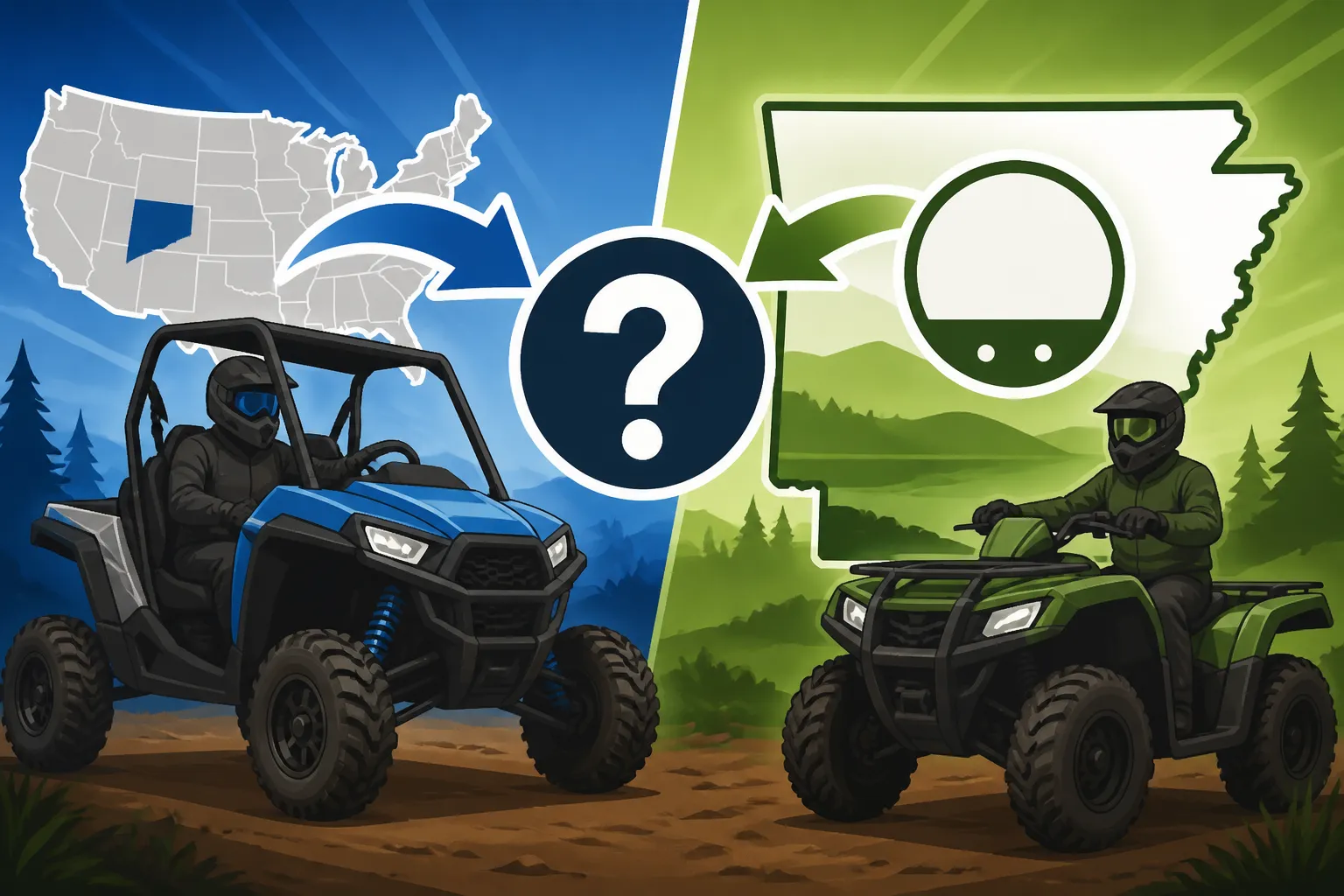
The short answer: reciprocity may cover the Arkansas decal
Arkansas visitors generally should not assume they need a second, Arkansas-issued registration decal merely because they plan to ride in the state. If your ATV or UTV is currently and properly registered in your home state, Arkansas may recognize that registration for temporary use, subject to the conditions of its nonresident rules.
That answer has an important qualification: reciprocity is not the same as a blanket exemption for every out-of-state machine. Your situation can change if the vehicle is not registered at home, the home jurisdiction does not require registration, the registration has expired, the machine does not fit Arkansas’s legal definition of an ATV, or you have become an Arkansas resident. The rules for riding on a particular forest, wildlife area, town street or private trail park may add separate requirements.
A practical way to think about the rules is to ask four different questions:
- Is the machine registered or otherwise recognized for use under the rules that apply to the rider?
- Does the land manager require a separate permit for that trail system?
- Is the intended route legally open to that type of machine?
- Does the riding area have its own entry, equipment, age or waiver rules?
A yes to one question does not answer the others. In particular, a forest OHV permit is not an Arkansas registration decal, and an out-of-state registration does not replace a forest permit.
| What you need to check | What it addresses | What it does not replace |
|---|---|---|
| Home-state registration or other recognized documentation | Whether the machine is properly documented for a visiting rider | A permit required by a forest or trail system |
| Arkansas registration rules | Whether an Arkansas decal is needed in your particular circumstances | Road permission, insurance requirements or local permits |
| Forest OHV permit | Access to a covered forest riding area | State registration or permission to ride on other land |
| Wildlife-area rules | Whether a specific road or area is open to a vehicle | A forest permit or private-park entry |
| Private-park rules | Admission, waivers and site-specific requirements | Public-land permits or state registration |
If you are unsure whether your home-state paperwork qualifies, verify the rule with the appropriate Arkansas agency before traveling. For a closer look at the general state-registration process, see Arkansas Registration and Nonresident Riders and How to Register an ATV in Arkansas.
What counts as registration reciprocity
Reciprocity is a recognition arrangement between jurisdictions. In practical terms, Arkansas may accept qualifying registration issued where a nonresident lives instead of requiring that visitor to obtain an Arkansas decal for a temporary visit.
That does not mean every sticker, card or bill of sale counts as registration. The document needs to show that the machine has the kind of current registration the applicable rules recognize. A sales receipt, insurance card, dealer paperwork or forest permit may be useful for other purposes, but it is not necessarily proof of vehicle registration.
Check the machine’s paperwork, not only your driver’s license
A rider’s out-of-state driver’s license can help show that the person is visiting, but it does not prove that the ATV or UTV is registered. Keep the machine’s registration document with you and make sure its identifying details match the vehicle.
Before leaving home, check that:
- The registration is current for the dates of your trip.
- The name on the document is consistent with the person who owns or is authorized to use the machine.
- The vehicle identification number or serial number matches the machine.
- The registration applies to the kind of off-highway vehicle you are bringing.
- Any required decal or plate is attached where your home jurisdiction requires it.
- You can show the registration promptly if a ranger, officer or trail operator asks.
If the machine is borrowed, rented or owned by someone else, carry written permission or rental documents as well. Those documents do not turn an unregistered machine into a registered one, but they can help explain who owns it and why you are operating it.
When home-state registration is not required
The hardest cases are often machines that are legal to use at home without a registration decal. A visitor may assume that because the home state does not require registration, Arkansas will treat the machine as exempt too. That is not a safe assumption.
The relevant question is not only whether you personally have a sticker from home. It is whether Arkansas’s nonresident rule recognizes the machine’s status under the laws of the state where it is based. Requirements can differ according to the machine, its use and the applicable rule. If your home state does not register that class of vehicle, ask Arkansas officials what documentation or Arkansas registration is required before you ride.
Do not rely on a dealer’s verbal assurance, an old online forum post or another rider’s experience as your only confirmation. A friend may have a different machine, live in a different state or be riding under a different land-access arrangement.
If you are moving to Arkansas
A temporary visitor and a new Arkansas resident should not assume they have the same status. If you have moved to Arkansas, are establishing residence there or are keeping the machine in the state for an extended period, check the rules for Arkansas owners rather than treating the trip as a short visit.
The paperwork and timing can differ based on when and how you acquired the machine. If you have recently moved, Arkansas ATV Registration for a New Resident can help you identify the questions to resolve. If the machine has no current paperwork, see Arkansas ATV Registration Without a Receipt before trying to use an old registration or purchase document as a substitute.
State registration and forest permits are different
This distinction is the source of many trailhead surprises. Arkansas registration is a state vehicle-documentation issue. A forest OHV permit is a land-access requirement imposed for a particular riding area. Having one does not automatically satisfy the other.
For example, a visitor may have valid registration from home and still need a permit to ride on a forest trail system that requires one. Conversely, buying a forest pass does not make an unregistered machine legal under state rules where registration is required.
Two national forests can mean two permit systems
Arkansas riding areas are spread across more than one national forest. The permit that applies to one forest or trail system may not apply to another. A pass for an Ouachita National Forest riding area should not be assumed to cover a separate system in the Ozark-St. Francis National Forest, or vice versa.
Before the trip, identify the actual trail system—not just the nearest town or campground—and confirm:
- Which forest or land manager operates the area.
- Whether the route is open to your machine’s type and width.
- Whether a day or annual permit is required.
- Whether the permit is tied to the vehicle, the rider or another basis.
- How the permit must be displayed or carried.
- Whether your pass covers the specific trailhead and dates you plan to use.
The requirements can change, so check the current information from the land manager before buying a pass or setting out. These guides explain the separate forest systems: Arkansas Riders Need Two Different Forest Passes, Arkansas OHV Permits: Two Forests, Two Prices and How to Buy an Arkansas Forest OHV Permit.
A permit may be needed even when registration is reciprocal
A nonresident exemption from Arkansas registration, if it applies to your machine, does not generally erase a trail manager’s access requirements. A ranger checking permits is addressing access to the land. An officer checking registration is addressing vehicle documentation. The same person might ask about both, but they are separate questions.
This matters at well-known places such as Wolf Pen Gap and Mill Creek. Do not assume that a registration decal from your home state gives you free access, or that a pass purchased for one trail system is valid at another. Confirm the requirements for the exact location. For system-specific details, see Wolf Pen Gap Permit Prices and the Fee Phase-In and Mill Creek OHV Permits in Arkansas.
Some public lands have different rules again. Wildlife management areas, for example, may open certain roads while keeping other roads, levees, food plots or gated routes closed to vehicles. A forest permit does not override those restrictions. Check the rules for the particular area in Arkansas AGFC WMA Rules for Riders and Arkansas WMA Access for a Quad.
Your machine must also fit the rules where you ride
A valid home-state registration does not guarantee that every Arkansas riding area will allow your machine. Trail systems can have vehicle definitions, width limits, seasonal closures and route restrictions. Private parks can set their own admission requirements. Road use is governed separately from off-road trail access.
Confirm vehicle type and width
An ATV, a side-by-side, a dirt bike and a golf cart may be treated differently under state rules and by individual land managers. The label used in a sales listing does not settle the legal classification. Arkansas’s ATV definition includes specific characteristics, and a machine outside that definition may fall under a different set of rules.
Width is another common source of trouble. Some routes and gates cannot accommodate wider side-by-sides, even if the vehicle is properly registered and the rider has bought the right permit. Measure the machine as the trail operator instructs, and confirm the limit for the specific system. Do not rely on a model name or advertised width if accessories, tires or other modifications change the machine’s actual dimensions.
For background, see Arkansas’s 50-Inch, 1,000cc ATV Definition, Arkansas UTV Registration Requirements and Arkansas ATV Trails With Width Limits. A machine that does not fit one trail’s limits may be allowed somewhere else, but that is a route question—not a reciprocity exception.
Public-road use is a separate issue
Registration and road legality are not interchangeable. An ATV or UTV can be registered, permitted for a forest trail and still be prohibited from riding on a public road. Arkansas has restrictions on road use, with limited exceptions and local rules that may apply in particular places.
Do not ride onto a road simply because it connects two trails, leads to a restaurant or appears quiet. Check whether that road is open to the machine and whether the specific exception or local ordinance applies. A town’s rule may permit certain UTV use on designated streets while nearby roads remain off limits. A local permit, where available, is not statewide permission.
For road questions, see Can You Drive an ATV on the Road in Arkansas?, Arkansas UTV Street Legal Rules by Town and Arkansas Rules for Crossing a State Highway. Treat road permission as a separate check from registration and trail permits.
Private parks can have their own entry rules
A private off-road park may ask for proof of ownership, a waiver, identification, a permit or other information. It may also set rules for helmets, passengers, age, noise, alcohol, vehicle condition and operating hours. These are park-entry conditions, not the same thing as Arkansas’s registration requirement.
Call the park before you travel, especially if your machine is borrowed, homemade, modified or missing its manufacturer’s identification plate. Ask what documents it expects and whether the machine’s class or dimensions are accepted on the trails you want to ride.
How to prepare before crossing into Arkansas
A little preparation can prevent a wasted trip or a dispute at the trailhead. The goal is to have a clear answer for each layer of the rules, not to collect every sticker you can find.
- Identify the machine accurately. Record its make, model, vehicle identification number or serial number, width and type. If you do not know which legal category it falls into, resolve that before relying on an ATV-specific rule.
- Check the home-state registration. Confirm that it is current and that the document and decal belong to this machine. If the vehicle is not registered at home, do not assume Arkansas reciprocity applies.
- Verify the nonresident rule. If anything about the machine or your residency is unusual, contact the relevant Arkansas office and ask whether your existing documentation is recognized for temporary use.
- Choose the exact riding area. Find out whether it is on national forest land, a wildlife management area, state land or private property. A general destination name is not enough to determine the permit.
- Check access permits separately. Confirm which permit is required, where it applies, how to buy it and whether it must be displayed on the machine or carried by the rider.
- Check machine restrictions. Confirm width limits, allowed vehicle types, seasonal closures and any route-specific restrictions.
- Check road rules for any connecting route. Do not treat a public road as an extension of an off-road trail. Confirm whether the route is open to your machine.
- Pack documents where you can reach them. Keep registration, proof of ownership or authorization, permits and any rental paperwork together. A waterproof document pouch from Amazon can help keep papers readable after a wet or dusty ride.
- Save current information offline. Cell service can be unreliable in remote areas. Save permit confirmations and maps to your phone, and consider a paper map as a backup.
- Recheck shortly before departure. Closures, permit details, access conditions and local rules can change. Verify them with the land manager or operator rather than relying on information from a previous trip.
When speaking with an agency or trail operator, be specific. Instead of asking, “Do I need a sticker?” explain that you are a nonresident, name your home state, describe the machine, say whether it is currently registered there, and identify the exact riding area. That gives the person answering a much better chance of addressing the right rule.
A compact checklist is useful for a group trip. One person can confirm the forest permit while another checks each machine’s registration and width. A small tire gauge from Amazon can be handy for the equipment inspection before a rocky trail ride, but it does not replace checking width or registration. For basic paperwork and planning, Arkansas Registration Paperwork Checklist is a useful companion.
What to carry and what to do if someone asks
Carry the documents that support the answers you gave when preparing. At a minimum, that usually means the machine’s current registration paperwork if it is registered at home, the relevant forest or trail permit, and proof that you own or are authorized to operate the machine. For rentals, keep the rental agreement available. For a borrowed machine, carry the owner’s contact details and written permission when practical.
Keep digital copies as a backup, but do not assume a phone screenshot will satisfy every requirement. A dead battery, damaged phone or lack of service can make a digital record difficult to show. A compact first-aid kit from Amazon can be useful for a different reason: it helps address minor trail injuries while you arrange assistance. It has no bearing on whether the vehicle is registered or permitted.
If an officer or ranger asks for documents:
- Stop in a safe place and follow instructions.
- Explain that you are visiting and show the current registration document.
- Show the trail permit separately from the registration paperwork.
- If the officer says a document does not meet the requirement, ask which rule or missing item is at issue.
- Avoid arguing from a social-media post or another rider’s experience at the roadside.
- Write down the agency, location and relevant details afterward if you need to follow up.
A missing decal and missing registration are not necessarily the same problem. A machine may have current registration but need a replacement display item; another machine may have no valid registration at all. Ask the issuing authority what proof is accepted while a replacement is arranged. For Arkansas decal issues, see Arkansas Decal Replacement If It Peels Off and Ordering a Duplicate Decal.
Keep the forest permit visible or accessible as the land manager directs. If you ride more than one system on the same trip, keep each permit’s scope clear. A pass valid for one forest does not necessarily work at a trailhead in another, and a valid pass does not authorize riding beyond open routes.
Common assumptions that lead to trouble
“My home state does not require a decal, so Arkansas cannot require one”
That conclusion may be wrong. The question is whether Arkansas’s rule recognizes your home-state status for temporary use, not simply whether your machine has no sticker. Confirm the treatment of unregistered-at-home machines before you travel.
“I bought the Arkansas forest pass, so I am registered”
A forest pass is an access permit for the area it covers. It is not state vehicle registration. If Arkansas registration rules apply to your machine, a trail pass does not replace the required registration documentation.
“My home-state decal lets me ride anywhere in Arkansas”
A recognized registration does not open every road, forest route, wildlife area or private property. You still need permission to enter the land and must follow that location’s vehicle and route restrictions.
“The machine is street legal at home, so it is street legal here”
Road-use rules vary. Home-state equipment or registration does not automatically authorize road riding in Arkansas. Check Arkansas law and any local ordinance that applies to the particular street.
“I have ridden here before without being asked”
Not being stopped on a past trip does not establish that the paperwork was sufficient. Your route, machine, residency or the current rules may be different. Prepare based on the requirements that apply now, not on whether someone checked last time.
A reliable way to make the decision
For a visiting rider, the safest approach is to handle the questions in order. First, confirm whether your home-state registration is current and whether Arkansas recognizes it for your temporary use. If your machine is not registered at home, your residency has changed, or the vehicle falls into an unusual category, ask Arkansas officials what registration is required.
Next, identify the exact place you plan to ride and confirm its permit and access rules. Check width, vehicle type, closures and route restrictions. Finally, treat public-road use as a separate legal question. A sticker or permit for one purpose does not create permission for another.
Keep the confirmation, paperwork and permits together, and recheck the requirements before each trip. That simple habit is more useful than buying an extra decal or pass without knowing what it covers. When details are uncertain, ask the agency or land manager responsible for that specific rule and describe your machine and circumstances clearly.
Disclaimer
This article is for general informational purposes only and does not constitute professional advice. Laws, prices and regulations vary by location and change over time. Consult a qualified professional for guidance on your specific situation.