What a Forest Ranger Checks on an Arkansas Trail
What a Forest Ranger Checks on an Arkansas Trail
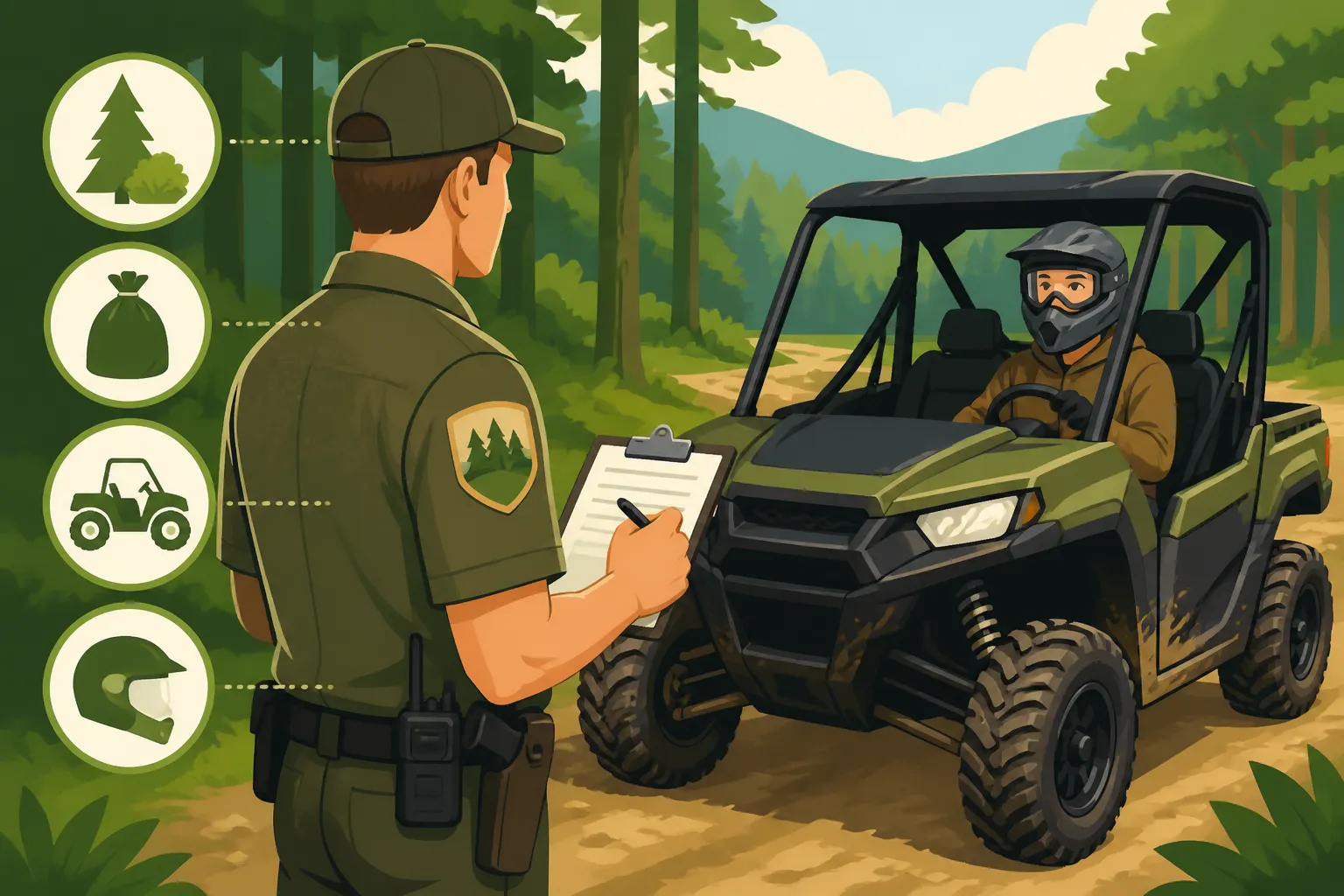
A trail pass is only one part of being ready to ride in Arkansas. A ranger or other law-enforcement officer may also check whether your machine is allowed on that trail, whether required permits are displayed, and whether you’re following forest rules. Knowing what to expect helps you avoid a frustrating turn-around—and makes it easier to keep the right paperwork and gear within reach.
The Forest Permit: What It Covers and What It Does Not
Arkansas has designated off-highway vehicle riding areas in both the Ouachita National Forest and the Ozark-St. Francis National Forests. A forest permit is generally tied to the riding area and machine, not simply to the fact that you are riding somewhere in Arkansas. If you ride in more than one forest, check the permit requirements for each one before you leave home.
For example, Arkansas Riders Need Two Different Forest Passes explains why a permit for one national forest does not automatically cover riding in the other. Mill Creek is in the Ozark-St. Francis National Forest; Wolf Pen Gap is in the Ouachita National Forest. A pass bought for one area should not be assumed to satisfy the rules at the other.
A ranger may ask to see your permit, check that it belongs to the machine you’re riding, or look for the required display on the vehicle. Follow the instructions that came with the permit. If it must be attached to a particular part of the machine, keep it visible and mounted as directed. A receipt or a photo of a pass on your phone may help you explain a problem, but don’t count on either as a substitute for a required physical display.
The permit is not a universal license for every road, trail or piece of public land. It applies only where the issuing forest or recreation area allows the vehicle and the permit is valid. It does not override a gate closure, a seasonal restriction, a width limit or a land-use rule.
It also does not replace state registration requirements. Arkansas OHV registration and forest access permits serve different purposes:
| What may be checked | What it generally establishes | What it does not establish |
|---|---|---|
| Forest OHV permit | Permission to ride in the designated area covered by that permit | Permission to use every road or trail in the forest |
| Arkansas OHV registration decal | Compliance with applicable state registration rules | Access to a particular national forest trail |
| Trail map, sign or current forest notice | Whether a route is open and what restrictions apply | Proof that your machine meets every other requirement |
| Machine identification | Which vehicle is being operated and whether records match | A substitute for a permit or registration |
If you’re unsure whether your machine needs Arkansas registration, start with Do You Need to Register an ATV in Arkansas?. If you’re riding in Arkansas with a registration decal from another state, review Do Out-of-State Riders Need an Arkansas Registration Decal? and confirm the current requirements before travelling. A forest permit and a state decal should not be treated as interchangeable.
Permit details, display instructions, fees and access rules can change. Check the official forest or recreation-area information for the place you plan to ride, especially before a long trip. For an overview of the permit process, see How to Buy an Arkansas Forest OHV Permit.
Your Machine: Identification, Width and Trail Fit
A ranger may need to establish what machine you’re operating and whether it belongs on the route. That can mean checking its make, model, identifying number or other details, particularly if a permit or registration record is tied to a specific vehicle. Keep the machine’s identification legible and avoid covering the serial plate or other identifying marks with accessories, mud or storage gear.
Before the ride, compare your machine with the access rules for the trail system. Some Arkansas routes have gates that limit the width of vehicles that can pass. A machine that fits on a road may still be too wide for a particular trail entrance. The posted restriction and the forest’s current guidance matter more than a general assumption that all side-by-sides or ATVs are welcome.
Measure the machine as it is set up for riding. Wheel spacers, aftermarket wheels, tires and other modifications can change its overall width. If a rack, fender flare or accessory sticks out, ask the forest office whether the stated width limit is measured at the tires or at the widest part of the vehicle. Don’t rely on the width printed in a sales brochure if your machine has been modified.
This matters at places such as Huckleberry Mountain, where the gates are a practical limit on what can enter. Check Arkansas Gates That Stop 72-Inch Machines before taking a wide side-by-side to a trail system with restrictive gates. If your vehicle is close to a stated limit, contact the managing office rather than guessing at the trailhead.
A ranger may also ask about vehicle type. An ATV, UTV, dirt bike, golf cart and homemade machine may not be treated the same under every rule. The machine’s appearance alone may not answer the legal question. Engine, width, tires, intended use and other characteristics can affect how a vehicle is classified under state law or a local trail rule. The broader state definition is covered in Arkansas’s 50-Inch, 1,000cc ATV Definition.
A practical pre-ride check:
- Find the current access page or map for the exact riding area.
- Check the listed vehicle types and width restrictions.
- Measure your machine in its current configuration.
- Make sure the identification number is readable.
- Confirm the permit and any registration are associated with the correct vehicle.
- Do not enter through a gate that your machine cannot pass without forcing or altering it.
A gate is not an invitation to test the limit by squeezing through, lifting a barrier or moving a post. Damaging a gate or bypassing it can create a safety problem and may lead to enforcement. If you arrive and discover the machine is too wide, turn around and choose a route that allows it.
Open Routes, Closures and Direction of Travel
A permit is not permission to ride wherever you can physically drive. Rangers may check whether you are on an open, designated route and whether you have crossed a closed barrier or entered an area marked for another use.
Look for signs at trailheads, junctions and gates. A route may be closed for maintenance, weather, erosion, resource protection or another management reason. Closures can be temporary or seasonal, and a route shown on an older map may not reflect current conditions. A gate that is closed should be treated as closed, even if tracks show that someone has gone around it.
Use current information rather than relying on a map saved months ago. Check for closure notices before you tow, then check again at the trailhead. If a sign and an old map appear to conflict, follow the current posted restriction and ask the managing office for clarification. Arkansas Trail Closures After a Storm explains why a route can be unavailable even when it looks passable.
Stay on the designated route. Cutting around a muddy section, riding through vegetation to pass another group, or taking an informal shortcut can damage the land and create new routes that are not open to motor vehicles. A trail that looks like an established track is not necessarily an authorized ATV trail.
Where signs establish one-way travel or direct riders onto a particular route, follow them. At intersections, slow down and check for signs before choosing a turn. Avoid treating a junction as an opportunity to explore unmarked roads. Forest roads may serve other users or have access rules that differ from the OHV trail system.
Rangers may also check whether a rider has entered a place that is closed to vehicles, such as a gated road, a protected opening or a non-motorized trail. Access rules can vary by land manager and location, so don’t assume that a rule from one forest applies to another. The basics of designated access are covered in Open Access Roads and What They Mean and Arkansas WMA Vehicle Rules in Plain English. Wildlife management area rules are separate from national forest trail rules; a forest permit does not grant access to a WMA route that is closed to your vehicle.
If a trail is blocked by a fallen tree, water or damage, don’t create a new route around the obstacle unless signs or official instructions specifically direct you to do so. Turn back or contact the appropriate office. A detour that seems harmless to one rider can widen a damaged trail or cause erosion that affects the whole system.
Documents and Proof That May Help at a Stop
The most useful paperwork is the paperwork that answers the question being asked. A ranger may want to know whether you have the right forest permit, whether the machine is properly registered under applicable rules, or who owns it. The exact items requested can vary with the location and the reason for the stop.
Carry the permit in the format required by the issuing authority. If the permit must be displayed on the machine, attach it before riding. Keep any receipt or confirmation as backup, but remember that a backup record does not necessarily replace the required display.
For state registration, keep the registration document available and make sure the decal is attached where required. Arkansas registration for an ATV is separate from forest access. If you are sorting out state paperwork, Arkansas Registration Paperwork Checklist gives a useful overview, while Arkansas Proof of Ownership for Registration covers documents that can support an application.
Ownership paperwork is especially helpful if the machine is newly purchased, borrowed, inherited, homemade or missing its usual documents. A bill of sale or other record may help establish ownership, but it does not necessarily satisfy every registration requirement. For a machine bought without a standard receipt, see Arkansas ATV Registration Without a Receipt.
Keep copies of important documents at home as well. A clear photograph of the machine’s serial number and a digital copy of its paperwork can be useful if the originals are lost or damaged. Store those records somewhere you can access without a signal; cell service can be limited in forest riding areas. You can take a clear photo with a phone, then save a backup somewhere that does not depend on connectivity. If you use a product from Amazon to organize paperwork or protect a phone, choose something that will hold up to dust and moisture, but don’t let a storage accessory distract from carrying the actual items the rules require.
If you are riding someone else’s machine, ask the owner what documents are carried with it and confirm that the permit applies to that specific vehicle. A borrowed machine with a pass attached to a different vehicle can create confusion at a stop. For group rides, make sure every machine has its own required permit rather than assuming that one rider’s paperwork covers the group.
It helps to keep a simple document pouch in your tow vehicle or riding gear. Include:
- The forest permit or the required proof of purchase
- State registration paperwork, if applicable
- Ownership or rental paperwork when relevant
- A paper map or offline map for the riding area
- A contact number for the machine owner, if you are borrowing it
- Any instructions provided by the permit issuer
Don’t hand over original ownership documents unnecessarily. If a ranger asks to see a document, remain calm, show the relevant item and ask politely if you’re unsure what is being requested. If there is a discrepancy, explain it honestly rather than trying to make the paperwork appear to say something it does not.
Equipment, Noise and Responsible Operation
Not every trail system has the same equipment requirements. A ranger or trail employee may check for compliance with rules that apply to the particular forest, route or machine. These may concern equipment, noise or safe operation. Do not assume that a requirement at one riding area applies everywhere, but do not assume it is optional just because you have ridden elsewhere without being asked about it.
Spark-arrestor requirements are one example riders should verify before heading into forest land. A spark arrestor can reduce the risk of igniting dry vegetation. If the riding area requires one, make sure it is approved and installed correctly rather than relying on an aftermarket part with unclear specifications. See Arkansas Spark Arrestor Requirements and check the current forest rules for the exact riding area.
Noise is another issue that can attract attention. Forest rules or local restrictions may address sound levels, and a modified exhaust can create problems even if the machine runs well. Keep the exhaust system in good condition, avoid unnecessary revving near trailheads and campsites, and check the applicable sound standard before changing pipes. Arkansas Sound Limits on Forest Land covers why a machine that seems acceptable to its owner may still be out of compliance.
Safe operation is part of being ready for a ranger’s questions, too. Follow posted speed limits, yield appropriately, and ride in control of the machine. Be especially cautious around blind corners, steep sections and areas where other users may be present. Keep passengers within the seating and capacity limits specified by the manufacturer and the trail rules.
Carry equipment that helps you respond to a breakdown without turning a minor problem into a rescue. For a day ride, that may include water, a basic first-aid kit, a phone or radio where appropriate, a tool kit, and a way to navigate if your device loses service. A paper map is useful even if you normally navigate on a phone. Some riders find a rugged map case or a compact compass through Amazon, but the important point is to know how to use your backup before you are deep in the forest.
Before unloading, inspect the machine for loose parts, fluid leaks, damaged tires, a blocked exhaust outlet and anything that could fall off on the trail. Secure tools and cargo so they do not come loose over rough ground. A ranger may not inspect every item, but a poorly maintained machine can create trail hazards and leave you stranded.
Be prepared to explain your route and turn back if the conditions change. A machine that is capable of climbing a difficult hill is not automatically safe to ride there. Wet rock, loose gravel, mud and water can change the difficulty of a trail quickly. If you are unsure about a section, stop in a safe place and assess it rather than following another rider into a situation you cannot handle.
Reciprocity and Riders From Outside Arkansas
Out-of-state riders often have two separate questions: whether their home-state registration is accepted for Arkansas riding, and whether they need a permit for the forest where they plan to ride. The answers are not the same.
A forest permit is specific to the area and machine covered by its terms. A registration decal from another state does not replace it. Likewise, buying an Arkansas forest permit does not automatically resolve whether the machine meets Arkansas registration requirements. Check both issues before the trip.
For state registration reciprocity, do not assume that a vehicle document accepted on a highway is sufficient for off-highway riding. Registration systems and vehicle categories differ from state to state. Review Arkansas Rules for an Out-of-State UTV or Arkansas Visitors From Missouri if that describes your situation, and confirm the current rule with the relevant Arkansas authority.
The practical questions to settle before you travel are:
- Does Arkansas require this type of machine to be registered?
- Does Arkansas recognize the registration or decal issued by your home state?
- Does the forest require a separate OHV permit for the area you will ride?
- Is the permit per vehicle, and how must it be displayed?
- Is your vehicle allowed on the trails because of its type and width?
- Are there seasonal closures or current restrictions?
If you are crossing between two national forests on one trip, verify each forest’s permit requirements separately. Do the same if you are riding at a private park, a state-managed area or a wildlife management area. A pass from one land manager does not necessarily carry over to another.
Bring documentation that makes your situation easy to explain: home-state registration paperwork, the forest permit, and proof that the machine is yours or that you have permission to use it. If you rent, ask the rental business which permits are included and which are not. Do not assume the rental company’s paperwork covers every forest or trail system on your itinerary.
How to Prepare for a Ranger Check
Most stops are easier when your permit is visible, your machine fits the trail rules and you know where you are. A little preparation at home can prevent confusion at the trailhead or during a ride.
Before leaving home
- Identify the exact riding area and land manager. A nearby trail name is not enough if the routes are in different forests or jurisdictions.
- Check the official page for current permit instructions, closures, vehicle limits and equipment rules.
- Buy or obtain the correct permit for each area, allowing time to follow any delivery or printing instructions.
- Check the machine’s width and make sure it meets the restrictions for the trails you plan to use.
- Confirm applicable state registration and reciprocity requirements.
- Photograph the machine’s identification number and save copies of important paperwork.
- Pack a current map, water, basic tools and a first-aid kit.
- Tell someone where you plan to ride and when you expect to return.
At the trailhead
Pause before unloading. Read the signs, check the permit display, confirm that your intended route is open and look for posted vehicle restrictions. If a requirement is unclear, ask the managing office or follow the more restrictive posted direction until you can confirm it.
A trailhead kiosk may provide useful details, but it may not show every change made after the information was printed. Keep an offline copy of the official trail map and check for alerts before you drive into an area with limited service. If the site has a self-service fee station, follow the posted payment and display instructions exactly. See Arkansas Self-Service Fee Stations for practical details about that type of system.
At the start of the ride, make sure each rider knows the route, the expected turnaround point and what to do if the group gets separated. A ranger’s question about where you are headed is easier to answer if everyone is following the same plan.
During a stop
Move to a safe place, switch off the machine if asked, and follow instructions. Keep your permit and documents accessible rather than buried under cargo. Answer questions directly. If you do not know an answer, say so and ask what you should do next.
Do not argue at the trail edge about a sign, permit or vehicle limit. If you believe there has been a misunderstanding, gather the details calmly and follow the appropriate process afterward. A disagreement is not a reason to ride past a closure or refuse a lawful direction.
If something does not match
A pass may be damaged, a display may have come loose, or the paperwork may show a different machine. Explain the problem and show any supporting receipt or record you have. Whether you can continue riding depends on the applicable rule and the officer’s direction; a phone photo or purchase confirmation may not cure a missing required permit.
If your machine turns out to be too wide, do not force it past a gate. If a route is closed, do not go around the barrier. If the forest permit is for a different area, stop and find out whether you can obtain the correct one before continuing. Being prepared to change plans is part of riding responsibly.
A Simple Pre-Ride Checklist
Use this checklist for each trip, even if you have ridden the same area before. Conditions and restrictions can change, and a permit that worked for one forest may not work for the next.
- I know which forest or recreation area manages my route.
- I checked the current permit instructions and have the correct permit for each machine.
- I know how the permit must be displayed.
- I checked Arkansas registration rules and out-of-state reciprocity, where relevant.
- My machine meets the type and width restrictions for the trails I plan to ride.
- The serial or identification number is readable.
- I checked current closures and trail conditions.
- I have a map available offline and a backup navigation option.
- I have the required documents and can reach them quickly.
- My machine is maintained, and required equipment is installed.
- Every rider knows the route and understands that closed gates and trails are off-limits.
A forest ranger’s check is not only about whether a sticker is present. It is about whether the machine, permit, route and rider all fit the rules for that place. When those pieces line up, you can spend less time sorting out paperwork at the trailhead and more time riding the trails that are actually open to you.
Disclaimer
This article is for general informational purposes only and does not constitute professional advice. Laws, prices and regulations vary by location and change over time. Consult a qualified professional for guidance on your specific situation.