Wildlife Openings and Why They Are Closed
Wildlife openings can look like convenient places to turn around, cross a field or reach another part of an Arkansas hunting area. But an opening is not automatically an ATV route. These clearings are often managed for wildlife, and driving across them can damage habitat or violate area rules. The safest approach is to ride only on routes specifically open to vehicles and treat the opening itself as off limits unless signs say otherwise.
What wildlife openings are and why they matter
A wildlife opening is a cleared area managed to support wildlife. Depending on the site and management plan, it may be planted with forage, maintained as a food plot, or kept open to provide habitat and improve conditions for wildlife. It can look like a field, clearing or broad strip beside a road.
That appearance can be misleading to riders. A clearing may seem like an easy way to avoid a rough section, turn around or cut across to another road. But it is not necessarily a trail, staging area or public vehicle route. Even if a machine can physically cross it, that does not mean riding across it is allowed.
Wildlife openings are managed for a purpose. Tire tracks can tear up soil, damage plants, create ruts that channel rainwater and disturb an area that is meant to remain undisturbed. Repeated traffic can also widen an informal route until a small shortcut becomes a damaged patch of ground. The impact is especially noticeable when soil is wet or when vegetation is newly planted.
A clearing may also be near a food plot or other managed habitat without being obvious from the trail. Riders may not know what has been planted, whether the ground is being rested, or whether an access restriction applies at that particular opening. The practical rule is not to decide based on how the ground looks. Check the area’s vehicle rules and follow the signs and barriers.
For a broader explanation of how vehicle access works on these properties, see Arkansas WMA Vehicle Rules in Plain English. The central distinction is between an area that is open to people for some purpose and a route that is open to motor vehicles. Those are not always the same thing.
Why an opening is not an ATV shortcut
On a wildlife management area, permission to enter the property does not necessarily mean permission to drive anywhere on it. Vehicle use is commonly limited to roads or routes designated as open. A wildlife opening does not become a road simply because it connects two visible tracks or has no fence around it.
This distinction matters because informal riding can quickly create confusion. A rider may assume that a route made by another vehicle is approved. Another rider sees the tracks and follows them. Over time, the opening may acquire a worn path that looks official even though it is not marked or designated for public vehicle travel.
Before you enter an area, find out which roads are open to vehicles and what restrictions apply to the specific WMA. Use current maps and on-site signs together: maps can help with planning, while signs may identify closures or conditions at the point of access. If a route is marked closed, blocked, or otherwise restricted, do not go around the obstruction to reach the opening.
| What you see | What it does and does not tell you | Safer choice |
|---|---|---|
| A broad clearing beside a road | It may be a managed wildlife opening, not a riding area | Stay on the designated route |
| Tire tracks across an opening | Tracks show that a vehicle went there, not that public riding is allowed | Check the current area rules |
| A road that appears to continue through a field | The visible path alone does not establish that the road is open | Confirm the route is designated open |
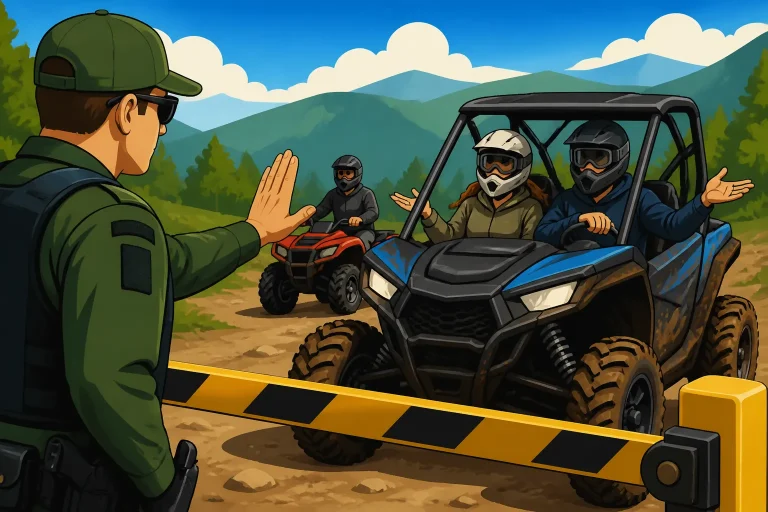
| A gate, cable or other barrier | The route may be closed even if the ground beyond it looks passable | Do not bypass it |
| An opening with no sign at its edge | No sign does not by itself make the clearing an approved route | Use the official map and contact the area manager if uncertain |
If the open route passes beside a clearing, keep your machine on that route. Do not widen the track, make a new turn-around spot in the opening or cross the clearing to reach a different road. If you are unsure whether a narrow track is an authorized route, stop and check rather than treating the opening as a way around the uncertainty.
This is also why Arkansas WMA Roads Open to Vehicles and Arkansas WMA Gated and Cabled Barriers are useful topics to review before a ride. A route’s appearance is not a substitute for knowing whether vehicles are allowed there.
How to check access before you ride
Rules can differ between WMAs and between individual routes on the same property. A route that is open in one location may be closed elsewhere, and seasonal access conditions can matter. Do not assume that a rule you followed at one WMA applies to another.
Use this process before riding:
- Identify the exact WMA. Confirm the property name and the area where you plan to enter. Nearby roads or adjoining land may be subject to different access rules.
- Check current vehicle-access information. Look for the official map, access information and posted notices for that WMA. Pay attention to road designations, seasonal conditions and any vehicle limits.
- Separate riding access from other access. A property may allow hunting, walking or other recreation in an area where motorized travel is not allowed. An opening being accessible on foot does not establish that it is open to ATVs or UTVs.
- Read signs at the entrance and along the route. Follow closure signs and barriers even if a map appears to show a route nearby. Do not move a barrier or ride around it.
- Stay on the route while riding. Do not cut across an opening to save time or create a new path when a road is muddy, blocked or difficult to follow.
- Ask when the status is unclear. Contact the managing agency or local office responsible for the property before riding into an uncertain area.
This check is worthwhile even if you are familiar with the property. Access designations, closures and conditions can change. A past ride across an opening, or a set of tire tracks left by another machine, is not reliable proof that the route is currently open.
A permit or decal also does not necessarily expand where you may ride. It may satisfy one requirement while leaving road and area restrictions in place. For permit questions, see Arkansas WMA Access for a Quad and Arkansas Leased Lands Permit WMAs. Check the rules for the specific land you plan to use rather than assuming one permit grants access to every road or opening.
What to do when a route meets an opening
When an authorized road reaches the edge of a wildlife opening, remain on the road unless the area’s official rules clearly designate another vehicle route. Do not interpret a wide entrance or an unmarked patch of ground as an invitation to cross. If the route ends, is blocked, or becomes difficult to identify, stop and retrace your path rather than making a new track through the clearing.
This matters most when conditions make the road hard to follow. Mud, leaves, snow or fresh vegetation can hide the difference between a route and the surrounding ground. Turning around in an opening may seem harmless, but repeated turning can damage plants and leave ruts. Choose a durable, authorized place to turn around instead.
If you ride with a group, agree beforehand that everyone will stay on marked or designated routes. A lead rider should not take a shortcut through an opening and expect others to know whether it is allowed. If someone in the group is uncertain, stop together and check the map or ask the managing agency.
Hunters should make the same distinction. A hunting purpose does not automatically make every opening a vehicle route. Special access rules may apply to certain activities, but they are not a general invitation to drive across habitat. Review Arkansas Hunters Riding During Open Season and Arkansas WMA Riding on a Food Plot for related issues, and confirm what applies to the specific WMA and route.
If you have already entered an opening by mistake, avoid making the damage worse. Do not continue farther across it or create another track to get out. Return by the same route if it is safe and lawful to do so, then check the property’s access rules before continuing. If you are unsure how to leave without causing further damage, contact the managing agency for direction.
A simple rule helps prevent most problems: ride the route, not the destination. A wildlife opening may be visible from an open road and may look easy to cross, but visibility and convenience do not establish vehicle access. Staying on designated roads protects managed habitat and helps keep access clear for riders who follow the rules.
Disclaimer
This article is for general informational purposes only and does not constitute professional advice. Laws, prices and regulations vary by location and change over time. Consult a qualified professional for guidance on your specific situation.