Arkansas Spark Arrestor Requirements
A modified exhaust can turn a routine Arkansas trail ride into a rule violation. Spark arrestor requirements also vary with the land manager, so knowing what applies before unloading matters. Here’s how to understand the Forest Service requirement, keep your machine compliant, and avoid confusing a spark arrestor with a general noise or permit rule.
What Arkansas’s spark arrestor rule requires
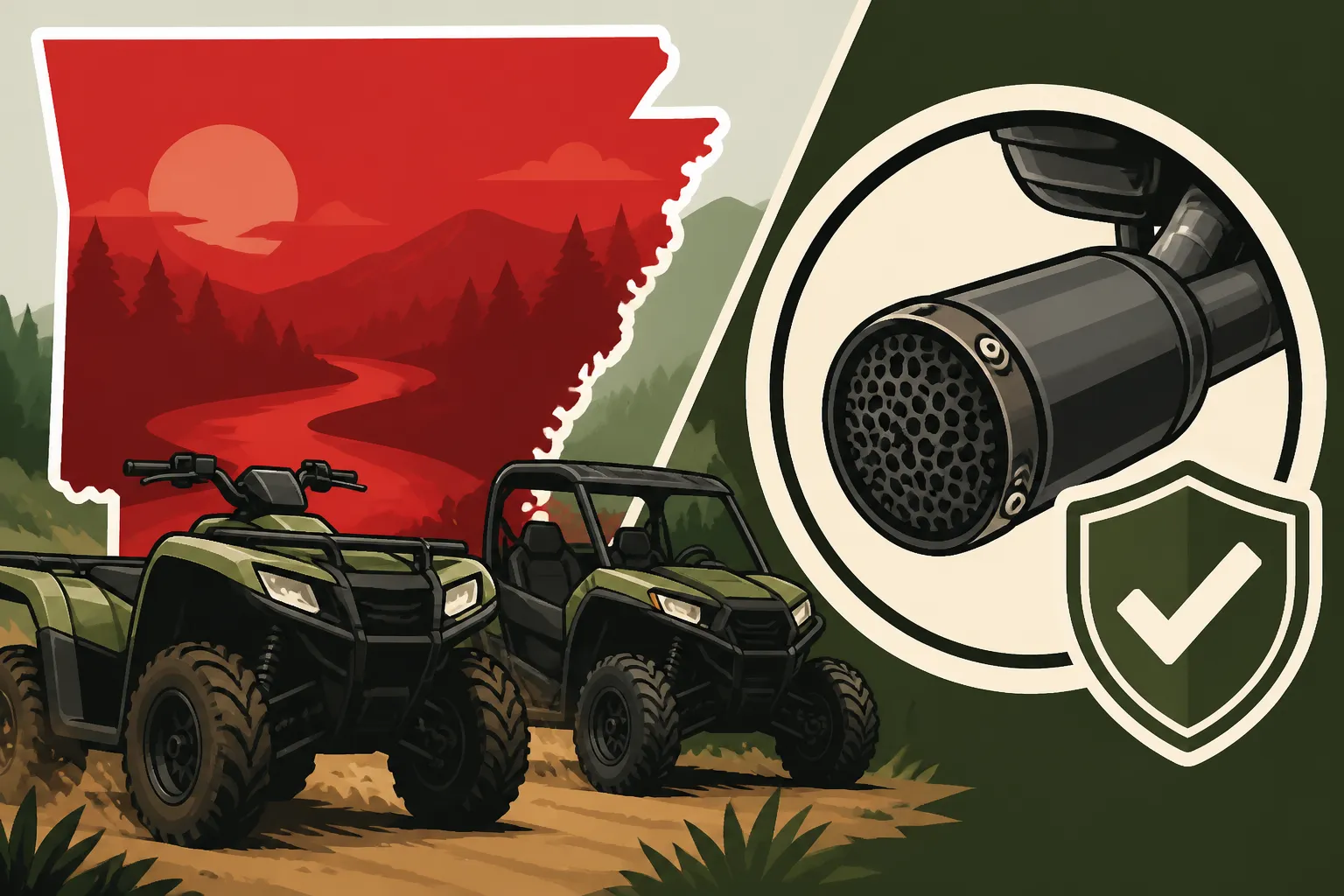
A spark arrestor is a device in an engine’s exhaust system intended to prevent sparks from escaping. For riders, the practical question is whether the machine has a properly installed, maintained arrestor—not simply whether the exhaust looks stock or sounds quiet.
The USDA Forest Service says federal regulations governing the National Forest System require internal combustion engines on off-highway vehicles to have a properly installed and maintained spark arrester. That requirement applies to ATV use in the Ozark-St. Francis National Forests. Treat it as part of your riding setup before you enter Forest Service land, rather than as an optional add-on.
A spark arrestor and a muffler are not interchangeable terms. A muffler reduces exhaust noise; a spark arrestor addresses sparks in the exhaust. A component may serve a role in an exhaust assembly, but a quiet machine is not automatically compliant. If you are unsure what is installed, check the owner’s manual and ask the manufacturer or the land manager to clarify whether the equipment meets the rule.
Arkansas law also prohibits operating an ATV with a modified exhaust or with a removed or modified spark arrester, according to the Arkansas State Legislature. Some public wildlife management areas apply a strict “Factory Exhaust Only” rule. That means replacing or altering factory exhaust equipment can create a problem beyond the specific federal spark-arrester requirement. Don’t assume that an aftermarket part is acceptable just because it fits or reduces noise.
| Situation | What to keep in mind |
|---|---|
| Riding an ATV in the Ozark-St. Francis National Forests | The USDA Forest Service requires a properly installed and maintained spark arrester on an internal combustion OHV. |
| Considering an exhaust modification | Arkansas law prohibits operating an ATV with a modified exhaust or a removed or modified spark arrester, according to the Arkansas State Legislature. |
| Entering a wildlife management area | Check that area’s rules; some enforce “Factory Exhaust Only” requirements. |
| Unsure whether a component qualifies | Check the owner’s manual and confirm with the land manager or manufacturer before riding. |
The table is a starting point, not a substitute for the rules at a particular riding area. Public land can be managed by different agencies, and restrictions may be more specific than the general rule. For example, the National Park Service oversees regulations within the boundaries of the Buffalo National River. Don’t assume that a rule you have checked for a national forest automatically settles what applies on National Park Service land, a state wildlife management area, or a private riding property.
The distinction between a spark arrestor rule and a permit rule matters, too. Having the right equipment does not mean you have permission to ride on every trail, and having a permit does not make prohibited exhaust modifications acceptable. For related land-access requirements, see Arkansas Riders Need Two Different Forest Passes and Arkansas AGFC WMA Rules for Riders.
How to check your ATV before riding
Start with the machine, not with a shopping search. Find the owner’s manual and identify the exhaust system the manufacturer specifies for your model. If you bought the ATV used, ask whether the exhaust has been changed and inspect it for missing, damaged, or altered parts. A previous owner’s assurance is useful, but it is not a substitute for confirming what is actually installed.
Then check the rules for the land you plan to ride. Look at the managing agency’s information for that trail or area, and contact the relevant office if the requirement is unclear. Ask specifically whether the machine’s existing equipment meets the spark-arrester rule and whether the area has a separate factory-exhaust or noise restriction. Don’t rely on general advice from a rider who uses a different trail system.
A practical pre-ride check can help you spot problems early:
- Identify who manages the riding area and read its current OHV rules.
- Check the owner’s manual to see what exhaust and spark-arrester equipment belongs on your machine.
- Inspect the exhaust for signs of removal, damage, or modification.
- If the machine has aftermarket components or you are uncertain about its condition, ask the manufacturer or land manager before riding.
- Carry or keep available any documentation that helps identify the installed equipment, if the agency recommends it.
This is a cautious preparation routine, not a claim that a particular document or test is universally required. The key legal requirements in the supplied federal and state rules are that the arrester be properly installed and maintained, and that an ATV not be operated with a removed or modified arrester or prohibited modified exhaust. If an officer or ranger questions the setup, a seller’s product description alone may not resolve whether it complies.
If a part needs replacement, match it to the specific ATV and exhaust configuration. A listing that uses the words “spark arrestor” is not, by itself, proof that the part is right for your machine or acceptable on the land you plan to ride. If you shop through Amazon or another retailer, verify model fit and product details with the manufacturer, and confirm any land-specific restriction before ordering. Avoid removing factory components or making exhaust changes based on a guess.
Pay attention to condition after installation as well. The USDA Forest Service requirement is not just to have an arrester present; it must be properly installed and maintained. If the exhaust is damaged, a component is loose, or you cannot tell whether an important part is still in place, postpone the ride until you have checked it. A repair that seems minor can still leave you uncertain about compliance.
Spark arrestor questions often overlap with noise rules, but they are not the same thing. A machine can be relatively quiet yet still have a missing or altered arrester. Likewise, meeting a spark-arrester requirement does not establish that the machine meets every sound restriction for the area. For that separate issue, see Arkansas Sound Limits on Forest Land.
Permits, trail rules, and common mistakes
Equipment compliance is only one part of preparing for public-land riding. Forest Service OHV areas may have route restrictions, seasonal closures, and access requirements. The USDA Forest Service says designated motorized trails in the Ouachita National Forest, including the Wolf Pen Gap Trail Complex, are typically open from the first Friday of March through October 31, with specified holiday periods from three days before Thanksgiving through two days after, and from December 22 through January 2. Confirm current conditions and closures with the Forest Service before making the trip; a general operating window does not guarantee that a particular trail is open on your planned day.
Permit rules also depend on the land and trail system. The USDA Forest Service says non-residents generally do not need a separate Arkansas state OHV registration or trail permit to ride designated routes on federal public lands such as Arkansas’s national forests, but rules and entry permits can vary with the agency managing the land. Specific systems in the Ozark-St. Francis National Forests, including Mill Creek and Moccasin Gap, require a day-use fee or permit. Check the current requirements for your destination instead of assuming that one pass covers every area. The related topics Arkansas OHV Permit Cost in 2026 and Arkansas WMA Access for a Quad can help you sort out permit questions.
Keep these common mix-ups in mind:
- A permit does not replace compliant equipment. Meeting a trail’s access requirements does not waive spark-arrester or exhaust rules.
- A factory-looking exhaust is not conclusive. Inspect the actual equipment and verify it against the manual and applicable rules.
- A quiet exhaust is not necessarily a spark arrester. Noise control and spark control are different functions.
- A rule for one type of public land may not apply elsewhere. Forest Service, state-managed wildlife areas, National Park Service land, and private parks can have distinct requirements.
- A trail’s usual open season is not a guarantee of access. Closures and conditions can change. Review Arkansas Trail Conditions Before You Tow before setting out.
Road use is a separate issue from trail use. Generally, operating an ATV on Arkansas public streets and highways is unlawful, except for specific exceptions such as farming, hunting, or direct road crossings, according to the Arkansas General Assembly. A compliant exhaust or spark arrester does not make a machine street legal. For the road rules, see Can You Drive an ATV on the Road in Arkansas?.
The safest approach is straightforward: keep the machine’s exhaust equipment intact, verify that the spark arrester is properly installed and maintained, and check the land manager’s current rules before each trip. If the machine has been modified or the applicable requirement is unclear, get an answer from the responsible agency before riding. That small check can prevent an avoidable trail-side dispute and helps keep your trip focused on the ride.
Sources
- USDA Forest Service — Wolf Pen Gap – Ouachita National Forest (checked November 2, 2026)
Disclaimer
This article is for general informational purposes only and does not constitute professional advice. Laws, prices and regulations vary by location and change over time. Consult a qualified professional for guidance on your specific situation.