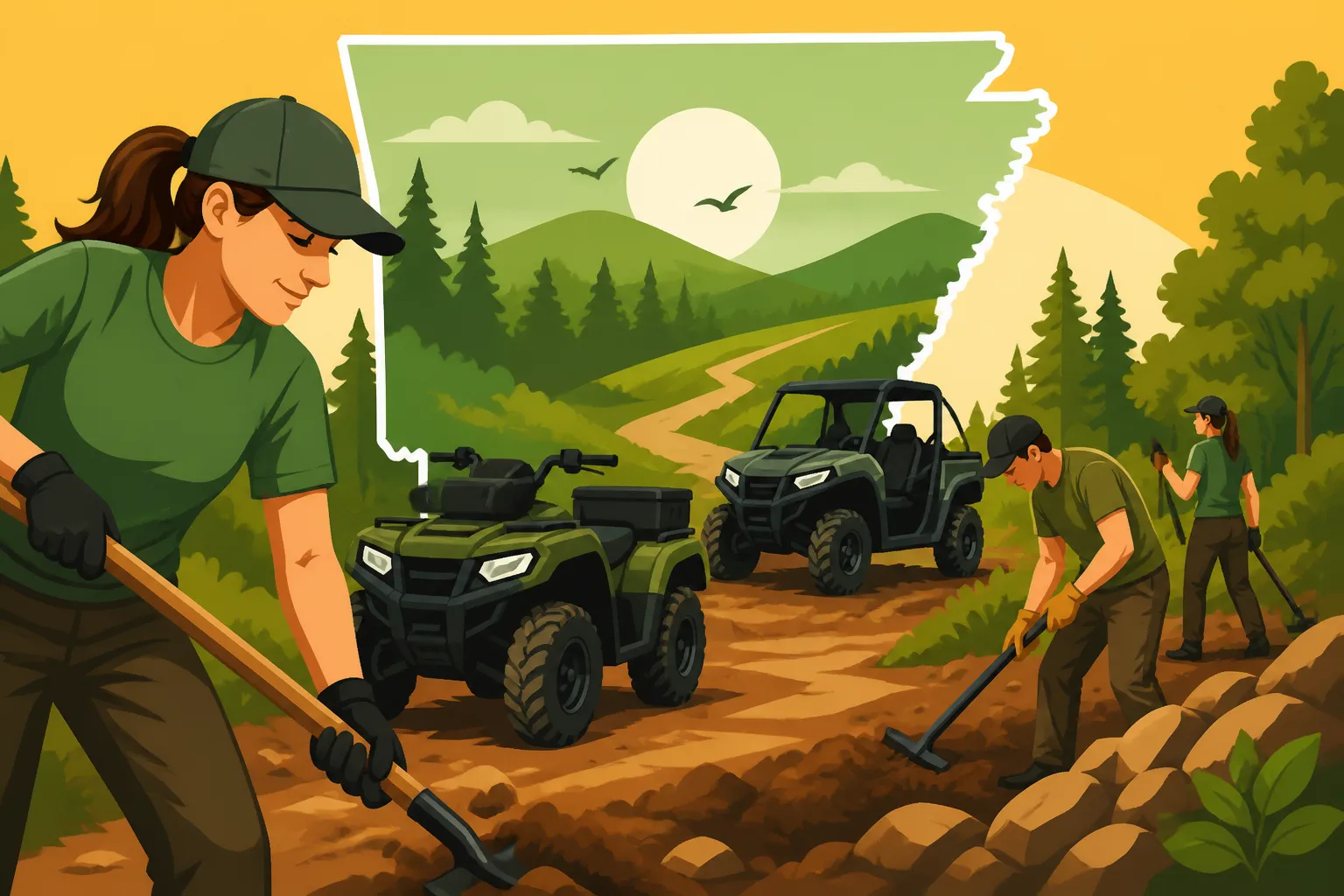
Arkansas Trail Volunteer Days
A washed-out Ozark trail, a blocked culvert, or a loose sign can turn a favorite Arkansas ride into a frustrating or unsafe outing. Volunteer trail days give riders a practical way to help care for the places they use, but work on public land needs coordination and permission. This guide explains how to find an organized project, prepare for the day, and lend a hand responsibly.
What Arkansas trail volunteer days involve
A volunteer day is usually a scheduled work session organized or approved by the land manager, trail group, or private riding area responsible for the site. The tasks depend on what needs attention and what volunteers are qualified to do. One outing might focus on picking up litter and clearing small branches; another may involve more involved trail maintenance under an experienced crew leader.
The key point is that trail work is not simply a matter of showing up with a chainsaw or moving rocks wherever they seem inconvenient. A trail may cross sensitive habitat, private property, a drainage area, or a section with a planned route change. Even a well-intentioned shortcut can make erosion worse or send riders somewhere they are not allowed to go.
Common work on a volunteer day
Many projects involve straightforward tasks such as collecting litter, removing small debris, cleaning around a trailhead, or helping maintain a sign or kiosk. These jobs can still make a noticeable difference. A clean, readable trailhead is easier for visiting riders to use, and removing debris from an approved work area can help keep the route clear.
Other projects may address water and erosion. Volunteers might help clean a drainage feature, stabilize a small trouble spot, or move soil and rocks under a supervisor’s direction. The right fix depends on the slope, soil, water flow, and trail design. A drainage issue that looks like a quick shovel job may need a specific approach to keep water from cutting a deeper rut.
Some work is more specialized. Operating power tools, repairing structures, or building trail features may require training, protective equipment, and direct supervision. Organizers should explain what tools are needed and what qualifications are expected before the workday. If a task is beyond your experience, it is perfectly reasonable to ask for a different assignment.
Why organized work matters on public land
Arkansas riding areas include public lands, managed trail systems, and private parks. Their rules and responsibilities are not interchangeable. A route in the Ouachita National Forest, for example, is managed differently from a private off-road park, and a volunteer group may only work on projects approved by the responsible manager.
This coordination helps protect the trail and the people using it. The land manager or designated organizer can identify where work is allowed, what materials or tools are appropriate, and whether a temporary closure is needed. They can also clarify whether volunteers should avoid a wet section, a habitat area, or a route that is already scheduled for repair.
That is why independent trail clearing is risky, even when the goal is helpful. Don’t cut trees, alter drainage, move signs, or create a bypass unless the responsible organization has approved the work. For a broader look at how riders can help keep shared routes usable, see Arkansas Trail Etiquette Locals Expect.
How to find a legitimate volunteer opportunity
Volunteer days may be announced by a land manager, riding club, park operator, or local trail group. There may not be a single statewide calendar covering every Arkansas riding area, so it helps to check with the organization responsible for the specific trail you want to support. Ask whether the project is open to new volunteers and whether you need to register in advance.
If you ride near Mena, contact the appropriate office or organization before planning a work trip. The What the Mena-Oden Ranger District Office Handles for Riders guide can help you understand the kind of rider questions that office handles. For other areas, start with the land manager or park operator listed for that trail system.
Ask the right organization first
For a National Forest trail, check with the relevant Forest Service office or an approved partner group. A local riding club may know about upcoming work, but confirm that the project is authorized and that the group has permission to work at the site. For a private park, contact the operator directly and ask whether it runs volunteer projects or accepts help outside scheduled events.
If you are interested in joining a rider community, Arkansas ATV Clubs Worth Joining is a useful starting point. A club can help you learn who maintains a particular route and how local projects are coordinated. Still, verify the details for each workday: a club ride or informal cleanup is not automatically a sanctioned trail-maintenance project.
When contacting an organizer, ask a few practical questions:
- Where is the meeting point, and how will you recognize the group?
- Is advance registration required?
- What tasks are planned, and how strenuous are they?
- Should you bring tools, gloves, water, or safety gear?
- Are machines allowed at the work site, or should volunteers arrive on foot?
- Will the work area or trail be closed to riding during the project?
- Is there a weather plan or a way to hear about a cancellation?
Clear answers are a good sign that the project is organized. If the location, authority to work, or safety expectations are unclear, wait for confirmation rather than guessing.
Check the trail’s status before you travel
A workday can be postponed because of rain, high water, heat, storm damage, or a change in the project plan. Check for updates shortly before leaving, especially if you are driving from Little Rock, Fayetteville, Fort Smith, or another distant starting point. It is disappointing to tow a machine and arrive at a closed or empty trailhead, but a quick status check can save the trip.
This matters even if you are volunteering rather than riding. The route into a work area may be muddy, gated, or inaccessible to ordinary vehicles. Use the organizer’s directions, not an old pin saved from a previous visit. For a riding trip around Wolf Pen Gap, How to Check Wolf Pen Gap Trail Status covers the importance of checking conditions before heading out.
Trail condition information can also help you decide whether to volunteer or reschedule. Arkansas Trail Closures After a Storm explains why a route may need to remain closed while it recovers. For a general trip-planning checklist, see Arkansas Trail Conditions Before You Tow. An off-road mapping tool such as onX Offroad can help you orient yourself while planning, but it does not replace a current closure notice or permission from the land manager.
Plan for a safe and useful day
Volunteer work can be more physically demanding than a normal ride. You may spend hours walking uneven ground, carrying supplies, bending, or working in hot and humid weather. A little preparation makes it easier to contribute without overdoing it or slowing down the crew.
Do not assume that riding gear alone is right for every job. A helmet and riding boots may be useful around machines, but hand tools, brush, heat, and lifting can call for different protective equipment. Follow the organizer’s instructions, and ask what will be provided before you pack.
Pack for the task and the weather
At minimum, consider sturdy footwear with good traction, work gloves, drinking water, snacks, sun protection, and clothing suited to the forecast. Long sleeves and long pants can help protect against brush, insects, and sun, though the organizer may recommend different clothing for a particular task. Bring personal medication you may need during the day.
If tools are requested, bring only the type and condition specified. A shovel, loppers, or hand saw may be useful for one project and unnecessary—or unsuitable—for another. Do not bring a chainsaw or powered equipment unless the organizer has specifically requested it and explained the safety requirements. Keep tools secured during transport so they cannot shift in a truck bed or trailer.
A sample packing checklist:
| Item | Why it may help | Check with the organizer |
|---|---|---|
| Water and a refillable bottle | Supports hydration during outdoor work | Ask whether potable water is available |
| Work gloves | Helps protect hands from rough surfaces | Confirm the type needed for the task |
| Sturdy boots | Improves traction on uneven ground | Ask about footwear requirements |
| Sun protection | Helps during exposed work | Check whether the work area is shaded |
| Snacks and lunch | Keeps energy up through a long session | Confirm meal or break arrangements |
| Hand tools | May be needed for assigned work | Bring only tools the crew has requested |
| First-aid supplies | Useful for minor personal needs | Ask who is responsible for group first aid |
| Rain layer or extra clothing | Weather can change during the day | Follow the event’s weather plan |
Use onX Offroad or another navigation aid to understand the general area and plan your approach, but download or save the organizer’s directions too. A phone map can be helpful, yet service may be weak in parts of the Ozarks and Ouachitas. Do not rely on a map app to tell you whether a road or trail is open to volunteers.
Follow the crew leader’s instructions
At the start of the day, listen to the safety briefing and make sure you understand the work boundary. Ask who is leading each task and where to go if you need help. If you arrive late, check in before joining a crew; otherwise, the leader may not know you are on site or which assignment you are doing.
Work at a steady pace. It is better to complete a smaller task carefully than to rush and leave a drainage feature or sign in worse condition. If you find a hazard outside your assigned area—such as a damaged tree, exposed wire, unstable ground, or a blocked route—tell the crew leader rather than trying to fix it yourself.
Riders sometimes bring an ATV or side-by-side because the trailhead is far from home or because they expect to ride after the project. Ask first. A workday may prohibit recreational riding, limit vehicle access, or require machines to stay in a designated staging area. Keep machines away from work crews unless the organizer has given clear instructions about their use.
Support Arkansas trails beyond one workday
A volunteer day is valuable, but trail stewardship is ongoing. Conditions change with storms, heavy use, seasonal closures, and maintenance needs. You can support a trail system by following posted rules, sharing accurate condition information with the responsible organization, and encouraging other riders to avoid damaging wet or closed routes.
For example, a volunteer may notice a new washout on a route near Ozark or a damaged marker in the Ouachitas. Reporting the location to the land manager is more useful than making an unauthorized detour around it. If you use a mapping app such as onX Offroad to note where you encountered an issue, treat that information as a helpful reference—not proof that the route is open or that maintenance work is permitted there.
Respect closures and temporary work zones
A closed trail is not an invitation to find another line through the woods. Closures may protect recovering soil, allow repairs, reduce safety risks, or prevent damage to nearby land. Riding around a barrier can widen the disturbed area and create a new route that managers have not approved.
When a work crew is present, slow down well before reaching the site and follow any signs or instructions. If the route is closed, turn around rather than trying to squeeze past workers or equipment. You can also review Arkansas Trail Closures After a Storm to understand why waiting for a trail to reopen is part of responsible riding.
If you are planning a ride around a volunteer project, check whether the work affects nearby routes or access roads. The Mill Creek OHV Trail System in Arkansas and other trail-system guides can help you plan around a specific riding area, but the organization responsible for the trail remains the authority on current access.
Make volunteering manageable for beginners
You do not need to be an experienced mechanic or trail builder to be useful. Many projects need people who can carry supplies, pick up litter, help at a meeting point, or follow a simple task with care. If you have a physical limitation, tell the organizer before the event; they may be able to suggest a suitable assignment or explain whether the site is accessible.
Families should ask about age requirements and supervision before bringing children. A trail worksite can include sharp tools, uneven ground, vehicles, and changing conditions. Keep children with an adult and follow the organizer’s rules about where they can be. Do not assume a project is family-friendly simply because it takes place outdoors.
You can also contribute without attending every workday. Share official closure updates, leave gates and signs as directed, pack out trash, and encourage friends not to ride muddy or restricted routes. A dependable volunteer who comes prepared and follows instructions is often more helpful than a large group arriving without knowing the plan.
Disclaimer
This article is for general informational purposes only and does not constitute professional advice. Laws, prices and regulations vary by location and change over time. Consult a qualified professional for guidance on your specific situation.