Carrying a Tow Strap in the Hills
A tow strap can turn a stuck ATV or UTV from a long, stressful trail-side problem into a careful, controlled recovery—but only if you bring the right gear and know how to use it. Arkansas hills add slick clay, loose rock, steep grades, and limited room to maneuver. This guide covers what to pack, how to connect safely, and when not to pull.
Why a Tow Strap Belongs in Your Arkansas Trail Kit
Hills make small problems harder
A machine that slides off the edge of a muddy rut or settles against a rock may not be badly stuck, but the slope can make it difficult to regain traction. On routes around Wolf Pen Gap or Mill Creek, a rider may also be far from a trailhead, cell service, or anyone able to help. A strap gives your group another option for a slow, controlled pull when a machine cannot move under its own power.
The need is not limited to dramatic mud holes. A UTV can high-center on a rock ledge, an ATV can lose traction on wet leaves, or a machine can drift into a ditch while trying to turn around on a narrow trail. A strap can help reposition a vehicle or move it a short distance to safer ground—provided both machines have suitable attachment points and the recovery path is clear.
Before heading out, look at the route, weather, and vehicle limits as well as your recovery gear. Arkansas Trail Conditions Before You Tow is useful context when rain or recent trail damage may affect the ride. If your route includes steep terrain, reading about Arkansas Trail Ratings and What They Mean can help your group think through whether the trail suits its riders and machines.
A strap is a backup, not a guarantee
Carrying a strap does not mean every stuck machine can be recovered safely. The vehicle may be wedged, positioned on a dangerous slope, or missing a proper recovery point. In those situations, pulling harder can make things worse: the stuck machine may shift suddenly, the pulling machine may lose traction, or equipment may fail under load.
It also helps to distinguish a tow strap from a kinetic recovery strap. A conventional tow strap is generally intended for a gradual, controlled pull; it is not automatically suitable for a high-speed, slack-line “snatch” recovery. Kinetic recovery gear is designed for a different use and must be selected and used according to its manufacturer’s directions. Never assume that a strap is appropriate for every kind of pull just because it looks sturdy.
For steep climbs or a machine that is firmly pinned, a properly equipped winch may offer more control than pulling with another vehicle. A strap still has a useful place in the kit, but it should not be treated as a substitute for a winch, a recovery plan, or a decision to stop and seek help. Winches and Steep Rock Climbs covers situations where a different recovery method may make more sense.
Choosing and Packing the Right Recovery Gear
Check the strap and its intended use
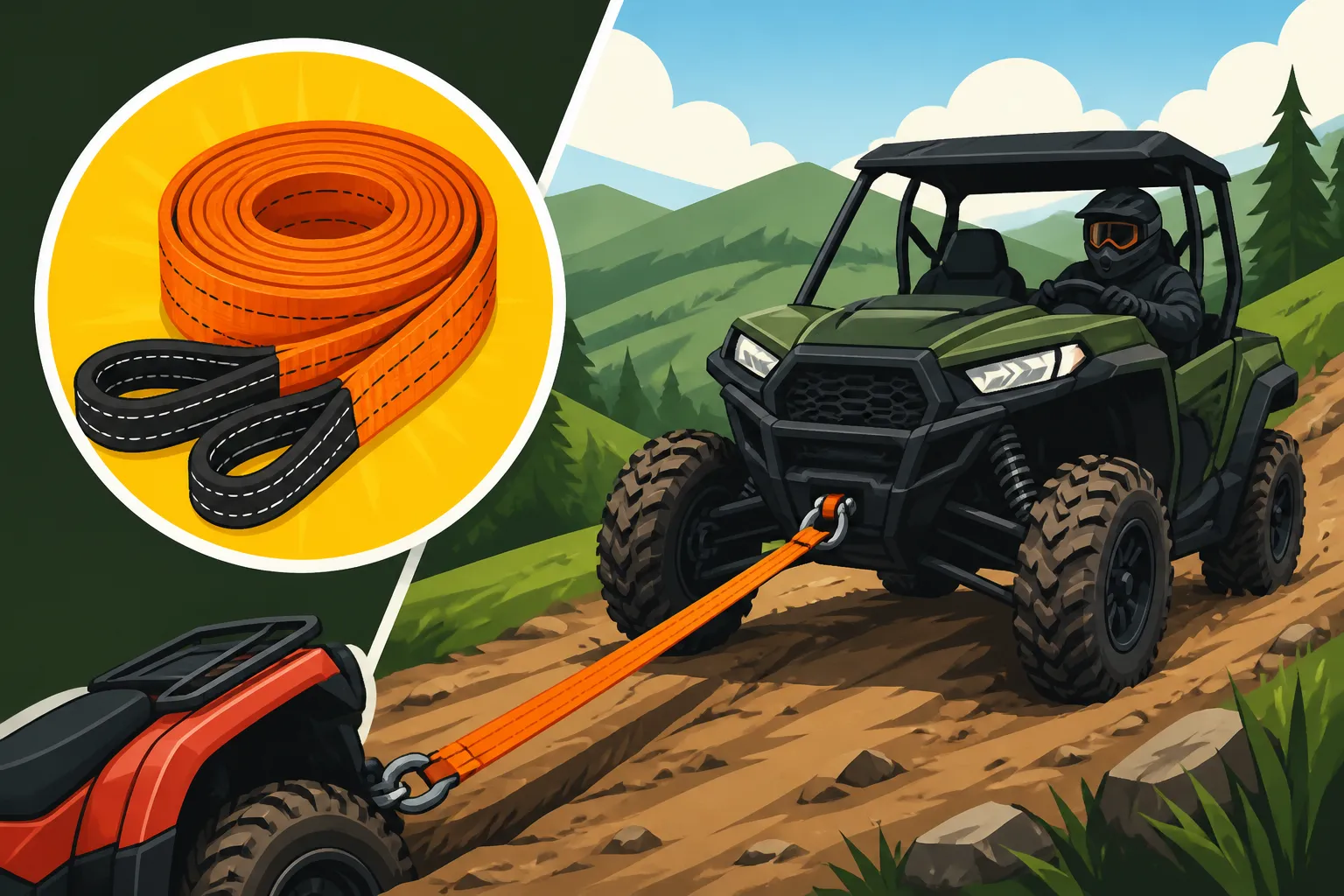
Choose a strap made for vehicle recovery, and read its label and instructions before the ride. Look for its stated working limits, intended use, and any guidance about compatible hardware. The combined weight of a machine and its cargo can be greater than a rider expects, especially with a loaded side-by-side, passengers, tools, and supplies on board. If you are unsure whether a strap is suitable for your machine or recovery situation, ask a knowledgeable dealer or recovery-equipment professional rather than guessing.
Inspect the strap before every trip. Look for cuts, torn stitching, fraying, melted or glazed areas, damaged loops, and contamination that could weaken the material. Dirt alone may be washable, but a strap with structural damage should not be trusted for recovery. Keep it dry and out of direct sun when storing it, and follow its care instructions. A strap tossed loose in a cargo bed can get pinched, dragged, or covered in grit; a bag or dedicated storage spot helps protect it.
Consider packing compatible soft shackles or other connectors only if you know how to use them and they are rated for the task. Metal hardware should be intended for recovery and compatible with the attachment points. A small collection of gear is not helpful if nobody in the group knows which parts work together.
Pack for the recovery you may actually face
A practical recovery kit can include a recovery-rated strap, suitable connectors, gloves, and a way to keep the strap clean and organized. A winch-equipped machine may need additional equipment suited to its system, such as a tree-protection strap, if the operator has been trained to use one. Follow the equipment manufacturer’s directions rather than improvising with cargo straps, chains, rope, or hardware of unknown strength.
| Gear | Why it can help | Important check |
|---|---|---|
| Recovery-rated tow strap | Allows a gradual pull or short repositioning | Confirm its stated use and limits |
| Compatible recovery connectors | Join the strap to proper recovery points | Use only hardware designed and rated for recovery |
| Work gloves | Help protect hands while handling dirty or rough gear | Keep hands clear of loaded connections |
| Storage bag | Keeps the strap contained and easier to find | Let wet gear dry before storing it long term |
| Winch equipment, when appropriate | Offers controlled pulling in situations a strap may not suit | Use only with compatible gear and proper training |
Navigation matters too. A recovery can become more complicated if a group loses track of its route or the nearest access point. Some riders use onX Offroad to review mapped routes and save information for areas where a phone may not have service. The app can support trip planning, but it does not replace checking land access, trail conditions, or local rules before riding. A paper backup is useful if a phone battery dies or an app is unavailable; see Carrying a Paper Map as Backup.
How to Use a Tow Strap More Safely
Stop and assess before attaching anything
When a machine gets stuck, the first impulse is often to pull immediately. Pause instead. Check whether anyone is injured, whether the machine is stable, and whether the ground below or beside it could give way. Ask everyone to move clear of the recovery area, including people standing between the machines or near the strap. Keep bystanders well away from the line of pull and any likely path of movement.
Look at the slope and ask what will happen if the stuck vehicle moves suddenly. Is there room for it to roll or slide? Could the pulling machine be dragged downhill? Is the strap likely to rub against a sharp rock, tree, or vehicle edge? If you cannot answer those questions confidently, do not tension the strap. On a steep or exposed section, repositioning both machines or getting qualified assistance may be safer than attempting a pull.
Check both vehicles’ recovery points. Use only points designed for recovery, and consult the vehicle manual if you do not know where they are. Do not attach a strap to a tow ball, suspension part, axle, cargo rack, or an ordinary bumper unless the manufacturer specifically identifies that point as suitable for recovery. A part that can handle normal towing or carry cargo is not necessarily built for recovery loads.
Make a slow, controlled pull
If the machines are stable, the recovery points are suitable, and the path is clear, connect the strap without twists or knots. Keep it away from sharp edges and hot components, and use the connector in the manner its manufacturer specifies. The people operating the machines should agree on a simple signal to start and stop. Nobody should straddle, step over, or stand close to a strap once it is under tension.
The pulling vehicle should take up slack gently and apply a gradual, controlled force. Do not build speed to jerk the stuck machine free with an ordinary tow strap. Sudden loading can damage equipment or cause a vehicle to move unpredictably. The operator in the stuck machine should follow the agreed plan and avoid spinning the tires aggressively; wheelspin can dig the machine in further or throw debris.
Stop immediately if the strap shifts, a connection starts to deform, a vehicle tilts or slides unexpectedly, or the pull is not working. Do not keep adding force just because the first attempt failed. Reassess the angle, ground, and attachment points. If the stuck vehicle is on a steep slope or the strap would cross an unsafe path, choose another recovery method or wait for help.
Keep people and equipment out of the danger zone
A loaded strap stores energy, and a failed connection can send equipment or parts moving with force. Never let anyone stand in the direct line of the strap or near a connection while it is loaded. Keep spectators farther away than seems necessary, and do not ask someone to hold the strap, guide a connection by hand, or stand between the machines to direct the pull.
Do not rely on a loose object placed over a strap as a guarantee of safety. It cannot make a dangerous attachment point or poor recovery plan safe. Instead, reduce risk by using sound equipment, suitable recovery points, a controlled pull, and clear communication. If the situation requires people to stand in a risky position, stop and change the plan.
After the recovery, inspect the strap and connectors before packing them away. If the strap has visible damage or was subjected to an event outside its intended use, set it aside until you can determine whether it remains serviceable. Make sure the recovered machine can travel safely before continuing. A successful pull does not automatically mean the vehicle is ready for a long ride.
Plan for Recovery Before You Need It
Match the route to the group and machines
A strap is most useful when it is part of a broader plan. Before leaving, talk through who carries the recovery gear, who knows how to attach it, and what the group will do if the trail becomes unsafe. Consider machine width, ground clearance, tires, passenger load, and rider experience. A route that feels manageable in dry weather can be a different proposition after rain, particularly where clay or loose rock affects traction.
Check the route using more than one source when possible. onX Offroad can help riders organize a route and review mapped terrain, but mapping information should be treated as a planning aid rather than a promise that every road or trail is open or passable. Check land manager information and local trail updates as well. For the Ouachita region, it is especially helpful to think ahead about areas with weak reception; Cell Dead Zones in the Ouachitas offers related planning context.
Leave a trip plan with someone who is not riding. Include the general area, planned route, group size, and expected return window. Tell the group what to do if separated, and agree on a point where everyone will regroup. These steps do not prevent every problem, but they make a delay or breakdown less confusing for the people waiting at home.
Respect trail conditions and other riders
A recovery should not create a bigger trail problem. If a machine is stuck in a soft or damaged section, avoid spinning tires or dragging equipment across vegetation when another option exists. Do not block a narrow trail longer than necessary, and be mindful of other riders who may approach from either direction. A calm signal to stop and wait can prevent a second vehicle from entering the recovery area.
Trail conditions can change quickly after a storm. A route that was firm during a previous visit may be deeply rutted or slippery now. If you find fresh damage, a closed gate, or a section that looks unsafe, turn around rather than trying to force the machine through. Arkansas Trail Closures After a Storm and Arkansas Trail Etiquette Locals Expect are useful companion reads for making that judgment and sharing the trail responsibly.
The same caution applies when a recovery happens near a steep edge, creek crossing, or blind turn. Give approaching riders a clear warning from a safe location. Do not leave a strap stretched across the trail, and do not assume that riders can see a stopped group around a bend. When the recovery is complete, gather all equipment and check the route before moving on.
Know when to stop trying
A tow strap is for a suitable, controlled recovery—not for every situation. Stop if the machine is unstable, the slope is too steep, no rated attachment point is available, the strap is damaged, or the pulling vehicle cannot hold its position. Stop as well if the attempt would put a person in the line of pull or require a sudden jerk. Waiting for help is frustrating, especially when a group has already spent hours getting to the trail, but a damaged machine or injured rider turns a delay into a much more serious problem.
After a difficult recovery, take a minute to decide whether the rest of the route still makes sense. A machine may have a bent component, damaged tire, or other problem that is not obvious at first glance. If it no longer handles normally, do not push on into remote terrain. A shorter return by a known route may be the safer choice.
A little preparation makes carrying a tow strap genuinely useful: choose gear suited to the machine, protect it from damage, learn the connection points, and agree on a slow, clear recovery plan before anyone gets stuck. onX Offroad can help with route planning, while a paper map and a group communication plan provide useful backups. Most importantly, treat an unsafe recovery as a reason to stop—not as a challenge to pull harder.
Disclaimer
This article is for general informational purposes only and does not constitute professional advice. Laws, prices and regulations vary by location and change over time. Consult a qualified professional for guidance on your specific situation.