Dust Complaints on a County Road
There's nothing quite like hitting the county roads in your ATV or UTV, feeling that fresh air and enjoying the freedom that comes with it. But let's be real: that freedom can sometimes come with a major downside for others – dust. If you've ever heard a neighbor grumble or seen a plume of fine Arkansas silt chasing you down a gravel road, you know exactly what I'm talking about. This guide is all about tackling that pesky problem, understanding why it happens, and exploring practical, realistic ways for riders and communities to reduce dust complaints on county roads.
Understanding the Problem: More Than Just a Little Dirt
When we talk about dust on county roads, it’s easy to think of it as just a minor annoyance. But for those who live along these routes, or for other drivers sharing the road, it’s often much more significant than that. The problem isn't always about malice from riders; sometimes it's simply a lack of awareness of the full impact, or the cumulative effect of many machines on unpaved surfaces.
Beyond Just a Nuisance: Health, Property, and Safety Concerns
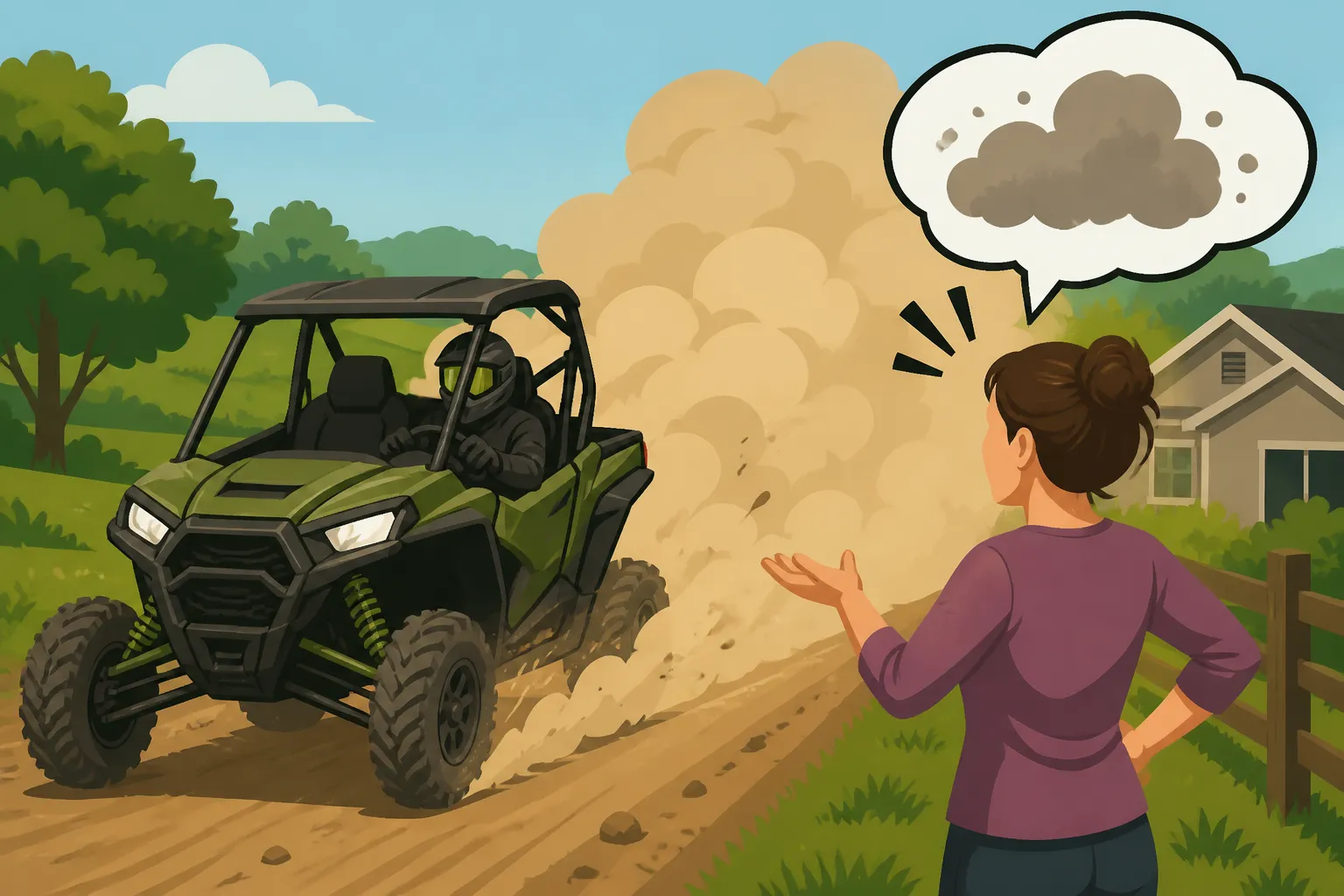
That cloud of dust you might kick up isn't just an aesthetic issue. It carries fine particulate matter, which can irritate eyes, noses, and throats. For individuals with respiratory conditions like asthma or allergies, prolonged exposure can exacerbate symptoms and lead to serious health issues. Imagine living next to a frequently used gravel road where ATVs and UTVs regularly pass by. The air quality inside and outside homes can suffer significantly.
Beyond health, dust has a real impact on property. It settles on everything: homes, vehicles, outdoor furniture, and even fresh laundry hanging on the line. Homeowners often find themselves washing cars and cleaning exteriors more frequently, leading to extra work and expenses. Gardens and landscaping can also be affected, as dust can coat plants and reduce their health.
Then there's the critical safety aspect. A dense dust cloud drastically reduces visibility for everyone on the road. For oncoming vehicles, this can create blind spots, making it difficult to see ATVs, UTVs, or even pedestrians. When multiple machines are riding together, the dust can obscure the rider in front, increasing the risk of collisions. This isn't just a hypothetical scenario; many near-misses on Arkansas's beautiful but often dusty backroads happen precisely because of visibility issues created by an unexpected dust plume.
The Ripple Effect on Community Relations and Local Ordinances
The impact of dust often extends beyond individual grievances and into the broader community fabric. Persistent dust complaints can strain relationships between residents and riders, fostering an "us versus them" mentality. If a local resident, who relies on a county road for daily access, constantly deals with dust from recreational riders, it can quickly lead to frustration and resentment. This animosity can escalate, sometimes leading to direct confrontations or calls for stricter regulations.
When enough complaints pile up, local city and county councils often feel compelled to act. This is where the real risk for riders comes in. Instead of seeking common ground, communities might push for outright bans on ATV and UTV use on certain roads, or implement restrictive ordinances that make riding less enjoyable or even impossible. You see towns across Arkansas grappling with this balance, trying to accommodate recreational riding while addressing citizen concerns. For instance, while some areas might be considering [Arkansas Local Permits for Street UTVs], others might be tightening rules specifically because of issues like dust and noise. Nobody wants to see their favorite riding routes restricted, but these outcomes are a very real possibility when dust issues aren't proactively addressed.
Practical Solutions for Riders: Taking the Initiative
As riders, we're often the first line of defense when it comes to mitigating dust. Taking personal responsibility and making a few adjustments to our riding habits and machines can go a long way in being a good neighbor and preserving our access to those scenic county roads. It’s not just about avoiding a ticket for [Arkansas Penalties for Illegal Road Riding], but about fostering a positive image for the entire ATV/UTV community.
Mindful Riding Habits: Slowing Down and Spacing Out
Believe it or not, one of the most effective dust reduction strategies doesn't cost a dime: it's simply how you ride. The faster you go on an unpaved road, especially one made of loose gravel or dirt, the more dust you'll kick up. It's basic physics! By reducing your speed, particularly when passing homes, other vehicles, or any area where dust would be an issue, you significantly decrease the amount of particulate matter thrown into the air.
Similarly, riding in a tight convoy of ATVs or UTVs will create a massive, continuous dust cloud. If you're out with a group, encourage everyone to spread out, leaving more distance between machines. This allows the dust from the lead rider to settle a bit before the next machine comes through, breaking up the continuous plume. Think of it like a train versus individual cars – individual cars, spaced out, have less collective impact. Also, consider the conditions. After a good rain, dirt roads are often packed down and dust is less of an issue. If it's been bone-dry for weeks, that's when you really need to be extra vigilant and perhaps even choose alternate routes or times of day when there's less traffic.
Equipment Modifications: Deflecting and Enclosing Dust
Sometimes, riding habits aren't enough, especially with the power some of today's machines possess. This is where investing in a few aftermarket modifications can make a significant difference.
- Windshields and Rear Panels: A full windshield on your UTV can block a lot of the dust that would otherwise blow back into your cab or directly onto passengers. But don't forget the rear! A rear dust panel or a full cab enclosure is often overlooked, but it's critical for preventing dust from swirling in from behind, which is a common complaint for UTV riders. Companies like SuperATV offer a wide array of options, from full glass windshields to vented rear panels, designed to create a more contained and dust-free environment for you and your passengers.
- Dust Deflectors: These smaller, strategically placed accessories can redirect airflow, preventing dust from entering specific areas, like between the seats or around the engine bay. They might seem minor, but they contribute to a cleaner ride.
- Tire Choice: While knobby tires are fantastic for off-road grip, some aggressive tread patterns can also churn up more dust on loose surfaces. If you primarily ride on county roads, considering a less aggressive, all-terrain tire with a tighter tread pattern might reduce dust kick-up, while still offering decent off-road performance. This is a trade-off, but one worth considering if dust is a major issue in your area.
Maintenance and Cleaning: Keeping Your Machine Clean
It might sound counterintuitive, but a dirty machine can contribute to the dust problem. Accumulated mud, dirt, and dried debris on your ATV or UTV can flake off as you ride, adding to the general dust on the road. Regularly washing your machine, especially after a muddy ride, helps ensure that you're not carrying extra "dust makers" with you onto the county roads.
Think about it: every time you hit a bump, bits of caked-on dirt could be loosening and adding to the plume behind you. A clean machine is not only more enjoyable to ride but also demonstrates a level of care and respect for the environment and other road users. Plus, it gives you a good reason to hang out at the wash station after an epic day on the trails!
Engaging with Local Authorities: Constructive Dialogue
When dust becomes a significant issue, it often involves a dialogue with local county officials. Approaching these conversations constructively, armed with information and potential solutions, is far more effective than just complaining or reacting defensively. Understanding local rules, like those governing [Arkansas Rules for Riding a County Road], is a great starting point.
Knowing Your County's Rules and Road Classifications
Before you even think about talking to a county commissioner or local official, do your homework. What are the specific ordinances in your county regarding ATV and UTV use on public roads? Is there a difference in regulations for different types of roads – for example, a gravel county road versus a paved state highway? While [Arkansas ATV Road Rules: What 27-21-106 Says] outlines state law, local rules can sometimes add another layer.
Many counties have different classifications for their roads based on usage, maintenance, and traffic volume. A lightly-traveled farm road might have different expectations and maintenance schedules than a main artery connecting two small towns. Knowing these distinctions can help you tailor your conversation and suggest solutions that fit the road's specific context. For example, some roads might be more amenable to dust abatement treatments than others. You might even find that certain towns, like Bono, Arkansas, have specific local ordinances that permit UTVs on their streets under certain conditions, as explored in [Bono and the First Arkansas UTV Ordinance]. Understanding these nuances is crucial for any productive discussion.
Approaching Officials Constructively: Gathering Evidence and Presenting Solutions
When you're ready to engage with county officials, whether it's the county judge, a road commissioner, or a city council member, preparation is key. Don't just show up to vent frustrations. Instead, try to gather some evidence of the problem. This could include photos of dust clouds, or even anecdotal accounts from multiple residents, which can illustrate the scope of the issue.
Even more importantly, come with solutions, not just complaints. Instead of saying, "Your roads are too dusty!" try, "We've noticed a significant dust problem on County Road 123, particularly near the Smith residence. As riders, we're trying to do our part by slowing down and installing dust deflectors on our machines from companies like SuperATV. We were wondering if the county has considered applying dust suppressants or increasing watering frequency on that stretch, perhaps as a trial?"
This approach shows you're part of the solution, not just pointing fingers. Suggesting solutions like increased watering or the application of dust palliatives (more on those below) demonstrates a willingness to collaborate. Perhaps you could even suggest rider groups volunteer to help with initial assessments or educational outreach. It frames the issue as a shared challenge with potential for cooperative remedies. This respectful and solution-oriented dialogue is far more likely to yield positive results than an adversarial stance.
Long-Term Community Approaches: Working Together
Solving the dust problem isn't always something individual riders or isolated homeowners can tackle alone. Sometimes, it requires a coordinated, community-wide effort that involves county resources, local organizations, and a shared commitment to finding sustainable solutions.
Dust Abatement Options for Roads: Water, Chemicals, and Surface Treatments
For county roads, especially those with heavy traffic or numerous residences, dust abatement is a common practice. There are several methods local governments employ:
- Watering: The simplest method involves regularly watering the road surface. This temporarily binds the dust particles, but it needs to be done frequently, especially in dry, hot Arkansas summers, making it resource-intensive.
- Calcium Chloride or Magnesium Chloride: These hygroscopic salts draw moisture from the air and hold it in the road surface, keeping the dust down for longer periods than just water alone. They are often applied as a liquid spray and penetrate the roadbed, providing a more lasting solution. The effectiveness varies with weather conditions, but it's a popular choice for many counties.
- Lignin Sulfonates: These are natural byproducts of the wood pulp industry. They act as a binder, gluing dust particles together when applied to the road. They are environmentally friendly and can provide good long-term dust control, improving the road's stability.
- Other Binders and Aggregates: Some counties might use more advanced polymeric emulsions or even add specific types of gravel or aggregates that are less prone to dusting. These are often more expensive upfront but can offer very durable and effective dust control.
These solutions aren't free, and that's often where the challenge lies for county budgets. However, understanding these options means you can have an informed discussion with officials about what's feasible for your local area.
| Dust Abatement Method | Pros | Cons | Typical Duration of Effectiveness |
|---|---|---|---|
| Watering | Inexpensive per application, immediate effect | Very temporary, requires frequent reapplication, uses lots of water | Hours to 1-2 Days |
| Calcium/Magnesium Chloride | Longer lasting than water, readily available | Can be corrosive to vehicles over time, environmental concerns | Weeks to Months (weather dependent) |
| Lignin Sulfonates | Environmentally friendly, good binding | Can be more expensive than chlorides, less immediate impact | Weeks to Months |
| Polymer Emulsions | Very durable, strong binding, stabilizes road | Higher upfront cost, requires specialized equipment | Several Months to a Year |
Forming Rider Associations and Community Partnerships
One of the most powerful long-term solutions is building a strong, organized rider community. [Arkansas ATV Clubs Worth Joining] often serve as advocates for responsible riding and can be a fantastic resource. When riders organize, they gain a collective voice that holds more weight than individual complaints or requests.
A local ATV/UTV club could take the initiative to:
- Educate: Distribute information on responsible riding habits, emphasizing speed reduction and spacing on dusty roads.
- Volunteer: Offer to help the county with maintenance efforts, such as clearing ditches or even assisting with dust abatement applications if permissible and insured.
- Advocate: Present a unified front to local government, discussing concerns about road access while also proposing solutions and demonstrating a commitment to being good stewards of the land and roads.
- Collaborate: Reach out to homeowner associations (HOAs), rural residents, and even other recreational groups to build bridges and find common ground. For instance, an HOA concerned about dust might be more receptive if an ATV club offers to help fund a dust suppressant application on a shared road.
By working together, riders can proactively address issues like dust, improve community relations, and ensure that county roads remain accessible for responsible ATV and UTV use for years to come. Ultimately, it’s about sharing the road and respecting each other, so everyone can enjoy the beauty of Arkansas.
Disclaimer
This article is for general informational purposes only and does not constitute professional advice. Laws, prices and regulations vary by location and change over time. Consult a qualified professional for guidance on your specific situation.