Hot Springs State Forest WMA Bans ATVs Outright
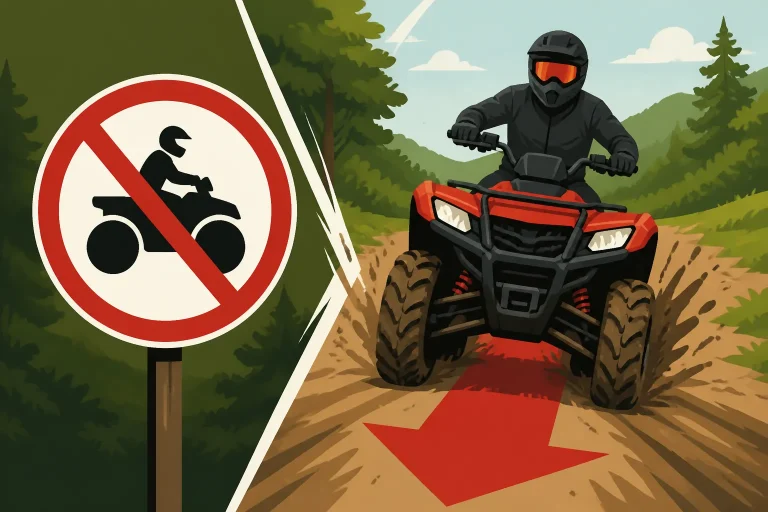
Hot Springs State Forest WMA is not a place to take an ATV for a casual trail ride: ATV use is prohibited there. A pass or permit for another Arkansas riding area does not cancel that restriction. The key is to identify exactly which land you are entering, then check its rules before unloading or following a road onto the property.
What the ban means for riders
The practical rule is straightforward: do not ride an ATV on Hot Springs State Forest WMA. Do not assume that a road, trail, gate opening, or route visible on a map is available to recreational ATV users. A route that looks passable is not necessarily open to motorized use.
That restriction is easy to confuse with other Arkansas access rules. Some public areas allow vehicles on designated roads or under limited conditions, while others prohibit ATV use. Rules can also differ between neighboring properties. Being allowed to ride on one tract does not give you permission to continue onto another.
The WMA’s name can add to the confusion. It includes “State Forest,” but riders should not treat a state-forest name as a general invitation to ride. Land designation alone does not tell you whether ATVs are allowed. The rules attached to the specific property and the posted signs determine where vehicle use is permitted.
For a broader explanation of how vehicle access works across wildlife management areas, see Arkansas WMA Vehicle Rules in Plain English. The useful takeaway is that access is not a single statewide yes-or-no rule. It depends on the area, the route, the type of vehicle, and any restrictions that apply to that particular place.
A permit does not create access
An Arkansas OHV or forest permit is not a universal license to ride anywhere in the state. It applies only to the land or riding system covered by that permit, and riders still have to follow that site’s restrictions. If an area prohibits ATVs, carrying a permit for a different area does not make riding there legal.
This distinction matters because Arkansas has separate permit systems and access rules for different recreation areas. A forest permit for one national forest does not authorize riding on a wildlife management area that prohibits ATVs. Likewise, a trail fee or pass from a private park applies to that park’s property, not nearby public land.
The overview Arkansas OHV Permits: Two Forests, Two Prices explains why permits for different riding systems should not be treated as interchangeable. Before a trip, check that the permit matches the exact area you plan to use, then check whether the property allows your machine at all.
Do not rely on a decal, registration, or permit as proof that you may ride on a particular tract. Those documents may satisfy requirements that apply to your machine or to another riding area, but they do not override a local land-use restriction.
| What you have or see | What it tells you | What it does not tell you |
|---|---|---|
| An Arkansas ATV registration decal | Your machine may meet a registration requirement that applies to it | That Hot Springs State Forest WMA allows ATV riding |
| A forest OHV permit | You have a permit for the forest area covered by its rules | That the permit works on every public property |
| A trail or road shown on a map | A route may exist or be mapped | That the route is open to ATV use |
| An open gate | There is no visible barrier at that point | That entry is authorized |
| A sign permitting access elsewhere | A rule applies to the location identified by the sign | That the same rule applies to this WMA |
How to check the property before you ride
The safest approach is to confirm access for the exact WMA and route, rather than searching only for “ATV trails near Hot Springs.” Search results may mix public land, private parks, forest roads, and nearby communities. These are not interchangeable destinations.
Start with the official information for Hot Springs State Forest WMA and read the vehicle rules, not just a general recreation description. Check for notices about prohibited vehicles, closed roads, seasonal access, and boundaries. If the available information is unclear or a sign at the site differs from what you found online, do not ride until you have confirmed the rule with the appropriate land manager.
Before leaving, identify the property boundary and your intended riding area. This is especially important when a route passes near a road, adjoining forest land, or a private riding park. A trailhead or staging area can be close to land with a different owner and a different rule set. Verify the route from start to finish instead of assuming that the whole area shares one policy.
At the entrance, read every sign that applies to vehicles. A sign may restrict a specific road or route, but the absence of a sign at one junction does not necessarily mean the whole WMA is open. Do not use a missing sign, an unlocked gate, tire tracks, or another rider’s presence as evidence that access is permitted.
If you need a quick pre-trip checklist, use this sequence:
- Confirm that you have the correct property name and boundary.
- Find the current official vehicle-use information for that property.
- Check whether ATVs are allowed at all, and whether any designated roads or conditions apply.
- Confirm that the permit you hold covers the area you intend to ride.
- Review posted notices at the entrance and along the route.
- If the rule remains unclear, choose another area until you can confirm access.
This extra check can prevent a frustrating trip and an avoidable violation. It also helps you avoid accidentally crossing from a permitted riding area onto a property where motorized use is closed.
Common misunderstandings about the restriction
Several assumptions can lead riders onto land where ATVs are not allowed. Most come from treating different kinds of public access as if they were the same.
“It is state land, so riding must be allowed”
Public ownership does not mean unrestricted vehicle use. Public lands are managed for different purposes, and some roads or facilities may be open to ordinary vehicle traffic while ATV recreation is prohibited. The land’s managing rules matter more than the fact that the property is publicly owned.
“I have a forest permit, so I can ride nearby”
A permit has a defined scope. It may apply to a particular forest or trail system, but not to an adjacent WMA. Do not use a permit’s general association with Arkansas forests as a substitute for checking the specific area. Arkansas National Forest Riding Explained covers the separate question of riding in national forest areas.
“The route appears on a map”
Maps are useful for planning, but they do not always show current closures or vehicle restrictions. A mapped road can be closed to recreational use, limited to a different vehicle class, or located on property where ATVs are prohibited. Treat the map as a navigation aid, not as permission.
For WMAs that do allow some vehicle access, the rules may distinguish between open access roads and routes behind barriers. The details in Arkansas WMA Roads Open to Vehicles and Arkansas WMA Gated and Cabled Barriers are relevant to those areas, but they should not be read as permission to ride at Hot Springs State Forest WMA.
“Other riders were there, so it must be allowed”
Other riders may be mistaken, may have permission for a different use, or may be breaking the rules. Their presence does not change the restriction. The same applies to tire tracks and informal paths: evidence that someone rode there is not evidence that riding is authorized.
“A hunting purpose makes the rule different”
Hunting access can involve specific rules, seasons, permits, and exceptions. Do not assume that being a hunter or traveling to a hunting location gives you permission to use an ATV on a property that prohibits ATV riding. Check the rules for both the property and the activity. Arkansas WMAs That Allow ATVs and Those That Do Not can help clarify why access differs across areas.
Where to ride instead and how to avoid a boundary mistake
If your goal is to ride near Hot Springs, choose an area that explicitly accepts ATVs and check its current conditions before you go. The private Hot Springs Off-Road Park in Arkansas is a separate riding destination; its rules and access do not apply to the WMA. Confirm the park’s operating details, machine requirements, and any fees directly with the operator before making plans.
Other Arkansas riding areas may use their own permits, seasonal closures, width limits, or trail rules. Start with Arkansas ATV Trails: Where to Ride to compare possible destinations, then follow the specific area’s directions and requirements. A convenient location is not automatically an authorized route, especially if reaching it involves crossing or riding on land with separate restrictions.
When planning a route, use these habits to reduce the chance of entering the WMA by mistake:
- Save the correct property boundary and trailhead location before you travel.
- Check whether your route crosses adjoining public or private land.
- Do not follow an unofficial track just because it appears to connect two roads.
- Stop and reassess when signs, maps, or barriers indicate a closure.
- Keep the machine on an authorized route, and turn around if you cannot verify access.
- Ask the appropriate land manager about a boundary or rule that is unclear.
The most important distinction is between having permission to ride somewhere and having permission to ride here. An Arkansas registration decal, an OHV permit, or a pass from another trail system does not open Hot Springs State Forest WMA to ATV use. For this property, plan on riding elsewhere unless official information expressly confirms an authorized exception for your specific use.
Disclaimer
This article is for general informational purposes only and does not constitute professional advice. Laws, prices and regulations vary by location and change over time. Consult a qualified professional for guidance on your specific situation.